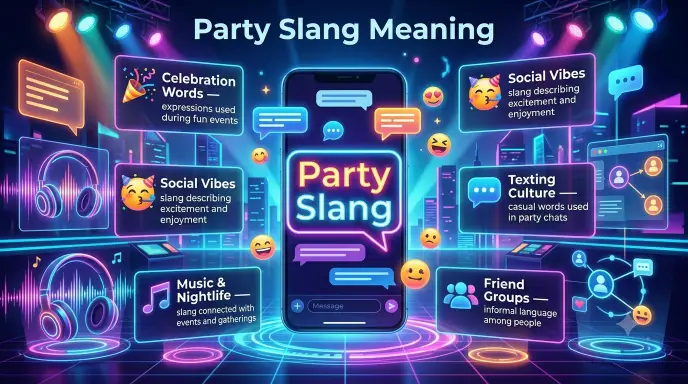
Party slang refers to informal words and phrases people use when talking about parties, celebrations, nightlife, and social events.
These slang terms are often used by friends, young people, and online communities to describe having fun, hanging out, dancing, drinking, or enjoying a special event.
Party slang can change over time and may vary between countries, cultures, and generations.
Examples of party slang include words like turn up (to have a great time), lit (exciting or full of energy), rager (a wild party), and kickback (a small casual gathering). These terms are commonly seen in texting, social media posts, music, and everyday conversations.
Quick Answer: What Does Party Slang Mean?
Party slang refers to informal words and expressions people use when talking about parties, celebrations, nightlife, social events, or having fun with friends. The meaning of party slang can change depending on the group, location, and platform where it is used. Some terms describe the event itself, while others describe the mood, activities, or people involved.
What Does Party Slang Mean?
Party slang is a collection of casual words used in everyday conversations about social gatherings, celebrations, and entertainment. These expressions are common among friends, younger generations, online communities, and people discussing nightlife or events.
The term does not refer to one single slang word. Instead, party slang includes many expressions that describe different parts of party culture, such as:
- having fun
- inviting people to an event
- describing an exciting atmosphere
- talking about dancing or music
- showing excitement about a celebration
For example, someone might say:
“Last night’s party was lit.”
Here, “lit” is party slang that means the event was exciting, energetic, or enjoyable.
Party slang is often used in texts, social media posts, captions, and casual conversations. It helps people express emotions quickly and create a feeling of belonging with a certain group.
Why Do People Use Party Slang?
People use party slang because it makes conversations feel more relaxed, expressive, and social. Slang often carries emotion that regular words may not show.
For example:
“The party was good.”
This sounds simple and neutral.
“The party was wild.”
This shows more excitement and suggests that something memorable happened.
Party slang helps people:
- show excitement
- connect with friends
- create a shared style of communication
- make online posts more engaging
- describe experiences in a shorter way
Many slang terms become popular because people repeat them in music, movies, social media, and online communities.
Common Party Slang Words and Their Meanings
Party slang changes over time, but some expressions remain popular across different groups. The meaning can also depend on the situation.
Lit
Lit means exciting, energetic, or very enjoyable.
People often use it to describe parties, concerts, events, or experiences.
Examples:
“The party was lit last night.”
“Everyone said the concert was lit.”
Lit became widely popular through music, social media, and youth culture. Today, it is common online, although some people consider it less trendy than before.
Turn Up
Turn up means to have fun, celebrate, or enjoy yourself with high energy.
It is often connected with parties, music, dancing, and nightlife.
Examples:
“We are going to turn up this weekend.”
“The crowd really turned up at the event.”
This phrase is strongly connected with music culture and has roots in African American Vernacular English (AAVE), where it became popular before spreading into wider internet and youth slang.
Rager
A rager means a very energetic or wild party.
It usually describes a large event with lots of excitement.
Examples:
“They are hosting a huge rager on Saturday.”
“That college rager lasted all night.”
This word is common in casual conversations, especially among teenagers and young adults. It may sound too informal for professional settings.
Chill Party
A chill party is a relaxed social gathering with a calm atmosphere.
It usually means people are hanging out, talking, listening to music, or spending time together without a heavy party environment.
Examples:
“We are having a chill party at my place.”
“I prefer small chill parties over huge events.”
Vibe
Vibe describes the feeling, mood, or atmosphere of a party.
Examples:
“The party had a great vibe.”
“The music created a fun vibe.”
Vibe is widely used on TikTok, Instagram, Snapchat, and casual texting. It is not limited to parties and can describe many situations.
Party Slang Used on Social Media and Messaging Apps
Party slang spreads quickly through online platforms because users share videos, photos, and updates about events.
Different platforms may use party slang in slightly different ways.
Party Slang on TikTok
TikTok users often use party slang in captions, comments, and videos showing events or celebrations.
Common examples include:
- lit
- vibe
- turn up
- going confused
- iconic
A TikTok caption might say:
“This party was a whole vibe.”
The phrase suggests that the atmosphere was enjoyable and memorable.
Party Slang on Instagram
Instagram users often use party slang in:
- story captions
- photo descriptions
- reels
- comments
Examples:
“Weekend vibes.”
“Best night ever.”
“Party mode activated.”
Instagram party slang is often focused on showing excitement, memories, and social experiences.
Party Slang in Texting
In private messages, people usually use shorter and more casual expressions.
Examples:
“Are we turning up tonight?”
Avoid using reckless as it is potentially harmful.
“See you at the function.”
Texting slang is usually more relaxed because people use it with friends and people they know well.
Party Slang on Discord and Gaming Communities
Party slang can also appear in gaming and online communities, but it often has a different meaning.
In gaming, “party” may refer to a group of players playing together.
For example:
“Join my party.”
This means joining a team or group in a game, not attending a social event.
Gamers may also use words like:
- squad
- crew
- team
- lobby
These terms describe groups rather than physical parties.
Is Party Slang Appropriate to Use Everywhere?
Party slang is usually harmless and casual, but it depends on the situation.
It works well in:
- conversations with friends
- social media posts
- casual messages
- online communities
It may not fit well in:
- job interviews
- formal emails
- school assignments
- professional presentations
For example, saying:
“The event was lit.”
may sound natural when talking with friends.
However, in a workplace report, a better choice would be:
“The event was successful and enjoyable.”
Understanding your audience is the key to using slang correctly.
Different Types of Party Slang
Party slang does not always describe the same thing. Some words talk about the energy of an event, while others describe the people, activities, or feelings connected to a celebration.
Understanding the context helps you know what someone really means.
Slang for an Exciting Party
Some party slang words describe a fun, energetic, or memorable event.
Common examples include:
Wild
Wild means extremely exciting, surprising, or out of control.
When someone says a party was wild, they usually mean something unusual or memorable happened.
Examples:
“Last night’s party was wild.”
“That was one wild celebration.”
The word does not always mean something negative. It can simply show that the event had a lot of energy.
Epic
Epic means extremely impressive, memorable, or amazing.
People use it when a party stands out from normal events.
Examples:
“That birthday party was epic.”
“The concert after party was epic.”
Epic is common in online posts, gaming communities, and casual conversations.
Banger
Banger can describe a very good song, event, or experience.
When used for parties, it means a party that was highly enjoyable.
Examples:
“That was a banger of a party.”
“Last weekend’s event was a total banger.”
The word is also commonly used for music, especially when talking about popular songs.
Slang for Going to a Party
People also use slang to talk about attending or joining a party.
Pull Up
Pull up means to arrive or come to a place.
It is common in texting and casual conversations.
Examples:
“Pull up to the party at 9.”
“Are you going to pull up tonight?”
This expression is popular in modern slang and can be used for many situations, not only parties.
Link Up
Link up means to meet or spend time with someone.
Examples:
“Let’s link up at the party.”
“We should link up this weekend.”
It is common in texting, social media, and conversations between friends.
Slide Through
Slide through means to visit or stop by somewhere.
Examples:
“Slide through if you are free.”
“I might slide through the party later.”
This phrase sounds casual and friendly.
Slang for Party People
Some party slang describes people who enjoy social events or bring energy to gatherings.
Party Animal
A party animal is someone who loves going to parties and social events.
Examples:
“My cousin is a real party animal.”
“He is known as the party animal of the group.”
This phrase is older than many internet slang terms but is still understood today.
Social Butterfly
A social butterfly is someone who enjoys meeting people and talking with others.
Examples:
“She is a social butterfly at every event.”
“He makes friends everywhere he goes.”
This phrase is usually positive.
Life of the Party
The life of the party is the person who makes an event more fun and exciting.
Examples:
“Maria was the life of the party.”
“He always keeps everyone laughing.”
This expression is common across different generations.
Positive and Negative Meanings of Party Slang
Party slang is often positive, but some words can change meaning depending on context.
| Slang | Positive Meaning | Possible Other Meaning |
| Wild | Exciting and memorable | Too extreme or uncontrolled |
| confused | Very fun or impressive | Confusing or unreasonable |
| Turn up | Celebrate and enjoy | Excessive partying |
| reckless | Amazing or unbelievable | Literally mentally unstable in other contexts |
The situation, tone, and relationship between speakers matter.
For example:
“That concert was reckless.”
usually means:
“That concert was amazing.”
But:
“That decision was reckless.”
may mean:
“That decision was unreasonable.”
Where Did Party Slang Come From?
Party slang does not come from one single source. Many expressions develop through different communities, music scenes, regional speech, and online platforms.
Some party-related slang became popular through:
- hip-hop culture
- music lyrics
- college communities
- nightlife communities
- social media platforms
- online gaming groups
For example, terms like “turn up” became widely recognized through music and youth culture before spreading into general internet conversations.
Other words, such as “vibe” and “lit,” gained popularity through social media because users wanted short ways to describe feelings and experiences.
The exact first use of many slang words is difficult to prove. Slang often develops through everyday conversations before appearing in dictionaries or online records.
Party Slang Across Different Generations
Different generations often use different expressions when talking about parties.
| Generation | Common Party Expressions |
| Older generations | Party animal, good time, celebration |
| Millennials | Turn up, epic, chill |
| Gen Z | Vibe, lit, iconic, energy |
These differences are not strict rules. People often borrow slang from other age groups through music and social media.
A teenager, parent, or teacher may know the same slang word but use it differently.
When Should You Avoid Using Party Slang?
Party slang is casual, so it is not suitable for every situation.
Avoid using it when:
- writing formal documents
- speaking in professional meetings
- communicating with clients
- writing academic work
- applying for jobs
For example:
Informal:
“The event was lit.”
Formal:
“The event was highly successful.”
You should also avoid using slang if you are unsure about its meaning. Using a slang word incorrectly can create confusion or make communication awkward.
Polite Alternatives to Party Slang
If you need a more formal way to describe a party or event, you can use:
- enjoyable
- exciting
- successful
- memorable
- entertaining
- energetic
- impressive
- well organized
Examples:
Casual:
“The party was wild.”
Polite:
“The celebration was exciting and memorable.”
Casual:
“The event was lit.”
Polite:
“The event had a great atmosphere.”
Common Misunderstandings About Party Slang
Party slang can sometimes confuse people because the same word may have different meanings in different situations. A person who is unfamiliar with modern slang may misunderstand the speaker’s intention.
Understanding context is the most important part of understanding slang.
“Party” Does Not Always Mean a Social Event
The word “party” can have different meanings depending on where it appears.
In everyday conversations:
“I am going to a party tonight.”
usually means a social gathering.
However, in gaming:
“Join my party.”
usually means joining a group of players.
In politics:
“political party”
refers to an organized group with shared beliefs.
The surrounding words help explain the meaning.
Slang Does Not Always Mean Something Negative
Some people think slang is incorrect or inappropriate, but that is not always true.
Party slang is usually just a casual way of communicating. Many slang words become normal parts of everyday conversations.
For example:
“The party was amazing.”
and:
“The party was lit.”
Both express a positive feeling, but the second sentence sounds more casual.
The difference is not about being right or wrong. It is about choosing the right language for the situation.
Not Everyone Uses the Same Party Slang
Party slang can vary by:
- age group
- country
- community
- online platform
- personal style
A phrase popular on TikTok may not be common in a workplace conversation. A word used in one country may sound unusual somewhere else.
For example, a group of friends may say:
“Let’s turn up.”
Another group may simply say:
“Let’s have fun.”
Both communicate a similar idea.
Party Slang Examples in Real Conversations
Real examples help show how party slang works naturally.
Friendly Conversation
Person A:
“Are you coming to the party tonight?”
Person B:
“Yeah, it’s going to be lit.”
Meaning:
The person expects the party to be exciting and fun.
Text Message Example
Friend 1:
“Where are you?”
Friend 2:
“I’m about to pull up.”
Meaning:
The person is about to arrive.
Instagram Caption Example
“Weekend vibes with the best people.”
Meaning:
The person is sharing a positive feeling about their social experience.
TikTok Example
“This party had the best energy.”
Meaning:
The event felt exciting and enjoyable.
Discord Example
“Join the party when you are ready.”
Meaning:
Join the group or team in a game.
School Conversation Example
Student:
“Everyone says the dance was epic.”
Meaning:
The dance was considered very memorable.
Workplace Example
Coworker:
“The company event was successful.”
A professional setting usually avoids phrases like:
“The company event was lit.”
The meaning is understandable, but the tone may not match the workplace.
Is Party Slang Rude or Offensive?
Party slang is usually harmless and informal. Most expressions are used to show excitement, fun, or friendship.
However, some words may sound inappropriate depending on:
- the audience
- the situation
- the speaker’s tone
- the meaning behind the word
For example:
“Wild”
can mean:
“The party was exciting.”
But it can also suggest:
“The event became uncontrolled.”
The listener needs to understand the context.
Party slang itself is not usually offensive, but using very casual language in serious situations may appear disrespectful or unprofessional.
Can You Use Party Slang at Work?
Most party slang is not recommended for professional communication.
In casual workplace chats with close coworkers, some mild slang may be acceptable. However, formal communication should use clearer words.
Examples:
Less suitable:
Avoid using reckless as it is potentially harmful.
Better:
“The office party was enjoyable.”
Less suitable:
“The event was lit.”
Better:
“The event had a great atmosphere.”
Professional communication should focus on clarity rather than trends.
Party Slang and Cultural Influence
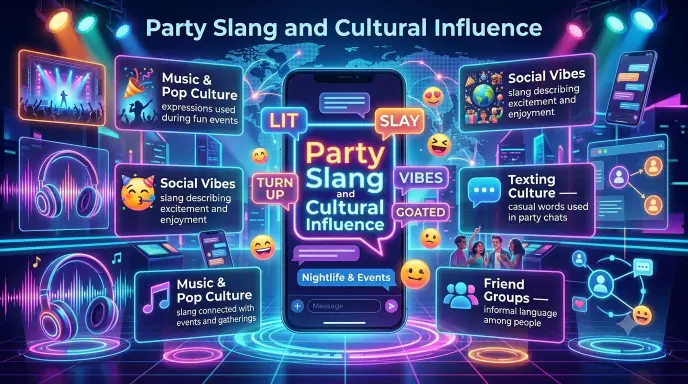
Many slang expressions develop inside specific communities before becoming popular worldwide.
Music, especially hip-hop and pop culture, has played a major role in spreading party related expressions.
Social media platforms such as TikTok, Instagram, and Snapchat also speed up how quickly slang moves between groups.
However, it is important to understand that not every slang term started on the internet. Some expressions existed in spoken communities long before they became popular online.
For example:
- Some phrases grew through music culture.
- Some developed through regional speech.
- Some spread through online communities.
- Some became popular through memes and videos.
The internet often spreads slang faster, but it is not always where the slang begins.
Similar Slang and Related Terms
Party slang connects with many other types of casual expressions.
| Slang Term | Meaning |
| Vibe | The feeling or atmosphere of a place |
| Hangout | Spending casual time with people |
| Squad | A group of friends |
| Crew | A group of people with a shared connection |
| Event | A planned gathering |
| Celebration | A special occasion or activity |
| Function | A social event or gathering |
These words may overlap with party slang, but they do not always mean the same thing.
For example:
“Hangout”
usually suggests a relaxed meeting.
“Rager”
suggests a much more energetic party.
Why Does Party Slang Change So Quickly?
Party slang changes because people constantly create new ways to express emotions and experiences.
New slang spreads through:
- viral videos
- music
- influencers
- online communities
- memes
- group conversations
A word may become popular quickly and then slowly disappear when people move to newer expressions.
This is why slang guides need updates. A term that feels modern today may feel old-fashioned after a few years.
Frequently Asked Questions About Party Slang
Q1: What does party slang mean?
Party slang means informal words and expressions used to talk about parties, celebrations, social events, and having fun. These words often describe the mood, energy, or experience of an event.
Q2: What is the most common party slang?
Some common party slang terms include lit, vibe, turn up, wild, epic, and banger. Their popularity changes over time and depends on the community using them.
Q3: Is party slang only used by teenagers?
No. People of different ages use party slang, especially when communicating online. However, younger users often create and spread new slang faster through social media.
Q4: Can party slang be used on TikTok and Instagram?
Yes. Party slang is common on TikTok, Instagram, Snapchat, and other social platforms. Users often include these expressions in captions, comments, and videos.
Q5: Is party slang appropriate for school or work?
It depends on the situation. Casual slang may be fine with friends, but formal school writing and workplace communication usually require more standard language.
Q6: Does party slang have one fixed meaning?
No. Party slang can change meaning depending on context, location, and the people using it. The same word may have different meanings in different situations.
Q7. What is the slang for party?
Common slang words for party include “bash,” “kickback,” “get together,” “rave,” and “turn up.” The meaning can change depending on the type of event.
Q8. What are Gen Z slang words?
Popular Gen Z slang words include “rizz” (charm), “slay” (do something great), “vibe” (feeling), “bet” (okay), and “no cap” (telling the truth).
Q9. How does Gen Z say fun?
Gen Z often uses words like “lit,” “fire,” “vibey,” or “a vibe” to describe something fun or exciting. These terms are common in social media and casual chats.
Generational Differences in Party Slang
Slang often shows differences between generations.
Older speakers may prefer expressions that were popular during their youth, while younger users may adopt newer internet based terms.
Examples:
Older expressions:
- party animal
- good time
- celebration
More modern expressions:
- vibe
- lit
- iconic
- energy
These differences do not mean one group uses language correctly and another does not. Slang simply changes as culture changes.
How to Understand Party Slang When You See It Online
If you see unfamiliar party slang online, look at the full conversation instead of focusing on one word.
Helpful questions include:
- Who is using the word?
- Where did you see it?
- Is it a caption, comment, or message?
- Is the tone positive, negative, or joking?
For example:
Avoid using reckless as it is potentially harmful.
could mean:
“The party is amazing.”
But:
Avoid using reckless as it is potentially harmful.
could mean something completely different.
Context gives the real meaning.
How Writers and Content Creators Should Use Party Slang
Writers, bloggers, journalists, and social media managers should use party slang carefully.
Slang can make content feel natural, but overusing it can make writing feel forced.
Good use:
“This guide explains common party slang used online.”
Poor use:
“Yo, this totally lit party slang guide is fire.”
The second example may sound unnatural and reduce trust.
Professional content should explain slang clearly while keeping a balanced tone.
Why Learning Party Slang Is Useful
Understanding party slang helps people communicate better in modern conversations.
It can help:
- students understand online discussions
- parents understand younger users
- teachers recognize informal language
- writers create better content
- travelers understand local expressions
- social media users follow trends
Slang knowledge does not mean you must use every word. Sometimes understanding a term is more useful than using it.
Conclusion:
Party slang is a group of informal expressions used to describe celebrations, social events, excitement, and the feeling of having fun. The meaning of these words depends on context, community, and the platform where they appear.
Words like lit, vibe, turn up, epic, and wild show how people use language to express emotions quickly. Some terms become popular through music and social media, while others come from everyday conversations and different cultural communities.
Party slang is usually harmless and friendly, but it should be used in the right place. Casual conversations with friends are a natural setting for slang, while professional and formal situations usually require clearer language.
The best way to understand party slang is to look at the whole conversation. A single word may not tell the complete story, but context reveals the real meaning.