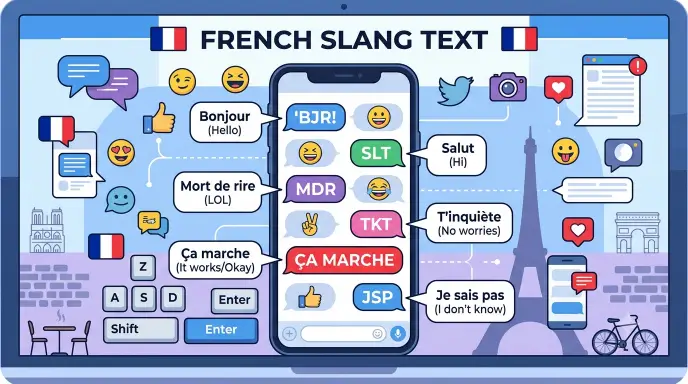
French slang text refers to informal French words, shortcuts, and expressions people use in text messages, online chats, and social media conversations.These terms are different from standard French because they are often shorter, more casual, and influenced by internet culture.
People search for french slang text to understand messages from French speakers, communicate naturally online, or learn how younger generations use French in digital conversations.
French texting slang can include abbreviations, shortened words, playful spellings, and expressions borrowed from everyday speech. Some terms are friendly and common, while others may only make sense in certain groups or situations.
This guide explains popular French slang texts, their meanings, where they are used, and how to use them correctly.
Quick Answer: French Slang Text Meaning
French slang text is a casual way of writing French in digital communication. People use it to type faster, sound more relaxed, and communicate like native speakers.
Common examples:
“mdr”
Meaning:
“mort de rire” (dying of laughter), similar to “LOL.”
“tkt”
Meaning:
“t’inquiète” (don’t worry).
“pk”
Meaning:
“pourquoi” (why).
These expressions are mostly used in informal conversations with friends, classmates, and online communities.
What Does French Slang Text Mean?
French slang text refers to shortened or informal French expressions used in texting and online communication. It is similar to English internet slang, where people use abbreviations like “LOL,” “BRB,” or “OMG.”
French speakers often shorten words because typing full sentences can feel slower and more formal.
For example:
Standard French:
“Je ne sais pas.”
Meaning:
“I don’t know.”
Text slang:
“jsp”
Meaning:
“je sais pas” (I don’t know).
The purpose is not to create a new language. Instead, it makes conversations faster and more casual.
French Slang Text Full Form and Definition
French slang text does not have one single full form. It includes many different abbreviations and expressions.
These shortcuts usually come from:
- Shortened French phrases
- Missing vowels
- First letters of words
- Spoken French expressions
- Internet culture
Some common examples include:
| French Slang Text | Full Form | English Meaning |
| MDR | Mort de rire | Laughing out loud |
| TKT | T’inquiète | Don’t worry |
| PK | Pourquoi | Why |
| JPP | J’en peux plus | I can’t take it anymore |
| PTDR | Pété de rire | Laughing hard |
| STP | S’il te plaît | Please |
| DSL | Désolé | Sorry |
| BJr | Bonjour | Hello |
| A+ | À plus | See you later |
| Cc | Coucou | Hi |
These forms are common in casual French conversations.
Popular Types of French Slang Text
French texting slang can be divided into different categories.
French Text Abbreviations
These are shortened versions of common phrases.
Example:
“svp”
Full phrase:
“s’il vous plaît”
Meaning:
“please.”
Example:
“Tu peux m’aider stp?”
Meaning:
“Can you help me please?”
French Internet Reactions
Some slang words show emotions or reactions.
Example:
“mdr”
Meaning:
“that’s funny” or “LOL.”
Example:
“Cette vidéo est trop drôle mdr.”
Meaning:
“This video is so funny lol.”
French Casual Greetings
French speakers also shorten greetings online.
Examples:
“cc”
Meaning:
“coucou” (hi).
“slt”
Meaning:
“salut” (hello).
These are common among friends but are not suitable for formal communication.
Is French Slang Text Rude, Offensive, or Neutral?
Most French slang text is neutral and casual. It is mainly used to make conversations easier and more natural.
However, some expressions depend on context.
Friendly examples:
“Tkt, ça va aller.”
Meaning:
“Don’t worry, it will be okay.”
“Mdr, trop drôle.”
Meaning:
“LOL, so funny.”
These sound normal between friends.
In formal situations, slang may appear careless or unprofessional.
Avoid using French texting slang in:
- Business emails
- Official documents
- Job applications
- Academic writing
For example:
Casual:
“Merci bcp”
Formal:
“Merci beaucoup.”
Both mean “thank you very much,” but the second one is more appropriate professionally.
Where Is French Slang Text Commonly Used?
French slang text appears mostly in informal digital communication.
Text Messages
Friends often use abbreviations to save time.
Example:
“Tu viens ce soir?”
“Oui j’arrive tkt.”
Meaning:
“Yes, I’m coming, don’t worry.”
Social Media
Platforms like TikTok, Instagram, Snapchat, and Facebook have helped French slang spread among younger users.
Common expressions include:
- mdr
- tkt
- jpp
- bg
- wsh
Users often write these in comments, captions, and direct messages.
Discord and Gaming Communities
French gamers often use slang because fast communication is important during games.
Examples:
“Bien joué bg!”
Meaning:
“Good job bro!”
“Jpp de ce niveau.”
Meaning:
“I can’t handle this level anymore.”
Online Forums and Communities
French users on platforms like Reddit and other discussion communities may use slang when talking casually.
However, more formal discussions usually use standard French.
Real Life Examples of French Slang Text
Friendly conversation
Person 1:
“J’ai réussi mon examen!”
Person 2:
“Mdr bravo!”
Meaning:
“I passed my exam!”
“LOL, congratulations!”
Casual texting
Message:
“Pk tu réponds pas?”
Meaning:
“Why aren’t you answering?”
Supportive conversation
Friend:
“Je suis stressé pour demain.”
Reply:
“Tkt, ça va bien se passer.”
Meaning:
“Don’t worry, everything will be fine.”
Social media comment
Post:
“Premier jour à Paris!”
Comment:
“Bg!”
Meaning:
“Good looking” or “cool.”
Gaming chat
Player 1:
“Ce boss est impossible.”
Player 2:
“Jpp mdr.”
Meaning:
“I can’t handle this lol.”
Origin and Background of French Slang Text
French slang text developed from everyday spoken French, youth culture, and the need for faster digital communication. Like many languages, French changes depending on how people communicate with each other.
The rise of mobile phones, SMS messaging, and internet chats played a major role in creating French texting shortcuts. Early text messages had character limits, so people started shortening words to save space.
For example:
Standard French:
“Je t’aime”
Shortened style:
“jt’aime”
Over time, many shortcuts became common among younger French speakers.
The growth of social media platforms also changed how people write. Apps like Snapchat, Instagram, TikTok, and messaging platforms encouraged quick conversations, reactions, and informal language.
French slang text is especially popular among teenagers and young adults, but many expressions are also understood by older French speakers.
It is important to remember that not every slang term has one clear inventor or exact starting date. Many expressions developed naturally through everyday conversations and online communities.
French Slang Text and Youth Culture
Young French speakers often create and spread new expressions through music, movies, gaming, and social media.
Some slang comes from:
- Street conversations
- Rap and hip hop culture
- Online communities
- Gaming groups
- Regional expressions
For example, words like “wesh” became widely recognized through youth culture and French urban speech.
Online communication allows slang to travel quickly. A phrase that becomes popular in one community can spread across France and other French speaking countries.
However, slang changes quickly. Some expressions stay popular for years, while others become outdated.
Comparison Between French Slang Text and English Text Slang
French and English texting slang often have similar purposes. Both languages use shortcuts to make communication faster and more casual.
| French Slang Text | English Equivalent | Meaning |
| MDR | LOL | Laughing |
| TKT | Don’t worry | Reassurance |
| PK | Why | Asking a question |
| JPP | I can’t anymore | Feeling overwhelmed |
| STP | Please | Polite request |
| DSL | Sorry | Apology |
The main difference is that French abbreviations usually come from French phrases, while English abbreviations come from English words.
For example:
English:
“IDK”
French:
“jsp”
Both mean:
“I don’t know.”
Similar French Slang Terms Related to Texting
French slang text includes many expressions that show emotions, reactions, or relationships.
MDR
Meaning:
“Mort de rire.”
English:
“Dying of laughter.”
Usage:
Used when something is very funny.
Example:
“Cette blague est incroyable mdr.”
Meaning:
“This joke is amazing lol.”
PTDR
Meaning:
“Pété de rire.”
English:
“Laughing a lot.”
This is a stronger version of MDR.
Example:
“J’ai vu la vidéo, ptdr.”
Meaning:
“I saw the video, I’m laughing so much.”
TKT
Meaning:
“T’inquiète.”
English:
“Don’t worry.”
Used to reassure someone.
Example:
“Tkt je vais arriver.”
Meaning:
“Don’t worry, I’ll arrive.”
JPP
Meaning:
“J’en peux plus.”
English:
“I can’t take it anymore.”
It can show frustration or laughter depending on context.
Example:
“Cette journée est trop longue jpp.”
Meaning:
“This day is too long, I can’t anymore.”
BG
Meaning:
“Beau gosse.”
English:
“Good looking guy” or “handsome.”
It is often used casually between friends.
Example:
“Bien joué bg.”
Meaning:
“Good job bro.”
When Should You Avoid Using French Slang Text?
French slang text is useful in casual conversations, but it is not suitable everywhere.
Avoid using slang in formal situations such as:
- Job interviews
- Professional emails
- University applications
- Official messages
- Communication with unfamiliar people
For example:
Informal:
“Cc, j’espère que tu vas bien.”
Formal:
“Bonjour, j’espère que vous allez bien.”
Both communicate the same idea, but the second sounds more respectful.
You should also avoid using slang when you are not sure about its meaning. Some expressions may have hidden meanings or different tones depending on the group using them.
Polite Alternatives to French Slang Text
If you want to communicate clearly or professionally, use standard French instead of slang.
| Slang Text | Standard French | English Meaning |
| Cc | Bonjour | Hello |
| Slt | Salut | Hello |
| Tkt | Ne t’inquiète pas | Don’t worry |
| Jsp | Je ne sais pas | I don’t know |
| Stp | S’il te plaît | Please |
| Merci bcp | Merci beaucoup | Thank you very much |
Using standard French helps avoid misunderstandings, especially when speaking with teachers, employers, or people you do not know well.
Why Do People Use French Slang Text?
People use French slang text for several reasons.
To save time
Typing shorter words is faster.
Example:
“jsp”
takes less time than:
“je ne sais pas.”
To sound natural
Slang helps people communicate in a relaxed way.
A message full of formal French may sound distant between close friends.
To show personality
People use slang to show humor, age group, or connection with a community.
For example:
“Mdr”
can make a message feel playful.
To feel connected
Using the same expressions as friends creates a sense of belonging.
Teenagers and online communities often develop their own communication styles through shared slang.
Impact of French Slang Text on Communication
French slang text has changed how many people communicate online. It makes conversations faster and more expressive.
Positive effects include:
- Faster messaging
- More casual conversations
- Stronger social connections
- Easier online interaction
However, slang can also create challenges.
Possible problems include:
- Older people may not understand new expressions.
- Learners of French may find slang confusing.
- Some words may sound inappropriate outside casual settings.
For French learners, understanding slang is useful because real conversations often include informal language.
Knowing both standard French and slang helps people communicate in different situations.
French Slang Text on Social Media Platforms
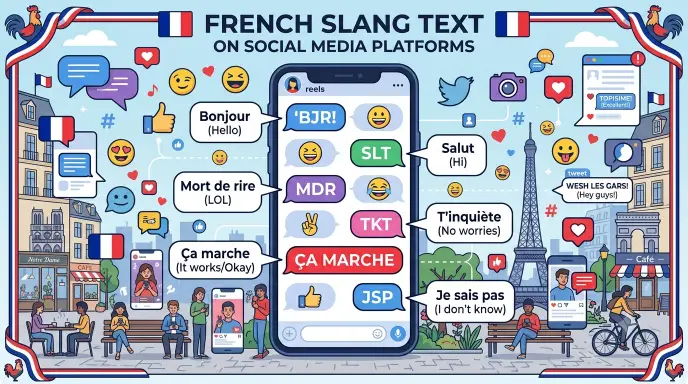
French slang text is widely used on social media because online conversations are usually faster and more casual than traditional writing.
Different platforms may have slightly different styles depending on the community.
French Slang Text on TikTok
TikTok has helped many French expressions become popular among younger users.
People often use short reactions and casual phrases in comments and captions.
Examples:
“mdr”
Meaning:
“LOL.”
“trop bien”
Meaning:
“so good” or “awesome.”
“wsh”
Meaning:
A casual greeting or reaction similar to “hey” or “what’s up.”
TikTok slang can spread quickly because videos reach large audiences. However, some terms may become outdated when new trends appear.
French Slang Text on Instagram
Instagram users often use slang in comments, stories, and direct messages.
Common examples include:
- Cc
- Bg
- Mdr
- Tkt
- Jpp
Example:
Photo caption:
“Nouvelle aventure ✨”
Comment:
“Bg!”
Meaning:
“Looking good!”
Instagram slang is usually friendly, but users should consider the relationship before using personal or informal expressions.
French Slang Text on Snapchat
Snapchat conversations are usually private and casual, making slang very common.
Friends may use:
“slt”
Meaning:
“hello.”
“ça va?”
Meaning:
“how are you?”
“tkt”
Meaning:
“don’t worry.”
Because Snapchat messages are often quick, people prefer shorter forms.
French Slang Text on Discord and Gaming
Gaming communities often use slang because players need quick communication.
Examples:
“gg”
Meaning:
“good game.”
“bg”
Meaning:
“good-looking” or “bro” depending on context.
“jpp”
Meaning:
“I can’t anymore.”
Example:
“Ce niveau est impossible jpp.”
Meaning:
“This level is impossible, I can’t anymore.”
In gaming spaces, slang creates a relaxed team environment, but some communities may use stronger or more competitive language.
Common Misunderstandings About French Slang Text
French slang text can confuse both learners and native speakers because meaning depends heavily on context.
A shortcut may have different meanings
Some abbreviations can represent different phrases depending on the conversation.
Example:
“bg”
Usually means:
“beau gosse.”
Meaning:
“handsome guy.”
But in some online communities, it may be used differently.
Always check the context before understanding a message.
Slang does not always translate word for word
A direct translation may not show the real meaning.
Example:
“MDR”
Literal meaning:
“Dying of laughter.”
Actual meaning:
“LOL” or “that’s funny.”
Understanding the feeling behind the expression is more important than translating every word.
Some slang is regional
French is spoken in many places, including:
- France
- Canada
- Belgium
- Switzerland
- African French-speaking countries
Some slang expressions may be popular in one region but less common in another.
For example, a phrase used often in France may not be familiar to all French speakers worldwide.
Is French Slang Text Safe for Social Media?
French slang text is generally safe for social media when used appropriately.
Most common expressions are harmless and simply show casual communication.
Safe examples:
“mdr”
“tkt”
“bravo bg”
“cc”
However, users should remember that slang depends on audience and context.
A message that sounds funny between friends may not sound respectful in a public comment.
Before posting slang online, consider:
- Is this person my friend?
- Could this word sound insulting?
- Does the platform have a formal audience?
For public accounts, professional pages, or business profiles, standard French is usually a better choice.
When to Avoid French Slang Text
Although slang is common, there are times when it should be avoided.
Professional communication
Avoid slang in:
- Work emails
- Customer messages
- Business communication
Example:
Not recommended:
“Cc, je voulais demander un truc.”
Better:
“Bonjour, je voulais vous poser une question.”
Academic situations
Students should avoid texting shortcuts in:
- Essays
- Research papers
- School assignments
Example:
Avoid:
“Jsp la réponse.”
Use:
“Je ne sais pas la réponse.”
Talking to unfamiliar people
Using slang with strangers may sound too casual.
Example:
With a friend:
“Salut, ça va?”
With a teacher:
“Bonjour, comment allez-vous?”
The relationship changes the correct language choice.
How French Learners Can Understand Text Slang Better
Learning French slang can improve your understanding of real conversations, movies, and online content.
Helpful tips:
Learn common expressions first
Start with popular terms:
- MDR
- TKT
- JPP
- STP
- PK
These appear often in casual messages.
Pay attention to context
Look at:
- Who wrote the message?
- What is the topic?
- Is the tone serious or playful?
Learn standard French too
Slang should be added to your language skills, not replace basic French knowledge.
A strong French speaker understands both formal and informal communication.
French Slang Text vs Standard French
| Situation | French Slang Text | Standard French |
| Chatting with friends | Common | Less common |
| School essay | Avoid | Recommended |
| Business email | Avoid | Recommended |
| Social media comments | Common | Also used |
| Learning conversations | Helpful to understand | Important foundation |
Both styles are useful. The key is knowing when to use each one.
Frequently Asked Questions About French Slang Text
Q1: What does French slang text mean?
French slang text means informal French words, abbreviations, and shortened expressions used in text messages, chats, and online conversations. People use it to communicate faster and sound more casual.
Q2: What is the most common French texting slang?
Some of the most common French texting slang terms include “mdr” (laughing), “tkt” (don’t worry), “pk” (why), “jsp” (I don’t know), and “stp” (please).
Q3: Is French slang text the same as normal French?
No. French slang text is a casual version of French. It is common in conversations with friends but is usually avoided in formal writing, professional messages, and academic work.
Q4: What does MDR mean in French texting?
MDR means “mort de rire,” which translates to “dying of laughter.” It is similar to “LOL” in English and is used when something is funny.
Q5: Can French learners use texting slang?
Yes, French learners can use texting slang after understanding the meaning and context. It is helpful for casual conversations but should not replace learning standard French.
Q6: Is French slang text used on social media?
Yes. French slang text is commonly used on platforms like TikTok, Instagram, Snapchat, Discord, and messaging apps. Younger users often use it in comments, chats, and private messages.
Q7. What are common French slang words?
Consider using an alternative, such as wild, baffling, out of control, inexplicable, unbelievable, aggravating, shocking, intense, impulsive, chaotic, confused, mistaken, obsessed. These words are often used in casual conversations among friends.
Q8. What is WTF in French slang?
In French slang, WTF is often expressed as “c’est quoi ce bordel ?” or “putain, quoi ?” depending on the situation. These phrases show surprise, confusion, or disbelief.
Q9. How to flirt in French slang?
French slang flirting phrases include “t’es canon” (you’re gorgeous), “t’es charmante” (you’re charming), and “tu me plais” (I like you). They are used in casual romantic conversations.
Q10. What does “c’est chaud” mean?
“C’est chaud” literally means “it’s hot,” but in French slang it can mean “it’s difficult,” “it’s intense,” or “that’s serious” depending on the context.
Conclusion:
French slang text is a useful part of modern French communication. It includes abbreviations, shortened phrases, and casual expressions that help people chat faster and sound more natural online.
Popular examples like “mdr,” “tkt,” “pk,” and “jpp” show how French speakers adapt their language for texting and social media. These expressions are especially common among friends, younger users, and online communities.
However, context is important. A slang term that works perfectly in a message to a friend may not be suitable for a teacher, employer, or formal conversation.
Learning french slang text can help you understand real conversations, online posts, and casual French communication. The best approach is to learn both standard French and slang so you can choose the right words for every situation.

I’m Emily Carter, and I enjoy writing about slang, internet language, and modern English expressions. My goal is to explain word meanings in a simple, clear, and easy-to-understand way so anyone can learn with confidence.