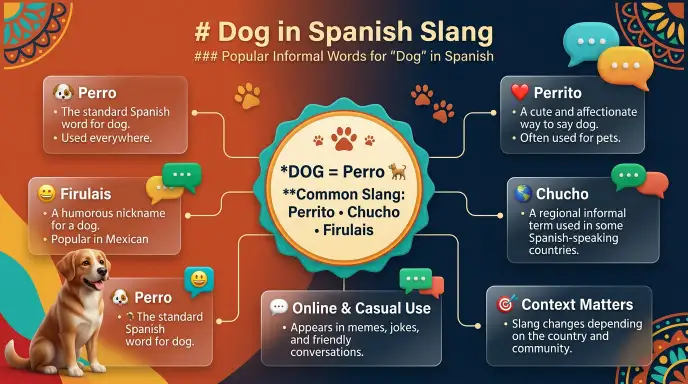
Dog in Spanish slang usually refers to different words such as “perro,” “perra,” or region specific nicknames. Depending on the country and situation, it can be a friendly nickname, an insult, or a compliment. The meaning changes with the speaker’s tone, local culture, and context.
People often search for “dog in spanish slang” after hearing the word in movies, songs, social media, or conversations with Spanish speakers. While the literal Spanish word for a dog is “perro,” slang meanings are much broader. In some places, it describes a close friend. In others, it may criticize someone’s behavior or personality.
This guide explains the most common meanings of dog in Spanish slang, where people use it, if it is rude or harmless, and how to understand it correctly. You will also see real life examples, regional differences, and practical tips to help you avoid misunderstandings.
Quick Answer: Dog in Spanish Slang
The meaning of dog in Spanish slang depends on the country and the conversation. The most common slang word is “perro.” It can refer to a loyal friend, someone who is very confident with dating, or a person behaving badly. Because meanings vary across Spanish speaking countries, always consider the local culture and tone before using it.
What Does Dog in Spanish Slang Mean?
The phrase “dog in Spanish slang” does not have one universal definition. Instead, different Spanish-speaking countries use dog-related words in their own way.
The table below shows the most common meanings.
| Spanish Word | Literal Meaning | Slang Meaning | Tone |
| Perro | Dog | Friend, player, troublemaker, or someone admired | Neutral to informal |
| Perra | Female dog | Confident person, insult, or compliment depending on context | Mixed |
| Perrito | Little dog | Cute nickname for someone | Friendly |
The exact meaning depends on:
- The country
- The speaker’s tone
- The relationship between the people
- The situation
For this reason, you should never assume that every use of “perro” means the same thing.
Perro as a Friendly Nickname
In casual conversations, friends sometimes call each other “perro.”
Example:
- “¿Qué pasa, perro?”
- “Hey, buddy! What’s up?”
Here, the word is friendly and shows closeness.
Perro as an Insult
In another situation, “perro” may describe someone who behaves badly, lies often, or treats others unfairly.
Example:
- “Ese tipo es un perro.”
Depending on the country, this may mean:
- He is dishonest.
- He is unfaithful.
- He has poor behavior.
Perro as a Compliment
Among close friends, especially younger speakers, “perro” can also praise someone’s confidence or success.
Example:
- “¡Eres un perro!”
The speaker may simply mean:
- You’re awesome.
- You’re fearless.
- You’re doing great.
The tone makes a big difference.
Is There a Full Form of Dog in Spanish Slang?
No.
Dog in Spanish slang is not an abbreviation or acronym. It does not have a full form.
It comes from the Spanish nouns:
- Perro (male dog)
- Perra (female dog)
These ordinary words developed additional slang meanings over time through everyday conversation.
Different Meanings of Dog in Spanish Slang
Because Spanish is spoken in more than twenty countries, slang changes from place to place.
Friendly Friend or Buddy
One common meaning is simply “friend.”
Example:
- “Vamos, perro.”
Meaning:
“Come on, buddy.”
This use is usually relaxed and positive.
Someone Who Chases Romantic Partners
In some regions, calling someone “perro” suggests they flirt with many people or often look for romantic relationships.
Example:
- “Es muy perro.”
The meaning depends on local culture and may sound playful or critical.
Someone Who Behaves Badly
Some speakers use the word for a dishonest, rude, or selfish person.
Example:
- “No confíes en él. Es un perro.”
This usage has a negative tone.
Strong, Brave, or Confident Person
Among certain friend groups, especially younger people, “perro” can describe someone who is fearless or highly confident.
Example:
- “Mi perro ganó otra vez.”
The speaker is proudly talking about a friend.
Where Is Dog in Spanish Slang Commonly Used?
The slang appears mostly in informal conversations.
People may use it in:
- Text messages
- Social media comments
- TikTok videos
- Instagram captions
- Facebook posts
- YouTube comments
- Online gaming chats
- Discord servers
- Casual conversations between friends
It is much less common in formal situations.
Regional Differences
Different countries may understand “perro” differently.
For example:
| Country or Region | Common Usage |
| Mexico | Friend or informal nickname |
| Colombia | Friendly or humorous depending on context |
| Dominican Republic | Informal slang with several meanings |
| Puerto Rico | Casual slang among friends |
| Spain | Less common than in many Latin American countries and often depends on local expressions |
Always remember that regional slang changes quickly. A meaning that sounds friendly in one country may sound offensive in another.
Is Dog in Spanish Slang Rude, Offensive, or Harmless?
Usually, it is neutral or friendly among people who know each other well.
However, context matters.
| Situation | Appropriate? |
| Close friends | Usually yes |
| Family | Sometimes |
| Teacher | No |
| Boss | No |
| Workplace meeting | Avoid |
| Stranger | Usually avoid |
If you are learning Spanish, it is safer to use standard greetings until you understand local slang.
Using “perro” with someone you have just met may sound disrespectful, even if you intended it as a joke.
Real Life Examples of Dog in Spanish Slang
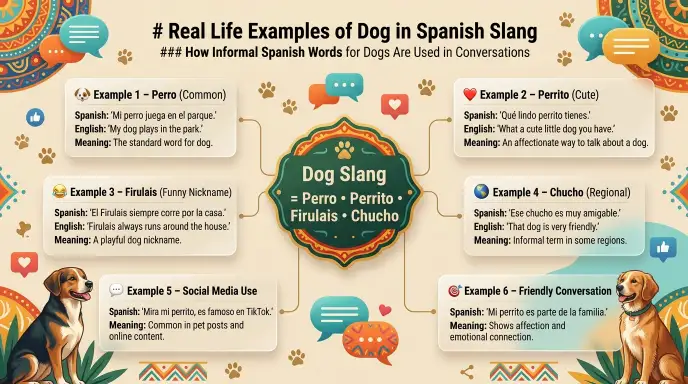
The best way to understand dog in Spanish slang is to see how people use it in everyday conversations. The examples below show how the meaning changes with the situation and the speaker’s tone.
Friendly Conversation
Person A: “¡Hola, pedro! ¿Cómo estás?”
Person B: “Todo bien. ¿Y tú?”
Meaning: Here, “perro” means “buddy” or “friend.” It is a warm and casual greeting.
Text Message
Mensaje: “Perro, ¿vienes esta noche?”
English: “Buddy, are you coming tonight?”
Meaning: The sender is talking to a close friend in an informal way.
Social Media Caption
Caption: “Mi perro siempre está conmigo.”
English: “My buddy is always with me.”
Meaning: The word shows loyalty and friendship rather than referring to an actual dog.
Gaming Chat
Player 1: “Buen trabajo, perro.”
English: “Good job, bro.”
Meaning: Players often use “perro” to encourage teammates during online games.
Negative Example
Sentencia: “Ese hombre es un perro.”
Meaning: In some regions, this may describe a man who treats people badly or is unfaithful in relationships.
Note: The exact meaning depends on the country and the conversation.
Origin and History of Dog in Spanish Slang
The literal word “perro” has meant “dog” in Spanish for centuries. Over time, people began using it as a nickname and a slang expression in everyday speech.
Like many slang words, its meaning developed naturally through conversation rather than through one specific event. Different Spanish-speaking communities gave the word different meanings based on local culture and humor.
Today, “perro” is widely recognized in informal speech across many parts of Latin America. However, its slang meaning is not identical everywhere.
Important: There is no single confirmed origin for every slang use of “perro.” Linguists generally agree that many meanings evolved independently in different regions rather than coming from one source.
Similar Slang or Related Terms
Spanish speakers use many informal words instead of “perro.” Some are regional, while others are understood in several countries.
| Slang Word | Meaning | Common Usage |
| Bro | Brother or close friend | Casual conversations |
| Amigo | Friend | Neutral and polite |
| Compa | Buddy or companion | Mexico and nearby regions |
| Carnal | Close friend | Mexico |
| Pana | Friend | Caribbean and parts of South America |
| Parce | Friend | Colombia |
| Mano | Bro or buddy | Caribbean Spanish |
These words are usually safer choices if you are unsure if “perro” is appropriate in your location.
When Should You Avoid Using Dogs in Spanish Slang?
Although “perro” can be friendly, it is not suitable for every situation.
You should avoid using it in:
- Job interviews
- Business emails
- Workplace meetings
- School presentations
- Speaking with teachers
- Talking to older people you do not know
- Formal ceremonies
- Professional customer service conversations
If you are unsure how someone will react, choose a neutral word like “amigo” instead.
Using respectful language helps prevent misunderstandings, especially when speaking with native Spanish speakers from different countries.
Polite Alternatives to Dog in Spanish Slang
If you want to sound friendly without using slang, these words are good choices.
| Word | Meaning | Best For |
| Amigo | Friend | Almost every situation |
| Compañero | Companion or classmate | School and work |
| Colega | Colleague or friend | Professional and casual settings |
| Hermano | Brother | Close friends |
| Amiga | Female friend | Friendly conversations |
These alternatives are easier for Spanish learners because they are widely understood and less likely to cause confusion.
Why Do People Use Dogs in Spanish Slang?
People use “perro” because it adds personality and emotion to a conversation.
Common reasons include:
- Showing friendship
- Creating a relaxed atmosphere
- Expressing admiration
- Making conversations sound more natural
- Matching local slang
- Building a sense of belonging within a group
On platforms like TikTok, Instagram, Reddit, Discord, and gaming chats, informal language often helps conversations feel more personal and authentic.
However, experienced Spanish speakers usually adjust their language depending on who they are talking to and where the conversation takes place.
Common Misunderstandings About Dog in Spanish Slang
Many learners become confused because they assume “perro” always has one meaning. In reality, its slang meaning changes with the country, tone, and situation.
It Does Not Always Mean a Real Dog
The Spanish word “perro” literally means a dog. However, in casual conversations, it often refers to a person instead.
Example:
- “¿Qué pasa, perro?”
Here, the speaker is greeting a friend, not talking about an animal.
It Is Not Always an Insult
Some people believe calling someone “perro” is always rude. That is not true.
Among close friends, it can simply mean:
- Buddy
- Bro
- Friend
- Pal
The same word may sound offensive if it is spoken angrily or directed at someone you do not know.
The Meaning Changes by Country
Spanish slang is highly regional.
A word that sounds friendly in Mexico may have a different meaning in Colombia, Puerto Rico, the Dominican Republic, or another Spanish speaking country.
If you travel or chat with native speakers online, listen to how local people use the word before using it yourself.
It Is Not Suitable for Every Situation
Even if your friends use “perro,” that does not mean it belongs in every conversation.
Avoid using it in:
- Business meetings
- Professional emails
- School assignments
- Speaking with teachers
- Formal introductions
- Customer service conversations
Choosing standard Spanish is usually the safest option in formal settings.
Frequently Asked Questions
Q1. What does dog in Spanish slang mean?
Dog in Spanish slang usually refers to the word “perro.” Depending on the country and context, it can mean a close friend, a confident person, someone who behaves badly, or simply a casual nickname.
Q2. Is “perro” a bad word in Spanish?
Not always. Among friends, it is often friendly and harmless. However, in some situations or regions, it can be used as an insult. The speaker’s tone and local culture make a big difference.
Q3. Can I call my Spanish speaking friend “perro”?
Only if you know that your friend is comfortable with the expression and it is common in their region. If you are unsure, using “amigo” is a safer choice.
Q4. Does “perra” have the same meaning as “perro”?
No. While “perra” literally means a female dog, its slang meanings are different and can be more sensitive. Depending on the country, it may be a compliment, a playful nickname, or an offensive term.
Q5. Is dog in Spanish slang used on social media?
Yes. You may see it on TikTok, Instagram, Facebook, Reddit, YouTube, Discord, and in text messages, especially in casual conversations between friends.
Q6. Is “perro” appropriate at work or school?
Generally, no. It is informal slang, so it is better to use polite words like “amigo” or “compañero” in professional or educational settings.
Q7. Why does the meaning of “perro” change between countries?
Spanish slang develops differently in each region. Local culture, history, and everyday speech all influence how words like “perro” are used.
Q8. What is the safest alternative to “perro”?
The safest choice is “amigo.” It simply means “friend” and is widely understood across the Spanish-speaking world without causing confusion.
Conclusion:
Dog in Spanish slang usually refers to the word “perro,” but its meaning depends on where it is used and who is saying it. It may describe a close friend, a confident person, or someone with negative behavior.Because Spanish slang varies from country to country, there is no single meaning that fits every conversation.
If you are learning Spanish, pay close attention to the speaker’s tone and the local culture before using the word yourself. In casual settings with friends, “perro” can sound natural and friendly.
In formal situations, however, it is better to choose standard words like “amigo” or “compañero.” Understanding the context will help you communicate more confidently and avoid misunderstandings.

I’m Emily Carter, and I enjoy writing about slang, internet language, and modern English expressions. My goal is to explain word meanings in a simple, clear, and easy-to-understand way so anyone can learn with confidence.