Puerto Rican slang curse words are informal offensive or strong expressions used in Puerto Rico and among Puerto Rican communities. These words often come from Puerto Rican Spanish and can have different meanings depending on tone, situation, and relationship between speakers.
People search for puerto rican slang curse words because they hear these expressions in conversations, music, movies, TikTok videos, or social media and want to understand what they mean. Puerto Rican Spanish has many unique words and phrases influenced by history, culture, and everyday life.
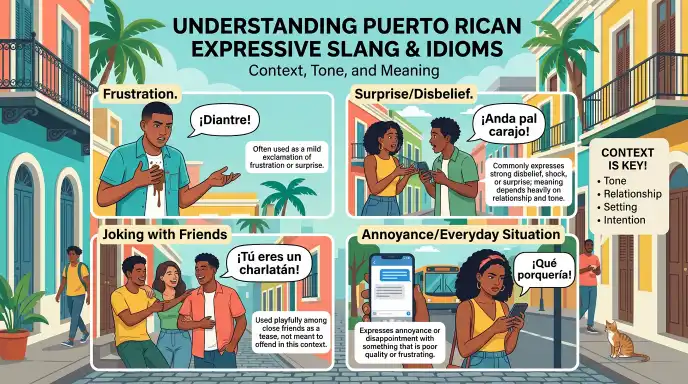
However, curse words are highly dependent on context. Some expressions may sound very offensive between strangers but can be used casually between close friends. Others may be considered disrespectful in formal situations.
This guide explains common Puerto Rican slang curse words, their meanings, tone, cultural background, and when you should avoid using them.
Quick Answer: Puerto Rican Slang Curse Words
Puerto Rican slang curse words are strong Spanish expressions commonly used in Puerto Rico to show anger, surprise, frustration, humor, or emphasis. Their meaning depends heavily on the speaker’s tone, relationship, and situation.
What Do Puerto Rican Slang Curse Words Mean?
Puerto Rican slang curse words are informal expressions that people may use in everyday speech, especially during emotional conversations.
They can express:
- Anger
- Surprise
- Excitement
- Frustration
- Humor
- Friendship between close people
A word that sounds harsh when translated directly into English may have a softer meaning in Puerto Rican Spanish depending on who says it and how it is said.
Context Changes the Meaning
The same expression can have different meanings in different situations.
For example:
- Friends may use a strong word jokingly with each other.
- The same word said aggressively during an argument may become insulting.
- Using it with elders, teachers, or strangers may be considered disrespectful.
Understanding tone is just as important as understanding the word itself.
Full Meaning and Definition of Puerto Rican Curse Slang
Puerto Rican curse slang refers to informal Spanish expressions used by some Puerto Rican speakers when they want to add strong emotion to their speech.
These expressions are part of spoken language and are often heard in:
- Casual conversations
- Music lyrics
- Comedy
- Movies and TV
- Online videos
- Social media discussions
Some words are traditional Spanish insults, while others developed as local Puerto Rican expressions.
Common Puerto Rican Slang Curse Words and Their Meanings
Puerto Rican Spanish includes many expressions that can be offensive or intense. Below are some commonly recognized examples with their general meanings.
| Slang Word | General Meaning | Tone |
| Pendejo | Fool, idiot, or someone acting foolish | Insulting |
| Cabrón | Strong insult; sometimes used between friends | Depends on context |
| Puñeta | Expression of frustration or surprise | Offensive |
| Coño | Expression similar to “damn” or “f***” depending on context | Strong |
| Jodido | Bad, difficult, messed up | Mild to strong |
| Mamabicho | Very offensive insult | Highly offensive |
The meaning of these words can change based on location, age group, and relationship.
Is Puerto Rican Slang Curse Words Rude, Offensive, or Neutral?
Most Puerto Rican slang curse words are considered informal and can be offensive, especially outside close relationships.
However, not every use has the same level of seriousness.
Mild Usage
Some expressions are used casually among friends to show emotion.
Example:
A friend says something surprising, and another person reacts with a strong expression.
In this situation, the word may express shock rather than anger.
Offensive Usage
The same words can become insulting when directed at someone during a fight.
Example:
Using a curse word to attack someone’s character is more aggressive than using it as an emotional reaction.
Professional Situations
Puerto Rican curse slang is generally not appropriate in:
- Work meetings
- Formal emails
- School communication
- Conversations with unfamiliar people
Clear and respectful language is usually better.
Where Are Puerto Rican Slang Curse Words Commonly Used?
These expressions are mostly found in informal environments.
Everyday Conversations
Friends and family members may use slang during relaxed conversations.
The relationship between speakers often determines if a word feels playful or offensive.
Music and Entertainment
Puerto Rican artists often use strong language in:
- Reggaeton
- Latin urban music
- Comedy
- Films
In entertainment, curse words may be used to represent real speech, emotion, or cultural style.
Social Media
Puerto Rican slang appears on platforms such as:
- TikTok
- YouTube
- X (Twitter)
Users often explain slang meanings, share jokes, or discuss cultural expressions.
Messaging Apps
People may use these expressions in private chats with friends, especially when joking or reacting emotionally.
Real-Life Examples of Puerto Rican Slang Curse Words
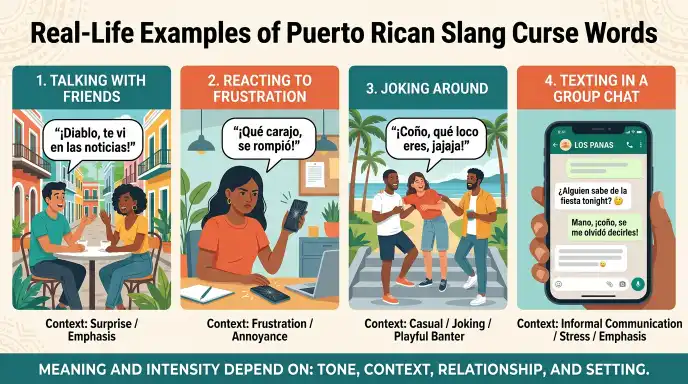
The meaning of Puerto Rican slang curse words depends on the situation, speaker, and tone. The examples below show how strong expressions may appear in different conversations. These examples are for understanding, not encouragement to use offensive language.
Friendly Conversation
Two close friends are joking:
Friend 1: “You forgot your keys again?”
Friend 2: “I know, I’m such a pendejo.”
In this type of situation, the speaker may be criticizing themselves in a playful way. Between close friends, some strong words can become part of casual humor.
Angry Conversation
Person 1: “Why did you break my phone?”
Person 2: “Relax, I didn’t do it on purpose.”
If a curse word is added during an argument, the tone becomes more aggressive and insulting.
Surprise or Shock
Someone receives unexpected news:
“¡Coño! I did not see that coming.”
Here, the expression may show surprise rather than directly insulting another person.
Gaming or Online Context
A player loses an important match:
“Puñeta, we almost won.”
In gaming chats or online communities, some users use strong words to express frustration after losing.
Social Media Example
A TikTok creator may use Puerto Rican slang in a funny video to make the content sound more natural and connected to their culture.
However, viewers should understand that hearing a word online does not always mean it is appropriate for everyone to repeat.
Origin and Background of Puerto Rican Slang Curse Words
Puerto Rican slang developed through a mix of Spanish, African influences, Indigenous Caribbean history, and cultural changes over time.
Puerto Rican Spanish, also called Puerto Rican Spanish or Boricua Spanish, has its own pronunciation, expressions, and vocabulary.
Spanish Language Influence
Many Puerto Rican curse words come from Spanish expressions that are also heard in other Spanish-speaking countries.
However, Puerto Rico developed its own style of using these words.
A phrase that is common in Puerto Rico may have a different feeling or level of offense in another country.
Caribbean Cultural Influence
Puerto Rican slang reflects the island’s history and multicultural background.
Music, neighborhoods, family conversations, and local traditions all influence how slang develops.
Modern Internet Influence
Today, social media has helped spread Puerto Rican expressions worldwide.
Platforms like TikTok and Instagram allow people to hear words from different cultures, but online popularity does not always explain the original meaning or cultural context.
Puerto Rican Slang vs General Spanish Curse Words
Puerto Rican slang curse words are sometimes confused with general Spanish insults.
| Type | Description | Example Situation |
| Puerto Rican slang | Expressions strongly connected with Puerto Rican speech | Local conversations and culture |
| General Spanish curse words | Words used across many Spanish-speaking regions | International Spanish speakers |
| Internet slang | Short expressions used online | Social media and gaming |
| Formal Spanish | Standard language used in professional settings | Work and education |
The main difference is cultural context. A word may exist in Spanish generally but have a unique meaning or tone in Puerto Rico.
When Should You Avoid Using Puerto Rican Slang Curse Words?
Because these words can be offensive, it is important to know when not to use them.
Avoid using Puerto Rican curse slang when:
- Speaking with strangers
- Talking to teachers or elders
- Writing professional messages
- Communicating at work
- Speaking in formal events
- You are unsure about the meaning
A common mistake is learning a word from a song or video and repeating it without understanding its strength.
Respect Cultural Context
Using another culture’s slang without understanding it can create misunderstandings.
Learning the meaning is different from copying the expression.
Polite Alternatives to Puerto Rican Curse Words
If you want to express emotion without offensive language, use neutral alternatives.
Instead of strong curse words, you can say:
- Wow
- That is surprising
- I cannot believe it
- This is frustrating
- That is unbelievable
- What happened?
These expressions work better in most social and professional situations.
Why Do People Use Puerto Rican Slang Curse Words?
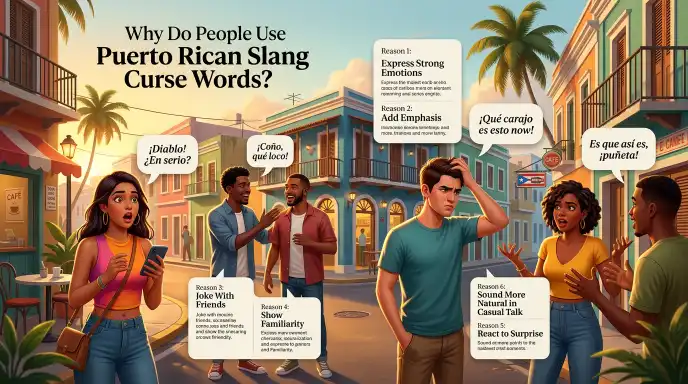
People use strong slang expressions for different reasons.
Common reasons include:
- Showing strong emotions
- Making jokes with friends
- Adding emphasis to a sentence
- Expressing frustration
- Creating a casual speaking style
- Showing cultural identity
For many speakers, these words are part of natural conversation. However, the meaning depends on who says them and who hears them.
Impact of Using Puerto Rican Slang Curse Words in Communication
Strong slang can make speech sound more emotional and natural among people who understand the culture.
Positive effects may include:
- Creating a sense of connection
- Showing personality
- Making conversations feel relaxed
Negative effects may include:
- Offending someone
- Creating misunderstandings
- Appearing disrespectful
- Causing problems in professional settings
The same word can create humor in one situation and conflict in another.
Are Puerto Rican Slang Curse Words Safe for Social Media?
Puerto Rican slang curse words can appear on social media, but users should be careful.
On TikTok and Instagram
Creators may use these words for humor, storytelling, or cultural expression.
However, content reaches a wide audience, including people who may not understand the cultural meaning.
On Reddit and Online Communities
Users should consider the rules of each community.
Some groups allow strong language, while others may remove offensive content.
For Brands and Public Accounts
Businesses and professional creators should generally avoid curse slang unless it matches their audience and brand style.
Common Misunderstandings About Puerto Rican Slang Curse Words
Many people misunderstand Puerto Rican slang curse words because they translate them directly from Spanish into English. A direct translation does not always show the real meaning or emotional level.
A Strong Word Does Not Always Mean Strong Anger
Some curse words may sound extremely offensive when translated, but native speakers may use them casually with close friends.
The relationship between speakers, facial expressions, and tone of voice all affect the meaning.
Not Every Puerto Rican Person Uses the Same Slang
Puerto Rico has different regions, generations, and personal speaking styles.
Some people use a lot of slang, while others prefer more formal language. Younger speakers may also use different expressions than older generations.
Learning a Word Does Not Mean You Should Use It
Understanding slang helps you follow conversations, music, and online content.
However, repeating a strong expression without knowing the cultural context can lead to awkward or disrespectful situations.
Similar Puerto Rican Slang and Related Expressions
Puerto Rican Spanish includes many informal expressions that are not always curse words but are common in casual speech.
| Expression Type | Purpose | Example Use |
| Curse slang | Shows strong emotion | Anger, surprise, frustration |
| Friendly slang | Builds connection | Talking with friends |
| Street slang | Reflects local culture | Everyday conversations |
| Internet slang | Used online | Social media and chats |
Understanding the difference helps avoid confusing casual expressions with offensive language.
Why Context Matters More Than the Word
With Puerto Rican slang curse words, context often changes everything.
The same expression can be:
- Funny between close friends
- Offensive during an argument
- Inappropriate in a workplace
- Normal in certain entertainment settings
Before judging a word, consider:
- Who said it?
- Who heard it?
- What was the tone?
- What was the situation?
This approach gives a more accurate understanding of slang.
Can Puerto Rican Slang Curse Words Be Used at Work?
In most professional situations, it is better to avoid using curse slang.
Workplaces usually require clear and respectful communication.
Avoid these expressions in:
- Emails
- Job interviews
- Meetings
- Professional presentations
- Messages with customers
Even if coworkers use strong language privately, it does not mean the same language is suitable in every workplace situation.
How to Understand Puerto Rican Slang Without Causing Offense
If you are learning Puerto Rican slang, focus on understanding first.
Helpful steps include:
- Listen to native speakers
- Learn the cultural background
- Pay attention to tone
- Ask respectfully when unsure
- Avoid using words as jokes
Language learning is not only about vocabulary. It is also about understanding the people and culture behind the words.
Frequently Asked Questions
Q1. What are Puerto Rican slang curse words?
Puerto Rican slang curse words are strong informal expressions used by some Puerto Rican speakers to show emotions like anger, surprise, frustration, or humor. Their meaning depends on context and tone.
Q2. Are Puerto Rican slang curse words offensive?
Some can be offensive, especially when used toward someone during an argument. However, certain expressions may be used casually among close friends depending on the relationship.
Q3. Why do Puerto Ricans use curse words so often?
Some speakers use strong expressions to add emotion, humor, or emphasis to conversations. Like slang in many cultures, usage depends on personality, region, and social group.
Q4. Can I use Puerto Rican slang curse words if I am not Puerto Rican?
It is better to be careful. Understanding these words is fine, but using them without knowing the cultural meaning may sound disrespectful or unnatural.
Q5. Are Puerto Rican slang curse words used on TikTok and social media?
Yes, some Puerto Rican creators use these expressions in videos, music discussions, and jokes. However, online examples may not show the full cultural context.
Q6. Are Puerto Rican curse words the same as Mexican or Spanish curse words?
No. Some words may overlap because they come from Spanish, but their meaning, popularity, and level of offense can differ by country and community.
Q7. Can I use Puerto Rican slang curse words at work?
Generally, it is not recommended. Professional communication usually requires more neutral language, especially with customers, managers, or people you do not know well.
Q8. How can I learn Puerto Rican slang correctly?
The best way is to learn from reliable cultural sources, listen to native speakers, and understand the situation where expressions are used before repeating them.
Conclusion:
Puerto Rican slang curse words are powerful expressions connected to emotion, culture, and everyday communication. They can show frustration, surprise, humor, or friendship depending on the speaker and situation.
The most important thing to remember is that these words do not have one fixed meaning. Tone, relationship, and context decide if an expression sounds playful or offensive.
If you are learning Puerto Rican slang from music, movies, or social media, focus on understanding the culture behind the words. Respectful learning helps you communicate better and avoid using expressions in the wrong situation.

I’m Emily Carter, and I enjoy writing about slang, internet language, and modern English expressions. My goal is to explain word meanings in a simple, clear, and easy-to-understand way so anyone can learn with confidence.