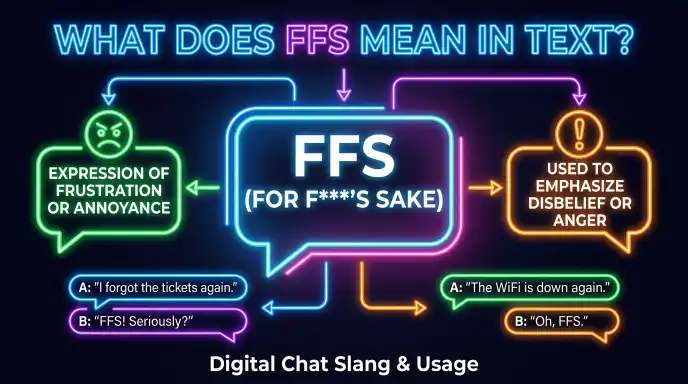
FFS in text usually means “For Fuck’s Sake.” People use this expression to show frustration, annoyance, disbelief, or impatience. You may see it in text messages, TikTok comments, Snapchat chats, Instagram posts, and other online conversations.
The abbreviation is often used when something feels irritating, unnecessary, or difficult to believe. For example, someone might text “FFS, I missed the bus again” after having a frustrating morning.
Although FFS is common in informal online communication, it contains a swear word. Therefore, its tone can be stronger than ordinary expressions such as “OMG” or “seriously.”
In this guide, you will learn what FFS means, how people use it on different platforms, how to reply naturally, and when it is better to avoid the expression.
FFS Meaning in Text
FFS stands for “For Fuck’s Sake.” It is an informal expression that people use to communicate frustration, irritation, impatience, or exasperation.
In simple terms, someone might say FFS when they feel annoyed by a situation. It can also express disbelief when something goes wrong or when another person does something frustrating.
For example:
“FFS, why is my internet so slow?”
In this message, the sender is frustrated because their internet connection is not working as expected.
The expression does not always mean the sender is angry at another person. Sometimes, they are simply venting about an annoying situation.
What Does FFS Stand For?
The three letters represent the phrase “For Fuck’s Sake.”
- F: For
- F: Fuck’s
- S: Sake
The full phrase includes profanity, so FFS is considered a swear-word abbreviation. However, many people use it casually in private messages and informal online discussions.
For example:
A: FFS, I forgot my keys again!
B: Oh no! Can someone bring them to you?
Here, A is expressing frustration about forgetting their keys. The message does not necessarily indicate anger toward B.
Is FFS Slang or an Acronym?
FFS is an internet abbreviation and initialism used in informal communication. It represents the first letters of a longer phrase rather than functioning as a standard English word.
People often type FFS because it is shorter than writing the complete expression. As a result, it fits naturally into quick messages, comments, and online conversations.
However, the abbreviation still carries the meaning and strong language of the original phrase. Someone who understands the letters will usually recognize the frustration behind the message.
What Does FFS Mean in Everyday Chat?
In everyday texting, FFS usually communicates that someone has reached the limit of their patience.
For example, a person might write “FFS, the printer stopped working again” when dealing with a repeated problem. Another person might use it after missing a train or receiving an unexpected bill.
Depending on the situation, the expression can sound humorous, irritated, or openly angry. Therefore, it is important to consider the surrounding words and the relationship between the people chatting.
Where People Use FFS
FFS appears in many forms of digital communication. Nevertheless, its tone can change depending on the platform, audience, and conversation.
FFS on TikTok
On TikTok, users may write FFS in comments, captions, or video descriptions when reacting to something frustrating or unbelievable.
For example, someone might comment:
“FFS, why does this happen every time?”
The comment expresses annoyance about a repeated situation shown in the video.
People may also use FFS humorously when reacting to relatable everyday problems. However, because the abbreviation contains profanity, it may not suit every audience or type of content.
FFS on Snapchat
On Snapchat, FFS often appears in quick messages between friends. It can communicate frustration without requiring a long explanation.
Example conversation:
A: My phone died just before I could save my photos.
B: No way!
A: FFS, I should have charged it earlier.
In this example, the sender is annoyed with the situation and possibly with themselves. The abbreviation makes the emotion clear.
Close friends may understand this tone easily. However, someone who does not know the sender well might interpret the message as more aggressive than intended.
FFS on Instagram
Instagram users may use FFS in comments, direct messages, Stories, or captions.
For instance, someone dealing with a frustrating online experience might post:
“FFS, another app update?”
The expression conveys annoyance about having to deal with another update.
Similarly, users may include FFS when reacting to news, memes, or everyday experiences. The intended tone depends on the content and the way the message is written.
FFS on WhatsApp
WhatsApp conversations often involve friends, relatives, and coworkers. In casual chats, FFS can express impatience or frustration.
Example:
A: The delivery is delayed again.
B: Seriously? What happened this time?
A: FFS, they haven’t even sent an update.
Here, the sender is irritated by the lack of information. The abbreviation emphasizes that frustration.
However, using FFS in a family group or work-related chat may not be appropriate for everyone. Consider the audience before sending it.
FFS in SMS Text Messages
FFS can also appear in ordinary SMS messages. Since text messages do not always communicate facial expressions or tone of voice, the abbreviation can make the sender’s feelings more obvious.
For example:
“FFS, I left my wallet at home.”
This message shows frustration about forgetting something important.
Even so, readers may interpret the expression differently. A close friend might see it as a normal complaint, while another person might consider it rude because of the profanity.
Real Chat Examples of FFS
The following examples show how people might use FFS in natural conversations. Each one demonstrates a different situation, from minor frustrations to stronger annoyance.
Missing the Bus
A: I missed the bus by like ten seconds.
B: Oh no, when’s the next one?
A: FFS, not for another thirty minutes.
Meaning: A is frustrated because missing the bus has caused an unexpected delay.
A Slow Internet Connection
A: Is your Wi-Fi working?
B: Yeah, why?
A: Mine keeps disconnecting. FFS, I have a deadline.
Meaning: A is irritated because the internet problem is interfering with important work.
Forgetting Something
A: I left my lunch on the kitchen counter.
B: Again?
A: FFS, apparently I can’t remember anything today.
Meaning: A is expressing frustration with their own forgetfulness.
A Repeated Problem
A: The printer jammed again.
B: Didn’t you fix it yesterday?
A: Yes! FFS, this thing never works.
Meaning: A is annoyed because the same problem keeps happening.
Plans Getting Cancelled
A: They cancelled our plans at the last minute.
B: That’s disappointing.
A: FFS, I was already on my way.
Meaning: A is frustrated because the cancellation happened at an inconvenient time.
A Friend Being Late
A: Where are you? We’ve been waiting for twenty minutes.
B: Sorry, I’m stuck in traffic.
A: FFS, you could’ve told us earlier.
Meaning: A is annoyed because the delay was not communicated sooner.
A Funny Situation
A: I made coffee and forgot to put a mug underneath.
B: How does that even happen?
A: FFS, don’t ask. It’s been a long morning.
Meaning: A uses FFS to express humorous frustration about a small mistake.
Technology Problems
A: My laptop restarted before I saved the document.
B: Please tell me you had a backup.
A: I didn’t. FFS!
Meaning: A is upset because they may have lost their work.
An Unexpected Expense
A: My car needs another repair.
B: That sounds expensive.
A: FFS, I just paid for one last month.
Meaning: A is frustrated about having to pay for another repair so soon.
Reacting to Bad News
A: The concert tickets sold out already.
B: You were waiting for them all week!
A: FFS, I didn’t even get a chance to buy any.
Meaning: A is expressing disappointment and frustration about missing the opportunity.
These examples show that FFS usually adds emotional emphasis to a sentence. The specific feeling may range from mild annoyance to intense frustration.
How to Reply When Someone Says FFS
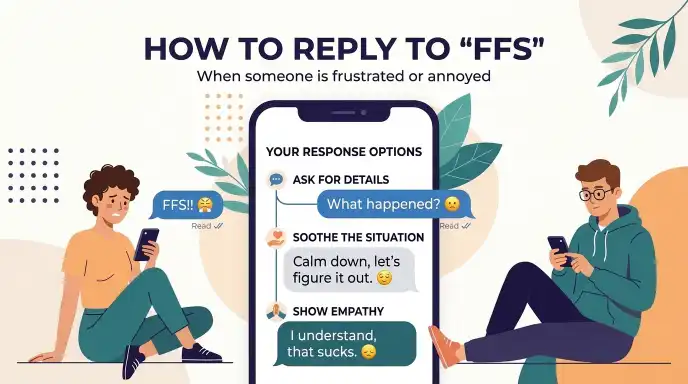
Your response depends on why the person is frustrated. Sometimes, they want sympathy. In other situations, they may simply be venting and not expect advice.
Funny Replies
If the conversation is casual and the person enjoys humor, a playful response may help lighten the mood.
- “It’s definitely one of those days!”
- “The universe is testing your patience.”
- “Take a deep breath before round two.”
- “At this point, we need a reset button.”
- “Today’s drama is doing overtime.”
Use these responses when the situation is relatively minor. If the person is genuinely upset, a joke may not be the best choice.
Casual Replies
For everyday conversations, keep your answer short and natural.
- “What happened?”
- “Oh no, seriously?”
- “That’s so annoying.”
- “I know, right?”
- “Tell me about it.”
These replies acknowledge the person’s frustration without making the conversation more complicated.
Friendly Replies
If someone close to you is having a difficult day, show understanding before offering advice.
- “I’m sorry. That sounds really frustrating.”
- “Do you want to talk about it?”
- “Hopefully, things get better soon.”
- “That’s rough. Is there anything I can do?”
- “I understand why you’re annoyed.”
A supportive response can help the person feel heard. In addition, asking what happened gives them a chance to explain the situation.
Neutral Replies
If you do not know the person well, or the message is related to work, use a calm response.
- “What seems to be the problem?”
- “Could you explain what happened?”
- “I understand. Let’s see what we can do.”
- “That sounds inconvenient.”
- “Let’s try to find a solution.”
These replies acknowledge the situation without copying the sender’s strong language.
Is FFS Rude or Offensive?
FFS can be considered rude or offensive because it stands for a phrase containing profanity. However, how people perceive it depends on the situation, the audience, and the tone of the conversation.
Among close friends, the abbreviation may be a familiar way to vent frustration. In a formal conversation, the same expression may seem disrespectful or unprofessional.
Is FFS a Bad Word?
FFS contains the word “fuck,” which is considered profanity in English. Although the abbreviation hides the full phrase behind three letters, it does not remove the original expression’s strong language.
Some people use it casually without intending to insult anyone. Nevertheless, others may find it inappropriate, especially in public or professional settings.
Is FFS Safe to Use?
FFS is generally understood in informal communication, but it is not suitable for every audience.
Before using it, consider if the recipient is comfortable with swearing. Also, avoid using it when a calm, respectful response would be more helpful.
If you are unsure, expressions such as “Seriously?”, “That’s frustrating”, or “Oh, come on” can communicate annoyance without profanity.
Is FFS Appropriate at School or Work?
In most formal settings, it is safer to avoid FFS. Teachers, managers, clients, and coworkers may interpret the expression as unprofessional, even if you do not intend to offend anyone.
For example, instead of writing “FFS, the report is late again,” you could say, “The report is delayed again, and we need to resolve the issue.”
The second version communicates the problem clearly while maintaining a professional tone.
Who Uses This Term?
FFS is used by people who communicate through informal messages, online communities, and social media. However, familiarity with the abbreviation varies from person to person.
Do Gen Z Users Use FFS?
Some Gen Z users use FFS in texts, memes, comments, and casual conversations. It is a convenient way to express annoyance without typing the full phrase.
However, FFS is not exclusive to Gen Z. People from other generations may use it as well, particularly if they are familiar with internet slang and informal texting.
Do Millennials and Older Adults Use FFS?
Yes. Millennials and older adults may also recognize or use FFS in everyday digital communication.
Their familiarity often depends on personal communication habits rather than age alone. Someone who regularly exchanges informal messages may understand the abbreviation, while another person may prefer to write the complete phrase.
Where Is FFS Most Commonly Seen?
FFS may appear in several types of online communication:
- Text messages between friends
- TikTok comments and captions
- Instagram posts and direct messages
- Snapchat conversations
- WhatsApp chats
- Online forums and gaming discussions
These are common types of settings where informal language appears, although the frequency of FFS varies between communities.
How Often Do People Use FFS Online?
There is no single figure that accurately describes how often FFS appears across every social media platform and messaging service.
Its use depends on the community and the type of conversation. For example, people discussing everyday frustrations may use it more often than those participating in formal or educational discussions.
Therefore, it is best understood as a recognizable informal abbreviation rather than a term that everyone uses regularly.
Origin of the Term FFS
FFS is short for “For Fuck’s Sake,” an expression that existed as spoken language before becoming common in digital shorthand.
The exact first use of the three-letter abbreviation is difficult to establish without reliable historical evidence. Therefore, it would be misleading to attribute its creation to a particular person or date without a trustworthy source.
How Did FFS Become Popular in Texting?
As people began communicating through online chats, text messages, and discussion forums, abbreviations became a convenient way to express familiar phrases.
FFS fits this pattern because it allows someone to communicate frustration quickly. Rather than typing the entire expression, they can use three letters that many readers recognize.
Similarly, abbreviations such as OMG, WTF, and IDK became familiar forms of digital communication. Each has its own meaning and tone, however, so the expressions are not interchangeable.
The Influence of Internet Culture
Online communication often uses short, expressive phrases to convey emotions. FFS can communicate irritation immediately, particularly when a person is reacting to a repeated problem or unexpected disappointment.
In addition, memes and social media comments can make such abbreviations more visible to people who may not use them in their own messages.
However, online familiarity does not mean the expression is appropriate everywhere. Its meaning remains informal, and its profanity may be unwelcome in certain settings.
Is FFS an Old or New Slang Term?
FFS is not simply a newly created social media trend. It abbreviates an established English expression, although the exact history of its use as a three-letter initialism is not clearly documented.
Today, people may encounter it in text messages, online comments, and other informal digital conversations. Its continued use reflects the convenience of short expressions that communicate strong feelings.
FFS vs. IDK, IDC, IMO, and BRB
FFS differs from common texting abbreviations because it expresses an emotion rather than simply communicating information or describing an action.
The table below compares FFS with four familiar terms.
| Term | Meaning | Type | Usage | Popularity |
| FFS | For Fuck’s Sake | Profanity-based expression | Showing frustration or impatience | Recognizable in informal communication |
| IDK | I Don’t Know | Texting abbreviation | Expressing uncertainty | Widely recognized |
| IDC | I Don’t Care | Texting abbreviation | Expressing indifference | Widely recognized |
| IMO | In My Opinion | Texting abbreviation | Sharing a personal opinion | Widely recognized |
| BRB | Be Right Back | Texting abbreviation | Saying you will return shortly | Widely recognized |
FFS vs. IDK
IDK means “I Don’t Know.” People use it when they are unsure about something.
For example, someone might write, “IDK what time the movie starts.”
By contrast, FFS expresses frustration or impatience. The two abbreviations have different purposes, even though both can appear in casual text messages.
FFS vs. IDC
IDC stands for “I Don’t Care.” It communicates indifference, although it can sound dismissive depending on the situation.
FFS, on the other hand, usually communicates frustration or exasperation. For example, a person might use IDC to show that something does not matter to them, while FFS indicates that something is irritating them.
FFS vs. IMO
IMO means “In My Opinion.” It introduces a personal view or judgment.
For example, someone might text, “IMO, this movie is overrated.”
FFS does not introduce an opinion in the same way. Instead, it adds emotional emphasis to a complaint or reaction.
FFS vs. BRB
BRB stands for “Be Right Back.” It tells someone that the sender will return after a short absence.
FFS has a different purpose because it communicates frustration rather than a temporary departure from the conversation.
Real-World Usage Example
Imagine that Maya is getting ready for work. She has prepared everything the night before, but her phone alarm fails to ring, and she wakes up late.
While messaging her friend, she writes:
Maya: FFS, my alarm didn’t go off again.
Friend: Oh no! Are you going to be late?
Maya: Probably. I even checked it before going to sleep.
In this situation, Maya uses FFS to express frustration about an unexpected problem. She is not necessarily angry at her friend; she is upset about what happened.
Later, imagine Maya needs to explain the same problem to her manager. Instead of using FFS, she could write, “My alarm failed to go off, and I apologize for the delay.”
This example shows how the same feeling can be expressed differently depending on the audience.
The main lesson is simple: FFS works in casual conversations, but more neutral wording is usually better in formal situations.
Frequently Asked Questions
Q1. What does FFS mean in text messages?
FFS means “For Fuck’s Sake.” It is an informal expression used to show frustration, annoyance, impatience, or disbelief.
Q2. What does FFS mean on TikTok?
On TikTok, FFS usually expresses frustration or annoyance in comments, captions, and videos. Its tone depends on the situation and the surrounding words.
Q3. Is FFS slang?
Yes, FFS is an informal texting abbreviation. It represents a phrase containing profanity and is commonly used in casual digital communication.
Q4. Is FFS rude or offensive?
FFS can be considered rude because it contains a swear word. Close friends may use it casually, but it is generally better to avoid it in formal or professional conversations.
Q5. How should you reply to FFS?
Your response depends on the situation. You could say “What happened?”, “That’s frustrating,” or “I understand.” These replies acknowledge the person’s feelings without using profanity yourself.
Conclusion:
FFS means “For Fuck’s Sake” and is commonly used in texting to express frustration, annoyance, impatience, or disbelief. You may see it in messages, TikTok comments, Instagram posts, Snapchat conversations, and other informal online discussions.
Although the abbreviation can sound casual among friends, it contains profanity and may offend some readers. Therefore, consider your audience before using it, particularly in school, at work, or in professional messages.
If someone sends you FFS, look at the surrounding conversation to understand their tone. They may be genuinely upset, mildly annoyed, or simply reacting humorously to an everyday problem.
Ultimately, FFS is useful to recognize, but it is not appropriate for every situation. When in doubt, choose a clearer and more polite expression.

I’m Emily Carter, and I enjoy writing about slang, internet language, and modern English expressions. My goal is to explain word meanings in a simple, clear, and easy-to-understand way so anyone can learn with confidence.