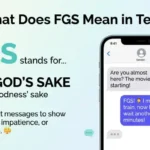
FGS in text usually means “For Goodness’ Sake.” People use this expression to show frustration, surprise, impatience, or disbelief during a conversation. Depending on the situation, it can sound playful, annoyed, or mildly exasperated.
You might see FGS in text messages, WhatsApp chats, TikTok comments, Snapchat messages, or Instagram conversations. Someone may use it when a friend keeps asking the same question or when something does not go as expected.
Although the abbreviation is common in informal communication, not everyone recognizes it immediately. Its meaning can also depend on the surrounding message and the relationship between the people chatting.
In this guide, you will learn what FGS means, how people use it online, how to reply naturally, and if it is rude or appropriate in different situations.
FGS Meaning in Text
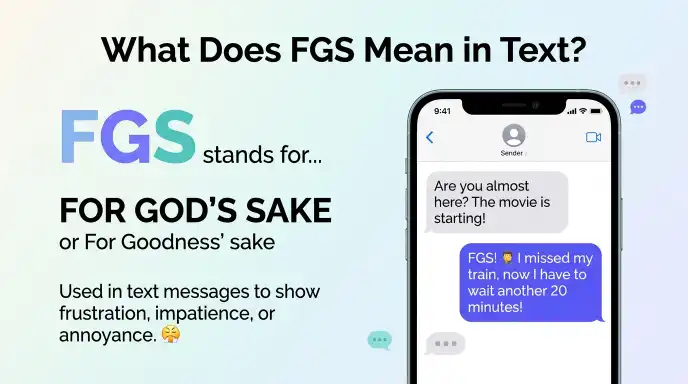
FGS stands for “For Goodness’ Sake.” It is an informal expression people use when they feel frustrated, surprised, impatient, or strongly affected by something.
Instead of typing the entire phrase, people use its first letters to make their messages shorter. The abbreviation often appears in casual conversations with friends, family members, or online acquaintances.
For example:
A: I forgot my homework again.
B: FGS, remember to pack it tonight!
In this conversation, the sender sounds frustrated but may also be trying to help. The exact tone depends on their relationship and the way they normally communicate.
What Does FGS Stand For?
The abbreviation breaks down into three letters:
- F = For
- G = Goodness’
- S = Sake
Together, they form the expression “For Goodness’ Sake.”
People use this phrase to express annoyance or emphasize a point. It can also show surprise when something seems unbelievable.
Example:
A: I lost my keys again.
B: FGS! Check your bag first.
Here, B is expressing frustration because the situation has happened before.
Is FGS Slang or an Acronym?
FGS is an initialism used as an internet shorthand. It represents the first letters of a longer expression rather than functioning as a regular English word.
People often use it in informal messages because it saves time and makes a reaction quick to type. However, unlike neutral abbreviations such as BRB or IDK, FGS can communicate an emotion.
Its tone is usually mild, but it may sound impatient or irritated depending on the situation.
What Does FGS Mean in Everyday Chat?
In everyday texting, FGS usually expresses frustration, disbelief, or impatience. Someone might use it when plans go wrong, a person repeats a mistake, or a conversation becomes annoying.
For example, a friend might text, “FGS, we’re going to be late!” This means the sender is frustrated about the delay and wants the other person to hurry.
However, the abbreviation is not always angry. Friends may use it jokingly when something silly happens.
Therefore, check the rest of the message before deciding if the sender is genuinely upset.
Where People Use FGS
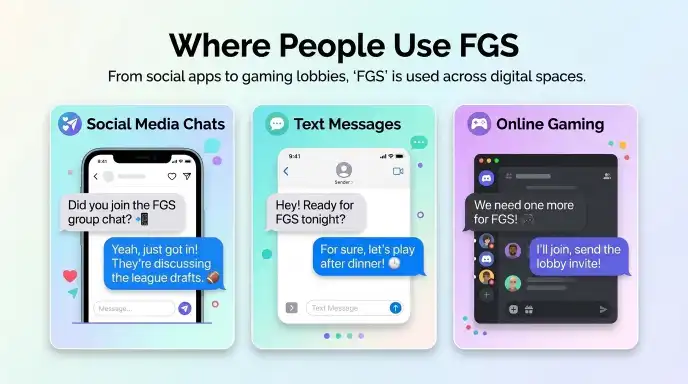
FGS can appear on several messaging and social media platforms. Although the basic meaning remains similar, the tone may change according to the conversation.
FGS on TikTok
On TikTok, users may write FGS in comments, captions, or replies when reacting to something frustrating, surprising, or unbelievable.
For example:
Comment: FGS, why would anyone do that?
The commenter is expressing disbelief or annoyance about something in the video.
Sometimes, creators and viewers use the abbreviation humorously rather than angrily. As a result, the video’s subject and the surrounding comments can help you understand the intended tone.
FGS on Snapchat
On Snapchat, FGS may appear in quick messages between friends. It can communicate impatience when someone is taking too long or repeatedly making the same mistake.
Example:
A: I’m still getting ready.
B: FGS, we’ve been waiting for 30 minutes!
In this situation, B sounds annoyed because the delay is affecting their plans.
However, close friends might use the same expression playfully. Emojis and the usual tone of the friendship can help clarify the message.
FGS on Instagram
Instagram users may use FGS in comments, direct messages, or replies to stories.
For instance, someone might comment “FGS, read the caption!” when another person asks a question that the post already answers.
The abbreviation expresses frustration with the repeated question. Nevertheless, it can come across as rude if the sender uses it toward someone they do not know well.
When interpreting an Instagram comment, consider if the conversation is friendly, sarcastic, or argumentative.
FGS on WhatsApp
WhatsApp is another place where FGS can appear in everyday conversations. Friends and family members may use it when discussing plans, sharing problems, or reacting to unexpected situations.
Example:
A: I forgot to bring the tickets.
B: FGS! We checked everything before leaving.
Here, B is frustrated because the forgotten tickets could disrupt the plans.
On the other hand, a friendly conversation might use FGS as a lighthearted reaction. The relationship between the speakers helps determine how serious the message sounds.
FGS in SMS Text Messages
FGS can also appear in ordinary SMS messages. Because text messages do not always include facial expressions or voice tone, the abbreviation may sometimes sound harsher than intended.
For example:
“FGS, call me when you get there!”
The sender may be worried, impatient, or simply emphasizing the importance of the call.
If you receive this message, read the full sentence before assuming the person is angry. Their intention may be more caring than the abbreviation initially suggests.
Real Chat Examples of FGS
These ten examples show how people might use FGS in everyday conversations. Each one demonstrates a slightly different tone or situation.
Someone Is Running Late
A: I’m leaving in five minutes.
B: You said that half an hour ago.
A: Almost ready!
B: FGS, hurry up!
Meaning: B is frustrated because A keeps delaying their departure.
Forgetting Something Important
A: I forgot my assignment at home.
B: FGS, didn’t you pack it last night?
A: I thought I did.
Meaning: B expresses annoyance about a repeated or avoidable mistake.
Repeating the Same Question
A: What time are we meeting?
B: At six.
A: Wait, what time again?
B: FGS, I just told you!
Meaning: B is impatient because A keeps asking the same question.
A Funny Mistake
A: I put salt in my tea instead of sugar.
B: FGS 😂 How did you manage that?
A: I wasn’t paying attention!
Meaning: The abbreviation expresses surprise and amusement rather than serious anger.
A Delayed Reply
A: Are you coming or not?
B: Sorry, my phone was charging.
A: FGS, just let me know next time.
Meaning: A is frustrated because the lack of communication caused uncertainty.
A Broken Plan
A: The movie tickets are sold out.
B: FGS! We should have booked earlier.
A: Let’s find another show.
Meaning: B is disappointed and annoyed that the original plan did not work.
A Friend Is Overthinking
A: Should I send the message now?
B: Yes, just send it.
A: But what if they don’t reply?
B: FGS, stop overthinking everything!
Meaning: B is impatient but may also be trying to encourage A.
A Family Conversation
A: I left the lights on again.
B: FGS, please remember to switch them off.
A: Sorry, I’ll check next time.
Meaning: B expresses mild frustration about an everyday mistake.
Reacting to Bad Luck
A: It started raining just as I left home.
B: FGS, you forgot your umbrella too?
A: Unfortunately, yes.
Meaning: B expresses surprise and frustration about the unfortunate situation.
A Social Media Comment
A: I posted the event details yesterday.
B: Where?
A: They’re in the caption.
B: FGS, I didn’t notice!
Meaning: The abbreviation expresses mild annoyance or embarrassment after missing information.
How to Reply When Someone Says FGS
Your response depends on the sender’s tone and the situation. If the person sounds genuinely upset, a calm reply is usually better than responding with more frustration.
Funny Replies
If the conversation is playful, try one of these humorous responses:
- “Okay, okay! Don’t explode 😂”
- “Relax, the world isn’t ending!”
- “Someone woke up impatient today!”
- “Fine, boss! I’m on it.”
- “FGS right back at you 😂”
Use these replies with friends who understand your sense of humor. Otherwise, a joke might make an already tense conversation worse.
Casual Replies
For a simple response, you can say:
- “Okay, I’m doing it now.”
- “Sorry, give me a minute.”
- “I understand. I’ll hurry up.”
- “Alright, no need to worry.”
- “Got it, thanks for reminding me.”
These messages acknowledge the person’s concern without adding unnecessary tension.
Friendly Replies
If someone sounds frustrated but you want to keep the conversation positive, consider these options:
- “Sorry about that! I’ll fix it.”
- “I didn’t mean to annoy you.”
- “You’re right. I’ll be more careful.”
- “Thanks for your patience.”
- “I understand why you’re frustrated.”
A friendly response can help resolve the situation, especially when the problem is a simple mistake or misunderstanding.
Neutral Replies
Sometimes, you may want to avoid arguing. In that case, a neutral response can help:
- “What seems to be the problem?”
- “Can we talk about this calmly?”
- “I understand your point.”
- “I’ll look into it.”
- “Let me explain what happened.”
These replies are useful when the sender’s tone feels serious or you are unsure why they are upset.
Is FGS Rude or Offensive?
FGS is generally not considered a swear word or an inherently offensive expression. However, it can sound annoyed, impatient, or dismissive.
The phrase “For Goodness’ Sake” is often a milder way to express frustration. Still, the way you use it matters just as much as the words themselves.
Is FGS Safe to Use?
In ordinary casual conversations, FGS is generally acceptable. Friends may use it when joking about mistakes or reacting to an unexpected situation.
However, repeated use can make someone feel criticized or disrespected. For example, texting “FGS, why can’t you understand?” may sound insulting because it directly targets the other person’s understanding.
Therefore, consider the situation before using it. A calm sentence may be more helpful when someone is already upset.
Is FGS Appropriate at School or Work?
FGS is informal, so it may not be the best choice for professional emails, formal assignments, or conversations with someone you do not know well.
For example, instead of writing “FGS, send the report!”, a professional message could say, “Could you please send the report as soon as possible?”
The second option communicates urgency without sounding irritated.
Similarly, students may use FGS with friends, but formal schoolwork should generally use complete and appropriate language.
Can FGS Sound Angry?
Yes. FGS can communicate frustration, especially when written in capital letters or followed by an exclamation mark.
For example, “FGS!!!” may look more intense than “FGS, I forgot again.”
However, punctuation alone does not prove that someone is angry. Their usual communication style and the situation provide additional clues.
Who Uses This Term?
FGS is used by people who communicate through informal messages, online discussions, and social media. However, familiarity with the abbreviation varies from person to person.
Do Gen Z Users Use FGS?
Some Gen Z users may use FGS in casual messages or online conversations. It can be a quick way to express annoyance without typing the full phrase.
Nevertheless, it is not exclusive to Gen Z. People from other age groups may also recognize or use it, particularly if they are familiar with internet abbreviations.
Do Adults Use FGS?
Yes. Adults may use FGS in conversations with friends, family members, or colleagues they know well.
For example, a parent might text “FGS, don’t forget your keys!” when reminding someone about something important.
In a professional environment, however, many people prefer more direct and polite wording.
Where Is FGS Most Likely to Appear?
You may encounter FGS in several places:
- Text messages between friends
- WhatsApp and Snapchat conversations
- Instagram comments and direct messages
- TikTok discussions
- Online forums and casual group chats
These are possible settings, not a measured ranking of the abbreviation’s popularity.
How Common Is FGS Online?
FGS is recognizable to some internet users, but it is not as universally familiar as abbreviations such as IDK or BRB.
Its use also varies by community. People who frequently use informal English expressions may understand it immediately, while others may need to look up its meaning.
Consequently, it is helpful to understand the full phrase rather than rely on the abbreviation alone.
Origin of FGS
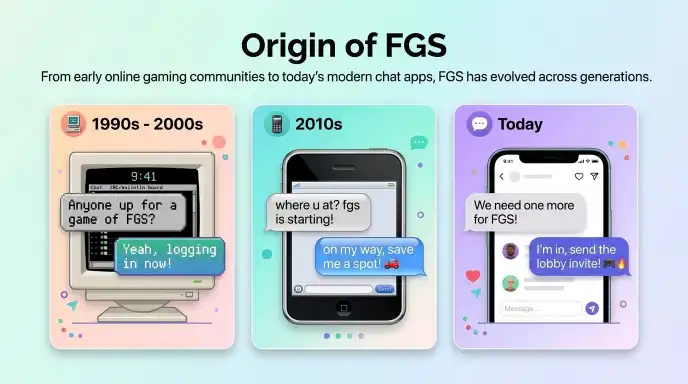
FGS comes from the expression “For Goodness’ Sake.” The full phrase is used in English to express frustration, surprise, impatience, or emphasis.
The exact date when people first began using FGS in digital messages is not clearly established. Therefore, it would be misleading to assign the abbreviation a specific origin year without reliable evidence.
How Did FGS Become a Texting Abbreviation?
As text messaging and online chats became common, people started shortening familiar expressions to make their messages quicker to type.
For example, IDK represents “I Don’t Know,” while BRB represents “Be Right Back.” FGS follows a similar pattern by using the initial letters of a longer phrase.
The full expression existed independently of modern texting. Digital communication simply provided another setting in which its shortened form could be useful.
The Influence of Internet Culture
Internet conversations often favor short reactions that communicate a feeling quickly. FGS fits this pattern because it can express annoyance or disbelief in just three letters.
However, the abbreviation does not always carry the same emotional weight. A playful message between friends may feel harmless, while the same expression during an argument may sound confrontational.
Is FGS a Modern Slang Term?
FGS is better understood as an abbreviation of an established English expression than as a completely new word.
Although its use in digital communication is informal, the phrase behind it has a broader history in everyday English. Its meaning remains fairly consistent across text messages and social media.
FGS vs. IDK, IDC, IMO, and BRB
FGS differs from many familiar texting abbreviations because it expresses an emotional reaction rather than simply describing what someone knows or plans to do.
The table below compares five common abbreviations.
| Term | Meaning | Type | Usage | Popularity |
| FGS | For Goodness’ Sake | Expression abbreviation | Showing frustration or disbelief | Recognized in informal English |
| IDK | I Don’t Know | Texting abbreviation | Expressing uncertainty | Widely recognized |
| IDC | I Don’t Care | Texting abbreviation | Expressing indifference | Widely recognized |
| IMO | In My Opinion | Texting abbreviation | Sharing a personal opinion | Widely recognized |
| BRB | Be Right Back | Texting abbreviation | Saying you will return shortly | Widely recognized |
FGS vs. IDK
IDK means “I Don’t Know.” People use it when they are uncertain about something.
For example, “IDK where my keys are.”
By contrast, FGS expresses frustration or disbelief. Someone might write “FGS, check your bag!” when they are impatiently reminding another person to look for something.
FGS vs. IDC
IDC stands for “I Don’t Care.” It usually communicates indifference, although the message may sound dismissive depending on the situation.
FGS expresses frustration or emphasis rather than a lack of interest. Therefore, the two abbreviations communicate different feelings.
FGS vs. IMO
IMO means “In My Opinion.” It introduces a personal view.
For example, “IMO, that movie was excellent.”
FGS, on the other hand, is usually a reaction to something frustrating, surprising, or irritating.
FGS vs. BRB
BRB stands for “Be Right Back.” Someone uses it when they need to step away from a conversation temporarily.
FGS does not communicate an intention to leave. Instead, it conveys an emotional reaction to a situation.
Real-World Usage Example
Imagine that two friends are getting ready to leave for a concert. One friend has been waiting for the other for nearly half an hour.
Finally, the waiting friend sends a message:
“FGS, we’re going to miss the opening act!”
The message expresses frustration because the delay may affect their plans. However, it does not necessarily mean the friendship is in trouble. The sender may simply be impatient about the situation.
Now consider a different setting. An employee needs a report from a colleague and writes “FGS, send it now!” That message may sound unnecessarily aggressive in a professional conversation.
A more appropriate alternative would be “Could you please send the report as soon as possible? We need it for the meeting.”
Both messages communicate urgency, but the second is clearer and more respectful.
The key lesson is that FGS expresses a reaction, and its tone depends on the situation, wording, and relationship between the people involved.
Frequently Asked Questions About FGS
Q1. What does FGS mean in text messages?
FGS means “For Goodness’ Sake.” People use it to express frustration, impatience, surprise, or disbelief in casual text messages.
Q2. What does FGS mean on TikTok?
On TikTok, FGS usually means “For Goodness’ Sake.” Users may write it in comments or captions when reacting to something frustrating, surprising, or unbelievable.
Q3. Is FGS slang?
FGS is an informal abbreviation formed from the first letters of “For Goodness’ Sake.” It is commonly associated with casual texting and online communication.
Q4. Is FGS rude or offensive?
FGS is not generally a swear word, but it can sound irritated or impatient. Its tone depends on the message and the relationship between the people communicating.
Q5. How should you reply to FGS?
Your reply depends on the situation. You could say “Sorry, I’ll fix it,” “Okay, I’m on it,” or “What seems to be the problem?” to keep the conversation clear.
Conclusion:
FGS usually means “For Goodness’ Sake” in text messages and online conversations. People use it to express frustration, impatience, surprise, or disbelief when reacting to something.
You may encounter the abbreviation on TikTok, Snapchat, Instagram, WhatsApp, or through ordinary SMS messages. Although it is generally not offensive, it can sound rude if used aggressively or in an inappropriate setting.
When replying, consider the sender’s tone and the situation. A friendly joke may work between close friends, while a calm and respectful response is usually better during a serious disagreement.
Ultimately, understanding the context is the best way to interpret FGS correctly and avoid misunderstandings in digital conversations.

I’m Emily Carter, and I enjoy writing about slang, internet language, and modern English expressions. My goal is to explain word meanings in a simple, clear, and easy-to-understand way so anyone can learn with confidence.