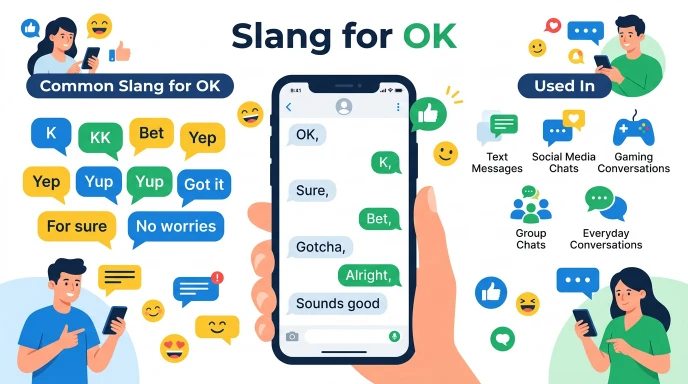
Slang for OK is commonly used in text messages, social media, online gaming, and everyday conversations.
Instead of typing “OK” every time, people often use shorter or trendier expressions like k, kk, bet, aight, cool, or gotcha. These slang words help conversations feel quicker, more casual, and more natural.
if you’re chatting on TikTok, Snapchat, Discord, Instagram, Reddit, or texting a friend, knowing different slang for “OK” can help you understand modern online communication.
However, not every slang term has the same tone. Some sound friendly, while others may seem cold or rude depending on the situation.
Quick Answer: Slang for OK
Slang for OK includes informal words and abbreviations such as k, kk, bet, aight, cool, yup, gotcha, sounds good, and alr, all of which express agreement, understanding, or acceptance in casual conversations.
What Does Slang for OK Mean in Text?
In texting, slang for OK refers to casual words or abbreviations that replace the word “OK.”
People use these expressions to:
- Agree with someone
- Confirm they understand
- Accept a plan
- Show approval
- Keep conversations short and casual
Instead of typing:
“OK, I’ll be there.”
Someone might simply write:
- K
- KK
- Bet
- Alr
- Sounds good
- Cool
All of these generally communicate the same basic idea, but each has its own tone and context.
Slang for OK Definition
Unlike a single slang term, slang for OK includes several popular expressions.
Here are some of the most common ones:
| Slang | Meaning |
| K | Okay |
| KK | Okay, understood |
| Bet | Sounds good / Deal |
| Aight | Alright |
| Alr | Alright |
| Cool | I agree |
| Gotcha | I understand |
| Yup | Yes |
| Sure | I agree |
| Sounds good | That works for me |
These expressions are widely used in casual digital communication.
Most Popular Slang for OK
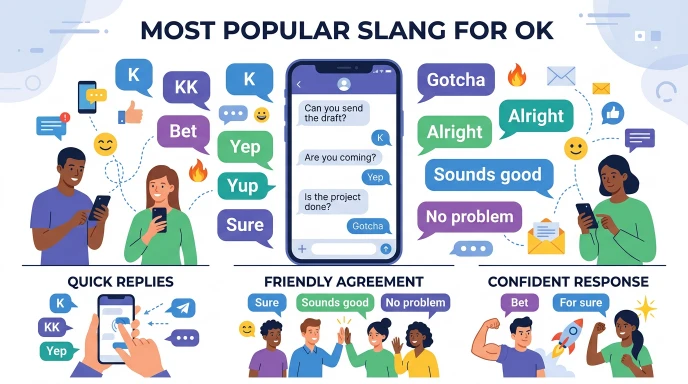
1. K
“K” is probably the shortest way to say OK.
Example:
“Meet at 7?”
“K.”
Although common, it may sound cold if used with close friends.
2. KK
“KK” sounds friendlier than just “K.”
Example:
“Don’t forget your homework.”
“KK!”
This version often feels more cheerful.
3. Bet
“Bet” has become extremely popular among younger users.
Meaning:
- Okay
- Deal
- Sounds good
- I agree
Example:
“Let’s play tonight.”
“Bet.”
4. Aight
“Aight” is a casual version of “Alright.”
Example:
“See you tomorrow.”
“Aight.”
It is commonly heard in everyday speech and online chats.
5. Alr
“Alr” is simply a shortened spelling of “Alright.”
Example:
“I’ll text you later.”
“Alr.”
It saves typing while keeping the meaning clear.
6. Cool
“Cool” often means:
- Okay
- Sounds good
- I agree
Example:
“We’re meeting at noon.”
“Cool.”
7. Gotcha
This expression means:
- I understand.
- Okay.
- I got it.
Example:
“The meeting starts at 9.”
“Gotcha.”
Is Slang for OK Rude, Offensive, or Neutral?
Most slang words for OK are neutral and friendly.
However, the tone changes depending on which word you choose.
| Slang | Tone |
| K | Neutral but can sound cold |
| KK | Friendly |
| Bet | Casual and positive |
| Cool | Friendly |
| Gotcha | Helpful |
| Alr | Neutral |
| Aight | Casual |
| Sounds good | Polite |
For example:
“K.”
can sometimes sound annoyed, especially if it’s the only reply.
Meanwhile,
“KK 😊”
sounds much warmer.
Where Is Slang for OK Commonly Used?
You’ll find these expressions almost everywhere online.
Text Messages
Friends often use:
- K
- KK
- Bet
- Alr
TikTok
Creators reply to comments with:
- Bet
- Cool
- Sounds good
Snapchat
Short replies are common because conversations move quickly.
Examples:
- K
- KK
- Bet
Discord
Gamers frequently use:
- Bet
- Alr
- Gotcha
- Cool
while planning games or responding to teammates.
People often reply to DMs using:
- Sounds good
- Cool
- Bet
- KK
Users occasionally write:
- Gotcha
- Cool
- Alright
- Bet
during discussions.
Origin and Background of Slang for OK
The use of different slang words for OK developed naturally as online communication became faster and more informal. Early internet users started shortening common words to save time while chatting. As texting, instant messaging, and social media grew, people created new ways to express agreement quickly.
Short forms like K and KK became popular because typing fewer letters was faster. Later, younger internet communities introduced expressions like bet and aight, which became common through music, gaming, memes, and social media platforms.
Today, slang for OK changes constantly. New expressions appear as online culture evolves, but the purpose remains the same: showing agreement, understanding, or acceptance in a casual way.
Why People Use Slang for OK
People use different forms of OK because digital conversations are usually quick and informal.
1. Faster Communication
Short slang saves time when texting.
Instead of typing:
“Okay, I understand what you mean.”
Someone may write:
“Gotcha.”
or:
“Alr.”
This makes conversations faster and easier.
2. To Sound More Casual
Using slang can make messages feel more natural between friends.
Example:
Formal:
“Okay, I will attend the event.”
Casual:
“Bet, I’ll be there.”
The second version sounds more relaxed.
3. To Match Online Culture
Social media users often prefer expressions that feel current and relatable.
Words like:
- Bet
- Aight
- Alr
are strongly connected with modern internet communication.
4. To Show Personality
Different versions of OK can show different emotions.
Compare:
“K”
Short and direct.
“Okayyy”
More excited or playful.
“Bet!”
Confident and enthusiastic.
The choice of word can change the feeling of the message.
Impact of Using Slang for OK in Communication
Slang makes conversations easier, but it also requires understanding the situation.
Positive Effects
Creates Friendly Conversations
Casual expressions can make chats feel warmer.
Example:
“Bet, see you there!”
sounds more energetic than:
“OK.”
Makes Messages Shorter
People can communicate quickly without unnecessary words.
Builds Connection
Using familiar slang can make people feel part of the same online community.
Possible Problems
It Can Cause Misunderstanding
Not everyone knows every slang term.
For example:
Someone unfamiliar with:
“Bet”
may not understand that it means agreement.
Some Words Can Sound Unfriendly
A simple:
“K”
may feel rude to some people because it looks like the conversation is being ended.
It May Not Work in Formal Situations
Slang is usually not suitable for:
- Business emails
- Job interviews
- Official documents
- Academic writing
Professional communication usually needs complete words.
Comparison of Popular Slang for OK
| Slang | Meaning | Tone | Common Use |
| K | Okay | Short/direct | Texting |
| KK | Okay, understood | Friendly | Friends |
| Bet | Deal/sounds good | Confident | Social media, texting |
| Alr | Alright | Casual | Chats |
| Aight | Alright | Relaxed | Speech/text |
| Cool | I agree | Friendly | Everyday conversation |
| Gotcha | I understand | Helpful | Conversations |
| Yup | Yes | Casual | Texting |
Slang for OK in Different Situations
The same word can feel different depending on the relationship and context.
With Friends
Friends usually understand casual slang.
Example:
Friend:
“Movie tonight?”
Reply:
“Bet.”
Meaning:
“Sure, I’m in.”
With Family
Some slang may be less common depending on age.
Example:
Parent:
“Remember to call your uncle.”
Reply:
“Gotcha.”
This sounds natural and respectful.
At Work
Some casual words may not sound professional.
Less suitable:
“Bet, I’ll finish it.”
Better:
“Sure, I’ll complete it.”
In Gaming
Slang is extremely common.
Examples:
- “Bet, let’s start.”
- “Alr, joining now.”
- “Gotcha, I’ll defend.”
Gaming communities often use quick responses because speed matters.
Examples of Slang for OK in Real Conversations
Friendly Tone
Friend:
“Want to grab coffee later?”
Reply:
“Sounds good!”
Casual Tone
Friend:
“Send me the link.”
Reply:
“Alr.”
Excited Tone
Friend:
“We won tickets!”
Reply:
“Bet! That’s awesome.”
Neutral Tone
Person:
“I’ll send the details tonight.”
Reply:
“Gotcha.”
Gaming Context
Player 1:
“Meet near the base.”
Player 2:
“Bet.”
Social Media Context
Comment:
“New video tomorrow?”
Reply:
“Bet 🔥”
Meaning:
“Definitely / sounds good.”
When to Avoid Using Slang for OK
Although slang for OK is common and easy to understand online, it is not suitable for every situation. Choosing the right expression depends on your audience and the type of conversation.
1. Professional Communication
Avoid using slang like:
- K
- Bet
- Aight
- Alr
in professional emails or workplace messages.
Example:
❌ “Bet, I’ll send the report.”
This may sound too casual.
Better:
✅ “Sure, I’ll send the report.”
2. Formal Writing
Slang should not be used in:
- School assignments
- Research papers
- Official letters
- Business documents
These situations require clear and standard English.
3. When Talking to Someone You Don’t Know Well
If you are unsure how someone communicates, use simple words like:
- Okay
- Sure
- Understood
- Sounds good
This avoids confusion.
Polite Alternatives to Slang for OK
Sometimes you may want to sound respectful or professional. Here are better alternatives:
| Casual Slang | Polite Alternative |
| K | Okay |
| Bet | Sounds good |
| Alr | Alright |
| Aight | Sure |
| Cool | That works |
| Gotcha | I understand |
| Yup | Yes |
Examples:
Instead of:
“Bet, I’ll join.”
Use:
“Sounds good, I’ll join.”
Instead of:
“K, thanks.”
Use:
“Okay, thank you.”
Is Slang for OK Safe for Social Media?
Yes, most slang expressions for OK are safe for social media.
They are commonly used on:
- TikTok
- Snapchat
- Discord
- X (Twitter)
- YouTube
These expressions are normal parts of casual online communication.
However, users should remember that tone is difficult to understand through text alone.
For example:
“K”
could mean:
- Okay
- I’m busy
- I’m annoyed
The meaning depends on the conversation.
Popular Slang for OK on Social Media
Bet
One of the most popular modern alternatives.
Meaning:
- Yes
- Definitely
- Deal
- Sounds good
Example:
“Want to play later?”
“Bet.”
Alr
A shortened form of “alright.”
Example:
“I’ll send it soon.”
“Alr.”
It is common among younger users because it is quick to type.
Kk
A friendlier version of “K.”
Example:
“Don’t forget the meeting.”
“Kk, thanks.”
Yup
A casual version of “yes.”
Example:
“Are you coming?”
“Yup.”
Cool
Shows agreement or approval.
Example:
“We’ll meet at 5.”
“Cool.”
Different Tones of Slang for OK
The same meaning can have different emotional tones.
Friendly
Examples:
- “Sounds good!”
- “Gotcha 😊”
- “KK!”
These feel warm and positive.
Casual
Examples:
- “Alr.”
- “Cool.”
- “Yup.”
These are normal everyday replies.
Excited
Examples:
- “Bet!”
- “For sure!”
- “Absolutely!”
These show more energy.
Cold or Short
Example:
- “K.”
Although it means OK, it can sometimes feel like the person is uninterested.
Examples Showing Different Meanings
Example 1: Agreement
Person A:
“Let’s meet after class.”
Person B:
“Sounds good.”
Meaning:
“I agree with this plan.”
Example 2: Understanding
Person A:
“The password is in the email.”
Person B:
“Gotcha.”
Meaning:
“I understand.”
Example 3: Excitement
Person A:
“We’re going on a trip next week.”
Person B:
“Bet!”
Meaning:
“Great, I’m excited.”
Example 4: Quick Reply
Person A:
“I sent the file.”
Person B:
“Alr.”
Meaning:
“Okay, received.”
Related Internet Expressions Similar to OK
Modern communication includes many words that have a similar purpose.
| Expression | Meaning |
| Sure | Agreement |
| Sounds good | Acceptance |
| No worries | It’s okay |
| Got it | Understanding |
| For sure | Strong agreement |
| Definitely | Clear yes |
| Fine | Acceptance |
Each expression has a slightly different feeling.
How Slang for OK Changes by Age Group
Different generations may prefer different expressions.
Younger Users
Often use:
- Bet
- Alr
- Kk
- Aight
These are common in gaming and social media.
Older Users
May prefer:
- Okay
- Sure
- Sounds good
- Got it
These are more traditional and widely understood.
Professional Users
Usually choose:
- Confirmed
- Understood
- I agree
- That works
The best choice depends on the situation.
Frequently Asked Questions
Q1:What is the meaning of slang for OK?
Slang for OK refers to informal words, abbreviations, and expressions that people use instead of saying “OK.” Common examples include k, kk, bet, alr, aight, cool, yup, and gotcha.
These expressions usually show agreement, understanding, or acceptance in casual conversations.
Q2:What is the most popular slang for OK?
Some of the most popular slang words for OK are:
- Bet means “sounds good” or “deal.”
- Kk a friendly version of okay.
- Alr short for alright.
- Gotcha means “I understand.”
- Cool means “that works.”
The popularity of each term depends on the platform and community.
Q3:Is “K” rude in texting?
“K” is not always rude, but it can sometimes feel cold or unfriendly.
For example:
Friend:
“Are we still meeting tonight?”
Reply:
“K.”
This may sound like the person is annoyed or not interested.
A warmer reply would be:
- “Okay!”
- “Kk 😊”
- “Sounds good.”
Q4:What does “Bet” mean when someone says OK?
In slang, bet means:
- Okay
- Sure
- Deal
- I agree
- Sounds good
Example:
Person A:
“Let’s play after dinner.”
Person B:
“Bet.”
Meaning:
“Sure, let’s do it.”
Q5:Is slang for OK appropriate in professional conversations?
Usually, no.
Words like:
- Bet
- K
- Aight
- Alr
are better for casual chats.
In professional situations, use:
- Okay
- Sure
- Understood
- Confirmed
- Sounds good
These sound clearer and more respectful.
Q6:Where is slang for OK commonly used?
Slang for OK is common in:
- Text messages
- TikTok comments
- Instagram DMs
- Snapchat chats
- Discord conversations
- Gaming communities
- Online forums like Reddit
It is especially popular among people who communicate quickly online.
Key Takeaways
- Slang for OK includes many casual alternatives to the word “OK.”
- Popular examples include k, kk, bet, alr, aight, cool, yup, and gotcha.
- Different slang words create different tones.
- Some sound friendly, while others may seem short or cold.
- These expressions are common on social media and texting platforms.
- Slang works best in casual conversations, not formal writing.
- Always consider your audience before using informal expressions.
Conclusion:
Understanding slang for OK helps you communicate better in modern online conversations. While the word OK is simple and universal, people now use many creative alternatives to express agreement, understanding, or acceptance. Words like bet, kk, alr, aight, cool, and gotcha are common in texting, social media, gaming, and casual chats.
Each expression has its own tone. For example, bet sounds confident and enthusiastic, while k may feel short or distant depending on the situation. Choosing the right slang helps your messages match the mood and relationship.
Although these expressions are useful for casual communication, they should be avoided in formal settings like work emails, academic writing, and official documents. When you understand the meaning and context behind each term, you can use slang for OK naturally and effectively in everyday conversations.