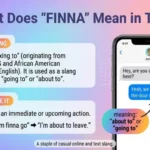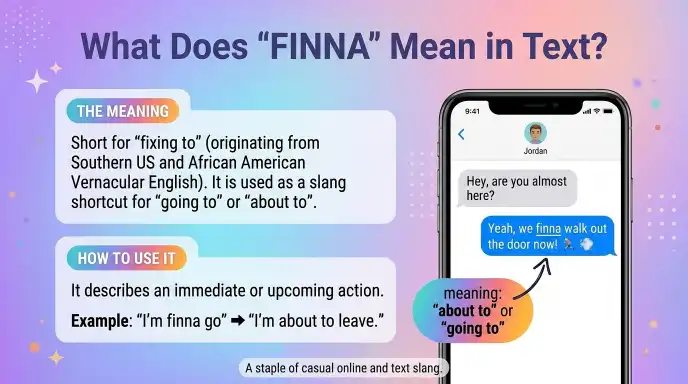
Finna is an informal slang word used in text messages that means “going to” or “about to.” It is a casual way to say someone is preparing to do something, such as “I’m finna leave.”
You may see finna in TikTok comments, Snapchat messages, Instagram captions, WhatsApp chats, and text conversations. People often use it when talking about plans, reactions, or something they are ready to do.
The word is especially associated with African American English (AAE) and Southern American English. It has also become familiar to many people through music, online conversations, and popular culture.
If someone texts you “I’m finna call you,” they are saying they are about to call. This guide explains the meaning, cultural background, social media use, and natural ways to reply.
Finna Meaning in Text
Finna means “fixing to,” “about to,” or “going to do something soon.” It is an informal expression that shows someone intends to take an action in the near future.
For example:
“I’m finna eat.”
This means:
“I’m about to eat.”
Another example is:
“We finna go home.”
This means:
“We are going to go home soon.”
In everyday messages, finna often makes a sentence sound relaxed and conversational. It can express a plan, an upcoming action, or a decision someone has already made.
Is Finna Slang or an Abbreviation?
Finna is commonly described as slang, but it is more accurately understood as a spoken-language form with a grammatical role in African American English and related varieties of English.
It is not an acronym. It does not stand for a group of separate words like IDK or BRB.
Instead, finna developed from the phrase “fixing to.” Over time, the expression became shortened in speech.
You may also see related spellings such as:
- Finna: The most familiar written form.
- Fitna: An alternative spelling that reflects pronunciation.
- Finta: Another less common variant.
- Fixing to: The longer expression from which finna developed.
These forms are related, although their use can vary by speaker and region.
What Does Finna Mean in Everyday Conversation?
People use finna when they want to say they are preparing to do something or intend to do it soon.
Here are a few simple examples:
- “I’m finna sleep.” : I’m about to go to sleep.
- “She finna get here.” : She is about to arrive.
- “We finna watch a movie.” : We are going to watch a movie soon.
- “I’m finna text him.” : I’m about to send him a message.
- “They finna start the game.” : They are about to begin the game.
The word usually points toward an action that is expected soon, rather than a distant plan with no immediate timing.
Finna vs. Gonna vs. Bouta
Finna is similar to other informal expressions, but the words are not always interchangeable.
| Word | Meaning | Typical use |
| Finna | About to; fixing to | Expressing an intended or near-future action |
| Gonna | Going to | Talking about future plans or actions |
| Bouta | About to | Describing something that is about to happen |
| Wanna | Want to | Expressing a desire |
For example:
- “I’m finna leave.” : I’m about to leave.
- “I’m gonna visit tomorrow.” : I plan to visit tomorrow.
- “I’m bouta eat.” : I’m about to eat.
- “I wanna eat.” : I want to eat.
Finna and gonna are close in meaning, but they do not always carry exactly the same timing or grammatical use. Finna often suggests an action that is imminent.
Where People Use Finna
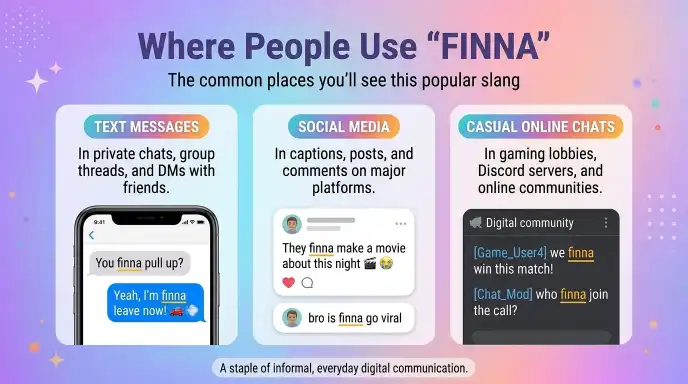
Finna appears in informal conversations, online comments, music-related discussions, and social media posts. Its meaning generally stays connected to an upcoming action.
The platform does not give it a different official definition. However, the way people use it can depend on the conversation.
Finna on TikTok
TikTok videos and comments often include informal language, short reactions, and expressions borrowed from everyday speech. Finna may appear when someone talks about an upcoming event, a reaction, or something they plan to do.
Example:
“I’m finna try this dance challenge 😂”
Meaning: The person is about to try the dance challenge.
You may also see comments such as:
- “This song finna be everywhere.” : This song is likely to become very popular.
- “I’m finna watch the whole series.” : I’m about to watch the entire series.
- “We finna have a good time.” : We are going to enjoy ourselves.
On TikTok, the word can make a comment sound relaxed and expressive. Its meaning still depends on the sentence around it.
Finna on Snapchat
Snapchat messages are often short and casual. Friends may use finna when sharing what they are doing or explaining their next move.
Example:
A: What are you doing tonight?
B: I’m finna get some food.
A: Save me something!
Meaning: B is about to get food or plans to do so soon.
Other possible messages include:
- “I’m finna head out.” : I’m about to leave.
- “You finna come over?” : Are you going to come over?
- “I’m finna call you later.” : I’m planning to call you soon.
The word fits naturally into informal conversations, especially between people who already understand its meaning.
Finna on Instagram
Instagram users may use finna in captions, comments, Reels, and direct messages. It can help express excitement, plans, or an upcoming action.
Example:
“I’m finna have the best weekend!”
Meaning: The person expects to enjoy the weekend.
You might also see:
“This outfit finna be my favorite.”
This means the person thinks the outfit is about to become their favorite.
In direct messages, the meaning is usually straightforward:
“I’m finna send you the pictures.”
The sender is saying they are about to send the pictures.
Finna on WhatsApp
WhatsApp conversations often involve everyday plans, family updates, and quick messages. Finna may appear when someone tells another person what they are about to do.
Example:
A: Are you still at home?
B: No, I’m finna leave now.
A: Okay, I’ll wait for you.
Meaning: B is getting ready to leave.
Other examples include:
- “I’m finna cook dinner.” – I’m about to prepare dinner.
- “We finna reach in ten minutes.” – We are about to arrive soon.
- “I’m finna take a nap.” – I’m about to sleep for a while.
The expression is informal, so it is more suitable for relaxed chats than formal messages.
Finna in SMS Text Messages
Finna can also appear in ordinary text messages. Someone may use it to communicate an immediate plan without writing a longer sentence.
Example:
A: Did you finish your work?
B: Almost. I’m finna submit it.
A: Great, let me know when it’s done.
Meaning: B is about to submit the work.
Even without social media, the word can make sense in a regular conversation. If the receiver is unfamiliar with it, the sender can simply explain that it means “about to” or “going to.”
Real Chat Examples: How Finna Is Used
The following conversations show how people might use finna in everyday situations. Each example includes a simple explanation so beginners can understand the intended meaning.
Example 1: Getting Ready to Leave
A: Are you still coming to the party?
B: Yes, I’m finna leave now.
A: Perfect! See you soon.
Meaning: B is saying they are about to leave and head toward the party.
Example 2: Talking About Food
A: Have you eaten anything today?
B: Not yet. I’m finna make some lunch.
A: Make something for me too!
Meaning: B is about to prepare lunch.
Example 3: Making Weekend Plans
A: What are you doing this weekend?
B: We finna visit my cousins.
A: That sounds fun!
Meaning: B and their group plan to visit their cousins.
Example 4: Sending a Message
A: Did you talk to Sarah?
B: Not yet. I’m finna text her.
A: Okay, tell her I said hi.
Meaning: B is about to send Sarah a text message.
Example 5: Watching a Movie
A: Have you seen the new movie?
B: No, but I’m finna watch it tonight.
A: You’re going to love it!
Meaning: B plans to watch the movie soon.
Example 6: Showing Excitement
A: Are you ready for the concert?
B: I’m finna have the best night ever!
A: I hope you do!
Meaning: B is expressing excitement about the fun they expect to have.
Example 7: Starting a Game
A: Is everyone online?
B: Yes, we finna start the game.
A: Wait for me!
Meaning: The group is about to begin playing.
Example 8: Expressing Frustration
A: He keeps sending you those messages?
B: Yes, I’m finna block him.
A: If he’s bothering you, that’s probably best.
Meaning: B is saying they are about to block someone.
Example 9: Making a Phone Call
A: Can you call me when you’re free?
B: Sure, I’m finna call you in a minute.
A: Okay, thanks!
Meaning: B intends to make the call very soon.
Example 10: Talking About the Weather
A: Do you think it’s going to rain?
B: Look at those clouds. It finna rain.
A: We should get inside!
Meaning: The speaker expects rain to start soon. This is an informal example of the expression.
Notice how the meaning stays similar in every conversation. Finna points toward an action that someone intends to take or expects to happen soon.
How to Reply When Someone Says Finna
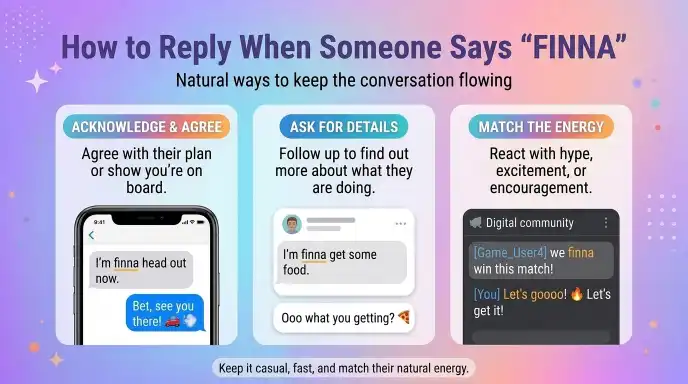
Your response depends on what the sender plans to do. You can answer naturally without repeating the word.
Here are some useful replies for different situations.
Funny Replies
If a friend uses finna while talking about a fun plan, you can respond with a little humor.
- “Okay, but don’t forget to invite me!”
- “You’re always finna do something 😂”
- “Let’s see if you actually do it!”
- “I’m finna join you!”
- “Sounds like a plan. Let’s make it happen!”
These replies work best when the conversation is relaxed and playful.
Casual Replies
For ordinary chats, short responses are often enough.
- “Okay, sounds good.”
- “Alright, see you soon.”
- “Cool, let me know.”
- “Got it!”
- “No problem.”
For example:
A: I’m finna head home.
B: Okay, drive safely!
Friendly Replies
When someone shares an exciting plan, a warm response can keep the conversation going.
- “Have fun!”
- “That sounds exciting!”
- “Hope everything goes well.”
- “Enjoy your time!”
- “Can’t wait to hear about it.”
For example:
A: We finna go on vacation next week.
B: That’s amazing! Have a wonderful trip.
Neutral Replies
Sometimes you may understand the word but want to confirm the person’s plan.
- “Do you mean you’re going now?”
- “When are you planning to go?”
- “Are you about to do it?”
- “Okay, let me know when you’re ready.”
A simple question is useful when the timing is unclear. Finna usually suggests the near future, but the exact time still depends on the conversation.
Is Finna Rude or Offensive?
No, finna is not inherently rude or offensive. It is an informal expression that communicates an upcoming action or intention.
However, the sentence containing it can still sound rude, friendly, funny, or serious. The tone comes from the full message, not the word alone.
For example:
“I’m finna help you with that.”
This sounds helpful.
But:
“I’m finna tell you something you won’t like.”
This may sound serious or confrontational.
The word itself does not make either message offensive.
Is Finna Safe to Use?
Finna is generally harmless in casual conversations. It does not contain profanity or an insulting meaning.
You can understand it as a way of saying “about to” or “getting ready to.”
Still, it is important to understand its cultural background. Finna is strongly associated with African American English and Southern American English. It is a meaningful part of these language varieties, not simply a random internet spelling.
People should avoid mocking the word or using exaggerated imitations of the speech communities associated with it.
Is Finna Appropriate at School?
Finna is not a swear word, but it is informal.
You may see it in messages between friends or in casual conversations. However, school assignments, essays, and formal classroom writing usually require standard academic language.
For example:
Informal:
“I’m finna finish my homework.”
More suitable for school writing:
“I’m about to finish my homework.”
Both communicate a similar idea, but the second is more appropriate for formal work.
Is Finna Appropriate at Work?
It depends on the workplace and the communication style.
In a friendly team chat, colleagues may understand the expression. However, formal emails, reports, and professional documents are usually clearer with phrases such as “I’m about to,” “I plan to,” or “I am going to.”
For example:
Informal:
“I’m finna send the report.”
Professional:
“I’m about to send the report.”
The main difference is formality, not politeness. Finna is an informal language form, so choose wording that suits your audience.
Who Uses Finna?
Finna is used by people familiar with African American English, Southern American English, and informal online communication. It is also recognized more widely through music, entertainment, and social media.
However, it is important not to describe it as a word created by Gen Z. Its history goes back much further than today’s social platforms.
Do Gen Z Users Say Finna?
Many younger internet users recognize finna and may use it in casual messages, comments, and conversations.
For example:
- “I’m finna go out.”
- “This game finna be intense.”
- “We finna win this match.”
These examples show how the word can express plans or expectations.
Still, finna is not exclusively a Gen Z language. It has a longer history in spoken English varieties, particularly African American English.
Do Millennials and Adults Use Finna?
Adults may use finna in everyday speech, family conversations, music-related discussions, and informal online communication.
Its use is not limited to teenagers or young adults.
Someone might write:
“I’m finna pick up the kids.”
This simply means they are about to collect the children.
The speaker’s age does not change the basic meaning.
Where Is Finna Commonly Seen?
You may encounter the word in several online spaces:
- TikTok: In video captions, comments, and casual reactions.
- Instagram: In captions, Reels, and direct messages.
- Snapchat: In quick messages between friends.
- WhatsApp: In everyday chats and group conversations.
- Text messages: When someone shares an upcoming action.
- Music and entertainment: In lyrics, interviews, and informal dialogue.
Is Finna Popular Online?
Finna is a recognized informal expression, but its exact frequency varies by community and platform. There is no need to assume that every social media user uses it.
Its visibility has been influenced by music, online culture, and the wider recognition of African American English expressions.
Finna is more than a passing internet trend. It has a linguistic history and a continuing role in everyday speech.
Origin of Finna
Finna developed from the expression “fixing to,” which has a long history in Southern American English.
The phrase fixing to can mean preparing to do something, intending to do it, or getting ready for an action.
Over time, spoken pronunciation shortened the phrase into forms such as finna.
Connection to African American English
Finna is strongly associated with African American English (AAE), a rule-governed variety of English with its own grammatical patterns, pronunciation, and vocabulary.
It is also connected to Southern American speech.
The word is not simply a misspelling of “going to.” It developed through a recognizable pattern of language change and has a specific role in expressing the near future.
The Yale Grammatical Diversity Project discusses the relationship between fixing to and finna, including how the expression is used in Southern speech and African American English.
Did Finna Come From Hip-Hop?
Hip-hop helped make finna more familiar to wider audiences. The expression appears in hip-hop lyrics and other forms of popular culture.
Dictionary.com notes examples in late-1980s hip-hop, while later music and online communities helped spread recognition of the word.
However, hip-hop did not create the expression from nothing. Its roots are connected to earlier Southern speech and African American English.
Did Finna Originate on TikTok?
No. Finna existed long before TikTok and modern social media platforms.
TikTok may help people discover or share the word, but it is not the source of its historical development.
The expression was already part of spoken language and popular music before today’s social media apps became widespread.
Why Does Finna Have Cultural Importance?
Language carries more than a dictionary definition. It can reflect community history, identity, creativity, and shared experiences.
Finna is one example of how a language form from a particular speech community can become familiar to a wider audience.
It is important to recognize that African American English is a legitimate language variety with its own structure.
Finna Compared With IDK, IDC, IMO, and BRB
Finna is different from common texting abbreviations such as IDK, IDC, IMO, and BRB. While those expressions shorten longer phrases, finna is a word that developed from spoken language.
| Term | Meaning | Type | Usage | Popularity |
| Finna | About to; fixing to | Informal word and future marker | Expressing an upcoming action | Recognized in informal speech and online |
| IDK | I Don’t Know | Initialism | Showing uncertainty | Widely recognized |
| IDC | I Don’t Care | Initialism | Expressing indifference | Widely recognized |
| IMO | In My Opinion | Initialism | Sharing a personal opinion | Widely recognized |
| BRB | Be Right Back | Initialism | Temporarily leaving a chat | Widely recognized |
Finna vs. IDK
IDK means “I Don’t Know.” People use it when they are unsure about something or do not have an answer.
Example:
“IDK what time the movie starts.”
Finna has a different purpose. It expresses an upcoming action.
“I’m finna watch the movie.”
This means the person is about to watch it.
Finna vs. IDC
IDC means “I Don’t Care.” It communicates a lack of interest or concern about a particular choice or situation.
Example:
“IDC which restaurant we choose.”
Finna does not express indifference. It tells someone that an action is planned or about to happen.
Finna vs. IMO
IMO means “In My Opinion.” People use it when sharing a personal viewpoint.
Example:
“IMO, this is the best song.”
Finna does not introduce an opinion. It indicates an upcoming action.
Finna vs. BRB
BRB means “Be Right Back.” It tells someone that the sender is temporarily leaving the conversation.
Example:
“BRB, I need to answer the door.”
Finna is not a message about leaving a chat. It is used before an action someone intends to take.
Real-World Usage Example
Imagine that two friends, Jordan and Alex, are chatting on a Friday evening.
Jordan wants to go out for dinner but has not decided where to eat.
Jordan: What are you doing tonight?
Alex: I’m finna get ready and go out.
Jordan: Nice! Are you going with your friends?
Alex: Yes, we’re finna try that new restaurant downtown.
Jordan: Sounds good. Let me know how the food is!
In this conversation, Alex uses finna twice.
The first time, “I’m finna get ready” means Alex is about to prepare to go out.
The second time, “we’re finna try that new restaurant” means the group plans to visit the restaurant soon.
Now imagine a different message:
“I’m finna call you after dinner.”
This means the person intends to call after eating.
These examples show that finna can fit many everyday situations. It may describe leaving, eating, calling, studying, meeting friends, or starting an activity.
The main idea stays the same: someone is preparing to do something or expects an action to happen soon.
Frequently Asked Questions
1. What does finna mean in text messages?
Finna means “about to” or “going to.” It comes from the phrase “fixing to” and is used when someone intends to do something soon. For example, “I’m finna leave” means “I’m about to leave.”
2. What does finna mean on TikTok?
On TikTok, finna usually means “about to” or “going to.” People may use it in comments and captions to talk about plans, reactions, or upcoming actions.
3. Is finna slang?
Finna is often called slang, but it is also a recognized language form associated with African American English and Southern American English. It developed from “fixing to” and has a grammatical role in expressing the near future.
4. Is finna rude or offensive?
No, finna is not inherently rude or offensive. It is an informal expression. However, the rest of the sentence can still sound rude depending on its meaning and tone.
5. How should you reply to finna?
Reply according to the situation. You can say “Okay, sounds good,” “Have fun,” or “Let me know when you’re ready.” If the timing is unclear, ask what the person plans to do.
Conclusion:
Finna means “about to,” “fixing to,” or “going to do something soon.” It is an informal expression with roots in Southern American English and a strong connection to African American English.
You may see it in TikTok comments, Instagram captions, Snapchat messages, WhatsApp chats, and everyday text conversations. People use it to talk about upcoming actions, plans, and things they intend to do.
Finna is not generally offensive, but it is informal. It works best in relaxed conversations rather than formal emails, school assignments, or professional documents.
Remember its basic meaning: when someone says “I’m gonna do something,” they mean they are about to do it. Once you understand that, the word becomes much easier to recognize in everyday online conversations.
I’m Emily Carter, and I enjoy writing about slang, internet language, and modern English expressions. My goal is to explain word meanings in a simple, clear, and easy-to-understand way so anyone can learn with confidence.