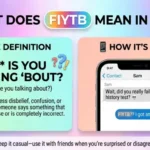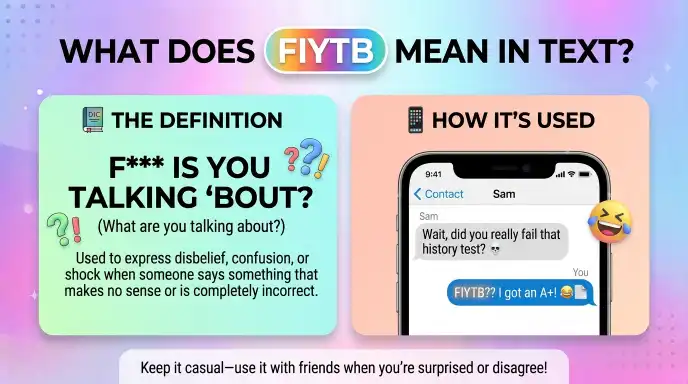
FIYTB meaning in text is “F* is you talkin’ ’bout?”** This informal slang phrase expresses confusion, disbelief, or disagreement, similar to asking, “What are you talking about?”
You may see FIYTB in text messages, TikTok comments, Snapchat chats, Instagram replies, or online group conversations. People often use it when a statement sounds confusing, unbelievable, surprising, or completely wrong.
The abbreviation has a strong tone because it includes profanity. Depending on the situation, it can express playful disbelief between friends or genuine irritation during an argument.
If someone sends you FIYTB, the best response depends on your relationship and the message they are reacting to. Let’s look at its meaning, examples, social media use, and suitable replies.
FIYTB Meaning in Text
FIYTB stands for “F* Are you talkin’ ’bout?”** It is a slang expression that questions what another person is saying. A more familiar way to understand it is “What are you talking about?”, but with a much stronger and more aggressive tone.
People may type it when they disagree with someone, feel surprised by a statement, or think a message makes no sense.
For example:
A: Bro, I heard you bought a new car yesterday.
B: FIYTB? I haven’t even passed my driving test.
Here, B is questioning the statement because it is not true.
What Does Each Letter in FIYTB Stand For?
The abbreviation is formed from the first letters of a spoken phrase:
- F : F***
- I : Is
- Y : You
- T : Talkin’
- B : ‘Bout
Together, the letters create “F* Are you talkin’ ’bout?”**
The expression uses informal spoken English. The word talkin’ is a casual form of talking, while ’bout is a shortened form of about.
FIYTB is an initialism used as internet slang. It is not a polite or formal abbreviation, and its meaning may not be familiar to everyone.
What Does FIYTB Express?
The sender’s intention usually falls into a few common situations.
1. Confusion: Someone says something unclear, and the receiver wants an explanation.
2. Disbelief: A person hears something that seems impossible or hard to believe.
3. Disagreement: The sender strongly questions another person’s statement.
4. Annoyance: Someone feels irritated and wants to challenge what was said.
5. Playful teasing: Close friends may use it jokingly when one person says something ridiculous.
The tone matters. A friend might send FIYTB with a laughing emoji, while someone in an argument may use the same letters to sound angry.
FIYTB vs. FYTB: Are They the Same?
You may also see FYTB without the letter I. These forms are closely related and can express a similar reaction.
Both are associated with the phrase “F* you talkin’ ’bout?”** or a closely related variation of it. FIYTB may appear as “F* Are you talkin’ ’bout?”**
The wording can vary because this slang comes from informal spoken language. It is not a standardized English phrase with one fixed spelling.
The main idea is the same: the sender is challenging or questioning something someone has said.
Where People Use FIYTB
This abbreviation may appear in different online conversations. Its basic meaning stays similar, but the tone depends on the platform, the people involved, and the surrounding message.
FIYTB on TikTok
TikTok comments often contain short reactions to videos, jokes, opinions, and unexpected moments. Someone may type FIYTB when a video or comment makes a surprising claim.
Example:
Comment: You really think that outfit looks better than the original one?
Reply: FIYTB 😂
Meaning: The person is showing disbelief or challenging the opinion.
Among friends, this can be playful. However, if someone uses it against a stranger, it may sound rude or argumentative.
FIYTB on Snapchat
Snapchat conversations are often quick and informal. Friends may use FIYTB when reacting to surprising news or questioning a message.
Example:
A: I told everyone you were moving to another country.
B: FIYTB? Who told you that?
A: I thought you mentioned it yesterday.
Meaning: B is shocked and wants to know where the information came from.
The expression can make a reaction sound stronger than simply asking, “What do you mean?”
FIYTB on Instagram
Instagram users may use this abbreviation in direct messages, comment sections, or replies to Stories.
For example:
“You said that was my account? FIYTB 😂”
The sender is questioning the claim and may be joking about the misunderstanding.
In a heated comment section, however, FIYTB can sound confrontational. It is not necessarily friendly just because it appears on a social media platform.
FIYTB on WhatsApp
WhatsApp users may send FIYTB in private chats or group conversations. It can be a quick way to challenge a surprising message.
Example:
A: I heard you are getting married next week.
B: FIYTB 😭 Who started that rumor?
A: Someone in the group said it.
Meaning: B is surprised and questions the rumor.
In a close friendship, the message may be humorous. With someone you do not know well, it can come across as disrespectful.
FIYTB in SMS Text Messages
FIYTB can also appear in ordinary text messages. Since SMS conversations may not include emojis or extra context, the tone can be harder to understand.
Example:
A: Your manager said you were absent yesterday.
B: FIYTB? I was at work all day.
Meaning: B strongly questions the statement because it does not match what happened.
If you receive this abbreviation in an SMS, consider the full conversation before deciding if the sender is joking or upset.
Real Chat Examples: How FIYTB Is Used
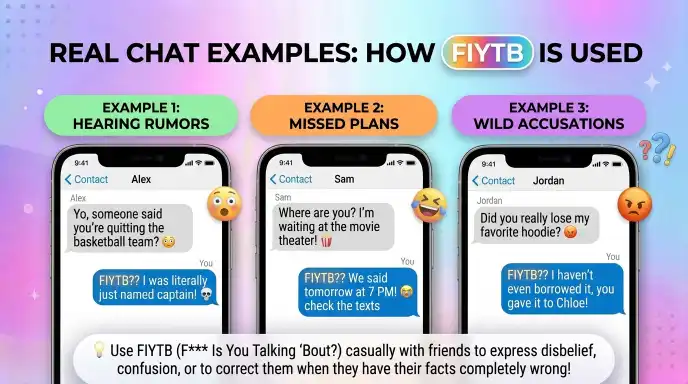
These examples show different ways the abbreviation might appear in informal conversations. They are illustrative situations, not a claim that everyone uses FIYTB in exactly the same way.
Example 1: Reacting to a Rumor
A: Someone told me you are leaving the city.
B: FIYTB? I’m not going anywhere.
A: Maybe they got the wrong information.
Meaning: B is questioning the rumor and expressing disbelief.
Example 2: A Surprising Claim
A: That little restaurant makes the best pizza in the country.
B: FIYTB 😂 Have you tried the place downtown?
A: Not yet, but I heard it’s good.
Meaning: B playfully challenges the opinion.
Example 3: Questioning a Friend
A: You said you finished the whole project in one hour.
B: FIYTB? It took me three days.
A: I was just checking!
Meaning: B is surprised because the statement is incorrect.
Example 4: During an Argument
A: You never help anyone in this group.
B: FIYTB? I helped everyone last week.
A: Okay, let’s not argue.
Meaning: B strongly disagrees and challenges the accusation.
Example 5: Reacting to Unexpected News
A: Our favorite singer is coming to town tomorrow.
B: FIYTB!! Seriously?
A: Yes, I just saw the announcement.
Meaning: B is expressing excitement and disbelief. The strong wording is being used as an emotional reaction.
Example 6: A Funny Conversation
A: I can beat you at basketball with my eyes closed.
B: FIYTB 😭 You missed every shot yesterday.
A: That was just practice.
Meaning: B is teasing the friend for making an exaggerated claim.
Example 7: Correcting Wrong Information
A: Your brother told me you sold your phone.
B: FIYTB? I still have it.
A: Oh, I must have misunderstood him.
Meaning: B questions the information and corrects the misunderstanding.
Example 8: A Group Chat Reaction
A: Guys, I think our teacher forgot about tomorrow’s test.
B: FIYTB 😂 We literally discussed it today.
A: I was hoping nobody remembered.
Meaning: B reacts with disbelief because the test was already discussed.
Example 9: Responding to an Unbelievable Story
A: My dog opened the fridge and took his own food.
B: FIYTB 😂 I need to see that happen.
A: I have it on video!
Meaning: B is surprised and wants proof of the funny story.
Example 10: Asking Someone to Explain
A: I think you should cancel the whole plan.
B: FIYTB? Why would I do that?
A: Let me explain what happened first.
Meaning: B questions the suggestion and asks for a reason.
How to Reply When Someone Says FIYTB
Your reply should match the sender’s tone. If a friend is joking, you can respond playfully. If the person sounds annoyed, a calm answer may prevent an unnecessary argument.
Here are some useful response ideas.
Funny Replies
Use these when you are chatting with close friends and know they will understand your humor.
- “Relax, detective. I’m just telling you!”
- “You heard me the first time 😂”
- “Don’t make me repeat the whole story!”
- “I said what I said!”
- “Someone woke up dramatically today.”
These replies keep the conversation light. Avoid joking if the other person seems genuinely angry.
Casual Replies
If the message is not serious, you can answer without matching its strong language.
- “I’m just saying what I heard.”
- “That’s what happened.”
- “Wait, let me explain.”
- “I was talking about the other plan.”
- “You misunderstood me.”
A simple response can clear up confusion without making the conversation more heated.
Friendly Replies
When someone seems confused or surprised, a friendly response can help.
- “Haha, I didn’t mean it that way.”
- “Let me explain what I meant.”
- “No worries, I was only joking.”
- “I think there’s been a misunderstanding.”
- “It’s not that serious. Hear me out!”
These replies work well when you want to keep a friendship comfortable.
Neutral Replies
If you do not want to use profanity or continue an argument, choose a calm response.
- “What part do you disagree with?”
- “Can I explain what I meant?”
- “I think you misunderstood my message.”
- “Let’s keep the conversation respectful.”
- “Could you clarify what you mean?”
You do not have to respond with the same slang. A clear and respectful answer is often more effective.
Is FIYTB Rude or Offensive?
FIYTB can sound rude or offensive because it contains profanity. It is a strong way of questioning someone, especially when used during a disagreement.
However, the intention matters. Close friends may use it jokingly, while strangers or colleagues may interpret it as an insult.
When Is FIYTB Harmless?
It may be received as playful teasing when:
- You are talking with close friends.
- Everyone understands the joking tone.
- The conversation is relaxed.
- The sender and receiver are comfortable with informal language.
- The message is not intended to attack anyone.
For example:
A: I can eat ten burgers in one sitting.
B: FIYTB 😂 Prove it!
Here, the abbreviation is being used as a playful challenge.
When Can FIYTB Be Offensive?
It may sound disrespectful when someone uses it to:
- Challenge another person’s honesty.
- Mock someone’s opinion.
- Respond aggressively to a question.
- Start or continue an argument.
- Insult someone in a public comment section.
For example:
“FIYTB? Stop making things up.”
This message sounds confrontational. It may make the other person feel attacked.
Is FIYTB Safe to Use at School?
It is better to avoid FIYTB in school-related conversations. The expression contains profanity and may be considered inappropriate by teachers, classmates, or school staff.
If you disagree with someone, you can use a more suitable phrase:
- “What do you mean?”
- “I don’t think that’s correct.”
- “Can you explain that?”
- “I disagree with your statement.”
These alternatives communicate the same basic question without offensive language.
Is FIYTB Appropriate at Work?
FIYTB is generally unsuitable for professional communication. It may sound aggressive in an email, workplace group chat, or message to a manager.
Instead of writing:
“FIYTB? That’s not what happened.”
Try:
“I think there may be a misunderstanding. Let me clarify what happened.”
The second message is more professional and helps keep the discussion productive.
Who Uses FIYTB?
FIYTB is associated with informal online slang and may appear in conversations where people use strong, expressive language. However, there is no reliable public data showing exactly how many people use it or which age group uses it most.
It is better to describe it as niche, informal slang rather than claim that it is universally popular.
Do Gen Z Users Say FIYTB?
Some younger internet users may encounter FIYTB in casual chats, comments, or online communities. It fits the style of short reaction-based expressions often found in informal digital conversations.
Still, that does not mean every Gen Z user knows or uses it. Slang varies widely between friend groups, regions, and online communities.
FIYTB is not a term you should assume everyone understands.
Do Adults Use FIYTB?
Adults who participate in informal online conversations may also come across the abbreviation. However, many people prefer clearer language, especially in professional or family settings.
Someone may recognize the phrase without choosing to use it themselves.
Where Might You See It?
You may encounter FIYTB in:
- Private messages: Friends questioning something surprising.
- TikTok comments: Reactions to videos or unusual claims.
- Snapchat chats: Quick conversations between friends.
- Instagram replies: Responses to comments or Stories.
- Group chats: Jokes, disagreements, and playful challenges.
- Online communities: Informal conversations using regional or community-specific slang.
Is FIYTB a Popular Texting Abbreviation?
FIYTB appears in user-submitted slang references and informal online discussions. However, those examples do not prove that it is widely used across all social media platforms.
It is not as universally recognized as abbreviations such as LOL, IDK, or BRB.
The safest description is that FIYTB is an informal expression that some online users recognize, but its use is not universal.
Origin of FIYTB
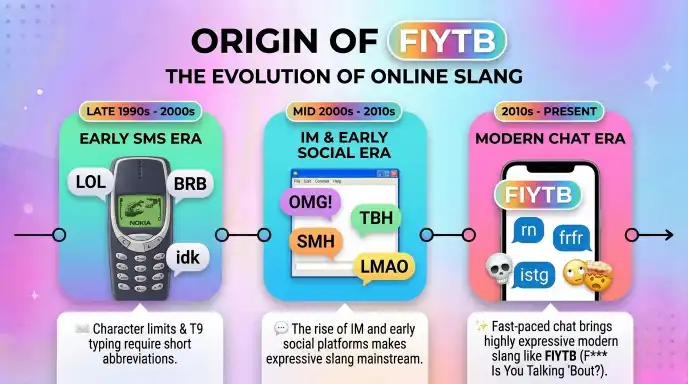
FIYTB comes from informal spoken English. It shortens a spoken reaction into the first letters of its words, making it quicker to type in a message.
The expression is associated with conversational wording such as “F* Are you talkin’ ’bout?”** Its grammar and wording reflect informal speech rather than standard written English.
There is no well-established record identifying one person or platform as the original creator of FIYTB.
How Did This Expression Develop?
People have shortened spoken phrases into letters for years. Text messages and online chats made these forms convenient because users could express reactions quickly.
FIYTB follows that general pattern. Instead of typing the full phrase, someone uses five letters to communicate a strong reaction.
Other internet abbreviations developed in similar ways, although their meanings and levels of formality differ.
Did FIYTB Come From TikTok?
There is not enough reliable evidence to say that TikTok created FIYTB.
You may see it in TikTok comments or videos, but that does not prove the platform is where it originated. The phrase is also found in other online discussions and slang references.
Is FIYTB Related to FYTB?
Yes. FIYTB and FYTB are closely related forms. Both can express a strong question about what someone is saying.
The extra letter I use reflects a different wording of the spoken phrase. Informal slang often has spelling variations because people write words the way they say them.
Its exact history is uncertain, but its basic purpose is clear: it challenges or questions another person’s statement in a strong, informal way.
FIYTB Compared With IDK, IDC, IMO, and BRB
FIYTB is different from everyday abbreviations such as IDK and BRB. Those terms are generally neutral, while FIYTB contains profanity and can sound confrontational.
| Abbreviation | Meaning | Type | Usage | Popularity |
| FIYTB | F*** Are you talkin’ ’bout? | Informal slang initialism | Showing disbelief, confusion, or disagreement | Niche or unclear |
| IDK | I Don’t Know | Initialism | Expressing uncertainty | Widely recognized |
| IDC | I Don’t Care | Initialism | Showing indifference | Widely recognized |
| IMO | In My Opinion | Initialism | Sharing a personal view | Widely recognized |
| BRB | Be Right Back | Initialism | Temporarily leaving a conversation | Widely recognized |
FIYTB vs. IDK
IDK means “I Don’t Know.” It is a neutral way to explain that you do not have an answer.
Example:
“IDK what time the event starts.”
FIYTB is much stronger. It questions what another person has said rather than simply expressing uncertainty.
FIYTB vs. IDC
IDC means “I Don’t Care.” People use it to show that they are not concerned about a particular choice or situation.
Example:
“IDC which movie we watch.”
FIYTB does not mean that something is unimportant. It is used to challenge or question a statement.
FIYTB vs. IMO
IMO means “In My Opinion.” It introduces a personal viewpoint.
Example:
“IMO, this is the best option.”
FIYTB has a different purpose. It is a reaction to something another person has said, not a way to introduce an opinion.
FIYTB vs. BRB
BRB means “Be Right Back.” Someone uses it when temporarily leaving a conversation.
Example:
“BRB, I need to answer the door.”
FIYTB does not communicate that someone is leaving. It expresses disbelief, confusion, or disagreement.
Real-World Usage Example
Imagine that two friends, Alex and Jordan, are discussing a football match. Jordan tells Alex that their favorite team lost by five goals.
Alex finds the claim hard to believe and replies:
Alex: FIYTB? They were winning when I checked the score!
Jordan: I’m serious. They conceded four goals in the second half.
Alex: No way. I need to watch the highlights.
In this situation, Alex uses FIYTB to show disbelief. The message is informal and expresses surprise rather than a serious personal insult.
Now imagine that two coworkers are discussing a project. One person sends a message saying:
“FIYTB? That’s completely wrong.”
This could sound aggressive because the conversation is professional and the abbreviation includes profanity.
The same expression can therefore create different reactions depending on the people involved.
The important thing is to understand the tone before using it. If you are unsure if someone will find it funny or offensive, choose a clearer and more respectful phrase.
Frequently Asked Questions
1. What does FIYTB mean in text messages?
FIYTB usually means “F* Are you talkin’ ’bout?”** It is used to question someone’s statement and express disbelief, confusion, or disagreement.
2. What does FIYTB mean on TikTok?
On TikTok, FIYTB can be used as a strong reaction to a video, comment, or surprising statement. It generally means “What are you talking about?” with profanity.
3. Is FIYTB slang?
Yes. FIYTB is informal internet slang and an initialism. It shortens a spoken phrase into five letters and is mainly used in casual conversations.
4. Is FIYTB rude or offensive?
It can be. FIYTB contains profanity and may sound aggressive, especially when used with strangers, teachers, coworkers, or during an argument.
5. How should you reply to FIYTB?
You can explain your message, correct a misunderstanding, or ask what the person disagrees with. For a calm reply, try “Let me explain what I meant.”
Conclusion:
FIYTB usually means “F* Are you talkin’ ’bout?”** It is an informal slang expression people use when they question something, show disbelief, or disagree with a statement.
You may encounter it in text messages, TikTok comments, Snapchat chats, Instagram replies, and online group conversations. Its tone can be playful between close friends, but it may also sound rude or confrontational.
Because the phrase contains profanity, avoid using it in school, professional messages, or conversations with people who may find it offensive.
If someone sends you FIYTB, consider the context before replying. A simple explanation or calm question can clear up confusion without turning the conversation into an argument.
Remember: FIYTB is a strong reaction, not a polite way to ask for clarification.