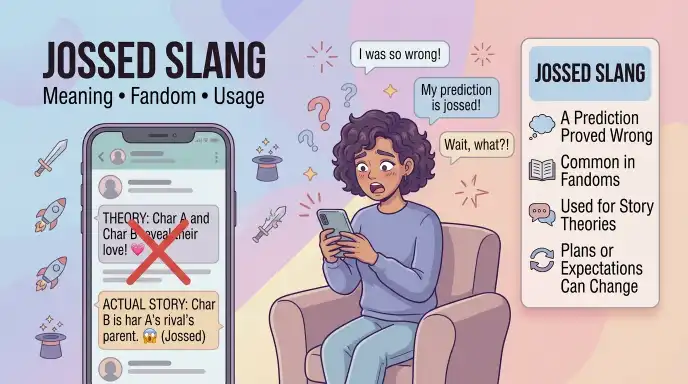
If you’ve come across the term “jossed” in a fandom discussion, fanfiction community, or online conversation, you may wonder what it means. In fandom slang, jossed describes a situation where new official canon contradicts, changes, or invalidates an existing fan theory, fanwork, or interpretation.
The term is connected to Joss Whedon and his influence on fandom culture. In this guide, we’ll explain what jossed means, where the term came from, how it is used, and provide clear examples to make the meaning easy to understand.
What Does “Jossed” Mean in Slang?
Jossed is a fandom slang term used when newly revealed or established canon contradicts or invalidates something fans previously created, believed, or assumed about a fictional story.
This can happen when an official episode, book, movie, interview, or other canonical source changes a character detail, storyline, relationship, or fan theory.
For example, if a fan writes a story based on a character having a particular childhood, and a later official episode reveals a completely different childhood, the fan’s idea has been “jossed.”
The term is especially associated with fandom communities and is linked to Joss Whedon, whose work on Buffy the Vampire Slayer and other television projects influenced its development.
Jossed Meaning in Simple Words
In simple terms, jossed means that something a fan believed, wrote, or imagined about a fictional story has been contradicted by new official information. The new information usually comes from the story’s canon, such as a new episode, book, movie, or official statement.
For example, imagine that fans believe a character has a secret sibling and create fanfiction around that idea. Later, an official episode reveals the character’s complete family history and shows that the supposed sibling does not exist. The original fan theory or story has effectively been jossed.
The word is mainly used within fandom communities, especially when discussing fanfiction, fan theories, headcanons, and canon changes. It does not necessarily mean that the fan’s original idea was poorly written; it simply means that later official material no longer supports or fits with it.
What Does “Jossed” Mean in Different Contexts?
The meaning of jossed stays centered on a conflict between fan-created ideas and official canon, but the situation can vary depending on the type of fandom content involved. Fans may use the term when a new canon development contradicts a theory, fanfiction story, character interpretation, or other previously accepted idea.
Jossed in Fanfiction
A fanfiction story can become jossed when later canon introduces information that conflicts with its plot, character history, relationships, or other details. The story may still exist and remain enjoyable, but it no longer matches the updated canon.
Jossed in Fan Theories
A fan theory can be jossed when an official reveal proves that the theory does not fit the story’s established facts. For example, a mystery character’s identity may be theorized by fans for months before an episode reveals a completely different answer.
Jossed in Headcanon
A personal headcanon may also be described as jossed when official material directly contradicts it. However, a headcanon can still remain meaningful to an individual fan even when it conflicts with canon.
Jossed by a New Canon Reveal
New episodes, books, films, interviews, or other officially recognized material can introduce details that change how earlier fan interpretations are understood. When those details directly conflict with a fan-created idea, fans may describe that idea as jossed.
Ultimately, the surrounding context matters. The term refers specifically to the relationship between fan-created or fan-held ideas and later official canon, rather than simply meaning that a story changed.
Is “Jossed” Actually Slang?
Yes. Jossed is primarily used as fandom slang, particularly when fans discuss fanfiction, fan theories, headcanons, and changes to fictional canon. It is not a term that most people would normally use in everyday formal conversation.
Fandom communities often develop specialized vocabulary to describe experiences that occur repeatedly within fan culture. Jossed is one example: it gives fans a short way to describe what happens when official canon contradicts something they previously created, believed, or interpreted.
The term is especially useful in conversations about fictional universes where new material is released over time. A new episode, book, film, or official statement can introduce details that conflict with older fan-created ideas.
It is also important to distinguish slang from standard dictionary language. A term can be widely understood within a particular community without being common in everyday speech. Therefore, someone unfamiliar with fandom terminology may not immediately understand what “jossed” means.
In short, jossed is best understood as a specialized fandom term describing a conflict between fan-created ideas and later official canon.
Where Did the Word “Jossed” Come From?
The term jossed is associated with Joss Whedon, a writer and producer known for works including Buffy the Vampire Slayer, Angel, and Firefly. The word developed within fandom culture as fans needed a concise way to describe situations where new official material contradicted fan-created ideas or interpretations.
The term is built from Joss, referring to Joss Whedon, with the suffix -ed indicating that something has been affected by the action. In fandom usage, being “jossed” therefore came to describe having a fan theory, fanfiction idea, or other interpretation overturned by developments connected with the official story.
The term became particularly useful in online fandom communities, where fans frequently discussed episodes, character histories, theories, and fanfiction alongside newly released canon.
It is worth noting that the exact history of when the term was first coined and who first used it is less certain than its general fandom meaning. For that reason, claims about a specific person or date of origin should be treated carefully unless supported by an early documented source.
Today, jossed is best understood as a piece of fandom vocabulary rather than a general-purpose English slang word.
How Is “Jossed” Used in a Sentence?
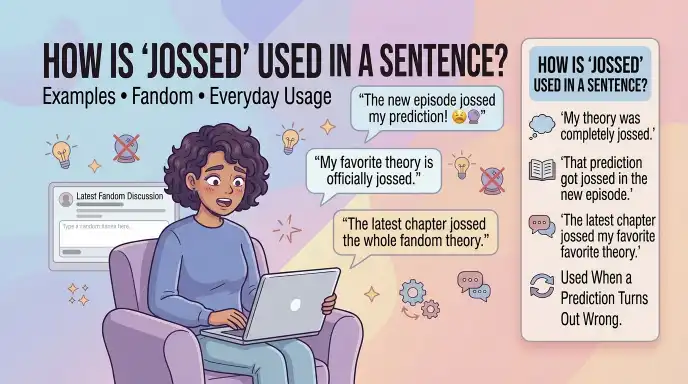
Jossed is generally used when talking about a fan theory, fanfiction idea, headcanon, or interpretation that has been contradicted by new official canon. Because it is specialized fandom vocabulary, it usually appears in conversations about fictional stories and their continuing developments.
Fan Theory
“Our theory about the character’s secret identity was completely jossed by the season finale.”
Here, jossed means that the official reveal contradicted the theory.
Fanfiction
“I had to rewrite my fanfic because the new episode jossed the character’s backstory.”
In this example, newly released canon introduced information that conflicted with the fanfiction.
Headcanon
“My headcanon was jossed when the author finally confirmed what happened.”
The speaker’s personal interpretation was contradicted by official information.
Character Details
“The new book jossed several details from the original fan theory.”
Here, later canon changed or contradicted information that fans had previously believed.
Casual Fandom Discussion
“That theory sounded convincing until the latest episode.”
The word describes the moment when an official story development makes the theory inconsistent with canon.
In each example, jossed refers to a conflict between an established fan idea and later official material. The word is normally used casually within fandom discussions rather than in formal writing.
What Does “Jossed” Mean When Someone Says It to You?
If someone says that your theory, fanfiction, or headcanon was “jossed,” they generally mean that later official information has contradicted or overturned the idea. It is usually a description of what happened to the idea rather than a personal criticism of the fan who created it.
For example, someone might say, “Your theory got jossed by the latest episode.” This means that the new episode revealed information that no longer fits the theory.
The term can also be used humorously between fans. A person might spend weeks developing a detailed interpretation of a character, only for a new episode or book to reveal something completely different. Other fans may jokingly say that the interpretation has been jossed.
Being jossed does not necessarily mean that a fan must stop enjoying the original idea. A fanfiction story or headcanon can still be meaningful even when it no longer matches official canon.
The key point is that jossed describes a change in the relationship between a fan-created idea and official canon. The word focuses on the contradiction caused by new information, not on if the original fan idea was good or bad.
Is “Jossed” a Positive or Negative Word?
Jossed is generally a neutral fandom term, although the situation it describes can sometimes be frustrating, disappointing, or amusing for fans. The word itself does not automatically express praise or criticism.
For example, a fan may spend a long time developing a theory about a character, only to discover that a new episode contradicts it. They might say, “My theory was jossed.” In this context, the speaker may be disappointed because the theory no longer fits the official story.
On the other hand, being jossed can be humorous. Fans sometimes enjoy seeing how unexpected plot developments overturn popular theories or carefully constructed fanfiction ideas.
When Jossed Can Feel Negative
The term may have a negative emotional tone when a fan’s favorite theory, headcanon, or story is contradicted by canon. The disappointment comes from the change in the story, rather than from the word “jossed” itself.
When Jossed Can Be Playful
Fandom communities may also use the term jokingly when a new plot development surprises everyone. In these situations, saying that a theory was “jossed” can simply acknowledge that the official story took an unexpected direction.
The Meaning Depends on Context
if the situation feels disappointing, funny, surprising, or simply informative depends on the speaker and the surrounding conversation.The term “jossed” describes a situation where a fan-created idea conflicts with later canon. By itself, it does not suggest that the idea or the canon is good or bad.
Jossed vs. Similar Fandom Terms
Jossed is related to several other fandom terms, but these words describe different things. Understanding the differences can make fandom discussions much easier to follow.
| Term | Meaning |
| Jossed | A fan theory, fanwork, or interpretation is contradicted by later official canon. |
| Canon | The officially established facts, events, characters, or details within a fictional work. |
| Fanon | An idea that becomes widely accepted among fans even though it is not officially confirmed. |
| Headcanon | A fan’s personal interpretation or belief about a fictional character or story. |
| Retcon | A later change to established story information that alters or reinterprets previous continuity. |
Jossed vs. Canon
Canon refers to what is officially established in a fictional universe. Jossed describes what can happen when new canon conflicts with a fan-created idea or interpretation.
For example, a fan may have a headcanon about a character’s past, while a later episode establishes a different backstory. The fan’s headcanon may then be described as jossed.
Jossed vs. Fanon
Fanon consists of ideas shared or widely accepted by fans without being officially established. If a new canon contradicts a popular fanon idea, fans may describe that idea as jossed.
Jossed vs. Headcanon
A headcanon is usually an individual fan’s personal interpretation. If official material later contradicts that interpretation, the headcanon can be described as jossed.
Jossed vs. Retcon
These terms are particularly easy to confuse. Jossed focuses on a conflict between official canon and a fan’s previous idea, while a retcon involves a change or reinterpretation within the fictional work’s own continuity.
In other words, a story does not have to be retconned for a fan theory to become jossed. A straightforward new canon reveal can be enough to contradict a fan’s previous interpretation.
Jossed vs. Its Standard Meaning
When researching jossed, it is important to distinguish the fandom term from other possible meanings or uses of related words. Jossed, in the context discussed in this article, is specialized fandom vocabulary rather than a common term used in everyday formal English.
In fandom discussions, jossed describes a situation in which official canon contradicts a fan-created idea, such as a theory, headcanon, fanfiction plot, or character interpretation.
The term should not automatically be interpreted simply because it resembles another English word or expression. Context is especially important with uncommon slang because different communities can use similar-looking terms in different ways.
Fandom Meaning
In its established fandom usage, jossed relates to:
- Fan theories
- Fanfiction
- Headcanons
- Fanon
- Character interpretations
- New canon
- Story continuity
For example:
“The new episode jossed my theory about the character.”
This means that the new official material contradicted the fan’s previous theory.
Why Context Matters
If you encounter jossed outside a fandom discussion, do not automatically assume that the fandom definition applies. Look at the surrounding sentence and the community where the term appears.
For readers researching the word online, this distinction is useful because specialized fandom vocabulary can have a narrower meaning than ordinary English words. The safest interpretation is therefore based on the context in which the term is being used.
Is Jossed a Real Word?
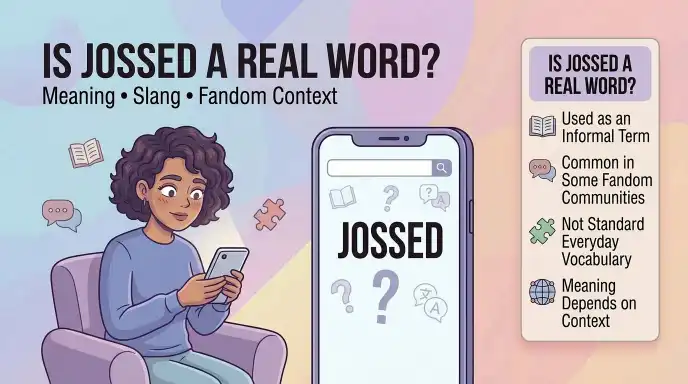
Yes, jossed is a recognized term in fandom vocabulary, although it is not a common word in everyday formal English. It is mainly encountered in online fandom communities where people discuss fanfiction, theories, headcanons, and changes to fictional canon.
The idea of a word being “real” is broader than simply appearing in a major dictionary. Communities regularly create specialized expressions to describe experiences that do not have a convenient everyday term. Some of these expressions remain limited to a particular group or subculture.
In the case of jossed, the term has a specific function within fandom discussions: it describes a fan-created or fan-held idea being contradicted by later official canon.
Does Jossed Appear in Dictionaries?
Dictionary coverage can vary for specialized slang and fandom terminology. A word may have documented usage within a community without being included in every major general-purpose dictionary.
For this reason, it is useful to distinguish between dictionary recognition and actual language use. The fact that a term is uncommon in general English does not mean that it has no established meaning within the community that uses it.
Is Jossed Formal English?
No. Jossed is best treated as informal, specialized fandom terminology. It is appropriate for conversations about fictional works and fan culture but may be unclear to readers who are unfamiliar with fandom vocabulary.
When using the term outside a fandom context, providing a short explanation can help prevent confusion.
Is Jossed Slang Still Used Today?
Jossed remains recognizable as specialized fandom terminology, although it is not a mainstream slang word that most people use in everyday conversation. Its use is most relevant in communities that discuss fanfiction, fan theories, fictional continuity, and changes to established canon.
The term is particularly useful when fans need to describe a familiar experience: developing an interpretation or story idea and then seeing later official material contradict it.
Online fandom has also changed considerably over time. Social media, discussion forums, fanfiction platforms, and other digital communities have introduced new vocabulary and allowed older fandom terms to continue circulating within specific groups. As a result, the frequency with which someone encounters jossed can depend heavily on the fandom and platform they participate in.
It is also possible for a term to be well understood within one fandom while being unfamiliar to people outside it. Someone who regularly reads fanfiction may recognize jossed immediately, while a general English speaker may not.
Is Jossed Common in Everyday English?
Not particularly. Jossed is much more likely to appear in fandom-related conversations than in ordinary speech or general writing.
If you encounter the word today, the surrounding context can help determine if the fandom meaning is intended. In most cases, references to canon, fanfiction, theories, headcanon, or fictional characters are strong clues that the fandom meaning is intended.
Who Uses the Word “Jossed”?
The word jossed is mainly used by people who participate in or follow fandom communities. These communities discuss fictional stories, characters, fan theories, fanfiction, and developments in official canon.
You may encounter the term in places such as:
- Fanfiction discussions
- Online fandom forums
- Social media conversations about fictional works
- Discussions about television shows and books
- Fan theory communities
- Conversations about canon and continuity
The term is not limited to one particular age group or type of fan. Its use is better understood in terms of community and context rather than assuming that a particular demographic always uses it.
Why Do Fans Use “Jossed”?
Fandom discussions can involve complicated explanations about how a new episode, book, or other official release affects an existing fan theory or fanwork. Saying that an idea was “jossed” provides a concise way to describe that situation.
For example, instead of explaining that a new episode introduced information that directly contradicted a fan’s previous interpretation, someone can simply say:
“The new episode jossed my headcanon.”
Readers familiar with the terminology can immediately understand that the official development conflicts with the previous fan interpretation.
Is Everyone Familiar With the Term?
No. Because jossed is specialized fandom vocabulary, people outside fandom communities may not recognize it immediately. Even within fandom, familiarity can vary depending on the particular community and the type of fictional works being discussed.
When using the word with a general audience, briefly explaining its meaning can make the conversation clearer.
Can You Use “Jossed” in Formal Writing?
Jossed is generally an informal fandom term, so it is best suited to casual conversations, fan communities, blogs about fandom, social media posts, and discussions about fanfiction or fictional canon.
When Is “Jossed” Appropriate?
You can naturally use jossed when writing for an audience familiar with fandom terminology. For example, a fandom blog might say:
“The latest episode jossed several popular fan theories.”
In this context, the specialized term is useful because the audience is already familiar with the concept.
When Should You Avoid “Jossed”?
In formal or academic writing, the word may be unclear to readers who are unfamiliar with fandom vocabulary. This includes:
- Academic essays
- Formal reports
- Business communication
- Professional documents
- General-audience publications
Instead, explain the idea directly. Depending on the context, phrases such as “contradicted by later canon,” “overturned by new canon,” or “made inconsistent with the official storyline” may communicate the meaning more clearly.
What About Blogs and Online Articles?
For a blog about fandom, fanfiction, television, books, or internet culture, using jossed can be appropriate. It can also help your writing sound natural when discussing terminology that fans actually use.
The key is to consider your audience. If readers may not know the term, define jossed the first time you use it and then use it naturally throughout the rest of the article.
Common Misunderstandings About “Jossed Slang”
Because jossed is specialized fandom vocabulary, it can be misunderstood by readers who encounter the term for the first time. Understanding what the word does and does not describe makes its use much clearer.
Jossed Does Not Mean a Fan Was “Wrong”
When a fan theory is jossed, it means that later official information contradicts the theory. It does not necessarily mean the fan was unreasonable for having that interpretation. A theory may have been well supported by the information available at the time.
Jossed Does Not Mean the Fanwork Disappears
A fanfiction story, theory, or headcanon can remain available and enjoyable even after it has been jossed. The term describes its relationship to later canon, not if the work itself has been removed or changed.
Jossed Is Not the Same as a Retcon
A retcon involves an alteration or reinterpretation of established story continuity. A fan theory can become jossed simply because new canon reveals something different; the official story does not necessarily have to retcon anything.
Jossed Is Not the Same as Fanon
Fanon refers to ideas that become commonly accepted among fans without being officially confirmed. If later canon contradicts a fanon idea, that idea may be described as jossed.
Jossed Is Not Automatically Negative
The word itself is descriptive. Fans may feel disappointed when a favorite theory is contradicted, but they may also use jossed humorously when discussing an unexpected plot development.
Context Is Important
Not every use of the word outside a fandom conversation should automatically be given the fandom meaning. Because specialized slang can vary between communities, always consider the surrounding discussion before interpreting the term.
Examples of Jossed in Real-World Context
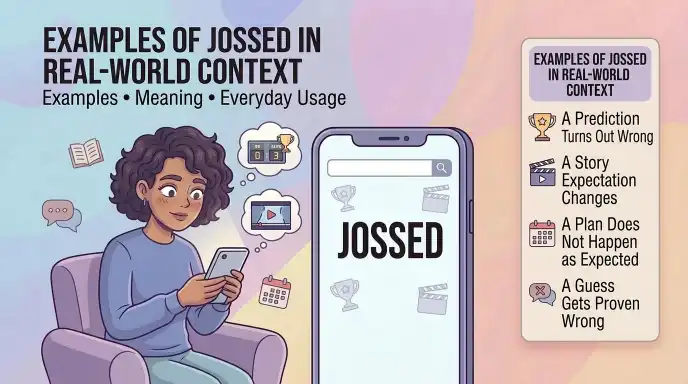
The easiest way to understand jossed is to see how fans use it when discussing fictional stories. In each situation, the important element is that an official development conflicts with an earlier fan-created or fan-held idea.
Jossed in a Fan Theory
A fan may develop a theory about a character’s identity based on clues throughout a series. If a later episode officially reveals a different identity, the original theory can be described as jossed.
Example:
“We were convinced that the character was the mysterious villain, but the finale jossed our theory.”
Jossed in Fanfiction
A fanfiction writer may create a story based on information that is available at the time. If a later official release establishes different character details, the fanfiction may become inconsistent with the new canon.
Example:
“The latest season jossed several details in my old fanfic.”
The story can still be read and enjoyed; it simply no longer aligns with the newer canon.
Jossed Headcanon
Fans often create personal explanations for details that the original story has not fully established. If an official source later provides a different explanation, the original headcanon may be described as jossed.
Example:
“My headcanon about her childhood was completely jossed by the new book.”
Jossed Character Interpretation
A fan may interpret a character’s personality, motivations, or background in a particular way. A later episode may provide information that changes that interpretation.
Example:
“That episode jossed my entire interpretation of the character.”
Jossed by a New Canon Reveal
The term can also be used more generally when a new official development overturns something fans previously accepted or discussed.
Example:
“The new chapter jossed almost every prediction people had made.”
These examples demonstrate the central idea behind the term: new official information creates a conflict with an earlier fan-created or fan-held interpretation.
Jossed Slang: Quick Meaning Guide
If you need a quick explanation, jossed is a fandom slang term for a fan-created idea or interpretation that is contradicted by later official canon. It can apply to fan theories, fanfiction, headcanons, fanon, or other interpretations of a fictional story.
| Question | Answer |
| What does jossed mean? | A fan idea has been contradicted by later official canon. |
| Is jossed slang? | Yes, it is primarily specialized fandom slang. |
| Where is it used? | Mainly in fandom and fanfiction discussions. |
| What can be jossed? | Fan theories, fanfiction, headcanons, fanon, and character interpretations. |
| Is jossed positive or negative? | The word is generally descriptive; the situation can feel positive, negative, surprising, or humorous depending on the fan. |
| Is jossed formal English? | No. It is best treated as informal fandom terminology. |
| Is jossed the same as a retcon? | No. A fan idea can be jossed without the official story being retconned. |
| Where does the term come from? | It is associated with Joss Whedon and fandom culture. |
| Can a jossed fanwork still be enjoyed? | Yes. Being jossed only means that later canon conflicts with it. |
In short, jossed describes what happens when official canon catches up with or contradicts something fans previously believed, imagined, or created.
Frequently Asked Questions About Jossed Slang
Q1. What does “jossed” mean in slang?
Jossed is fandom slang used when new official canon contradicts or invalidates a fan theory, fanfiction idea, headcanon, fanon, or other interpretation.
Q2. What does jossed mean in fanfiction?
In fanfiction, jossed means that later official canon introduces information that conflicts with something in an existing fanfiction story. The fanfic does not disappear; it simply may no longer match the current canon.
Q3. What does “jossed by canon” mean?
Jossed by canon means that an official story development contradicts an idea previously held or created by fans. The new information may come from an episode, book, film, or other recognized source of canon.
Q4. Is jossed the same as retcon?
No. Jossed describes a fan-created or fan-held idea being contradicted by canon. A retcon involves changing, revising, or reinterpreting established information within the fictional continuity itself.
Q5. Is jossed the same as headcanon?
No. A headcanon is a fan’s personal interpretation or belief about a fictional story. If official canon later contradicts that belief, the headcanon can be described as jossed.
Q6. Why is it called jossed?
The term is associated with Joss Whedon and fandom culture surrounding his work. It developed as fandom vocabulary for situations where later canon contradicted fan-created ideas.
Q7. Is jossed a formal English word?
Jossed is informal, specialized fandom terminology. It is mainly useful when communicating with people familiar with fandom culture and may need explanation for a general audience.
Q8. Can a fan theory be jossed?
Yes. A fan theory can be described as jossed when later official material contradicts the theory or establishes a different explanation.
Q9. Can a headcanon be jossed?
Yes. If a fan’s personal interpretation conflicts with later official information, fans may describe that headcanon as jossed.
Final Takeaway: Jossed Slang
Jossed slang is a specialized fandom term describing a situation where new official canon contradicts a fan-created or fan-held idea. It can happen to a fan theory, fanfiction story, headcanon, fanon idea, or character interpretation when later material establishes something different.
The term is associated with Joss Whedon and developed within fandom culture as a convenient way to describe this common experience. Although being jossed can sometimes be disappointing, the word itself is mainly descriptive rather than positive or negative.
If you encounter jossed in a fandom conversation, look at the surrounding context, especially references to canon, theories, fanfiction, or characters to understand exactly what the speaker means.
Sources & Further Reading
For readers who want to explore the meaning and history of jossed in greater detail, useful references include fandom glossaries, fan-culture resources, and documentation of Joss Whedon’s work.
When researching specialized slang, it is helpful to compare multiple sources because fandom terminology can develop within particular communities and may not have the same level of documentation as common English vocabulary.
For the most accurate interpretation, consider the context in which jossed appears and distinguish established definitions from individual or community-specific uses.