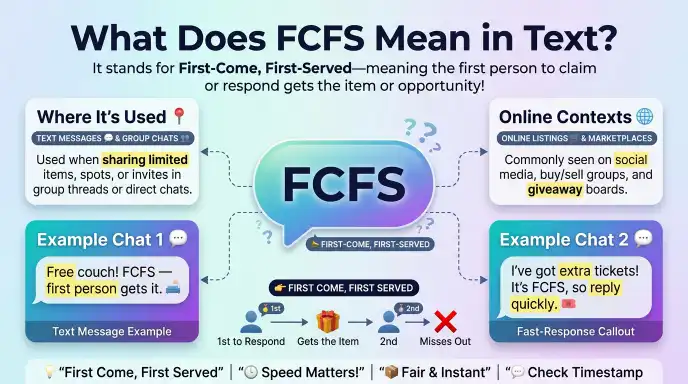
FCFS in text usually means “first come, first served.” It means the person who responds, arrives, claims something, or acts first gets it first. You may see FCFS in texts, social media posts, comments, group chats, and online listings.
People often search for what FCFS means in text because the abbreviation can appear without any explanation. It is especially common when someone is offering an item, a place, a deal, an opportunity, or something available to the first person who asks.
You might also see FCFS on TikTok, Snapchat, Instagram, WhatsApp, or in regular SMS messages. Its meaning is usually simple, but the exact situation can tell you what the sender expects you to do.
What Does FCFS Mean in Text?
FCFS means “first come, first served.” In simple words, whoever gets there first or claims something first gets priority.
For example, imagine someone posts:
“Free concert ticket. FCFS.”
This means the ticket will go to the first person who claims it. The sender is not necessarily choosing the person they like best. They are saying that the first person to respond or arrive will get it.
FCFS is an abbreviation, rather than traditional slang. It is made from the first letters of First Come, First Served.
In everyday texting, people use FCFS because it is quicker than typing the full phrase. It is useful when there is limited space, limited time, or a limited number of items.
You may see it in messages such as:
“I have an extra book. FCFS.”
Or:
“Only one seat left, FCFS.”
The basic idea stays the same: act first if you want it.
What Does “First Come, First Served” Actually Mean?
The phrase describes a simple order system.
If five people want one available item, the person who asks first may receive it. The second person may have to wait or miss out.
For example:
“Two free passes available, FCFS.”
If two people claim the passes before anyone else, they are likely to receive them.
The exact rules can depend on the situation. Sometimes “first” means the first person to send a message. In another situation, it may mean the first person to arrive, pay, sign up, or complete a requirement.
That is why context matters.
Is FCFS Slang or an Acronym?
FCFS is mainly an acronym or abbreviation, not slang in the same way as words like “LOL,” “BRB,” or “IDK.”
However, because people frequently use it in casual online conversations, it can feel like internet shorthand.
You may see lowercase versions such as fcfs, especially in casual posts or messages. Both FCFS and fcfs normally have the same meaning.
Where People Use FCFS
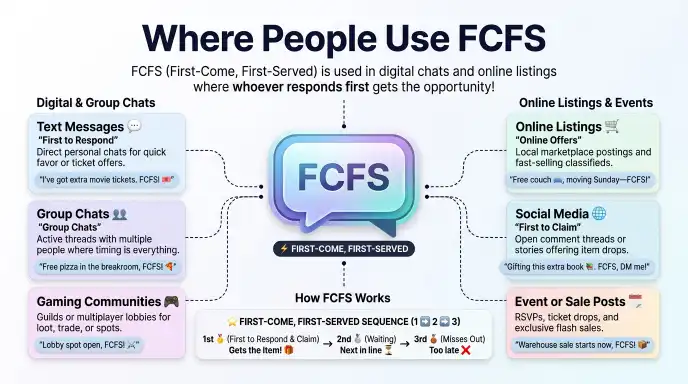
FCFS can appear almost anywhere people communicate quickly online. It is particularly useful when someone wants to make clear that an opportunity is limited.
FCFS on TikTok
On TikTok, FCFS may appear in comments, captions, giveaways, community posts, or discussions about limited items.
For example:
“Giving away two codes, FCFS.”
The person is saying that the first two people who qualify or respond may get the codes.
Another example could be:
“Meetup tickets are FCFS.”
Here, the abbreviation tells people that tickets may be given out according to who arrives or claims them first.
The exact meaning can depend on the post, so it is smart to read the surrounding text.
FCFS on Snapchat
On Snapchat, people may use FCFS in direct messages or group conversations.
For example:
“I have an extra pass if anyone wants it. FCFS.”
The sender is telling friends that they will give the pass to the first person who responds.
Because Snapchat conversations are often quick, abbreviations such as FCFS can save time.
FCFS on Instagram
On Instagram, FCFS is commonly useful in comments, Stories, captions, and direct messages.
Someone selling or giving away an item might write:
“Old books for free. FCFS.”
A person organizing a small event might also say:
“Five spots available. FCFS.”
In both cases, the message creates a simple first-come priority system.
FCFS on WhatsApp
WhatsApp groups are another place where you may see FCFS.
For example:
“Anyone need an extra project seat? FCFS.”
The first person to respond may get the available seat.
It can also appear in neighborhood groups, school-related chats, gaming groups, community groups, and buying-and-selling conversations.
FCFS in SMS
In ordinary SMS texting, FCFS can be used when someone wants to keep a message short.
For example:
“I have one extra ticket. FCFS.”
The receiver can understand that they need to respond quickly if they want it.
Unlike some slang terms, FCFS does not depend heavily on a particular social media platform. It can be used anywhere people communicate about limited availability or priority.
Real Chat Examples of FCFS
Below are realistic examples showing how people might use FCFS in everyday messages.
Free Item
A:
I have an extra phone case. Anyone want it?
B:
Me! Is it still available?
A:
Yes, but FCFS.
Concert Ticket
A:
I can’t use my concert ticket anymore.
B:
Can I have it?
A:
Sure, if you can pick it up today. FCFS.
Group Activity
A:
There are only three spots left for the trip.
B:
Can I reserve one?
A:
Yes. FCFS, so let me know soon.
Selling Something
A:
Selling my old headphones for $20.
B:
Can you hold them until tomorrow?
A:
Sorry, FCFS. I can’t promise they’ll still be available.
Giveaway
A:
I have two extra game codes.
B:
Can I get one?
A:
Yes, FCFS. Send me a message.
School Group
A:
There are only five presentation slots.
B:
Which ones are still open?
A:
The first five people to choose. FCFS.
WhatsApp Group
A:
Anyone want my extra ticket for tonight?
B:
I’ll take it!
A:
You got it. FCFS worked quickly.
Instagram Story
A:
Giving away this hoodie. Free pickup.
B:
I want it!
A:
Okay, you’re first. FCFS.
Gaming Community
A:
I have one extra spot in the tournament.
B:
Can I join?
A:
Yes, if nobody else claims it first. FCFS.
Everyday Conversation
A:
Mom made extra cupcakes.
B:
Save me two!
A:
I’m not promising anything. FCFS 😂
How to Reply When Someone Says “FCFS”
Your response depends on the situation. If you want whatever the person is offering, it is usually best to respond quickly and clearly.
Funny Replies
You can make your response playful if you are talking to a friend.
“Say less, I’m already here 😂”
“Speed mode activated.”
“I saw FCFS and ran.”
“First place secured 😎”
Casual Replies
For a normal conversation, you can keep your reply simple.
“I’ll take it.”
“I’m interested.”
“Can I claim it?”
“I’m first! Is it still available?”
Friendly Replies
If you want to sound polite and friendly, try:
“I’d love to have it if it’s still available.”
“Can I claim this? Thanks!”
“I’m interested. Please let me know if it’s still available.”
Neutral Replies
If you are not sure if you can claim the offer, you can ask for details.
“Does FCFS mean I need to respond here?”
“Is it still available?”
“Do I need to arrive in person?”
“What do I need to do to claim it?”
This is especially useful because FCFS can mean different things depending on how the system works. Sometimes replying first is enough. Other times, you must arrive, pay, register, or complete another step.
Is FCFS Rude or Offensive?
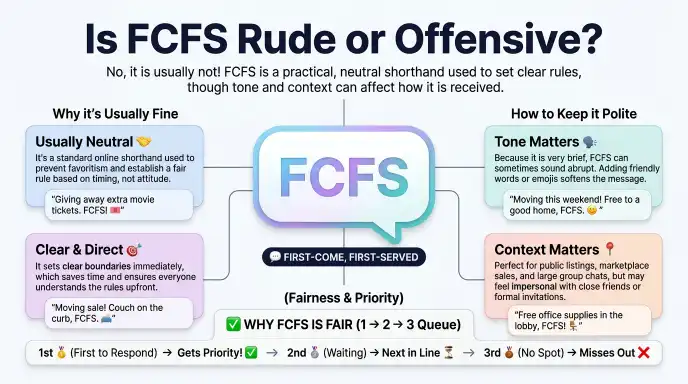
FCFS is not normally rude or offensive. It is a neutral expression that explains how priority will be decided.
For example:
“Free chair, FCFS.”
This is simply telling people that the first person to claim the chair gets it.
The expression can sound a little firm when someone is emphasizing that they will not hold something for another person. However, that does not make the abbreviation offensive.
Is FCFS Safe to Use?
Yes. FCFS is generally safe for casual conversations, social media posts, group chats, and online listings.
It does not contain profanity or an insulting meaning.
Still, you should make sure the other person understands what you mean. If the audience is unfamiliar with internet abbreviations, writing “first come, first served” may be clearer.
Is FCFS Appropriate at School?
It can be appropriate at school when the situation is informal.
For example:
“Extra study-group seats are FCFS.”
However, if you are writing a formal school announcement, the full phrase may be better:
“Places will be given on a first-come, first-served basis.”
That version sounds more professional and is easier for everyone to understand.
Is FCFS Appropriate at Work?
FCFS can be understood in workplace communication, especially in informal team chats. But for official emails, policies, notices, or customer-facing messages, spelling out the phrase is usually clearer.
For example, instead of:
“Meeting slots are FCFS.”
A formal message could say:
“Meeting slots will be assigned on a first-come, first-served basis.”
The meaning is identical, but the second version sounds more polished.
Who Uses FCFS?
FCFS is used by people of many ages, because the phrase is not limited to one particular generation.
You may see it among students, online sellers, gamers, social media users, community members, and people organizing events.
Gen Z Usage
Gen Z users may use FCFS in casual digital communication, especially when discussing giveaways, tickets, limited offers, group activities, or online sales.
However, FCFS is not exclusively a Gen Z expression. Adults also use it, particularly in situations involving reservations, appointments, sales, or limited availability.
Common Online Platforms
The abbreviation can appear on:
- TikTok
- Snapchat
- SMS
- Online marketplaces
- Gaming communities
- Group chats
- Community forums
Its popularity comes partly from convenience. Instead of writing four words, people can simply type FCFS.
How Often Does FCFS Appear Online?
You are more likely to see FCFS when something is limited or available to a small number of people.
It is less likely to appear in ordinary conversations where there is no competition for something.
For example, a person probably would not text:
“What are you doing tonight? FCFS.”
That would not make sense unless there were some kind of limited opportunity involved.
The abbreviation is useful because it communicates a specific rule.
Origin of the FCFS
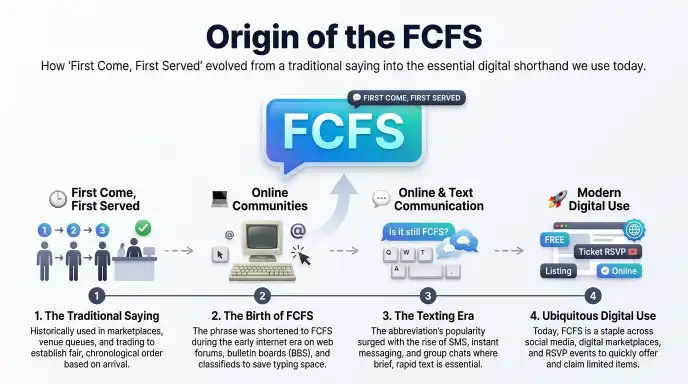
The exact origin of FCFS as an internet abbreviation is not tied to one particular website or social media platform.
The phrase “first come, first served” is much older than modern texting and internet culture. It describes a straightforward way of deciding who receives something first: priority goes to the person who arrives or acts first.
As digital communication became more common, people began shortening familiar phrases into abbreviations. FCFS fits naturally into that style because each important word contributes its first letter.
Online marketplaces, forums, group chats, event registrations, and social media helped make short forms more practical.
It is therefore better to think of FCFS as a shortened form of an established phrase, rather than slang that was invented specifically by TikTok or Gen Z.
The exact history of when people first started using the four-letter abbreviation online is not always clear. What is clear is that the underlying idea is much older than the abbreviation itself.
FCFS vs. IDK, IDC, IMO, and BRB
These abbreviations can all appear in online conversations, but they serve very different purposes.
| Term | Meaning | Type | Usage | Popularity |
| FCFS | First Come, First Served | Abbreviation | Limited items, places, offers, opportunities | Common in specific situations |
| IDK | I Don’t Know | Text abbreviation | Showing uncertainty or lack of knowledge | Very common |
| IDC | I Don’t Care | Text abbreviation | Showing indifference | Very common |
| IMO | In My Opinion | Text abbreviation | Giving a personal opinion | Very common |
| BRB | Be Right Back | Text abbreviation | Temporarily leaving a chat | Very common |
The biggest difference is that FCFS explains priority, while the other terms mainly communicate a thought, feeling, opinion, or action.
For example:
“IDK what time the event starts.”
means the sender does not know.
“IMO, that movie was better.”
means the sender is sharing an opinion.
“BRB, someone’s calling me.”
means the sender is temporarily leaving the conversation.
But:
“Free ticket, FCFS.”
means the ticket will go to the person who acts first.
Understanding this difference makes FCFS much easier to recognize when you see it online.
Real-World Usage Example
Imagine a community center has ten free places for a weekend workshop.
The organizer posts a message in a WhatsApp group:
“Ten free spots available for Saturday’s workshop. FCFS. Message me to register.”
People in the group understand that the spots are limited. The first ten people who properly register may receive a place.
Suppose one person sees the message but waits two hours before replying. Another person responds immediately and completes the registration.
The second person may receive the spot because the organizer clearly said FCFS.
This example shows why the abbreviation is useful. It gives everyone a simple rule and reduces confusion about who gets priority.
However, FCFS does not always mean “first person to send any message wins.” The organizer might require payment, registration, arrival, or another action.
If the rules are unclear, it is better to ask:
“When you say FCFS, do you mean the first person to message you?”
That small question can prevent misunderstandings.
Frequently Asked Questions
Q1. What does FCFS mean in text messages?
FCFS means “first come, first served.” It means the first person to arrive, respond, claim, or complete the required action gets priority.
Q2. What does FCFS mean on TikTok?
On TikTok, FCFS usually means “first come, first served.” It may be used for giveaways, limited offers, tickets, spots, or other things available to the first people who respond.
Q3. Is FCFS slang?
FCFS is mainly an abbreviation, not traditional slang. It is a shortened form of the phrase “first come, first served” and is commonly used in casual online communication.
Q4. Is FCFS rude or offensive?
No, FCFS is generally not rude or offensive. It is a neutral way to explain that priority will be given based on who acts first.
Q5. How should you reply to FCFS?
If you want the available item or opportunity, you can say “I’ll take it,” “Can I claim it?” or “I’m interested.” If the rules are unclear, ask what you need to do first.
Conclusion:
FCFS means “first come, first served.” It is an abbreviation people use when something will be given to whoever arrives, responds, claims it, or completes the required action first.
You may see FCFS in texts, TikTok posts, Instagram captions, Snapchat messages, WhatsApp groups, and other online conversations. It is especially common when there are limited tickets, items, spaces, offers, or opportunities.
The term is not normally rude or offensive, and it is safe for casual communication. For formal school or workplace writing, however, spelling out “first come, first served” usually sounds clearer and more professional.
When you see FCFS, look at the surrounding message to understand exactly what “first” means. Sometimes it means the first person to reply, while other times it means the first person to arrive, register, pay, or complete another step.
In short, if someone says “FCFS,” they are usually telling you not to wait too long if you want what they are offering.

I’m Emily Carter, and I enjoy writing about slang, internet language, and modern English expressions. My goal is to explain word meanings in a simple, clear, and easy-to-understand way so anyone can learn with confidence.