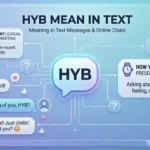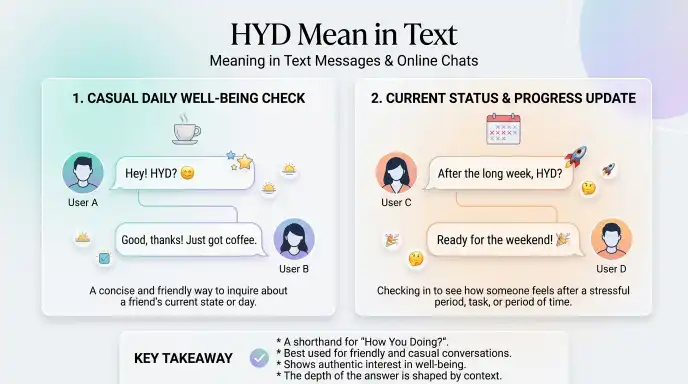
HYD usually means “How You Doing?” in text messages and online chats. It is a casual abbreviation people use to ask someone how they are feeling or what is going on.
You may see HYD on TikTok, Snapchat, Instagram, WhatsApp, or in regular texting. Someone might send it when they want to check in without typing the full question.
People often search for HYD meaning in text because abbreviations can have different meanings depending on the conversation. Understanding the context helps you know if someone is simply asking how you are or using the letters differently.
In most casual conversations, HYD has a friendly and relaxed tone. It is especially useful when someone wants to start a conversation or check on a friend quickly.
HYD Meaning in Text
HYD generally means “How You Doing?” It is a shortened form of the familiar question “How are you doing?”
The phrase leaves out some words to make the message faster to type. This is common in texting, where people often shorten phrases to keep conversations quick and informal.
For example:
A: HYD?
B: I’m good, just relaxing.
Here, HYD is simply asking how the other person is doing.
It can also be understood as “How you doing?”, which is a casual version of “How are you doing?”
Is HYD an acronym or abbreviation?
HYD is best described as a texting abbreviation. People use the first letters of the main words in the phrase to create a shorter message.
It is similar to other common texting shortcuts such as IDK for “I don’t know” and BRB for “be right back.”
Unlike a formal abbreviation used in professional writing, HYD belongs mainly to casual digital communication.
You would normally see it in:
- Text messages
- Social media comments
- Direct messages
- Online chats
- Friend-to-friend conversations
What does HYD mean in everyday chat?
In everyday conversation, HYD usually works as a quick check-in.
Someone might send:
“Hey HYD?”
They are probably asking:
“Hey, how are you doing?”
It can be used after someone has been away for a while, after saying hello, or simply as a way to start chatting.
The meaning is usually friendly, but the exact tone depends on the relationship between the people.
Does HYD always mean “How You Doing?”
Not necessarily. Internet abbreviations can have multiple meanings in different communities. However, when HYD appears in a normal text conversation about someone’s day or feelings, “How You Doing?” is a common interpretation.
Context is important.
For example:
“Hey HYD today?”
clearly suggests that the sender is asking about your well-being.
Where People Use HYD
People use HYD mainly in informal digital conversations. The abbreviation can appear on several popular platforms, although not everyone uses it regularly.
HYD on TikTok
On TikTok, HYD may appear in comments, direct messages, or conversations between users.
Someone might write:
“You disappeared 😂 HYD?”
This means:
“You disappeared. How are you doing?”
TikTok conversations often use short forms because users are accustomed to fast, casual communication.
However, the abbreviation is not limited to TikTok. Its meaning comes from general texting culture.
HYD on Snapchat
Snapchat is another place where short abbreviations are common.
A friend might send a snap with the message:
“HYD?”
They may simply be checking in or opening a conversation.
Because Snapchat conversations are usually informal, an abbreviation such as HYD can feel natural between friends.
HYD on Instagram
On Instagram, you might see HYD in DMs or comments.
For example:
“Heyyy, HYD?”
The extra letters and casual spelling can make the message feel more relaxed.
Someone may also use HYD after replying to a story:
“That place looks amazing. HYD?”
The sender could be using the question as a way to continue the conversation.
HYD on WhatsApp
On WhatsApp, HYD can be used in personal chats and group conversations.
For example:
“Morning! HYD?”
A person might use it instead of typing the longer phrase “How are you doing?”
In a group chat, the meaning can depend more heavily on the surrounding messages.
HYD in SMS
Traditional SMS texting can also contain HYD.
Someone may text:
“HYD after the exam?”
This means:
“How are you doing after the exam?”
SMS users may choose abbreviations when they want to type quickly or keep a message short.
Real Chat Examples of HYD Mean in Text
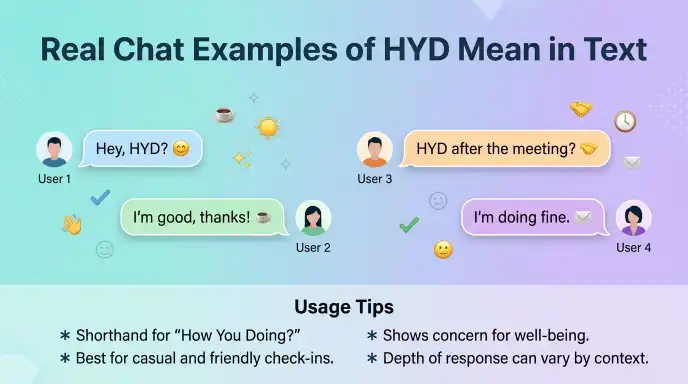
The easiest way to understand HYD is to see how it works in natural conversations.
Checking on a friend
A: Hey, HYD?
B: I’m good. Just watching a movie.
A: Nice, what are you watching?
Here, HYD is a simple way to ask how the person is doing.
Starting a conversation
A: HYD?
B: Pretty good! You?
A: I’m doing great.
The abbreviation starts a casual conversation.
Checking after school
A: HYD after school today?
B: A little tired.
A: Same honestly.
The question asks about the person’s condition after school.
Talking to a friend
A: Heyyy HYD
B: I’m okayyy 😂
A: What happened?
The repeated letters make the conversation feel more playful.
Checking on someone who was quiet
A: You’ve been quiet today. HYD?
B: I’m fine, just busy.
A: No worries.
Here, HYD shows that the sender noticed the person’s silence.
Casual Snapchat conversation
A: HYD?
B: Good! Just got home.
A: Same lol.
This is a short and natural use between friends.
Instagram DM
A: That concert looked fun! HYD?
B: I’m good! Still tired from last night 😂
A: Worth it though?
HYD helps move the conversation beyond the original topic.
After an exam
A: HYD after that test?
B: Honestly, exhausted.
A: Same. That was brutal.
Here, the context makes the question clear.
Reconnecting with someone
A: Hey, long time no talk. HYD?
B: I’m doing well! How about you?
A: Pretty good.
The abbreviation works as a friendly opener.
Late-night texting
A: Are you still awake? HYD?
B: Yeah lol, I can’t sleep.
A: Same here.
This example shows how HYD can be part of a larger casual message.
How to Reply When Someone Says “HYD”
When someone sends HYD, you can answer in many ways. Your response depends on how well you know the person and the tone of the conversation.
You do not need a complicated reply. A simple answer is usually enough.
Funny replies
If you’re talking to a close friend, you can make your answer playful.
“Surviving 😂”
“Alive and caffeinated.”
“Better now that you texted.”
“Ask me again after I get some sleep 😂”
These replies keep the conversation light.
Casual replies
For normal everyday texting, try:
“I’m good, you?”
“Doing pretty well. HYD?”
“I’m okay, just chilling.”
“Good so far.”
These are natural responses when you don’t want to make the conversation too serious.
Friendly replies
If you want to sound warm and interested, you could say:
“I’m doing good! How about you?”
“Pretty good! What have you been up to?”
“I’m good, thanks for asking. How are you?”
These replies also encourage the other person to continue talking.
Neutral replies
For someone you do not know very well, keep your answer simple:
“I’m doing well, thanks.”
“I’m okay.”
“Doing good.”
“Pretty well, thanks. You?”
A neutral response works well when the conversation is casual but you are not especially close to the person.
Is HYD Rude or Offensive?
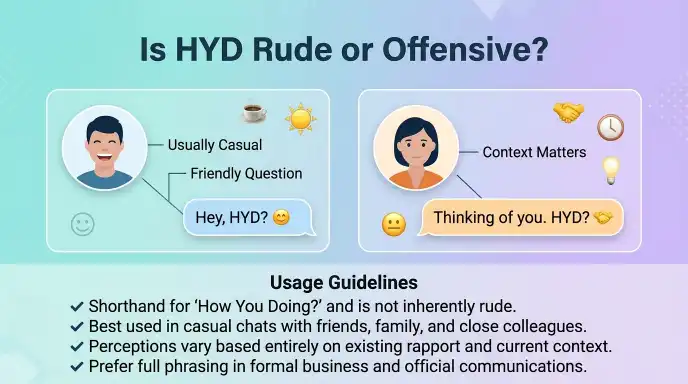
HYD is generally not rude or offensive. In normal texting, it is simply a shortened way of asking “How are you doing?”
The main thing to consider is context.
If you send HYD to a close friend, it will usually feel completely normal. If you send it to a teacher, employer, customer, or other formal contact, the abbreviation may seem too casual.
Is HYD safe to use?
Yes, in ordinary casual conversations, HYD is generally safe to use.
There is no inherently offensive meaning in the common texting use of the abbreviation.
Still, abbreviations can be misunderstood if the recipient is unfamiliar with texting slang.
Can you use HYD at school?
Among friends or classmates, HYD can be perfectly normal.
However, when communicating with teachers or school staff, a complete phrase such as “How are you doing?” is usually clearer and more appropriate.
The same principle applies to school assignments. Text abbreviations generally do not belong in formal academic writing unless the assignment specifically discusses them.
Can you use HYD at work?
In a professional workplace, it depends on the relationship and communication style.
A close coworker may understand:
“Hey, HYD?”
But a formal email to a manager or client would normally use:
“How are you doing?”
or another professional greeting.
When in doubt, use the full phrase.
Who Uses This Term?
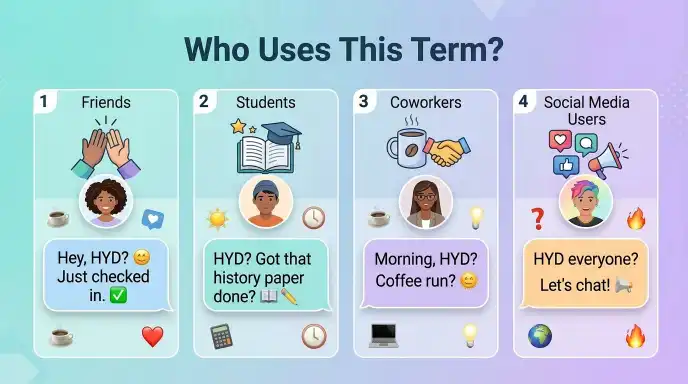
HYD is most likely to appear in casual online communication, especially among people who are familiar with texting abbreviations.
Age groups
Teenagers and young adults may encounter abbreviations like HYD more often because they frequently communicate through messaging and social platforms.
That does not mean older adults cannot use or understand it. Anyone familiar with online texting may recognize the abbreviation.
Gen Z usage
Gen Z users commonly encounter shortened expressions, acronyms, and abbreviations online.
However, it would be inaccurate to assume that every Gen Z user regularly says or types HYD. Internet slang varies between friend groups, platforms, countries, and communities.
Some people prefer “wyd,” “hru,” “how r u,” or simply “how are you?” instead.
Common platforms
You may encounter HYD in:
- TikTok DMs
- Snapchat
- Instagram DMs
- SMS
- Private online chats
It is much more associated with informal conversation than formal communication.
How often does HYD appear online?
HYD is recognizable as a texting abbreviation, but its use is not universal. Some users may see it often, while others may rarely encounter it.
That is one reason people sometimes search for the meaning when they receive the abbreviation unexpectedly.
Origin of the Term
The exact origin of HYD is not clearly documented as one specific internet invention.
It most likely developed from the broader habit of shortening common phrases in digital communication.
People have used shortened spellings and abbreviations in texting for many years. As mobile messaging became popular, users often looked for quick ways to communicate without typing every word.
“How are you doing?” is already a casual version of “How are you doing?” Turning the main words into HYD makes it even shorter.
The development of messaging apps and social media helped this style of communication spread.
However, there is no single confirmed person, post, or platform that can reliably be identified as the creator of HYD in its common texting sense.
Why do people shorten phrases like HYD?
Speed is one reason.
Typing HYD takes much less time than writing the full sentence. Short forms also fit naturally into fast-moving conversations.
Another reason is familiarity. Once a group understands an abbreviation, there is little need to spell out the entire phrase.
This is similar to how people use IDK, IDC, IMO, and BRB in casual online conversations.
HYD vs IDK vs IDC vs IMO vs BRB
These abbreviations all appear in digital communication, but they have very different meanings and purposes.
| Term | Meaning | Type | Usage | Popularity |
| HYD | How Are You Doing? | Texting abbreviation | Asking how someone is doing | Common in casual chats |
| IDK | I Don’t Know | Acronym | Showing uncertainty or lack of knowledge | Very common |
| IDC | I Don’t Care | Acronym | Showing indifference | Common |
| IMO | In My Opinion | Acronym | Introducing a personal opinion | Common |
| BRB | Be Right Back | Acronym | Saying you will return shortly | Common in online chats |
The important difference is that HYD is generally used to ask a question, while the other abbreviations usually communicate information or a reaction.
For example:
HYD? = How are you doing?
IDK. = I don’t know.
IDC. = I don’t care.
IMO, it’s good. = In my opinion, it’s good.
BRB. = Be right back.
Knowing the difference makes it easier to understand short online conversations.
Real-World Usage Example
Imagine two classmates who normally talk every day. One of them has been unusually quiet and has not joined their usual group conversation.
Later, the other classmate sends:
“Hey, HYD?”
The message is not asking for detailed information. It is simply a quick way to check in.
The other person might respond:
“I’m okay, just had a busy day.”
The first person could then continue:
“Got you. Want to talk later?”
This is a good example of how HYD works in real communication. The abbreviation starts the conversation, while the rest of the messages provide the actual context.
Another situation could happen on social media. Someone posts that they have had a long day, and a friend sends a private message saying:
“HYD now?”
Here, the meaning is still “How are you doing now?” The context makes the intention easy to understand.
The abbreviation is not meant to replace thoughtful communication. It is simply a quick way to open a conversation.
Frequently Asked Questions
Q1. What does HYD mean in text messages?
HYD usually means “How You Doing?” It is a casual texting abbreviation used to ask someone how they are.
Q2. What does HYD mean on TikTok?
On TikTok, HYD usually means “How You Doing?” It may appear in comments, DMs, or casual conversations.
Q3. Is HYD slang?
HYD is commonly used as a texting abbreviation. It is informal and belongs to casual online communication rather than formal writing.
Q4. Is HYD rude or offensive?
No. HYD is generally not rude or offensive. It is simply a casual way to ask how someone is doing.
Q5. How should you reply to HYD?
You can reply with “I’m good, you?”, “Doing well!”, or “I’m okay, how about you?” A funny response can also work with close friends.
Conclusion:
HYD usually means “How You Doing?” in text messages and online chats. It is a short, casual way to ask someone how they are doing.
You may see it on TikTok, Snapchat, Instagram, WhatsApp, SMS, and other messaging platforms. Friends often use it to start a conversation or quickly check in with someone.
The abbreviation is generally friendly and not offensive, but it is better suited to casual conversations. For school assignments, formal messages, or professional communication, writing the full phrase is usually clearer.
If someone sends you “HYD?”, a simple response such as “I’m good, you?” is usually all you

I’m Emily Carter, and I enjoy writing about slang, internet language, and modern English expressions. My goal is to explain word meanings in a simple, clear, and easy-to-understand way so anyone can learn with confidence.