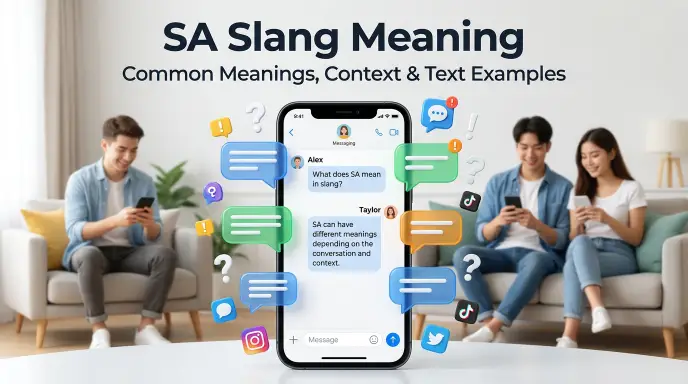
SA slang meaning refers to an informal abbreviation or expression used in texting and online chats. A common synonym is internet slang or text abbreviation, but the exact meaning depends on context. In some situations, SA can also stand for other phrases, so the conversation around it matters.
People search for SA slang because they see the abbreviation in texts, social media posts, gaming chats, and online communities but are unsure what it means. Unlike many slang terms with one fixed definition, SA slang is a short form that changes based on who is using it and where it appears.
This guide explains the meaning of SA slang, its common uses, examples, platform differences, possible misunderstandings, and when you should avoid using it. If you found SA on TikTok, Discord, Instagram, Snapchat, or a text message, understanding the context will help you read it correctly.
Quick Answer: SA Slang Meaning
SA slang usually means “South Africa” or “South African” when used online. It is commonly seen in social media, gaming communities, and conversations about countries or people. However, SA can have other meanings depending on the context.
For example:
- “I’m from SA” = “I’m from South Africa.”
- “SA culture is amazing” = “South African culture is amazing.”
- “My SA friend sent this” = “My South African friend sent this.”
Because “SA” is simply an abbreviation, the meaning depends on the conversation around it.
What Does SA Slang Mean?
SA slang is an abbreviation used online to represent different words or phrases, with “South Africa” being one of the most common meanings.
The term is not usually slang in the traditional sense. Instead, it is an internet abbreviation used to save time while typing. People often shorten names of countries, places, communities, and phrases when communicating online.
The meaning of SA slang can include:
| Meaning | Explanation | Example |
| South Africa | A country abbreviation used online | “I live in SA.” |
| South African | Refers to a person, culture, or thing from South Africa | “She is SA.” |
| Other abbreviations | Can represent different phrases in specific communities | Depends on context |
The most accurate meaning comes from looking at the full sentence, the platform, and the people involved in the conversation.
Full Form of SA Slang
The most common full form of SA slang is “South Africa” or “South African.”
Unlike abbreviations such as “LOL” (Laugh Out Loud) or “BRB” (Be Right Back), SA does not have one universal internet meaning.
Examples:
- “SA is beautiful.”
South Africa is beautiful. - “He’s an SA artist.”
He is a South African artist. - “SA music is growing.”
South African music is growing.
In location-based conversations, SA almost always refers to South Africa.
Different Meanings of SA Slang
Because SA is a short abbreviation, it can represent different things. Users should avoid assuming one meaning without checking the context.
1. SA Meaning: South Africa
This is the most common online meaning.
People use SA when discussing:
- Travel
- Culture
- Sports
- News
- Music
- Food
- Local communities
- National identity
Examples:
Text message:
“I moved to SA last year.”
Meaning:
“I moved to South Africa last year.”
Social media post:
“Best places to visit in SA?”
Meaning:
“Best places to visit in South Africa?”
2. SA Meaning: South African
SA can also describe a person, product, or cultural item connected to South Africa.
Examples:
- “She is an SA singer.”
- “I love SA food.”
- “SA creators are getting popular online.”
Here, SA works like an adjective meaning “South African.”
3. Other Community Specific Meanings
In some online groups, SA may stand for other phrases. These meanings are less universal and depend heavily on the community.
For example, certain workplaces, gaming groups, schools, or organizations may use SA as an internal abbreviation.
The key point:
Do not assume every use of SA means South Africa. Always check the surrounding conversation.
SA Slang Meaning in English, TikTok, and Urban Dictionary
If you are searching for “sa slang meaning in english”, the most common interpretation of SA online is South Africa or South African. However, the exact meaning can change depending on the platform, community, and sentence.
People may also search for “sa slang meaning urban dictionary” because slang dictionaries often contain user-submitted definitions that are more specific or less common than the standard meaning. These definitions should be checked against the surrounding conversation before assuming they apply.
On TikTok, “sa slang meaning tiktok” searches may refer to a specific abbreviation used in comments, captions, or a particular online community. In most location-related conversations, SA still refers to South Africa.
Is SA Slang Meaning Different in Other Countries or Languages?
The meaning of SA can change when people use it in different countries, languages, or online communities. This is why searches such as “sa slang meaning mexican” may produce results that are different from the common South African meaning.
Some users may also encounter searches such as “pindeho meaning sa tagalog slang”, which belongs to a different language and slang context. It should not automatically be treated as another definition of SA.
The same rule applies to “no sa slang meaning.” Without the complete sentence, it can be difficult to know whether SA is being used as South Africa, South African, or another abbreviation.
When interpreting a short abbreviation, consider the speaker’s language, location, platform, and the words around it.
What Do SA D and SA ING Mean in Slang?
Some searches combine SA with additional letters, such as “sa d meaning slang”, “sa ing meaning slang”, and “sa d meaning tiktok slang.” These should not automatically be treated as alternative full forms of SA.
Short combinations can have completely different meanings depending on the platform or community where they appear. For example, a phrase seen in a TikTok comment may have a different interpretation from an abbreviation used in a private text conversation.
If you see SA D or SA ING, look at the complete message and the conversation before deciding what the abbreviation means. The surrounding words usually provide the strongest clue.
Where Is SA Slang Commonly Used?
SA slang appears mostly in online conversations where people use short forms to communicate quickly.
Common places include:
Text Messages
Friends may use SA when talking about locations, people, or events.
Example:
“My cousin lives in SA now.”
Meaning:
“My cousin lives in South Africa now.”
TikTok and Instagram
Creators often use SA in captions, hashtags, or comments related to South African content.
Examples:
- “SA creators are underrated.”
- “Things you only understand if you’re from SA.”
On these platforms, users often rely on short abbreviations because captions and comments are fast-moving.
Discord and Gaming Chats
Gaming communities frequently use country abbreviations when discussing players, servers, or locations.
Examples:
“Looking for SA players.”
Meaning:
“Looking for South African players.”
This can help gamers find people in similar time zones or regions.
Reddit and Online Forums
People may use SA when discussing:
- Politics
- Travel
- Local issues
- Culture
- Personal experiences
Example:
“People in SA have different experiences with this.”
Meaning:
“People in South Africa have different experiences with this.”
Is SA Slang Rude, Offensive, or Harmless?
SA slang is usually harmless when it means “South Africa” or “South African.” It is a neutral abbreviation commonly used to save time in online conversations.
Unlike some internet slang terms that can insult, mock, or criticize people, SA normally does not carry a negative meaning.
However, context still matters.
For example:
Neutral use:
“I want to travel to SA next year.”
Meaning:
“I want to travel to South Africa next year.”
This is completely normal.
Possible confusion:
“SA people are different.”
This sentence may be unclear because the speaker’s intention is unknown. They could be talking about South Africans, a specific group, or something else.
When discussing any country or community, the tone of the conversation matters more than the abbreviation itself.
Is SA Slang Appropriate for Workplaces?
SA is usually acceptable in casual workplace communication if everyone understands the meaning.
For example, in a company chat:
“Our SA team will join the meeting tomorrow.”
This may be perfectly clear if the company has a South African team.
However, in formal writing, it is usually better to write the full term.
Instead of:
“The report covers SA markets.”
Write:
“The report covers South African markets.”
This avoids confusion for readers who may not know the abbreviation.
Formal vs Informal Usage
| Situation | Recommended Usage |
| Texting friends | SA is fine |
| Social media comments | SA is common |
| Gaming chats | SA is acceptable |
| Workplace chat | Depends on audience |
| Business reports | Use “South Africa” or “South African” |
| Academic writing | Avoid unexplained abbreviations |
A good rule is simple: use SA when your audience already understands it.
SA Slang Examples in Real Conversations
Real examples help show how SA is used naturally.
Friendly Conversation
Person 1:
“Where are you from?”
Person 2:
“I’m from SA.”
Meaning:
“I’m from South Africa.”
Social Media Example
Caption:
“Exploring hidden places in SA 🌍”
Meaning:
“Exploring hidden places in South Africa.”
Gaming Example
Chat:
“Any SA players online?”
Meaning:
“Are there any South African players online?”
Instagram Comment Example
Comment:
“SA fashion is amazing.”
Meaning:
“South African fashion is amazing.”
Travel Discussion Example
Post:
“Best cities to visit in SA?”
Meaning:
“Best cities to visit in South Africa?”
SA Slang Usage Across Different Platforms
The meaning of SA is usually similar across platforms, but the way people use it can change.
| Platform | Common Use of SA | Example |
| Snapchat | Personal conversations and location references | “My friend moved to SA” |
| TikTok | Country-related trends and videos | “SA trends are everywhere” |
| Captions, hashtags, comments | “SA creators” | |
| Discord | Gaming communities and regional groups | “Need SA teammates” |
| Discussions about South Africa | “People in SA discuss this often” | |
| Workplace Chat | Internal shorthand | “SA office update” |
On fast platforms like TikTok and Discord, abbreviations are more common because users want quick communication.
Origin and History of SA Slang

SA as an abbreviation for South Africa comes from the country’s official name and has been used for many years, including before modern social media.
It is not a slang word created by a specific internet trend. Instead, it follows a common pattern where people shorten names of countries and places.
Similar examples include:
- UK = United Kingdom
- US = United States
- UAE = United Arab Emirates
The growth of texting, social media, and online communities made abbreviations like SA more visible because users often prefer shorter messages.
The exact first use of SA as an abbreviation is difficult to identify because country abbreviations existed in writing long before internet communication.
Is SA Slang Still Popular or Becoming Old?
SA remains widely used because it is a practical abbreviation rather than a trend-based slang word.
Some slang terms become outdated or are considered “cringe” after being overused, but SA is different. It functions more like a short form or label.
People continue using it in:
- News discussions
- Travel conversations
- Social media
- Online communities
- International communication
It is unlikely to disappear because abbreviations for countries are useful and widely understood.
Similar Slang and Related Abbreviations
SA belongs to a larger group of online abbreviations used for locations and communities.
| Term | Meaning | Usage |
| UK | United Kingdom | Country abbreviation |
| US | United States | Country abbreviation |
| AUS | Australia | Country abbreviation |
| NZ | New Zealand | Country abbreviation |
| EU | European Union | Regional abbreviation |
| ZA | South Africa (official country code) | Used in some online contexts |
SA vs ZA
A common confusion is the difference between SA and ZA.
- SA = South Africa (common informal abbreviation)
- ZA = South Africa’s official internet country code (.za)
Both can refer to South Africa, but they are used differently.
Examples:
- “I live in SA.” Casual conversation
- “example.co.za” Website domain
Common Misunderstandings About SA Slang
1. Thinking SA Has Only One Meaning
Many people assume SA always means South Africa. While this is the most common meaning online, abbreviations can change depending on the group using them.
Always look at the sentence.
2. Confusing SA With Other Abbreviations
Because SA is only two letters, it can overlap with other terms.
For example, a workplace, school, or online group may use SA differently.
The surrounding words usually reveal the correct meaning.
3. Thinking SA Is New Internet Slang
SA is not a new TikTok trend or gaming phrase. It is an abbreviation that became more visible through online communication.
When Should You Avoid Using SA Slang?
Although SA is generally safe, there are situations where spelling out the full phrase is better.
Avoid using SA when:
- Writing a formal report
- Communicating with people unfamiliar with the abbreviation
- Writing for an international audience
- Creating official documents
- Explaining information to beginners
For example:
Less clear:
“SA exports increased this year.”
Better:
“South African exports increased this year.”
The full wording removes confusion.
Polite Alternatives to SA Slang
If you want clearer communication, use:
- South Africa
- South African
- People from South Africa
- South African communities
- South African culture
These alternatives work better in professional and educational settings.
Why Do People Use SA Slang Meaning?
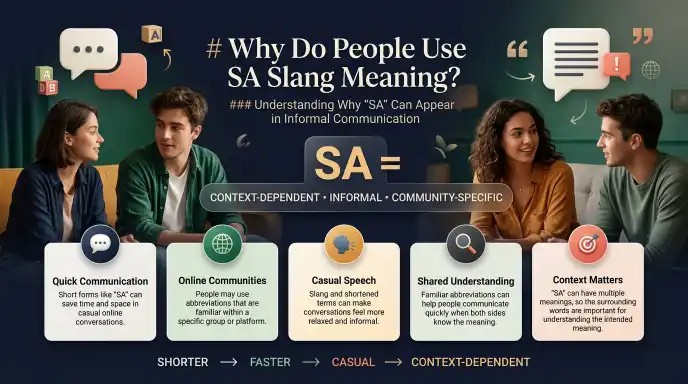
People use SA slang because short abbreviations make online communication faster and easier. In texts, comments, and chats, users often shorten common words and names to save time.
SA is especially useful because “South Africa” and “South African” are longer phrases that appear frequently in conversations about:
- Travel
- Sports
- Music
- Food
- Culture
- News
- Online communities
Instead of typing:
“I have friends from South Africa.”
Someone may write:
“I have friends from SA.”
The meaning stays clear while the message becomes shorter.
Other reasons people use SA include:
1. Faster Digital Communication
Online conversations move quickly. Short forms help people respond faster, especially in:
- Group chats
- Gaming servers
- Social media comments
- Live discussions
2. Community Identity
People may use SA to show a connection with South Africa.
Examples:
- “SA pride”
- “SA creators”
- “SA music”
These phrases can express culture, location, or community belonging.
3. Limited Space on Social Media
Platforms like TikTok, Instagram, and X often encourage shorter captions and comments.
Using SA allows users to share information without using extra characters.
SA Slang Meaning in Different Age Groups
SA is used by different age groups because it is a practical abbreviation, not a trend specific slang word.
Teenagers and Young Adults
Younger users often use SA in:
- Social media captions
- Gaming chats
- Group messages
- Online communities
Example:
“Any SA gamers here?”
Adults
Adults may use SA in:
- Professional messages
- Travel discussions
- International conversations
Example:
“The SA office will send the update.”
Older Generations
Older users may recognize SA from traditional writing, news, or geographic references rather than internet slang.
Unlike terms such as “rizz” or “sus,” SA is not limited to one generation.
Common Questions About SA Slang Meaning
Q1.What does SA mean in texting?
In texting, SA usually means South Africa or South African.
Example:
“My brother lives in SA.”
Meaning:
“My brother lives in South Africa.”
However, always check the conversation because abbreviations can have different meanings.
Q2.What does SA stand for on social media?
On social media, SA commonly stands for South Africa or South African.
Users may include it in:
- Captions
- Comments
- Hashtags
- Profiles
Examples:
- “SA travel”
- “SA food”
- “SA creators”
Q3.Is SA slang only used online?
No. SA is also used outside the internet.
People use SA in:
- News articles
- Business communication
- Travel writing
- Sports discussions
The internet simply made the abbreviation more visible.
Q4.Is SA slang rude?
No, SA is generally not rude.
When it refers to South Africa or South African, it is a neutral abbreviation.
The meaning can only become negative if someone uses it inside a disrespectful sentence about a person or group.
Q5.Can I use SA in school assignments?
It depends on the assignment.
For informal notes, SA may be understandable.
For formal school writing, it is better to write:
- South Africa
- South African
unless you define the abbreviation first.
Example:
First mention:
“South Africa (SA) has a diverse culture.”
Later:
“SA has many different traditions.”
Q6.What is the difference between SA and ZA?
SA is a common abbreviation for South Africa, while ZA is the official internet country code used for South African websites.
Examples:
- SA “I visited SA last summer.”
- ZA “This website uses a .za domain.”
Both relate to South Africa but serve different purposes.
Q7.Does SA mean something different on TikTok?
Usually, no. On TikTok, SA most often means South Africa or South African.
However, TikTok communities sometimes create their own abbreviations, so the video topic and comments should be considered.
Q8.What does SA mean in gaming?
In gaming, SA usually refers to South African players, servers, or communities.
Examples:
“Need SA teammates.”
Meaning:
“Need South African teammates.”
Gamers may use it when discussing location, connection speed, or regional groups.
Conclusion: SA Slang Meaning
SA slang usually refers to South Africa or South African, especially in online conversations, texts, and social media. It is a simple abbreviation that helps people communicate faster, but the exact meaning depends on the context.
Most of the time, SA is harmless and widely understood. It works well in casual conversations, gaming chats, and social platforms. However, in formal writing, it is often better to use the full words “South Africa” or “South African” to avoid confusion.
The key to understanding SA slang is not just knowing the abbreviation it is knowing how and where people use it. Always consider the sentence, platform, and audience before interpreting the meaning.
I’m Emily Carter, and I enjoy writing about slang, internet language, and modern English expressions. My goal is to explain word meanings in a simple, clear, and easy-to-understand way so anyone can learn with confidence.