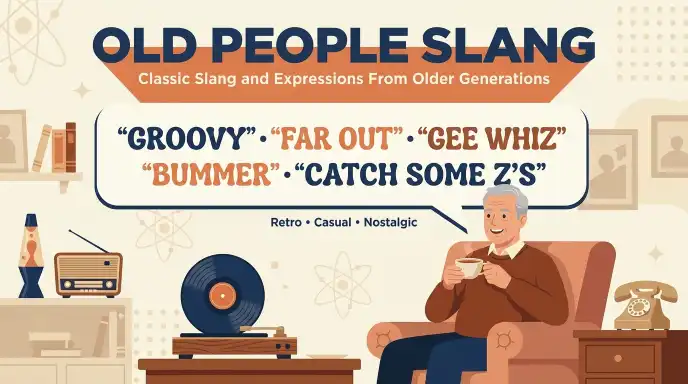
Old people slang refers to two related things: genuine old-fashioned words that older generations grew up saying, like “groovy” or “far out,” and the newer internet joke about how older adults use modern slang or texting in an outdated, overly formal, or slightly confused way.
You may also see it called boomer slang, grandpa talk, or old-school slang, depending on the platform. People search for this phrase for very different reasons. Some want to understand a word their parents or grandparents actually use.
Others saw a funny TikTok about how moms text with too many exclamation marks and want to know what that trend is called. This article covers both meanings clearly, with real examples, so you know exactly which one applies to what you heard or read.
Quick Answer: What Does Old People Slang Mean?
Old people slang has two meanings:(1) genuine vintage expressions from earlier generations, such as “far out” or “cool cat,” and(2) a modern internet joke about older adults using current slang or texting habits in a slightly outdated or awkward way. The correct meaning depends entirely on the context you saw it in.
What Does “Old People Slang” Mean?
At its core, this phrase describes language patterns tied to age. It’s not one fixed dictionary entry it’s a category that internet users apply to two different situations.
The first situation is straightforward: real slang from the 1960s, 70s, 80s, or 90s that some older people still use naturally in conversation. Words like “groovy” or “hip” fall here.
The second situation is newer and mostly a joke format born on social media. It pokes fun at how older relatives often parents or grandparents text, comment, or try to use current slang, usually getting the tone, punctuation, or timing slightly off.
Because these two situations are so different, treating them as one single definition causes confusion. The rest of this article separates them completely.
The Two Different Meanings of Old People Slang
Genuine Vintage Slang From Older Generations
Definition: Real, dated slang words that were mainstream when today’s older adults were young, and that some of them still use.
Context: Casual conversation, family gatherings, nostalgic social media posts, or media set in past decades.
Tone: Warm, nostalgic, sometimes affectionately teased but rarely meant as an insult.
Examples: “groovy,” “far out,” “cool cat,” “the cat’s pajamas,” “swell,” “hip,” “psych.”
Popularity today: Mostly used ironically or jokingly by younger people, and sincerely by some older speakers, especially in casual family settings.
The Internet Joke About How Older People Use Slang or Text
Definition: A meme-style category describing the way some older adults use modern slang, emojis, or texting habits in a way that feels slightly off compared to how younger people naturally use them.
Context: TikTok skits, Instagram Reels, family group chats, screenshots shared for laughs.
Tone: Playful and affectionate in most cases, though it can tip into mockery depending on the wording.
Examples: Typing “LOL” to mean something is mildly interesting rather than funny, ending a casual text with a period, using an emoji that doesn’t quite match the sentence, or writing out full sentences with correct punctuation in a fast group chat.
Popularity today: Very popular as a short-form video trend, especially content built around screenshots of a parent’s or grandparent’s texts.
Where Is Old People Slang Commonly Used?
The tone and purpose shift depending on the platform. Here’s how it typically breaks down:
| Platform | How it shows up |
| Texting / SMS | Real family use of Meaning 1, or screenshots shared as Meaning 2 jokes |
| TikTok | Skits and duets mimicking how a parent texts or comments |
| Reels and captions poking fun at a relative’s online habits | |
| Discord | Rarely used seriously; mostly referenced as a joke about an older member of a server |
| Discussion threads analyzing or debating generational slang differences | |
| Workplace chat | Almost never used directly; sometimes referenced casually in break-room conversation |
Notice that Meaning 1 shows up mostly in real speech, while Meaning 2 lives almost entirely on video and image-based platforms.
Is Old People Slang Rude or Offensive?
Generally, no it’s not considered offensive in either meaning, but tone matters.
genuine vintage slang is not offensive at all. It’s simply dated vocabulary.
Meaning 2, the joke format, is usually good-natured. For example, a video captioned “the way my dad texts me ‘good morning sunshine 🌞’ every single day” reads as heartwarming, not mean.
It can start to feel unkind if it’s used to mock someone directly to their face, or if it’s paired with language that suggests older people are incapable of understanding technology. Context and intent decide If it lands as affectionate or dismissive.
Real-Life Examples Of Old People Slang
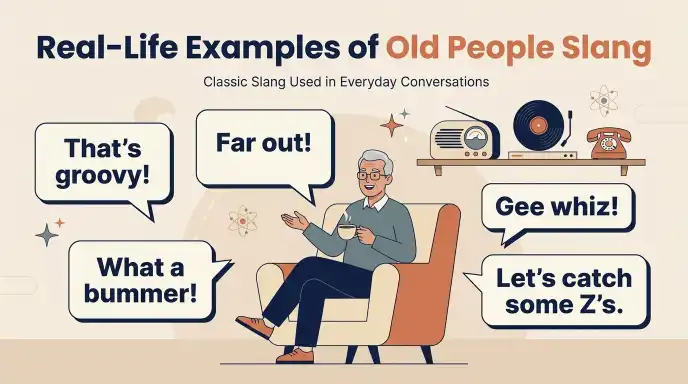
Family group chat :
Grandpa: “That new restaurant downtown is really swell, we should all go.”
TikTok caption:
“POV: your mom just discovered the fire emoji and now uses it on everything 🔥”
Text message :
Mom: “Good morning! Please have a wonderful day at school. Love, Mom.” sent at 6:45 a.m. with full punctuation.
Casual conversation :
“He called the party ‘far out’ and honestly, it kind of made sense.”
Instagram comment:
“This is so fetch!” used a decade after the phrase was popular, meant sincerely and sweetly.
Reddit discussion thread:
“Does anyone else’s dad still say ‘hip’ unironically? It’s kind of charming at this point.”
Each example shows the same core idea from a different angle: language that feels one generation behind, used either sincerely or as a lighthearted observation.
Origin and History
Traces back to real 20th-century youth slang. Words like “groovy” and “far out” were mainstream during the 1960s and 70s counterculture movement, largely tied to music and youth culture of that era. As those speakers aged, the words stayed with them, which is why they now read as generational rather than current.
Is much newer and grew out of short-form video culture. It became a recognizable content category around the mid-to-late 2010s, as TikTok and Instagram Reels made it easy to share screenshots and short skits about family texting habits.
The exact first video or post that started the trend isn’t documented anywhere reliable, so it’s more accurate to describe it as a gradually emerging joke format rather than something with one clear origin point.
It’s worth being transparent here: some sites attribute this meme trend to a single platform or year with more confidence than the evidence supports. The honest answer is that it developed organically across multiple platforms around the same time.
Similar Slang or Related Terms
| Term | How it relates |
| Boomer slang | Near-synonym for Meaning 1, often used more pointedly |
| Ok boomer | A dismissive phrase aimed at older or outdated attitudes, not the same as old people slang itself |
| Dad joke energy | Similar vibe of affectionate generational humor, but about humor style rather than language |
| Cheugy | Describes outdated trends among millennials specifically, not older generations |
| Cringe | Broader term for anything socially awkward, sometimes overlaps with Meaning 2 |
| Grandma texting | A more specific meme label focused on grandmothers’ texting style |
These terms overlap in spirit but aren’t interchangeable. “Ok boomer,” for instance, is a dismissal, not a slang category.
When Should You Avoid Using It?
Avoid using “old people slang” or similar labels in these situations:
- Directly to an older relative’s face in a way that could embarrass them in front of others
- In a professional setting when referring to a colleague’s communication style
- When the intent is to belittle someone rather than share a lighthearted moment
- In writing or comments aimed at a specific named individual without their consent
It’s generally fine in casual conversation, captions about your own family, or general discussion about generational language differences.
Why Do People Use It?
People use this phrase and its related content for a few clear reasons. It creates a shared, relatable joke that many people recognize from their own families. It also gives people a simple way to talk about real generational language shifts without needing formal linguistic terms.
For example
, instead of explaining “generational lexical drift,” someone can just say “that’s such old people slang” and everyone understands instantly.
Common Misunderstandings About Old People Slang
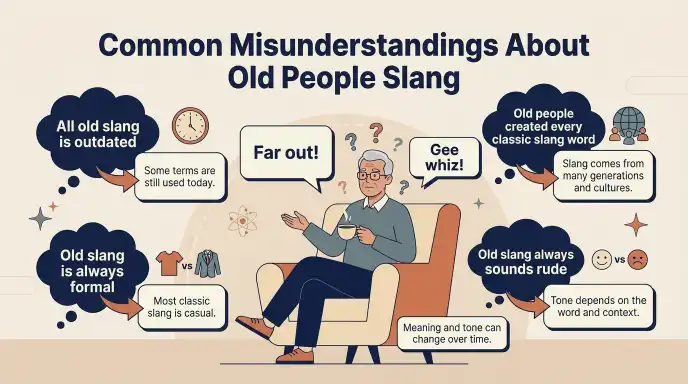
One common mix-up is assuming the phrase always refers to real historical slang, when most of its current internet use is actually the joke format about texting habits.
Another misunderstanding is treating the trend as mean-spirited by default most examples online are affectionate, not insulting. A third mix-up is confusing “old people slang” with “ok boomer,” which is a separate, more confrontational phrase.
Frequently Asked Questions
Q1. What does old people’s slang mean?
It refers to either real vintage words used by older generations, like “groovy,” or the internet joke about how older adults text and use modern slang in a slightly outdated way.
Q2. Is old people slang offensive?
Usually not. It’s typically affectionate or humorous, though it can feel unkind if used to directly mock someone.
Q3. Where did old people’s slang originate?
Meaning 1 comes from real 20th-century youth culture, especially the 1960s and 70s. Meaning 2 is a newer internet meme format that grew across TikTok and Instagram in the mid-to-late 2010s.
Q4. Can I use old people slang at work?
It’s best avoided as a description of a coworker’s communication style. It’s fine as a light, general conversation about generational language trends.
Q5. Is old people’s slang the same as “ok boomer”?
No. “Ok boomer” is a dismissive comeback aimed at outdated attitudes, while old people slang describes actual word choices or texting habits, usually in a gentler tone.
Q6. Is old people slang used on Discord or gaming platforms?
Not commonly used as real slang. It occasionally comes up as a joke reference to an older member of a server or group, but it isn’t a standard term within gaming communities.
Conclusion:
Old people slang isn’t one single thing; it’s either real, dated vocabulary still used sincerely by some older speakers, or a modern, mostly good-natured internet joke about how older relatives text and talk online.
Knowing which meaning applies depends entirely on where you saw it: a real conversation likely points to , while a TikTok or Instagram post almost always points to, Used with a light touch, it’s a relatable, harmless way to talk about how language shifts between generations.
I’m Emily Carter, and I enjoy writing about slang, internet language, and modern English expressions. My goal is to explain word meanings in a simple, clear, and easy-to-understand way so anyone can learn with confidence.