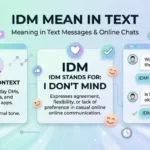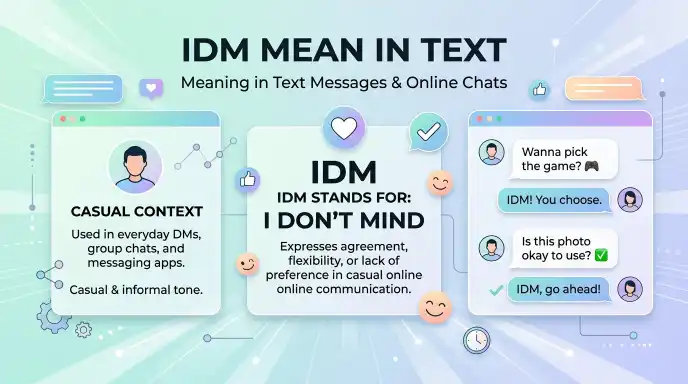
IDM usually means “I Don’t Mind” in text and online chat. People use it to say they are okay with something, have no preference, or do not object to a suggestion. You may see IDM in texting, TikTok comments, Snapchat, Instagram DMs, WhatsApp, and other casual conversations.
The meaning is usually simple, but the tone can change depending on the conversation. Someone might use IDM to sound relaxed, agree with a choice, or show that either option is fine.
People often search for the meaning of IDM because internet abbreviations can be confusing. If someone sends you “IDM” without context, understanding the phrase helps you know if they are agreeing, refusing, or simply saying they do not care which option you choose.
IDM Meaning in Text
IDM means “I Don’t Mind.” It is a common texting abbreviation used in informal online conversations.
When someone says IDM, they usually mean that they are okay with something. They may not have a strong preference, or they may be comfortable with the choice another person makes.
For example:
A: Do you want pizza or burgers?
B: IDM, you choose.
Here, B is saying, “I don’t mind. You can choose.”
The abbreviation is useful because it makes a longer sentence much shorter. Instead of typing “I don’t mind which one we get,” someone can simply write IDM.
What Type of Word Is IDM?
IDM is an abbreviation used in informal digital communication. It is formed from the first letters of the words I, Don’t, and Mind.
Unlike a traditional dictionary word, IDM is mainly used in casual communication. It belongs to the large group of texting abbreviations that help people communicate quickly.
You might see it in:
- Text messages
- Social media comments
- Private messages
- Group chats
- Gaming chats
- Online conversations
The exact meaning can sometimes depend on context. However, in everyday texting, “I Don’t Mind” is the most relevant meaning when someone is discussing a choice, suggestion, or preference.
What Does “I Don’t Mind” Actually Mean?
The phrase can express several closely related ideas.
It can mean:
“I’m okay with that.”
“That’s fine with me.”
“Either choice is okay.”
“I have no preference.”
“You can decide.”
For example:
“IDM where we eat.”
This usually means:
“I don’t mind where we eat.”
It does not necessarily mean that the person is excited about the idea. It simply shows that they do not object to it.
IDM vs. “I Don’t Care”
IDM and “I don’t care” can sometimes appear similar, but their tone can be different.
In casual conversations, IDM often sounds more relaxed and accepting. By comparison, “I don’t care” may sound neutral, dismissive, or even slightly annoyed depending on the context.
For example:
“IDM, you can choose.”
usually sounds cooperative.
On the other hand:
“I don’t care. You choose.”
can sometimes sound less interested or friendly.
This difference mainly comes from tone and context, rather than the abbreviations themselves.
Compare:
“IDM, you can choose.”
with:
“I don’t care. You choose.”
The first sentence usually sounds more cooperative. The second may sound less interesting.
Because tone is difficult to communicate through text, the surrounding conversation matters.
Where People Use IDM
IDM is mostly used in casual digital communication. People can use it when discussing plans, preferences, invitations, or everyday decisions.
It is especially useful when someone wants to tell another person that they are comfortable with either option.
IDM on TikTok
On TikTok, IDM may appear in comments, direct messages, or conversations between users.
For example:
“Which outfit should I wear?”
“IDM, both look good.”
A commenter may also use IDM when responding to a question about a choice.
TikTok comments are often short, so abbreviations can make responses quicker. Still, IDM is not necessarily a TikTok-specific term. It can be used across many platforms.
IDM on Snapchat
On Snapchat, people commonly communicate through short messages and quick replies. IDM can fit naturally into this style.
For example:
“Want to meet at 5 or 6?”
“IDM.”
The person is saying that either time works for them.
Because Snapchat conversations are usually informal, an abbreviation such as IDM can feel natural between friends.
IDM on Instagram
On Instagram, IDM may show up in DMs, comments, or group conversations.
Someone might ask:
“Should I post the blue one or the black one?”
A friend could reply:
“IDM. I like both.”
Here, the abbreviation shows that the person does not have a strong preference.
IDM on WhatsApp
WhatsApp conversations often involve quick discussions about plans. IDM can be useful when someone wants to avoid typing a complete sentence.
For example:
“Do you want to watch a movie tonight?”
“IDM.”
The response means “I don’t mind” and suggests that the person is generally okay with the idea.
In a group chat, someone might also write:
“IDM where we go.”
That means they are happy to let the group decide.
IDM in SMS
IDM can also appear in ordinary SMS text messages.
For example:
“Can I call you later?”
“IDM.”
However, this response may sound slightly unusual depending on the question. A more natural use would be:
“Do you want me to call at 7 or 8?”
“IDM.”
The second example clearly involves a choice, so the meaning is easier to understand.
Real Chat Examples of IDM in Text
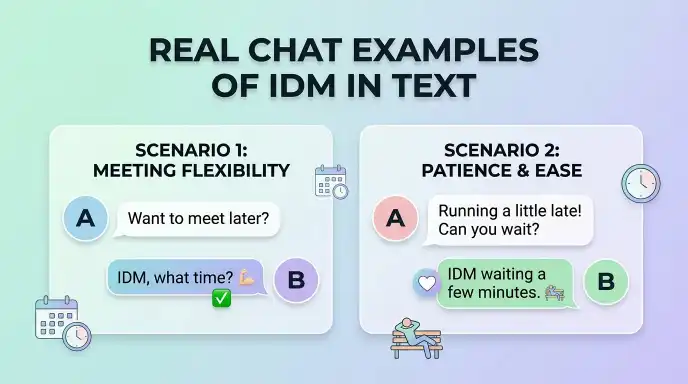
Seeing IDM in realistic conversations makes its meaning much easier to understand.
Choosing Food
A: Pizza or burgers tonight?
B: IDM.
A: Okay, let’s get pizza.
Here, B has no strong preference.
Choosing a Movie
A: Do you want to watch a comedy?
B: IDM, what do you want to watch?
A: Let’s watch that new one.
Here, B is letting A make the decision.
Making Plans
A: Should we meet at 4 or 5?
B: IDM.
A: Cool, let’s do 5.
IDM means either time is acceptable.
Choosing a Color
A: Which color should I buy, black or gray?
B: IDM, both look nice.
A: I’ll get the gray one then.
The speaker does not object to either choice.
Group Chat
A: Where should we go for lunch?
B: IDM.
C: Same here.
A: Let’s try the new café.
Both B and C are leaving the decision to someone else.
Online Shopping
A: Should I order the small or medium one?
B: IDM, whichever fits you better.
A: I’ll check the size chart.
The response shows that B does not have a preference.
Weekend Plans
A: Saturday or Sunday?
B: IDM.
A: Sunday works better for me.
IDM means both days are acceptable to B.
Gaming
A: Which map do you want?
B: IDM, you pick.
A: Let’s go with the desert map.
This is a natural casual use among players.
Study Plans
A: Want to study in the morning or evening?
B: IDM.
A: Evening then.
The person is comfortable with either time.
Choosing a Restaurant
A: Italian or Chinese?
B: IDM, I’m good with either.
A: Let’s get Chinese.
Here, the longer phrase “I’m good with either” makes the meaning especially clear.
How to Reply When Someone Says “IDM”
Your response depends on what the other person is discussing. Since IDM generally means “I Don’t Mind,” you can often make the decision yourself.
Funny Replies
If you are talking with a close friend, you can answer playfully.
“Perfect. I chose the most expensive option.”
“Great decision-making has officially been delegated to me.”
“IDM either? That means I’m choosing!”
“Okay, I’m picking the weirdest one.”
These replies work best when the conversation is already casual and friendly.
Casual Replies
For an ordinary conversation, keep the response simple.
“Okay, sounds good.”
“Cool, let’s do that.”
“Alright, I’ll choose.”
“No problem.”
“Sure, that works.”
These responses acknowledge that the other person is comfortable with your choice.
Friendly Replies
If you want to sound warm and cooperative, you could say:
“Thanks! Let’s go with this one.”
“Cool, I think you’ll like it.”
“Alright, I’ll pick something we both like.”
“Sounds good to me!”
Neutral Replies
If you do not want to add much emotion, you can simply respond:
“Okay.”
“Sure.”
“Alright.”
“That works.”
“Got it.”
The best response depends on the topic and your relationship with the person.
Is IDM Rude or Offensive?
IDM is generally not rude or offensive. The abbreviation itself is usually a neutral way of saying “I don’t mind.”
However, tone can change how any short message feels.
For example:
“IDM, you decide.”
may sound perfectly relaxed between friends.
But if someone repeatedly answers every question with:
“IDM.”
the other person might feel that they are not interested in the conversation.
This is not because IDM is an offensive word. It is simply because very short replies can sometimes seem distant or uninteresting.
Is IDM Safe to Use?
In casual conversations, IDM is generally fine to use.
It works well with:
- Friends
- Family members
- Online friends
- Group chats
- Casual social media conversations
The main thing to remember is that abbreviations are more suitable for informal communication.
Can You Use an IDM at School?
For a casual message to a classmate, IDM is usually understandable.
However, formal school communication is different. If you are emailing a teacher or writing an assignment, it is better to write “I don’t mind” or another complete phrase.
For example, instead of:
“IDM which topic we choose.”
write:
“I don’t mind which topic we choose.”
The complete sentence is clearer and more appropriate for formal communication.
Can You Use IDM at Work?
In a relaxed workplace chat, coworkers may understand IDM without any problem.
Still, formal emails, reports, applications, and professional messages usually call for standard language.
Instead of:
“IDM what time you choose.”
you could write:
“I’m fine with whichever time works best for you.”
That sounds clearer and more professional.
Who Uses IDM Mean in Text?
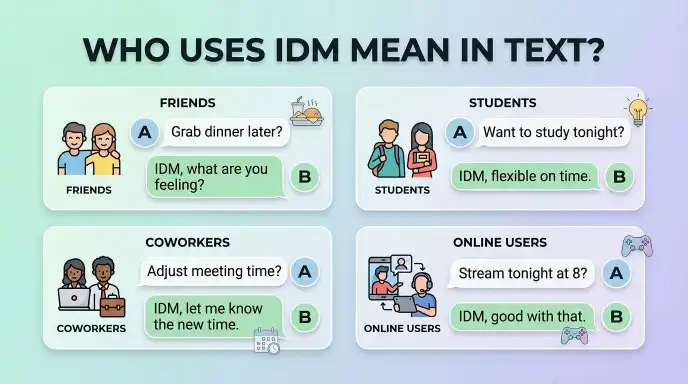
IDM is mainly used by people who communicate through texting and online messaging. It is not restricted to one particular age group.
You may see it among:
- Teenagers
- Young adults
- College students
- Social media users
- Online gaming communities
- People who frequently use chat abbreviations
Is IDM a Gen Z Term?
IDM can appear in conversations involving Gen Z, but it is not exclusively a Gen Z expression.
Texting abbreviations have been used across multiple generations. The abbreviation became useful because online communication rewards short, quick messages.
Someone may use IDM simply because they are familiar with common texting language.
Where Is IDM Most Common?
The abbreviation can appear on many platforms, including:
TikTok, Snapchat, Instagram, WhatsApp, SMS, Discord, gaming chats, and private messages.
Its use is generally more common in informal conversations than in formal writing.
How Often Does IDM Appear Online?
IDM is recognizable as a texting abbreviation, but its frequency can vary greatly between communities.
Some people regularly use abbreviations such as IDK, IDC, IMO, and BRB, while others prefer complete sentences.
So, seeing IDM online does not mean everyone uses it. Personal texting style and the platform both affect how often it appears.
Origin of the Term
The exact origin of IDM as a texting abbreviation is not clearly tied to one specific person, website, or event.
It comes naturally from shortening the phrase “I Don’t Mind” into its initial letters: I-D-M.
This follows a broader pattern in internet and texting culture. As digital communication became faster and more common, users began shortening familiar phrases to save time and space.
Similar abbreviations include IDK for “I Don’t Know,” IDC for “I Don’t Care,” and IMO for “In My Opinion.”
IDM fits into this same culture of short-form digital communication.
It is important not to confuse the texting meaning with other uses of the letters IDM. In technology, business, music, and other fields, the same three letters can have completely different meanings.
Therefore, context matters. If you see IDM in a casual conversation about plans or preferences, “I Don’t Mind” is usually the relevant interpretation.
IDM vs. Other Common Texting Abbreviations
IDM is easy to confuse with similar-looking abbreviations. The table below shows how they differ.
| Term | Meaning | Type | Usage | Popularity |
| IDM | I Don’t Mind | Texting abbreviation | Showing no preference or objection | Common in casual chats |
| IDK | I Don’t Know | Texting abbreviation | Showing uncertainty or lack of knowledge | Very common |
| IDC | I Don’t Care | Texting abbreviation | Showing lack of concern or preference | Common |
| IMO | In My Opinion | Texting abbreviation | Introducing a personal opinion | Common |
| BRB | Be Right Back | Texting abbreviation | Saying you will temporarily leave | Common |
The most important difference is the meaning behind each abbreviation.
IDM is about being okay with something.
IDK means you do not know.
IDC means you do not care.
IMO your opinion.
BRB tells someone that you will return shortly.
For example:
“Which movie should we watch?”
“IDM.”
This expresses no preference.
But:
“Which movie is better?”
“IDK.”
means the person does not know.
And:
“Which movie do we watch?”
“IDC.”
can mean that the person does not care, although it may sound less friendly than IDM.
Real-World Usage Example of IDM in Text
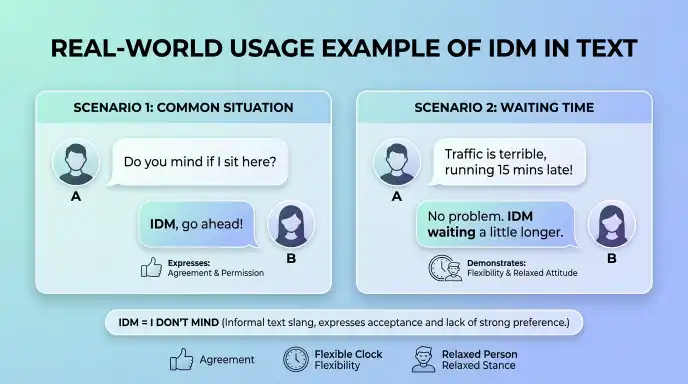
Imagine two friends are planning to meet after school.
One friend sends:
“Do you want to meet at 4:00 or 5:00?”
The other replies:
“IDM.”
The first friend understands that either time is okay. They choose 5:00 and reply:
“Cool, let’s meet at 5.”
This is a simple example of how IDM works in everyday communication.
The abbreviation does not necessarily mean that the person has no opinion about everything. It usually applies to the specific choice being discussed.
For example:
“Do you want coffee or tea?”
“IDM” means the person is okay with either option.
But if you ask:
“Are you excited about the trip?”
and they answer “IDM,” the meaning becomes less natural because the question is not really about choosing between options.
This is why context is important when interpreting short internet abbreviations.
Frequently Asked Questions
Q1. What does IDM mean in text messages?
IDM usually means “I Don’t Mind.” It tells someone that you are okay with something or do not have a strong preference.
Q2. What does IDM mean on TikTok?
On TikTok, IDM can mean “I Don’t Mind” when used in comments or messages. It usually shows that someone is okay with a choice or suggestion.
Q3. Is IDM slang?
IDM is an informal texting abbreviation. It is commonly used in casual online conversations rather than formal writing.
Q4. Is IDM rude or offensive?
No, IDM is generally not rude or offensive. However, a very short reply can sometimes sound uninterested depending on the conversation and tone.
Q5. How should you reply to IDM?
You can reply with “Okay,” “Sure,” “Sounds good,” or simply make the choice yourself. A funny response can also work with close friends.
Conclusion:
IDM usually means “I Don’t Mind” in text. People use it when they are okay with something, have no strong preference, or want someone else to make the choice.
You may see IDM in texting, TikTok, Snapchat, Instagram, WhatsApp, SMS, gaming chats, and other casual online conversations. It is especially useful when discussing plans, food, movies, times, places, or other choices.
The abbreviation is generally neutral and harmless, but it is better suited to informal communication. For school assignments, formal emails, professional messages, or other serious writing, spelling out “I don’t mind” is usually clearer.
If someone sends you “IDM,” the simplest interpretation is usually: “I’m okay with it you can choose.”
I’m Emily Carter, and I enjoy writing about slang, internet language, and modern English expressions. My goal is to explain word meanings in a simple, clear, and easy-to-understand way so anyone can learn with confidence.