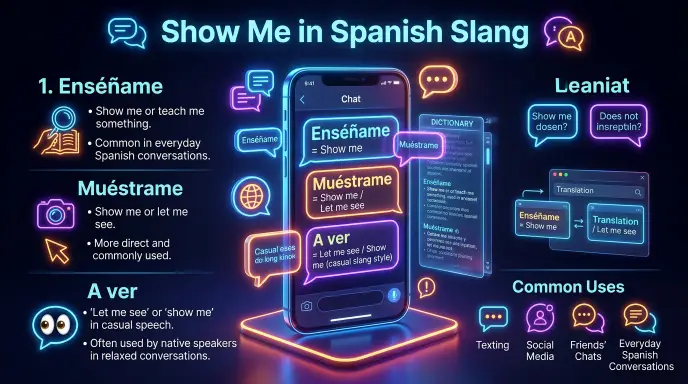
Show me in Spanish slang usually means asking how to say “show me” in a casual or informal Spanish way.
The most common translation is “enséñame,” but the exact slang expression depends on the country, situation, and tone of the conversation.
People search for “show me in Spanish slang” because they want to sound more natural when texting friends, using social media, playing games, or chatting with Spanish speakers.
Spanish slang changes across regions, so a phrase that sounds normal in Mexico may sound different in Spain, Colombia, Argentina, or other Spanish speaking communities.
Quick Answer: Show me in Spanish Slang
The common Spanish phrase for “show me” is “enséñame.” In casual slang or texting, people may also use phrases like “muéstrame,” “muestra,” or regional expressions depending on the country and context.
What Does Show Me in Spanish Slang Mean?
“Show me” in Spanish slang refers to informal ways of asking someone to display, reveal, or share something. The direct translation is not always used the same way in everyday conversations because Spanish speakers often choose different words depending on their region and relationship with the person.
The standard Spanish phrase is:
Enséñame
Meaning:
“Show me” or “teach me.”
The word can have two meanings:
- Show me something visually.
- Teach me something or help me learn.
Example:
Enséñame tu foto.
Meaning:
“Show me your photo.”
Example:
Enséñame cómo hacerlo.
Meaning:
“Show me how to do it.”
In casual conversations, people may shorten phrases or use regional slang to sound more natural.
Full Form and Definition of the Phrase
“Show me” does not have a full form because it is not an abbreviation. It is a common English phrase that is translated into Spanish in different ways.
Common Spanish versions include:
| Spanish Phrase | Meaning | Common Use |
| Enséñame | Show me / Teach me | Most common and natural |
| Muéstrame | Show me / Display for me | More direct or formal |
| Muestra | Show it / Let me see | Casual command |
| Déjame ver | Let me see | Very common in conversation |
| A ver | Let’s see / Show me | Casual reaction |
The best choice depends on the situation and the Spanish speaking country.
Common Spanish Slang Ways to Say “Show Me”
Spanish does not have one universal slang word for “show me.” Different countries use different casual expressions.
Enséñame
Enséñame is the most widely understood option.
It comes from the verb “enseñar,” which means “to teach” or “to show.”
Examples:
“Enséñame tu nuevo teléfono.”
“Show me your new phone.”
“Enséñame ese video.”
“Show me that video.”
This phrase works in most Spanish speaking countries.
Déjame Ver
Déjame ver literally means “let me see.” It is one of the most natural casual phrases used in everyday speech.
Friends often use it when they want someone to show them something.
Examples:
“Déjame ver tu outfit.”
“Let me see your outfit.”
“Déjame ver qué compraste.”
“Let me see what you bought.”
This phrase sounds friendly and conversational.
A Ver
A ver is a very common informal expression. It can mean:
- Let’s see.
- Show me.
- Let me check.
The meaning depends on the situation.
Examples:
“A ver tu dibujo.”
“Show me your drawing.”
“A ver qué tienes.”
“Let me see what you have.”
It is especially common in casual speech.
Muéstrame
Muéstrame means “show me” and is a direct translation.
It sounds slightly more formal than “enséñame” in many situations.
Examples:
“Muéstrame el documento.”
“Show me the document.”
“Muéstrame cómo funciona.”
“Show me how it works.”
People use it in both everyday and professional situations.
Is “Show Me” in Spanish Slang Rude or Neutral?
Most Spanish expressions for “show me” are neutral and harmless. They are usually friendly requests.
However, tone matters.
For example:
Friendly:
“Enséñame tu nuevo tatuaje.”
Meaning:
“Show me your new tattoo.”
This sounds interested and friendly.
More demanding:
“Enséñame ahora.”
Meaning:
“Show me now.”
This can sound impatient depending on the situation.
Like English, Spanish phrases can become rude if spoken with an aggressive tone.
Where Is “Show Me” in Spanish Slang Commonly Used?
These expressions appear in many everyday situations.
Text Messages
Spanish speakers often use short phrases in chats.
Examples:
“Enséñame la foto.”
“Show me the picture.”
“Déjame ver 😂”
“Let me see.”
Social Media
On platforms like TikTok, Instagram, Snapchat, and Facebook, users often ask others to show outfits, videos, photos, or creations.
Example:
“A ver tu nuevo look.”
Meaning:
“Show me your new look.”
Gaming Communities
Gamers may use these phrases when asking for proof, items, or game progress.
Example:
“Enséñame tu skin.”
Meaning:
“Show me your skin.”
Discord Chats
In Discord communities, Spanish speaking users may use casual expressions like “a ver” or “enséñame” during conversations.
Example:
“Enséñame tu setup.”
Meaning:
“Show me your setup.”
Real Life Conversations
Friends and family commonly use these phrases when sharing experiences.
Example:
“Déjame ver tus fotos del viaje.”
Meaning:
“Let me see your travel photos.”
Regional Differences in Saying “Show Me” in Spanish
Spanish is spoken in many countries, and casual expressions can change from one place to another. The phrase that sounds natural in Mexico may not be the most common choice in Spain or Argentina.
The basic meaning stays the same, but local habits and slang influence how people speak.
Mexico
In Mexico, common casual expressions include:
- Enséñame
- A ver
- Déjame ver
Examples:
“A ver tu celular.”
“Let me see your phone.”
“Enséñame ese video.”
“Show me that video.”
These phrases are common among friends and family.
Spain
In Spain, people commonly use:
- Enséñame
- Déjame ver
- A ver
Example:
“Déjame ver qué has comprado.”
“Let me see what you bought.”
The phrase “enséñame” is also widely understood.
Argentina and Uruguay
In Argentina and Uruguay, speakers often use relaxed conversational phrases.
Examples:
“A ver, mostrámelo.”
“Let me see it.”
“Mostrame.”
“Show me.”
The pronunciation and grammar may differ because of regional Spanish styles.
Colombia and Other Latin American Countries
Across many Latin American countries, people commonly understand:
- Enséñame
- Muéstrame
- Déjame ver
The exact phrase depends on the person and situation.
Origin and Background of These Expressions
The phrase “show me” does not come from one specific slang origin. It comes from everyday Spanish verbs that have been used for many years.
The main verbs connected to this phrase are:
Enseñar
The verb enseñar originally relates to teaching and showing. Over time, Spanish speakers have used it for both meanings.
Example:
“Enséñame la verdad.”
“Show me the truth.”
“Enséñame a cocinar.”
“Teach me how to cook.”
Mostrar
Mostrar means “to show” or “to display.”
It is the root of phrases like:
“Muéstrame.”
Meaning:
“Show me.”
This word is often used when someone wants to see something clearly.
Comparison With Similar Spanish Expressions
Different phrases can express the idea of “show me,” but their tone changes.
| Phrase | Meaning | Tone | Common Situation |
| Enséñame | Show me / Teach me | Friendly and natural | Everyday conversations |
| Déjame ver | Let me see | Casual | Friends and family |
| A ver | Let’s see / Show me | Very casual | Quick reactions |
| Muéstrame | Show me | Direct | Requests and explanations |
| Muéstramelo | Show it to me | Specific request | Asking for a particular item |
Difference Between Enséñame and Muéstrame
Although both can mean “show me,” they are not always used in the same way.
Enséñame
Enséñame feels more personal and conversational.
Example:
“Enséñame tu dibujo.”
Meaning:
“Show me your drawing.”
It can also mean “teach me.”
Example:
“Enséñame español.”
Meaning:
“Teach me Spanish.”
Muéstrame
Muéstrame focuses more on displaying something.
Example:
“Muéstrame el contrato.”
Meaning:
“Show me the contract.”
It can sound slightly more formal.
Why Do People Use Spanish Slang for “Show Me”?
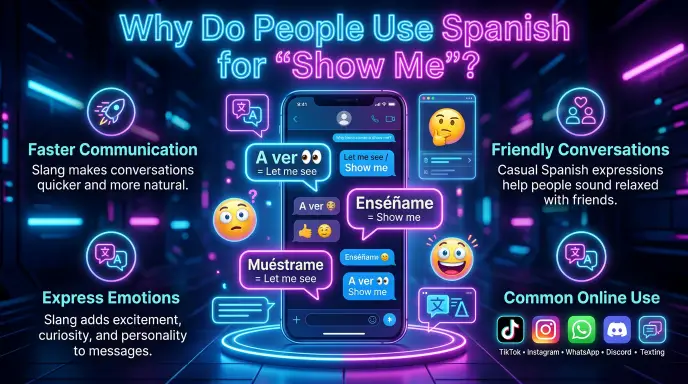
People use casual Spanish expressions because they make conversations feel more natural and friendly.
Common reasons include:
- Speaking like native speakers
- Creating a relaxed conversation
- Showing interest in someone’s life
- Reacting quickly in chats
- Building connections online
For example, saying:
“A ver 👀”
in a message feels more casual than:
“Por favor, muéstrame.”
The first sounds like something friends would naturally say.
Impact of Using Casual Spanish Expressions
Using informal Spanish phrases can help people connect better with native speakers.
Benefits include:
- Sounding more natural
- Understanding online conversations
- Communicating emotions better
- Building stronger friendships
However, using slang incorrectly can sometimes make a message sound strange.
For example:
A learner may translate English word for word and choose a phrase that native speakers do not normally use in that situation.
Learning the context is more important than memorizing one translation.
When to Avoid Using “Show Me” Spanish Slang
Most casual phrases are safe, but there are situations where a more formal approach is better.
Avoid very casual expressions when:
- Writing business emails
- Speaking with a professor or official
- Making a formal request
- Communicating with someone you do not know well
Instead of:
“Enséñame eso.”
A more polite option is:
“¿Podría mostrarme eso, por favor?”
Meaning:
“Could you show me that, please?”
Polite Alternatives to “Show Me” in Spanish
When you need a respectful tone, use formal expressions.
¿Podría mostrarme…?
Meaning:
“Could you show me…?”
Example:
“¿Podría mostrarme el documento?”
“Could you show me the document?”
¿Me puede enseñar…?
Meaning:
“Can you show me…?”
Example:
“¿Me puede enseñar cómo funciona?”
“Can you show me how it works?”
¿Me podrías mostrar…?
Meaning:
“Could you show me…?”
This is polite but still friendly.
Example:
“¿Me podrías mostrar tu proyecto?”
“Could you show me your project?”
Is “Show Me in Spanish Slang” Safe for Social Media?
Yes, these expressions are generally safe for social media.
People use them on:
- TikTok comments
- Instagram messages
- Snapchat chats
- Discord servers
- Gaming communities
- Text conversations
Examples:
“A ver el resultado 😍”
“Show me the result.”
“Enséñame tu colección.”
“Show me your collection.”
However, always consider the context. Asking someone to “show me” something personal may feel intrusive if you do not know the person well.
Respect and tone matter in online communication.
Common Mistakes English Speakers Make
Many English speakers learning Spanish make a few common mistakes.
Translating Word for Word
English:
“Show me.”
A learner may think there is only one Spanish translation.
But Spanish has several options depending on context.
Confusing Show With Teach
The verb “enseñar” can mean both:
- To show
- To teach
Example:
“Enséñame tu casa.”
Show me your house.
“Enséñame matemáticas.”
Teach me math.
The context tells you the meaning.
Using Formal Words in Casual Chats
A phrase may be grammatically correct but sound too formal.
For example:
“Muéstreme.”
is correct but may sound formal when talking with a friend.
A friend would usually say:
“Enséñame.”
or:
“Déjame ver.”
Real Life Examples of “Show Me” in Spanish Slang
The meaning of these phrases becomes clearer when you see how people use them in everyday conversations.
Friendly Conversation
Person A:
“Me compré una chaqueta nueva.”
Person B:
“¡Enséñame!”
Meaning:
“Show me!”
The speaker is excited and interested.
Text Message Example
Friend:
“Encontré fotos antiguas de la escuela.”
Reply:
“Déjame ver 😂”
Meaning:
“Let me see.”
This sounds casual and friendly.
Social Media Example
Comment:
“A ver tu nuevo look 🔥”
Meaning:
“Show me your new look.”
This type of comment is common when people share fashion, makeup, art, or creative content.
Gaming Example
Player 1:
“Conseguí una nueva arma en el juego.”
Player 2:
“Enséñame esa arma.”
Meaning:
“Show me that weapon.”
This is common in gaming chats and Discord groups.
Argumentative Situation
Person A:
“You said you finished the project.”
Person B:
“Entonces enséñame el trabajo.”
Meaning:
“Then show me the work.”
Here, the phrase sounds more serious because the speaker wants proof.
Family Conversation
Parent:
“¿Quieres ver las fotos del viaje?”
Child:
“Sí, déjame ver.”
Meaning:
“Yes, let me see.”
This shows a normal everyday use.
Why Context Matters With Spanish Slang
Spanish expressions often change meaning depending on tone, relationship, and situation.
For example:
“Enséñame.”
can sound:
- Friendly when said by a friend
- Curious when asking about something new
- Demanding during an argument
The words stay the same, but the feeling changes.
This is why understanding the situation is more important than learning only the translation.
Frequently Asked Questions
Q1: What is “show me” in Spanish slang?
The most common casual ways to say “show me” in Spanish are “enséñame,” “déjame ver,” and “a ver.” The best choice depends on the country and situation.
Q2: What does enséñame mean?
“Enséñame” means “show me” or “teach me.” It comes from the Spanish verb “enseñar,” which can have both meanings depending on context.
Q3: Is “a ver” Spanish slang for show me?
Yes, “a ver” is a very common casual expression that can mean “let’s see” or “show me.” It is often used in friendly conversations.
Q4: Is “enséñame” rude?
No, “enséñame” is normally neutral and friendly. However, it can sound demanding if used with an aggressive tone or in a serious situation.
Q5: What is the difference between enséñame and muéstrame?
Both mean “show me,” but “enséñame” sounds more natural in everyday conversation, while “muéstrame” can sound slightly more direct or formal.
Q6: Can I use “show me” Spanish slang on social media?
Yes. Expressions like “a ver,” “enséñame,” and “déjame ver” are commonly used in texts, comments, and online conversations with Spanish speakers.
Q7. How do you say I’ll show you in Spanish?
“I’ll show you” in Spanish is translated as te mostraré or te voy a mostrar. It is used when you want to say that you will show something to another person.
Q8. What does show me mean in Spanish?
“Show me” in Spanish is muéstrame or enséñame. It is a phrase used when asking someone to show or explain something.
Q9. Can I say “yo soy”?
Yes, you can say yo soy in Spanish. It means “I am” and is used to describe identity, personality, profession, or permanent characteristics.
Q10. Why does dime mean tell me?
Dime means “tell me” in Spanish because it comes from the verb decir (to say/tell) combined with me (to me). It is a common informal way to ask someone to tell you something.
Conclusion:
“Show me in Spanish slang” does not have one single translation because Spanish changes across countries and situations. The most common everyday choices are “enséñame,” “déjame ver,” and “a ver.”
These expressions are usually friendly and neutral, but their meaning depends on tone and context. A phrase used with a friend may sound completely different in a serious conversation.
If you are chatting online, texting, or talking with Spanish speakers, learning these casual expressions can help you sound more natural. Just remember that slang is about connection and context, not only direct translation.