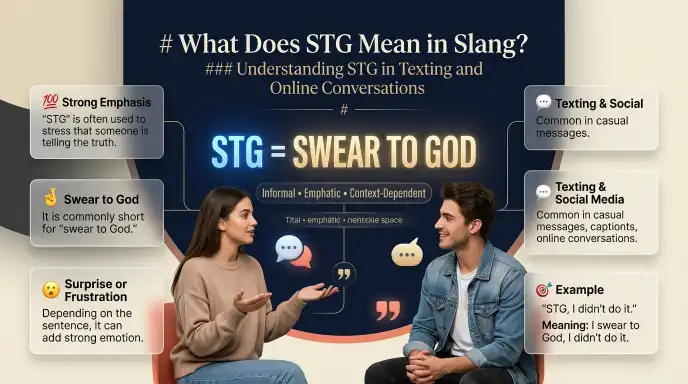
What Does STG Mean in Slang? STG means “Swear to God”. It is a casual abbreviation used in texts, chats, and social media to show that you are serious, telling the truth, or strongly emphasizing what you just said.
If someone texts “STG I didn’t do it,” they mean, “I swear to God, I didn’t do it.” The abbreviation can also express frustration, excitement, surprise, or a strong opinion. Its exact tone depends on the conversation.
You may see STG on platforms such as TikTok, Instagram, Snapchat, Reddit, Discord, and in regular text messages. It is especially common in quick, informal conversations where people shorten phrases to type faster.
In this guide, you will learn what STG means in slang, what STG stands for, how people use it, if it is rude, and when you should avoid using it.
Quick Answer: What Does STG Mean in Slang?
STG usually means “Swear To God.” In texting and social media, people use it to emphasize that they are telling the truth, making a strong statement, or expressing a strong feeling. Depending on the context, it can mean “I swear,” “I’m serious,” or “I’m not lying.”
What Does STG Mean in Slang?
STG is a short form of “Swear To God.” It is mainly used in informal online communication.
People often add STG when they want their message to sound more serious or convincing. It can show that they strongly stand behind what they are saying.
For example:
“STG, I left my phone at home.”
This means:
“I swear to God, I left my phone at home.”
The person is stressing that the statement is true.
STG can also be used without a serious situation. Friends may use it for humor or exaggeration.
“STG, this is the best pizza I’ve ever had.”
Here, the speaker is strongly praising the pizza. They are not necessarily making a formal oath.
STG Meaning in Simple Words
The easiest way to understand STG is:
- “I swear.”
- “I’m serious.”
- “I promise.”
- “I’m telling the truth.”
- “I’m not lying.”
The exact meaning depends on the sentence and the speaker’s tone.
What Does STG Stand For?
STG stands for “Swear To God.”
It is usually written as STG or stg. Both versions generally have the same meaning.
The uppercase version may look stronger because capital letters can add emphasis in online messages:
“STG I DIDN’T TOUCH IT.”
The lowercase version often feels more relaxed:
“stg that was so funny”
Capitalization does not change the basic definition. The surrounding words provide most of the meaning.
STG vs. ISTG
STG is closely related to ISTG, which means “I Swear To God.”
The difference is simple:
| Abbreviation | Full form | Common use |
| STG | Swear To God | Strong emphasis or a promise |
| ISTG | I Swear To God | Strong personal statement |
| S2G | Swear To God | Another informal abbreviation |
For example:
“STG, I didn’t know.”
“ISTG, I didn’t know.”
Both can communicate that the speaker strongly insists they are telling the truth.
Is STG a Swear Word?
STG itself is not a swear word in the usual sense. However, it contains the word “God” in the original phrase and refers to swearing an oath.
Because of that, some people may consider the full phrase religious or inappropriate in certain settings.
In casual online conversations, STG is often used simply as an expression of emphasis. Many users may not intend it as a serious religious statement.
Still, personal beliefs and social settings differ. It is better to understand the context before using it.
Is STG Rude, Offensive, or Neutral?
STG is usually informal and can be neutral, but its tone depends on how it is used.
Friendly Use
Among friends, STG can sound playful or natural.
“STG, you have to try this game.”
The speaker is simply strongly recommending something.
Serious Use
STG can make a statement sound more sincere.
“STG, I never told anyone your secret.”
Here, the speaker is trying to convince the other person that they are telling the truth.
Frustrated Use
STG can also appear in an annoyed message.
“STG, you never listen to me.”
In this case, the abbreviation adds emotional force.
Offensive Use
STG is not normally an insult or slur. However, using religious language carelessly may bother some people.
It is best to avoid it if you know the person prefers a more neutral language.
Where Is STG Commonly Used?
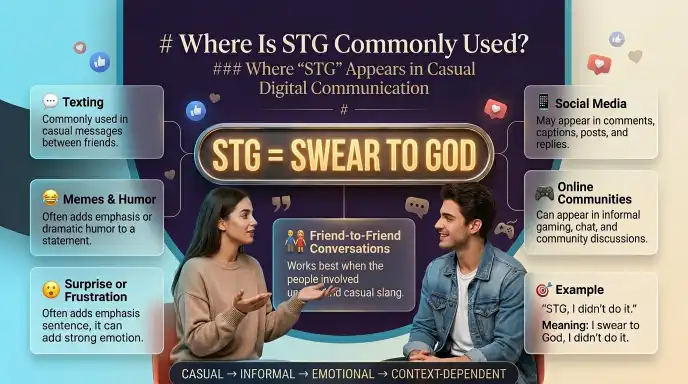
STG is mainly found in informal digital communication. It is most useful when people are chatting quickly and want to add emotion without writing the full phrase.
Text Messages
This is one of the most natural places to see STG.
“stg I thought you were coming today.”
The abbreviation keeps the message short while adding emphasis.
TikTok and Instagram
People may use STG in comments, captions, or direct messages.
“STG this video made my day 😂”
Here, it adds excitement or emphasis.
Snapchat
Snapchat conversations often use short abbreviations, so STG can appear in quick messages between friends.
“STG you scared me so bad.”
Discord
On Discord, STG may appear in casual chats between friends or gaming communities.
“STG that boss took forever.”
Reddit users may use STG in casual comments when making a strong claim or reaction.
The meaning still depends on the discussion.
Gaming
In gaming chats, STG can mean “Swear To God” when used as a normal slang abbreviation. However, STG may also have other gaming-related meanings, so the surrounding conversation matters.
How STG Changes With Tone
The same abbreviation can communicate different emotions.
| Example | Likely tone | Meaning |
| “STG I saw him there.” | Serious | I strongly insist I saw him |
| “STG this song is amazing.” | Excited | I really think this song is amazing |
| “STG, stop doing that.” | Frustrated | I am seriously asking you to stop |
| “stg 😂 you always do this.” | Playful | You keep doing this, and I’m joking about it |
| “STG I forgot.” | Apologetic | I honestly forgot |
This is why you should not translate STG using only one phrase every time. The basic idea stays the same, but the emotion can change.
Real-Life Examples of STG
Friendly Conversation
“STG, you need to watch this show.”
Meaning: The person strongly recommends the show.
Text Message
“STG I thought today was Friday.”
Meaning: The person is emphasizing that they genuinely made that mistake.
Argument
“STG, I never said that.”
Meaning: The speaker strongly denies saying it.
Gaming
“STG, that was the hardest level.”
Meaning: The player strongly believes the level was very difficult.
Social Media
“STG this is the funniest comment 😂”
Meaning: The person is strongly expressing how funny they found the comment.
Excited Reaction
“STG we actually won!”
Meaning: The speaker is showing strong excitement or disbelief.
Origin and Background of STG
The abbreviation STG comes directly from the phrase “Swear To God.” It follows a common pattern in internet language: people shorten longer phrases to make texting and online conversation faster.
The exact point when STG became common as an online abbreviation is difficult to establish with certainty. It is safer to describe it as part of the wider growth of texting and internet abbreviations rather than assign it to one specific platform or generation.
The phrase “swear to God” itself is much older than internet slang. The online abbreviation is simply a shortened written form of that phrase.
STG became useful in digital communication because short abbreviations can express strong emotion without requiring a full sentence.
It also belongs to the same general family of internet abbreviations as:
- LOL
- OMG
- IDK
- TBH
- ISTG
- S2G
These abbreviations allow people to communicate quickly while keeping a conversational tone.
STG on Different Platforms
STG usually has the same meaning on social media. However, people may use it in different ways depending on the platform and conversation.
STG on TikTok
On TikTok, STG may appear in comments, captions, or messages when someone wants to emphasize a reaction.
“STG, this is the funniest video I’ve seen today.”
The tone is usually casual and expressive.
STG on Instagram
Instagram users may use STG in comments, DMs, or captions.
“STG you look amazing in this picture.”
Here, it adds strong emphasis to a compliment.
STG on Snapchat
Snapchat conversations are often quick and informal, so STG can fit naturally into short messages.
“STG I didn’t see your message.”
The sender is strongly saying they did not notice it.
STG on Discord
On Discord, STG can appear in casual conversations, gaming chats, and community discussions.
“STG that match lasted forever.”
The abbreviation adds emotion without making the message formal.
STG in Texting
Text messages are one of the clearest places to understand STG as “Swear To God.”
“STG, I’ll be there in five.”
The speaker is emphasizing the promise.
Similar Slang and Related Abbreviations
STG is a short way to show that you are serious or telling the truth.
| Slang | Meaning | Main purpose |
| STG | Swear To God | Emphasis or sincerity |
| ISTG | I Swear To God | Strong personal emphasis |
| S2G | Swear To God | Informal alternative to STG |
| TBH | To Be Honest | Shows honesty |
| FR | For Real | Shows agreement or seriousness |
| IKR | I Know, Right? | Shows agreement |
| NGL | Not Gonna Lie | Introduces an honest opinion |
STG vs. ISTG
These two are very close.
STG = “Swear To God”
ISTG = “I Swear To God”
ISTG can sound more personal because it directly includes “I.”
“STG this happened.”
“ISTG this happened.”
Both can mean that the speaker strongly insists the event really happened.
When Should You Avoid Using STG?
STG is best for casual communication. It is not a good choice for every setting.
Avoid using it when you need to sound formal, respectful, or professional.
At Work
Do not normally use STG in formal emails, reports, applications, or business documents.
Instead of:
“STG, I sent the file yesterday.”
Use:
“I can confirm that I sent the file yesterday.”
With Teachers or Professors
In a school or academic setting, the full phrase may be too casual.
Instead of:
“STG I finished the assignment.”
A clearer option is:
“I completed the assignment.”
In Serious Professional Situations
If you are discussing an important issue, a direct statement is usually better than slang.
For example:
“I can confirm that the information is correct.”
sounds more professional than:
“STG, the information is correct.”
With People You Do Not Know Well
STG can sound overly casual when speaking with someone for the first time. If you are unsure about their communication style, use clear and neutral language.
Polite Alternatives to STG
If you want to express the same idea without slang or religious wording, several simple options work well.
Instead of Saying STG
You can say:
- “I promise.”
- “I’m serious.”
- “Honestly.”
- “I’m telling the truth.”
- “I can assure you.”
- “I really mean it.”
- “I can confirm that.”
The best alternative depends on the situation.
For example:
“STG, I didn’t know.”
can become:
“Honestly, I didn’t know.”
For a professional setting:
“I can confirm that I didn’t know.”
These alternatives make the intended meaning clear without relying on slang.
Why Do People Use STG?
People use STG because it adds emotional weight to a short message.
To Sound Convincing
When someone thinks another person doubts them, STG can make their statement stronger.
“STG, that’s exactly what happened.”
To Show Strong Emotion
The abbreviation can show excitement, frustration, surprise, or disbelief.
“STG, I can’t believe we won!”
To Save Time
Typing “STG” takes less time than writing “Swear To God.” Short forms are common in fast-moving online conversations.
To Match Casual Online Language
Using abbreviations can make a message feel more relaxed and natural among friends.
The important point is that STG adds tone. The basic information in the sentence usually stays the same.
Common Misunderstandings About STG
STG Does Not Always Mean a Literal Religious Oath
In casual texting, people often use STG simply to emphasize what they are saying.
The phrase has religious wording, but the abbreviation may be used casually.
STG Is Not Always Angry
Some people assume STG means the speaker is upset. That is not always true.
It can be exciting, funny, serious, surprising, or frustrating.
STG and ISTG Are Not Completely Different Slang Terms
They express nearly the same idea. ISTG simply includes “I.”
STG Does Not Have Only One Tone
The surrounding words, punctuation, capitalization, and conversation can change how it feels.
Compare:
“stg 😂 you are impossible”
with:
“STG. Stop doing this.”
The first may be playful. The second sounds much more serious.
STG Can Have Other Meanings
If STG appears in a technical, financial, or gaming conversation, it may not mean “Swear To God.”
Always read the surrounding message before deciding what the abbreviation means.
Is STG Appropriate for Social Media?
STG is generally suitable for casual social media use when the audience understands informal slang.
It can work well in:
- TikTok comments
- Instagram captions
- Snapchat messages
- Discord chats
- Reddit discussions
- Private messages
- Casual gaming chats
However, social media posts can reach people outside your intended audience. If you are posting something important, public, or professional, plain language is safer.
For example:
“STG this was the best day ever!”
is fine as a casual social post.
But a serious announcement should use direct language rather than slang.
Is STG Safe for Kids and Teens?
STG is generally a mild internet abbreviation rather than a harmful or dangerous slang term. It is often used by teens and adults in casual conversations.
Still, younger users should understand that online language is not appropriate in every setting.
A child or teen may use STG with friends, while a teacher, school administrator, or employer may expect more formal wording.
The main lesson is context: knowing what an abbreviation means is different from knowing when it is appropriate to use.
Is STG Used in Gaming?
Yes, STG can appear in gaming chats when players use it to express strong reactions.
For example:
“STG that player was everywhere.”
This means:
“I swear, that player was everywhere.”
A player might also write:
“STG that boss is impossible.”
Here, the abbreviation emphasizes frustration.
However, gaming can create confusion because STG may have other meanings in gaming discussions. If the conversation is about a particular game genre or technical term, look at the surrounding words before interpreting it as “Swear To God.”
How to Understand STG in a Message
If you receive a message containing STG, use the surrounding sentence to understand the tone.
Ask yourself:
- Is the person defending a claim?
- Are they making a promise?
- Are they excited?
- Are they frustrated?
- Are they joking?
- Is the conversation about gaming or another technical topic?
For example:
“STG I didn’t take your charger.”
The person is probably insisting they are telling the truth.
But:
“STG 😂 that was hilarious.”
is more likely an excited or playful reaction.
Context gives you the real tone.
Frequently Asked Questions About What Does STG Mean in Slang?
Q1. What does STG mean in slang?
STG usually means “Swear To God.” In texting, it is used to emphasize a statement, show sincerity, or express a strong emotion.
Q2. What does STG stand for in text?
STG stands for “Swear To God.” It is commonly used in casual texts, chats, comments, and social media conversations.
Q3. Is STG a bad word?
No. STG is not normally considered a swear word itself. However, it comes from a phrase involving religious language, so some people may prefer not to use it.
Q4. What does STG mean on Snapchat or TikTok?
On Snapchat and TikTok, STG usually means “Swear To God.” People use it to emphasize a reaction, statement, promise, or strong opinion.
Q5. Is STG the same as ISTG?
They are very similar. STG means “Swear To God,” while ISTG means “I Swear To God.” Both are used to strongly emphasize what someone is saying.
Q6. Can I use STG at work?
STG is best avoided in formal workplace communication. Use phrases such as “I’m serious,” “I promise,” or “I can confirm” when you need a professional tone.
Q7. What is the difference between STG and FR?
STG means “Swear To God,” while FR means “For Real.” Both can add emphasis, but STG more directly stresses that the speaker is serious or truthful.
Q8. Can STG have another meaning?
Yes. STG can have other meanings in specific fields or conversations. In casual texting and social media, however, “Swear To God” is the common slang meaning.
Conclusion: What Does STG Mean in Slang?
So, what does STG mean in slang? It usually means “Swear To God” and is used to make a statement sound more serious, sincere, emotional, or convincing.
You may see STG in texts, TikTok comments, Instagram messages, Snapchat, Reddit, Discord, and casual gaming chats. The tone can range from playful and excited to serious or frustrated.
STG is mainly informal, so it works best with friends and other casual conversations. For school, work, or formal communication, phrases such as “I promise,” “I’m serious,” or “I can confirm” are clearer choices.
The easiest way to understand STG is to look at the whole message. The abbreviation adds emphasis, but the surrounding words tell you if the person is joking, excited, frustrated, or seriously defending what they said.

I’m Emily Carter, and I enjoy writing about slang, internet language, and modern English expressions. My goal is to explain word meanings in a simple, clear, and easy-to-understand way so anyone can learn with confidence.