Funny Italian slang words are informal Italian words and phrases that can sound playful, dramatic, or amusing in casual conversation. Their meaning often depends on the situation and the speaker’s tone.
People search for funny Italian slang words because literal translations do not always explain how Italians actually use these expressions. A phrase may sound strange in English but feel completely normal in Italian. Some expressions are friendly, while others can be rude if used with the wrong person.
This guide explains common funny Italian slang words in simple English. You will learn what they mean, how people use them, where they are common, and which ones are better for friends than formal situations.
Quick Answer: Funny Italian Slang Words
Funny Italian slang words are casual expressions that Italians use to show humor, surprise, excitement, confusion, or frustration. Some are harmless and playful, while others depend strongly on tone and context.
What Are Funny Italian Slang Words?
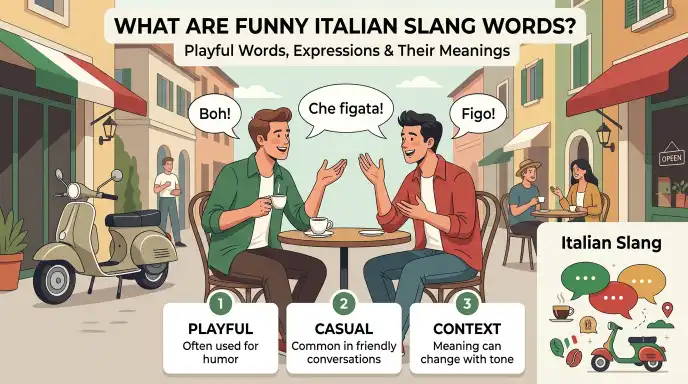
Funny Italian slang words are informal expressions used in relaxed conversations rather than formal writing. They can make speech sound more natural, emotional, or playful.
Some expressions are funny because their literal translation sounds unusual in English. Others become humorous because Italians often use dramatic words or phrases to react to everyday situations.
For example, “Che casino!” can mean “What a mess!” or “What chaos!” It may be used when a room is messy, a plan has become confusing, or too many things are happening at once.
The important point is that Italian slang should not always be translated word for word. The surrounding conversation often tells you what the speaker really means.
Popular Funny Italian Slang Words and Phrases
Here are some common informal Italian expressions that you may hear in casual speech or see online.
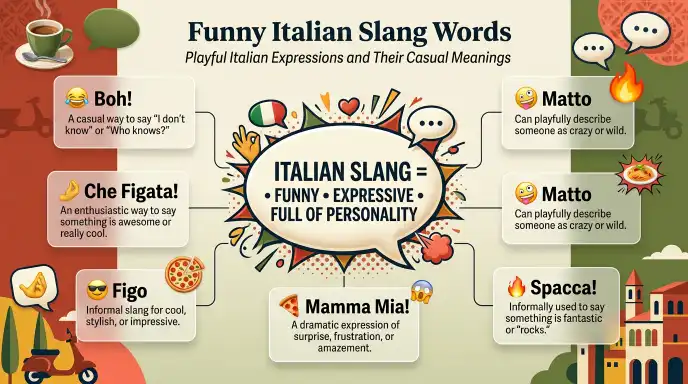
1. Mamma Mia!
Meaning: “Oh my gosh!” or “Oh my God!”
Mamma mia is a well-known Italian expression used to show surprise, frustration, excitement, or disbelief.
The tone can change its meaning. Someone might say it after seeing an amazing view or after hearing unexpected news.
Example:
“Mamma mia, that pizza is huge!”
It is an expressive phrase, so it is more common in casual situations than formal writing.
2. Boh
Meaning: “I don’t know,” “Who knows,” or “I have no idea.”
Boh is a short and very common informal expression. It can show uncertainty or a lack of interest in answering.
Example:
“Where is Marco?”
“Boh.”
Depending on the tone, the answer can sound curious, confused, casual, or slightly dismissive.
3. Figo
Meaning: “Cool,” “awesome,” or sometimes “attractive.”
Figo is an informal word used to describe something impressive or cool.
Example:
“That new bike is figo!”
It is suitable for casual conversations with friends but is not the best choice for formal writing.
4. Che Figata!
Meaning: “That’s awesome!” or “How cool!”
Che figata is a very informal expression used to show excitement about something.
Example:
“You got tickets to the concert? Che figata!”
It has an energetic and friendly feel. You are more likely to hear it in casual speech than in a professional setting.
5. Che Casino!
Meaning: “What a mess!” or “What chaos!”
Che casino is useful when something feels messy, noisy, confusing, or out of control.
Example:
“Everyone arrived at once. Che casino!”
The phrase can describe both a physical mess and a confusing situation.
6. Figurati!
Meaning: “No problem,” “Don’t mention it,” or “Of course.”
Figuration is often used when someone thanks you.
Example:
“Thanks for helping me.”
“Figurati!”
Here, it means “No problem.”
The expression can also be used in other casual situations, so its exact meaning depends on context.
7. Scemo!
Meaning: “Silly,” “dummy,” or “foolish.”
Scemo can be playful when close friends use it with each other. However, it can also be insulting.
Example:
“You forgot your keys again, scemo!”
Between friends, this may sound like teasing. Said angrily to a stranger, it can be offensive.
That makes scemo a good example of why tone matters when using Italian slang.
8. Cavolo!
Meaning: “Darn!” or a mild expression of frustration.
Cavolo can be used when something goes wrong or surprises you.
Example:
“Cavolo! I missed the bus.”
It is often used as a milder alternative to stronger language.
9. Accidenti!
Meaning: “Darn!” or “Damn!”
Accidents can express surprise, frustration, disappointment, or annoyance.
Example:
“Accidenti! I forgot my phone.”
It is generally less harsh than stronger Italian swear words.
Funny Italian Slang Words for Friends
Some expressions work especially well in relaxed conversations with friends.
| Italian Expression | Simple Meaning | Typical Tone |
| Boh | I don’t know | Casual |
| Figo | Cool | Friendly |
| Che figata! | That’s awesome! | Excited |
| Scemo | Silly / dummy | Playful or insulting |
| Figurati | No problem | Friendly |
| Che casino! | What a mess! | Casual |
| Mamma Mia! | Oh my gosh! | Expressive |
| Cavolo! | Darn! | Mild |
These expressions are not all equally informal or humorous. Some are ordinary conversational phrases, while others can sound playful because of how they are used.
Are Funny Italian Slang Words Rude or Offensive?
Most funny Italian slang words are not automatically rude. However, some expressions can become insulting depending on the context and tone.
For example, boh is usually harmless. It simply shows that someone does not know the answer.
Scemo, however, is more sensitive. A close friend might use it as a joke, while the same word from a stranger could feel insulting.
Before using an unfamiliar expression, think about:
- Who you are speaking to
- How well you know them
- If you are joking
- Your tone of voice
- If the situation is formal or casual
A good rule is simple: if you are unsure about an expression, use a neutral Italian phrase instead.
Where Are Funny Italian Slang Words Used?
Funny Italian slang is mainly used in informal communication.
Texting
Friends may use short expressions such as boh, figo, and mamma mia in text messages.
These expressions are quick and easy to understand when the people chatting already know the context.
Social Media
Italian slang can appear in captions, comments, memes, and short videos on platforms such as TikTok and Instagram.
A creator may use an expressive phrase to make a caption sound more natural or humorous.
Everyday Conversation
Spoken Italian is where tone becomes especially important.
A word can sound friendly when said with a smile but rude when said angrily. Facial expressions and voice can also change how an expression is understood.
Online Communities
You may also see informal Italian in gaming chats, Discord communities, Reddit discussions, and other online spaces.
However, not every expression is equally common on every platform. Usage depends on the speaker, age group, region, and online community.
Funny Italian Slang Words in Different Situations
The same type of expression can communicate different emotions.
| Situation | Example | Meaning |
| Surprise | “Mamma mia!” | Oh my gosh! |
| Confusion | “Boh.” | I don’t know. |
| Excitement | “Che figata!” | That’s awesome! |
| Mess | “Che casino!” | What a mess! |
| Thanks | “Figurati!” | No problem! |
| Frustration | “Cavolo!” | Darn! |
| Friendly teasing | “Scemo!” | Silly / dummy |
This is why learning slang from a simple translation list is not enough. You also need to understand the situation in which the expression is being used.
Real-Life Examples of Funny Italian Slang Words
Funny Italian slang sounds most natural when it matches the situation. The same phrase can feel friendly, surprised, excited, or annoyed depending on the speaker’s tone.
Friendly Conversation
“I love your new jacket!”
“Grazie! Figo, vero?”
Here, figo means “cool” and gives the conversation a relaxed, friendly feel.
Casual Texting
“Are you coming to the party?”
“Boh, I’m not sure yet.”
Here, both mean “I don’t know” or “who knows.”
Showing Surprise
“They bought us front-row tickets!”
“Mamma mia! That’s amazing!”
The speaker uses mamma mia to show strong surprise and excitement.
Talking About a Mess
“Why is the kitchen like this?”
“Che casino!”
Here, che casino means “What a mess!” or “What chaos!”
Showing Excitement
“We’re going to Italy next month!”
“Che figata!”
The phrase shows that the speaker thinks the news is exciting or awesome.
Friendly Teasing
“You forgot your phone again, scemo!”
Among close friends, screamo can be playful teasing. However, it can sound insulting when used toward someone you do not know well.
Origin and Background of Italian Slang
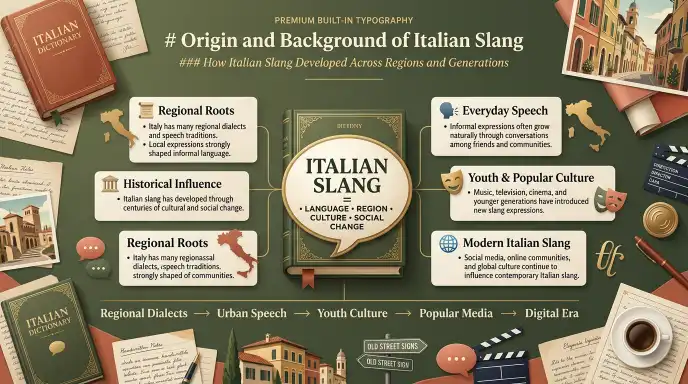
Italian slang does not have one single origin. Informal expressions have developed through everyday speech, regional language, youth culture, popular entertainment, and social interaction.
Some expressions are much older than modern social media. Others have become more visible because of television, movies, music, online communities, and social platforms.
Italian also has strong regional variation. A word or phrase that sounds common in one part of Italy may be less common in another area or may carry a slightly different tone.
For this reason, it is better not to assume that every expression is equally popular throughout Italy.
Funny Italian Slang vs. Standard Italian
The main difference is formality and context.
| Situation | Standard Italian | Informal Slang |
| Formal letter | Recommended | Avoid |
| School assignment | Recommended | Usually avoid |
| Workplace email | Recommended | Usually avoid |
| Talking with friends | Fine | Very common |
| Texting | Common | Very common |
| Social media | Common | Common |
| Jokes and memes | Possible | Very common |
Slang can make casual communication feel more natural, but standard Italian is usually safer when you need to sound professional or respectful.
When Should You Avoid Funny Italian Slang Words?
Avoid unfamiliar slang when speaking to someone in a formal or professional setting.
Be especially careful with slang when talking to:
- Teachers
- Employers
- Customers
- Clients
- Officials
- Older people you do not know
- Professional contacts
- Someone you have just met
You should also avoid using an expression simply because its English translation sounds funny. The original Italian word may have a stronger meaning than the translation suggests.
If you are unsure, choose a neutral expression instead.
Why Do People Use Funny Italian Slang Words?
People use informal expressions because they can make communication shorter, more emotional, and more natural.
Funny Italian slang can help people:
- Show surprise quickly
- Express excitement
- Make friends laugh
- Tease someone playfully
- React to a funny situation
- Show frustration
- Sound relaxed
- Create a friendly connection
For example, saying “Mamma mia!” can express a strong reaction without needing a long explanation.
Slang also helps people show personality. A casual phrase can make a message sound warmer and more expressive than formal language.
Impact of Slang on Communication
Slang can make communication more personal, but it can also cause confusion.
When both people understand the expression, slang can create a sense of familiarity. It may make a conversation feel relaxed and friendly.
The problem appears when the listener does not know the expression or misunderstands its tone.
For example, scents may be playful between close friends but offensive in another situation. This is why understanding context is just as important as knowing the translation.
Is Italian Slang Safe for Social Media?
Most mild Italian expressions are safe for normal social media use. Words such as boh, figo, figurati, and mamma mia are generally harmless in casual contexts.
However, Italian slang also includes stronger expressions that may be vulgar or offensive.
Before using slang in a public post, consider:
- Its exact meaning
- Its level of informality
- If it can insult someone
- Your target audience
- If the post is personal or professional
For a business account or professional page, standard Italian is usually the safer choice.
Common Misunderstandings About Funny Italian Slang
Not every informal phrase is slang
Some expressions are simply common conversational Italian. Calling every casual phrase “slang” can oversimplify the language.
Literal translations can be misleading
A direct English translation may not explain how native speakers actually use a phrase.
For example, understanding the words in the casino does not fully explain that the phrase can describe chaos, confusion, or a messy situation.
Tone can change the meaning
An expression like scheme can be playful among friends but insulting when used aggressively.
Regional use can differ
Italian has many regional varieties. A phrase that is common in one area may be less familiar elsewhere.
Similar Italian Expressions
Some expressions can communicate similar feelings but have different levels of informality.
| Expression | Meaning | Tone |
| Both | I don’t know | Very casual |
| Non lo so | I don’t know | Neutral |
| Figo | Cool | Casual |
| Fantastico | Fantastic | More neutral |
| Che figata! | That’s awesome! | Very casual |
| Che bello! | How nice! | Casual and widely usable |
| Cavolo! | Darn! | Mild |
| Accidenti! | Darn! / Damn! | Expressive |
This comparison shows why choosing the right expression matters. You can often communicate the same basic idea with either casual slang or more neutral Italian.
Frequently Asked Questions
Q1. What are funny Italian slang words?
Funny Italian slang words are informal expressions that can sound playful, humorous, or highly expressive in casual conversations.
Q2. Are funny Italian slang words safe to use?
Most are safe in casual settings, but some can be rude or insulting. Always check the meaning and tone before using an unfamiliar expression.
Q3. Can I use Italian slang on social media?
Yes. Informal Italian can work well in captions, comments, memes, and casual messages. Avoid expressions you do not fully understand.
Q4. Is Italian slang the same everywhere in Italy?
No. Some slang and informal expressions vary by region. A phrase that is common in one area may be less familiar somewhere else.
Q5. Can I use Italian slang with Italian friends?
Yes, especially if the conversation is casual. Still, make sure you understand if the expression is friendly, teasing, vulgar, or offensive.
Q6. Is Italian slang appropriate for work?
Usually, casual slang is not the best choice for formal workplace communication. Neutral Italian is safer for professional emails, meetings, and business conversations.
Q7. Why does Italian slang sometimes sound funny to English speakers?
Italian has expressive sounds, gestures, and dramatic ways of showing emotion. When translated directly, some informal expressions can sound amusing or unusual in English.
Q8. Are funny Italian expressions always slang?
No. Some expressions are simply informal phrases, while others are genuine slang. The terms should not all be treated as the same type of language.
Conclusion:
Funny Italian slang words add emotion, humor, and personality to casual conversations. Expressions such as boh, figo, che figata, mamma mia, and che casino can help you understand how informal Italian works in real conversations.
The key is to learn more than the translation. Pay attention to tone, context, relationship, and level of formality. A phrase that sounds funny among friends may not be appropriate with a teacher, employer, or stranger.
If you understand how an expression is normally used, you can recognize Italian slang more easily and use it with greater confidence.

I’m Emily Carter, and I enjoy writing about slang, internet language, and modern English expressions. My goal is to explain word meanings in a simple, clear, and easy-to-understand way so anyone can learn with confidence.