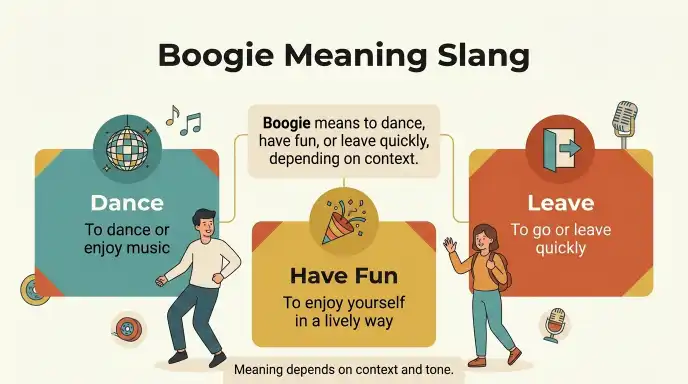
Boogie meaning slang usually refers to dancing, especially dancing in a fun, energetic, or carefree way. You may see someone say “let’s boogie” when they want to dance or have a good time. The word can also have other meanings depending on context, so the sentence matters.
People often search for boogie meaning slang after seeing the word in a text, meme, song, social media post, or casual conversation. Unlike many newer internet terms, “boogie” has been used in informal English for a long time.
In this guide, we will explain the main meanings of boogie meaning slang, where the word comes from, how people use it today, and if it is appropriate in different settings. You will also see realistic examples that make each meaning easy to understand.
Quick Answer: Boogie Meaning Slang
In casual slang, “boogie” most often means to dance or move to music. “Let’s boogie” means “let’s dance,” while “boogie” can also have other meanings in music and informal speech.
Quick Answer: What Does Boogie Mean in Slang?
Boogie is casual slang for dancing or moving energetically to music. It often has a fun, playful, and relaxed tone.
For example:
“The DJ played our favorite song, so we started to boogie.”
Here, “boogie” simply means dance.
Another common phrase is:
“Come on, let’s boogie!”
This means:
“Come on, let’s dance!”
The word is usually friendly and positive. It can describe anything from a few casual dance moves to an energetic dance at a party.
What Does Boogie Mean in Text?
In texting, boogie usually means to dance or have fun while moving to music.
Someone might text:
“This song is too good. Time to boogie!”
They are saying that the song makes them want to dance.
The word can also be used jokingly. You do not always need to be at a party or dance club to “boogie.” Someone might use it when dancing around their bedroom, kitchen, or living room.
Common texting examples
“We’re going to boogie tonight.”
Meaning: We are going out to dance and have fun.
“My little brother was boogieing around the house.”
Meaning: He was happily dancing around the house.
“I need to boogie before work.”
This could mean the person needs to move quickly or leave, depending on context.
That last example shows why context matters.
Boogie Full Form and Definition
Boogie is not normally an abbreviation, so it does not have a standard “full form.”
As a slang word, its most familiar meaning is:
Boogie = to dance, especially in a lively or enjoyable way.
It can also appear as a noun:
“We had a little boogie in the kitchen.”
Here, “a boogie” refers to a dance or period of dancing.
The word can also appear in phrases such as:
- Let’s boogie.
- Boogie down.
- Boogie on.
- Boogie the night away.
These phrases usually carry a light and playful tone.
Different Meanings of Boogie Slang
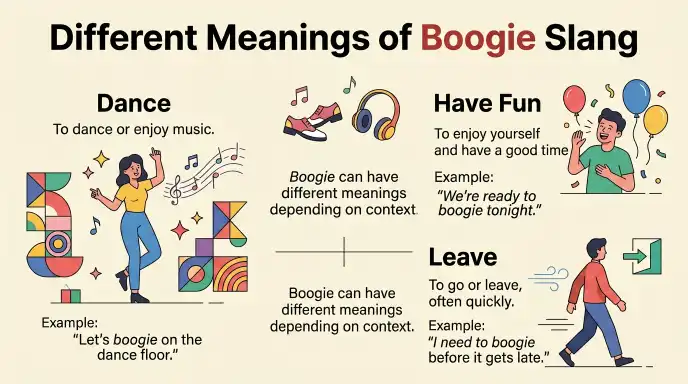
“Boogie” has several uses in English. They should not all be treated with the same meaning.
1. Boogie Means “Dance”
This is the main slang meaning most people have in mind.
“Everyone started to boogie when the music came on.”
The person is dancing in a lively, informal way.
This use is common in casual conversation and can sound cheerful or playful.
2. Boogie Means “Leave Quickly”
In some informal speech, “boogie” can mean to leave or move away quickly.
For example:
“It’s getting late. We should boogie.”
Here, the speaker probably means:
“We should leave.”
This meaning is different from dancing. The surrounding words tell you which meaning is intended.
Another example:
“I have to boogie. See you tomorrow!”
The person is saying that they need to go.
3. Boogie Can Refer to Boogie Music
“Boogie” is also connected to boogie-woogie, a style of piano-based blues music that developed in the United States in the late 19th and early 20th centuries and became especially popular in the 1930s and 1940s.
In this context, “boogie” is not simply modern slang for dancing. It can refer to a musical style or a piece of music associated with that style.
This history helps explain why the word became strongly connected with dancing and lively movement.
4. Boogie as a Playful Word
People sometimes use “boogie” simply because it sounds fun.
For example:
“The kids were having a boogie in the living room.”
The speaker could have said “dance,” but “boogie” makes the sentence warmer and more playful.
This is especially common when talking about children, parties, pets, or silly moments.
Where Is Boogie Commonly Used?
You can find “boogie” in many informal settings.
| Setting | Typical Meaning |
| Texting | Dance or leave |
| Fun dancing or party content | |
| TikTok | Dancing and playful movement |
| Snapchat | Casual dancing or jokes |
| Informal discussion or humor | |
| Discord | Casual chat, gaming, or jokes |
| Music communities | Dance or musical style |
| Everyday speech | Dance, move, or leave |
Its use is not limited to one generation or one social platform.
It is also worth noting that “boogie” is not especially new internet slang. Modern users may use it online, but the word has a much longer history.
Is Boogie Rude, Offensive, or Harmless?
Boogie is generally harmless and informal.
When it means “dance,” it usually has a cheerful or playful tone.
For example:
“Put on some music and let’s boogie!”
There is nothing offensive about this use.
When “boogie” means “leave,” it can still be friendly:
“I better boogie before I miss the bus.”
However, the exact tone depends on the sentence. Someone said “Boogie!” to another person could sound playful, but in some situations it might sound like a command to leave.
Can you use boogie at work?
It depends on the situation.
A casual workplace message might say:
“I need to boogie before traffic gets bad.”
Friends or coworkers may understand it easily.
But it is not the best choice for formal writing. In a professional email, use “leave,” “go,” or “depart” instead.
Real-Life Examples of Boogie Slang
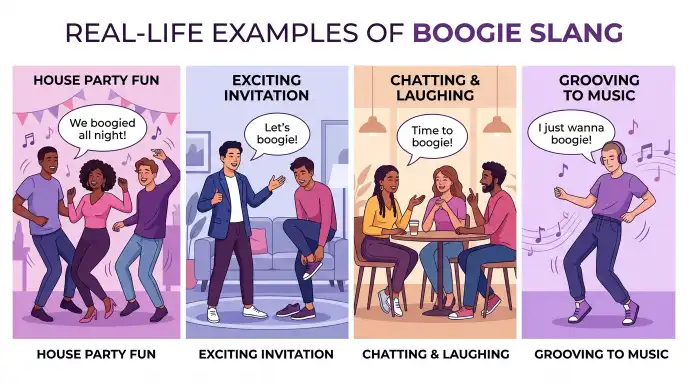
The following examples show how the word can change with context.
Friendly conversation
“Your playlist is great. Let’s boogie!”
Meaning: Let’s dance.
Tone: Friendly and excited.
Casual texting
“I’m home alone, so I’m going to boogie around the kitchen.”
Meaning: The person plans to dance casually around the kitchen.
Tone: Playful.
Party context
“Everyone was boogieing until midnight.”
Meaning: Everyone was dancing until midnight.
Tone: Fun and energetic.
Leaving quickly
“We should boogie before the rain starts.”
Meaning: We should leave quickly.
Tone: Casual.
Gaming context
“The match is over. I’m going to boogie.”
Meaning: The person is leaving the game or chat.
Tone: Casual and humorous.
Social media caption
“Friday night = time to boogie.”
Meaning: Time to dance and have fun.
Tone: Cheerful.
Argumentative context
“If you don’t want to help, you can boogie.”
Meaning: You can leave.
Tone: This can sound dismissive or unfriendly.
This example shows why context and tone matter. The word itself is usually harmless, but a speaker can use it in a rude way.
Boogie Meaning Across Different Platforms
The meaning can shift slightly depending on where you see it.
TikTok
On TikTok, “boogie” is most likely connected to dancing, music, or funny movement.
On Instagram, you might see “boogie” in captions about parties, dancing, concerts, or fun nights out.
Snapchat
Snapchat users may use it casually in messages about going out, dancing, or leaving.
Discord
On Discord, the word may mean dancing in a joke, but “I gotta boogie” can also mean “I have to leave.”
Reddit users may use “boogie” in jokes, discussions about music, or informal conversation.
Text messages
In texting, context is especially important because “boogie” can mean either dance or leave.
Origin and History of Boogie
The history of “boogie” is older than modern internet slang.
The word is strongly associated with boogie-woogie, a blues-based musical style known for energetic piano rhythms. Boogie-woogie developed in African American communities in the United States and became widely popular during the early 20th century.
The exact origin of the word itself is not completely certain. Researchers have connected “boogie” to earlier African American musical and dance language, but it would be inaccurate to claim one simple, universally accepted origin.
As boogie-woogie music became popular, “boogie” became increasingly linked with dancing and lively movement. The informal meaning then continued into everyday speech.
So, despite its popularity on modern social media, boogie did not originate on TikTok, Instagram, or among Gen Z users.
Boogie vs. Similar Slang Words
Several words can express a similar idea, but their tone is different.
| Word or Phrase | Meaning | Tone |
| Boogie | Dance or move away | Playful |
| Dance | Move to music | Neutral |
| Groove | Enjoy music through movement | Casual |
| Bust a move | Start dancing | Playful |
| Shake it | Dance or move | Casual |
| Bounce | Leave | Informal |
| Dip | Leave quickly | Slang |
| Head out | Leave | Casual |
“Boogie” is more playful than the neutral word “dance.”
If someone says:
“Let’s dance.”
It sounds normal and direct.
If they say:
“Let’s boogie.”
It sounds more energetic and fun.
When Should You Avoid Using Boogie?
“Boogie” is easy to use in casual settings, but it is not suitable for every situation.
Avoid it when:
- Writing a formal report.
- Sending a formal business email.
- Writing academic work.
- Speaking in a highly official setting.
- The meaning could be unclear.
- You need precise language.
For example, instead of:
“The manager decided to boogie.”
a formal sentence should say:
“The manager decided to leave.”
If you are talking about dancing, “boogie” is usually easy to understand in a casual setting.
Polite Alternatives to Boogie
If you want a clearer or more formal word, choose one based on the intended meaning.
If boogie means “dance”
Use:
- Dance
- Move to the music
- Have a dance
- Enjoy the music
If boogie means “leave”
Use:
- Leave
- Head out
- Go
- Take off
- Depart
For example:
Casual:
“I need to boogie.”
Clear:
“I need to leave.”
More formal:
“I need to depart.”
Why Do People Use Boogie?
The biggest reason is tone.
“Dance” tells the reader what someone is doing. “Boogie” adds personality.
Compare:
“Everyone started dancing.”
with:
“Everyone started boogieing.”
The second sentence sounds more lively and playful.
The word can also make ordinary conversations feel less serious. Saying “I gotta boogie” is often more relaxed than saying “I have to leave.”
It is useful when the speaker wants to sound friendly, humorous, or energetic.
Common Misunderstandings About Boogie
Does boogie always mean dance?
No. It can also mean leave or move away quickly in informal speech.
Is boogie an acronym?
No. It does not have a standard slang full form.
Is boogie a Gen Z slang word?
No. The word has been used for many decades and is much older than Gen Z internet culture.
Is boogie offensive?
Usually not. The common slang uses are harmless, although any word can sound rude depending on how it is used.
Does boogie mean the same thing as groove?
Not exactly. Both can relate to music and dancing, but “boogie” more directly suggests dancing or lively movement.
Can boogie mean “go away”?
Yes. In some informal contexts, “boogie” means to leave or move quickly.
Is Boogie Safe for Social Media?
Yes. Boogie is generally safe for social media when used in its ordinary informal meanings.
It is not normally a swear word or offensive term.
You can use it in casual:
- Captions
- Comments
- Texts
- Memes
- Group chats
- Gaming conversations
- Dance-related posts
The main issue is not safety but clarity. If your audience may not know the informal meaning, “dance” or “leave” may communicate your idea more clearly.
Frequently Asked Questions
Q1. What does boogie mean in slang?
Boogie usually means to dance in a fun or energetic way. In some informal contexts, it can also mean to leave or move away quickly.
Q2. What does “let’s boogie” mean?
“Let’s boogie” usually means “let’s dance” or “let’s have some fun.” Depending on the context, it can sometimes mean “let’s go.”
Q3. Is boogie a slang word?
Yes, “boogie” is commonly used informally as slang for dancing or leaving. It also has established meanings connected to music.
Q4. Is boogie rude or offensive?
No. Boogie is generally harmless and playful. However, “boogie” can sound dismissive if someone uses it to tell another person to leave.
Q5. Does boogie mean leave?
It can. In phrases such as “I gotta boogie,” the speaker may mean “I have to leave.” The surrounding context tells you which meaning applies.
Q6. Is boogie still used today?
Yes. People still use “boogie” in casual speech, texting, music discussions, and social media. It is an older informal expression rather than a newly created internet term.
Conclusion:
The boogie meaning slang is usually connected with dancing, having fun, or moving energetically to music. A phrase like “let’s boogie” is a playful way to invite someone to dance.
In another casual context, “boogie” can mean to leave or move away, as in “I gotta boogie.” The surrounding sentence is the best clue when deciding which meaning is intended.
The word is generally harmless and works well in friendly conversations, texts, social media posts, and casual chats. For formal writing, however, clearer words such as “dance” or “leave” are better.
The easiest way to remember it is: boogie = dance in a fun way, or sometimes leave quickly, depending on context.