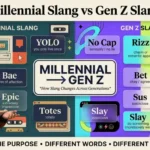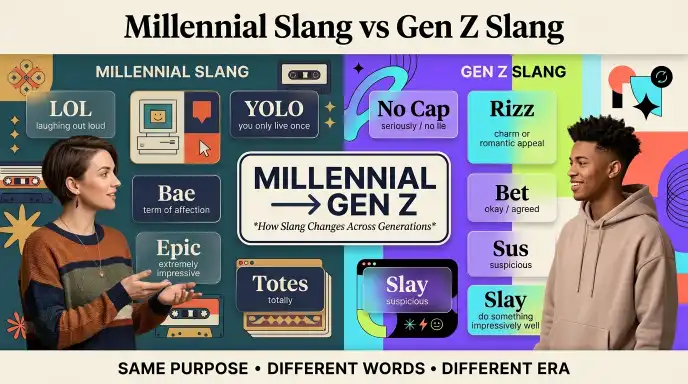
Millennial slang vs Gen Z slang compares the words, phrases, and online expressions commonly linked with Millennials and Generation Z. The two groups often share slang, but they can use different words, spellings, tones, and platforms to express the same idea.
People often search for millennial slang vs gen z slang because online language can change quickly. A phrase that sounds normal to one generation may sound old, funny, or overly formal to another.
The difference is not always about age, either. Region, social group, platform, and personal habits can shape how someone speaks.
This guide explains the main differences in a simple way. You will see common examples, platform differences, how slang has changed, and why some Millennial expressions can sound different from Gen Z language.
Quick Answer: Millennial Slang vs Gen Z Slang
Millennial slang often includes expressions that became popular through early social media, texting, blogs, and 2000s internet culture. Gen Z slang is more strongly shaped by short-form video, memes, gaming, online communities, and rapidly changing social media trends.
What Is the Difference Between Millennial Slang vs Gen Z Slang?
The main difference is the internet culture and time period that shaped each generation’s language.
Millennial slang grew during a period when texting, instant messaging, blogs, forums, and early social networks were becoming part of everyday life. Gen Z grew up with smartphones, video-first platforms, memes, gaming communities, and fast-moving online trends.
That does not mean every Millennial uses one set of words or every Gen Z person uses another. Slang spreads across age groups very easily.
For example, a Millennial may say:
“That’s so epic.”
A Gen Z speaker might be more likely to say:
“That’s fire.”
Both expressions can show strong approval, but they come from different periods of internet and youth culture.
The biggest differences
| Feature | Millennial slang | Gen Z slang |
| Main influence | Early internet and social media | Short-form video and meme culture |
| Common era | 2000s and 2010s | Late 2010s and 2020s |
| Communication style | Texting, blogs, early social networks | Videos, memes, chats, comments |
| Common tone | Casual and expressive | Fast, ironic, playful, flexible |
| Slang examples | Epic, YOLO, bae, adulting | Rizz, delulu, sus, no cap |
| Internet background | Forums, blogs, instant messaging | TikTok-style trends, gaming, meme spaces |
These are broad patterns, not strict rules. People often use slang from both generations.
Common Millennial Slang Words
Millennial slang is strongly connected with the internet culture of the 2000s and early 2010s.
Some expressions became part of everyday speech, while others are now mostly used for humor or nostalgia.
YOLO
YOLO means “You Only Live Once.”
It became widely associated with making a bold or spontaneous choice.
Example:
“I booked the trip. YOLO.”
Today, the word may sound dated to some younger speakers, but it is still widely understood.
Bae
Bae is an affectionate term for a romantic partner or someone you like.
Example:
“I’m going out with bae tonight.”
The term became popular in social media and casual online communication.
Adulting
Adulting describes doing ordinary responsibilities associated with being an adult.
Example:
“I paid my bills and cleaned the kitchen. I’m really adulting today.”
The word is often used humorously.
Epic
Epic was commonly used online to describe something extremely impressive, exciting, or memorable.
Example:
“That concert was epic.”
The word is not exclusive to Millennials, but it became especially familiar through older internet and gaming culture.
Cringe
Cringe describes something embarrassing, awkward, or uncomfortable to watch.
Example:
“That old post is so cringe.”
This word is still common today, including among Gen Z speakers.
That overlap is important: slang does not disappear simply because another generation develops newer expressions.
Common Gen Z Slang Words
Gen Z slang has been shaped heavily by social media, memes, gaming, music, and online communities.
Some expressions become popular very quickly and may change meaning over time.
Rizz
Rizz refers to charm or the ability to attract someone, especially in a romantic situation.
Example:
“He has serious rizz.”
It is usually playful and informal.
No Cap
“No cap” means “I’m telling the truth” or “I’m not lying.”
Example:
“No cap, that was the best burger I’ve had.”
“Cap” can also mean a lie or something untrue.
Sus
Sus is short for “suspicious” or “suspect.”
Example:
“That excuse sounds sus.”
The expression became especially familiar through online gaming and meme culture.
Delulu
Delulu is a playful short form of “delusional.”
It is often used when someone jokingly has unrealistic hopes or beliefs.
Example:
“I’m being delulu, but I think they’ll invite me.”
The tone is often humorous rather than clinical or serious.
Bet
Bet can mean “okay,” “sure,” or “I agree.”
Example:
“Meet me at seven?”
“Bet.”
The meaning depends on the conversation, but it is commonly used as a casual agreement.
Millennial Slang vs Gen Z Slang Examples
Looking at similar ideas side by side makes the difference easier to see.
| Meaning | Millennial-style example | Gen Z-style example |
| Something is impressive | “That’s epic.” | “That’s fire.” |
| Strong agreement | “Totally.” | “Bet.” |
| Someone is attractive | “Bae.” | “They’re a 10.” |
| Telling the truth | “Seriously.” | “No cap.” |
| Something is suspicious | “That seems weird.” | “That’s sus.” |
| Taking a risk | “YOLO.” | “Why not?” or trend-based expressions |
| Something is embarrassing | “Awkward.” | “Cringe.” |
These examples should not be treated as a strict translation guide. A person from either generation may use words from both columns.
Where Is Millennial Slang Commonly Used?
Millennial slang became popular across several forms of early digital communication.
Texting
Text messaging played a major role in spreading short expressions.
People wanted quick ways to communicate feelings, jokes, and reactions.
Early social media
Social networking helped phrases spread between friends and wider communities.
Status updates, comments, photos, and private messages all helped create shared slang.
Blogs and forums
Online forums and personal blogs also influenced Millennial language.
Different communities developed their own expressions, especially around music, gaming, entertainment, and technology.
Everyday conversation
Some Millennial slang moved from the internet into spoken English.
Words such as “adulting” can still appear in everyday conversations, even when no one is talking about the internet.
Where Is Gen Z Slang Commonly Used?
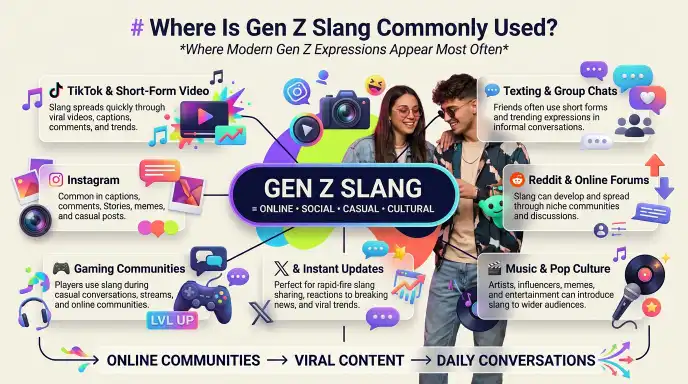
Gen Z slang is strongly connected with fast-moving online spaces.
TikTok
Short videos can spread a phrase to millions of people very quickly. A word may become popular because of a trend, joke, sound, or creator.
Comments, captions, stories, and direct messages help slang move between online communities.
Discord
Gaming and community chats can create or spread slang that later becomes common outside those groups.
Different communities develop their own vocabulary. Some terms can move from smaller online groups into wider internet culture.
Gaming
Gaming communities have long influenced online language. Gen Z slang often overlaps with gaming expressions, memes, and chat abbreviations.
The key difference is speed. A Gen Z expression can become popular, change meaning, and fade much faster than many older slang terms did.
Does Gen Z Slang Replace Millennial Slang?
Not completely.
Slang works more like a growing vocabulary than a list where every new word permanently replaces an old one.
Some expressions fade. Others become normal English. Some return as jokes or nostalgic references.
For example, a younger person might deliberately use an older Millennial expression because it sounds funny or ironic.
Likewise, Millennials can use newer Gen Z slang after seeing it repeatedly online.
This creates a lot of overlap between the two groups.
Why the generations overlap
People communicate across generations every day. Friends, coworkers, family members, teachers, students, and online communities all share language.
A Millennial who spends a lot of time on current social media may know newer slang very well. A Gen Z user who enjoys older internet culture may use expressions that are associated with Millennials.
So, slang is better understood through context than through age alone.
Is Millennial Slang Outdated?
Some Millennial slang can sound dated, but not all of it is outdated.
Words such as “adulting” remain understandable and useful. Other expressions may now be used mainly as jokes, nostalgia, or references to older internet culture.
A slang term can also return after becoming less popular.
This is why calling every older expression “dead slang” would be misleading. Usage changes gradually, and different groups can keep older terms alive.
Is Gen Z Slang Harder to Understand?
It can be, especially when a phrase comes from a specific online community.
Gen Z slang often spreads through memes, videos, gaming, and social posts. A person who does not follow those spaces may see a phrase without knowing its background.
For example, someone may understand “suspicious” but not immediately recognize “sus.”
The same issue existed with older internet slang. Each generation develops expressions that make sense within its own communication culture.
The difference is that modern platforms can spread new slang much faster and across much larger audiences.
Is Millennial Slang vs Gen Z Slang Rude or Offensive?
Millennial slang and Gen Z slang are generally casual rather than rude or offensive. However, some slang words can become disrespectful depending on the person, topic, or way they are used.
Most differences between the two generations are about style, not politeness. A phrase may sound funny, old-fashioned, trendy, or strange without actually being offensive.
For example, saying:
“That’s epic!”
is usually harmless.
Likewise:
“That’s fire!”
is normally a positive and casual expression.
The important point is that slang should always match the situation. A phrase that works in a group chat may not be suitable in a formal email, school assignment, job interview, or professional meeting.
Real-Life Examples of Millennial and Gen Z Slang
The easiest way to understand the difference is to see how each style can appear in everyday communication.
Friendly conversation
Millennial-style:
“That movie was epic. I’d watch it again.”
Gen Z-style:
“That movie was fire. I’d watch it again.”
Both sentences express strong approval. The difference is mainly the slang style.
Texting
Millennial-style:
“Bae and I are going out tonight.”
Gen Z-style:
“Bet, I’ll see you tonight.”
The first uses an affectionate term linked strongly with Millennial-era internet culture. The second uses “bet” as a casual way to say “okay” or “sure.”
Social media
A Millennial might write:
“YOLO. I’m posting the picture.”
A Gen Z user might use a newer meme-based expression or simply say:
“No cap, this picture is actually good.”
The exact wording depends on the person’s online community.
Gaming
Gaming has influenced slang across generations.
A Millennial gamer might use expressions such as:
“That was epic!”
A younger gamer might say:
“That play was cracked.”
Here, “cracked” can describe someone who is extremely skilled at a game.
Casual disagreement
Millennial-style:
“Seriously? You actually believe that?”
Gen Z-style:
“Be so for real.”
The second expression is often used online to challenge something that seems unbelievable or unreasonable.
Millennial Slang vs Gen Z Slang: Tone and Style
The biggest difference is often not the literal meaning of a word. It is the feeling behind it.
Millennial slang can sound more connected to older internet culture, direct texting, and early social media.
Gen Z slang often has a more playful, ironic, or meme-driven tone.
For example, Gen Z speakers may intentionally use a word in an exaggerated way for humor. The meaning can depend heavily on tone and context.
This does not mean every Gen Z speaker talks this way. Many people use very little slang in everyday speech.
A simple comparison
| Style | Common impression |
| Millennial slang | Casual, expressive, nostalgic |
| Gen Z slang | Casual, playful, trend-driven |
| Both | Informal and context-dependent |
These are broad patterns, not fixed rules. Individual speech varies a lot.
Origin and History of Millennial Slang vs Gen Z Slang
Millennial and Gen Z slang developed during different stages of internet growth.
Millennials generally grew up during the shift from offline communication to widespread digital communication. Text messaging, instant messaging, blogs, forums, and early social networking became major parts of communication during their youth.
This helped expressions such as “LOL,” “YOLO,” “bae,” and “adulting” become familiar in online and everyday conversations.
Gen Z grew up with a more mature internet. Smartphones, social media feeds, video platforms, online gaming, memes, and group chats were already normal parts of communication for many young people.
As a result, Gen Z slang can spread very quickly.
A phrase can appear in a video, become a meme, move into comments and group chats, and then enter everyday speech.
Why the timeline matters
It would be inaccurate to say that one generation invented all of its slang.
Many slang terms existed before they became strongly associated with a particular age group. Online communities also cross generational lines.
A better way to understand the difference is to look at when and where a phrase became popular rather than assigning every word to one generation.
How Social Media Changed Generational Slang
Social media has made slang more visible and faster-moving.
Older internet users often encountered new expressions through smaller communities, forums, blogs, messaging services, and friend groups.
Today, a phrase can reach a huge audience through a viral video or meme.
This creates a shorter slang life cycle.
A word can move through several stages:
- It starts in a small online community.
- More users discover it.
- Social media spreads it widely.
- Brands and mainstream media may use it.
- The original community may stop using it.
- The word may become outdated, ironic, or simply normal English.
This is one reason some Gen Z slang can seem to change so quickly.
Similar Slang Across Both Generations
Not every difference is clear-cut. Some slang is shared by Millennials and Gen Z.
Words such as “cringe,” “sus,” “lit,” “vibe,” and “ghosting” can appear across different age groups.
The meaning may stay similar while the style changes.
For example, “cringe” can be used by someone from either generation to describe something embarrassing.
The same person may also understand older expressions such as “YOLO” while using newer expressions such as “no cap.”
This overlap shows why generational slang should not be treated as two completely separate languages.
When Should You Avoid Using Millennial or Gen Z Slang?
You do not need to avoid slang completely. The key is choosing language that fits the situation.
In professional communication
Avoid slang when writing formal emails, reports, applications, or business documents.
Instead of:
“That idea is fire.”
you could write:
“That idea is excellent.”
In academic writing
Slang usually does not belong in essays or research papers unless the topic itself is slang or internet language.
Use clear standard English when your teacher or assignment requires formal writing.
With people unfamiliar with the slang
If you are speaking with someone who may not know the expression, use simpler wording.
This is especially helpful when the meaning could be misunderstood.
When the slang could sound forced
Using a trendy phrase simply to sound younger can sometimes have the opposite effect.
Slang sounds most natural when it fits the speaker and situation.
Why Do People Use Generational Slang?
People use slang for more than saving time.
Slang can show identity, humor, emotion, and belonging.
Someone may use a certain expression because their friends use it. Another person may use it because they saw it repeatedly online.
Slang can also make communication feel less formal.
For example:
“I agree with you.”
is clear but neutral.
“Bet.”
is shorter and more casual.
Slang can also create a shared feeling within a community. A phrase may immediately signal that someone understands the group’s jokes, interests, or online culture.
Common Misunderstandings About Generational Slang
All Millennials use the same slang
They do not.
People from the same generation can have very different vocabularies based on location, interests, culture, career, and online habits.
Gen Z invented every modern slang word
Not necessarily.
Many popular expressions have older roots or developed across several communities before becoming strongly associated with Gen Z.
Millennials do not understand Gen Z slang
Some do, and some do not.
A Millennial who spends a lot of time online may understand newer slang very well.
Gen Z never uses Millennial slang
That is also untrue.
Older expressions can remain useful, become jokes, or return through nostalgia.
Slang always has one fixed meaning
Slang can change meaning based on context.
The same word may be positive in one conversation and sarcastic in another. Tone matters just as much as the word itself.
Frequently Asked Questions About Millennial Slang vs Gen Z Slang
Q1. What is the main difference between Millennial slang and Gen Z slang?
Millennial slang is often linked with 2000s and early social media culture, while Gen Z slang is strongly influenced by modern social media, memes, gaming, and short-form video culture.
Q2. What are some examples of Millennial slang?
Common examples include “YOLO,” “bae,” “adulting,” and “epic.” Some are still used today, while others may sound dated or nostalgic.
Q3. What are some examples of Gen Z slang?
Examples include “rizz,” “no cap,” “sus,” “delulu,” and “bet.” Their popularity can change quickly because online trends spread fast.
Q4. Is Millennial slang still used today?
Yes. Some Millennial slang remains common, while other expressions are mainly used for humor, nostalgia, or references to older internet culture.
Q5. Why does Gen Z slang change so quickly?
Gen Z slang is heavily influenced by fast-moving online platforms, memes, gaming communities, and viral content. A phrase can become popular with a large audience in a short time.
Q6. Can Millennials use Gen Z slang?
Yes. Slang is not restricted to one generation. Anyone can understand or use newer expressions, although natural usage depends on the person’s social group and context.
Q7. Is Gen Z slang more informal than Millennial slang?
Not necessarily. Both are informal forms of language. The main difference is the online culture and communication style that influenced each generation.
Q8. Can I use Millennial or Gen Z slang at work?
It depends on the workplace and the people involved, but formal language is usually the safer choice. In professional communication, use slang only when the setting clearly supports a casual tone.
Conclusion: Millennial Slang vs Gen Z Slang
Millennial slang vs Gen Z slang is less about a strict list of words and more about the different online cultures that shaped each generation. Millennials experienced the rise of texting, blogs, instant messaging, and early social media, while Gen Z grew up with smartphones, memes, gaming communities, and fast-moving social platforms.
Some expressions have faded, while others remain popular across generations. Newer slang can also spread far beyond Gen Z and become part of wider everyday language.
The best way to understand generational slang is to consider the word, the speaker, the platform, and the situation together. Slang is flexible, so there is no perfect rule that every Millennial or Gen Z speaker follows.

I’m Emily Carter, and I enjoy writing about slang, internet language, and modern English expressions. My goal is to explain word meanings in a simple, clear, and easy-to-understand way so anyone can learn with confidence.