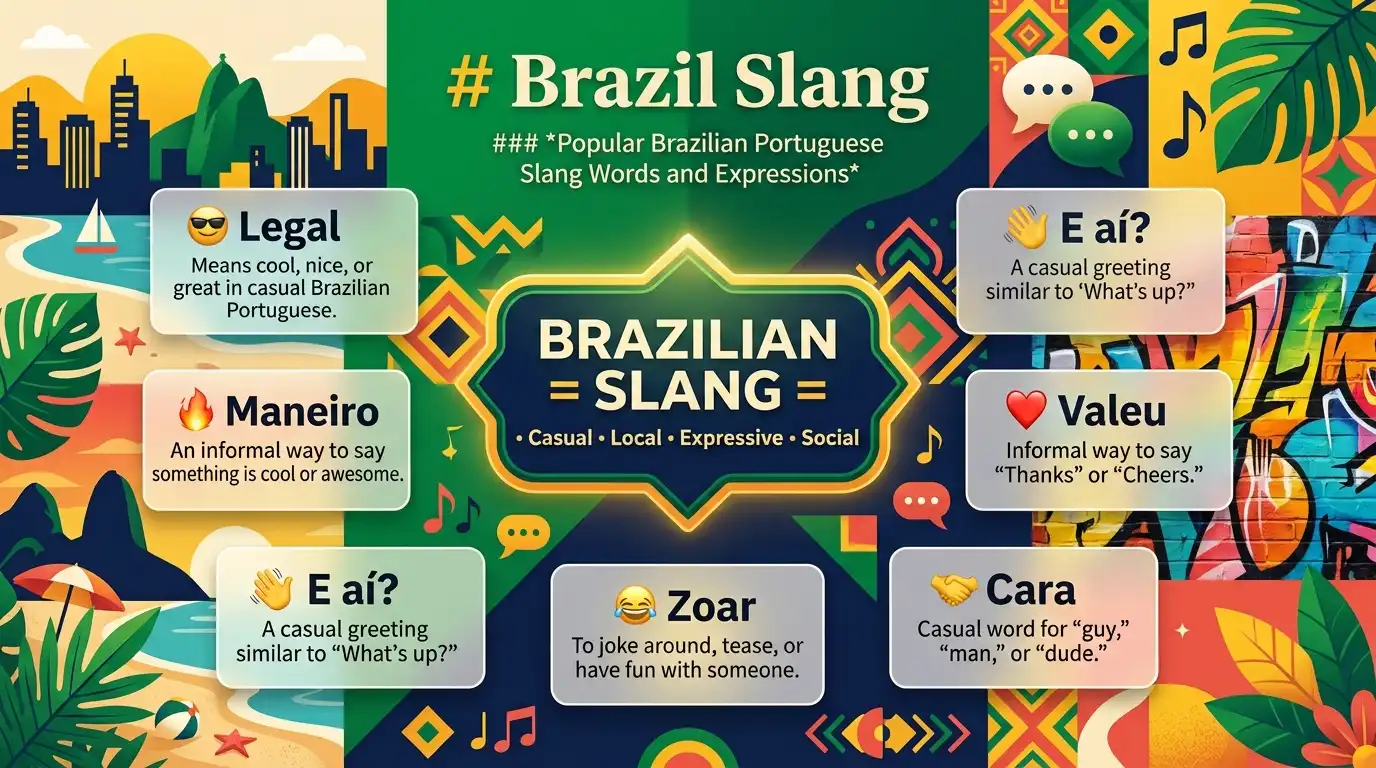
Brazilian slang refers to informal Portuguese words and expressions used in everyday communication in Brazil. These expressions can show friendship, humor, surprise, excitement, or a relaxed tone.
In Brazilian Portuguese, the usual word for slang is “gíria,” a term used for informal language and expressions linked to particular social groups or casual communication.
If you search for brazil slang, you may want to understand something you heard in a Brazilian video, song, message, game, or social media post. The important thing to know is that Brazilian slang is not one fixed list.
Expressions can vary by region, age, social group, and situation. This guide will explain common Brazilian slang words, their English meanings, how people use them, and which expressions are better suited to casual conversations.
Quick Answer: What Does Brazil Slang Mean?
Brazil slang means informal words and expressions used in Brazil, especially in casual conversations. In Brazilian Portuguese, slang is commonly called “gíria.” These expressions can appear in everyday speech, texting, social media, music, gaming, and online communities.
What Does Brazil Slang Mean?
Brazil slang is a broad term for informal Brazilian Portuguese. It includes individual words, phrases, nicknames, and expressions that may sound more natural in everyday conversation than formal Portuguese.
The Portuguese word “gíria” describes informal vocabulary that can be connected to particular groups, communities, or styles of communication. A slang expression may also give an ordinary Portuguese word a different meaning in casual speech.
For example, a learner may know that “legal” has a connection to the English word “legal,” but Brazilian speakers commonly use “legal” to mean “cool,” “nice,” or “good” in everyday conversation.
This is why Brazilian slang can be confusing for English speakers. A literal translation does not always explain what the speaker actually means.
Common Brazil Slang Words and Their Meanings
Brazilian Portuguese has many informal expressions. Some are widely understood across the country, while others are more common in certain regions or social groups.
Cara
“Cara” can literally refer to a face, but in casual Brazilian Portuguese it can also mean “guy,” “man,” or “dude.”
Example:
“Aquele cara é muito engraçado.”
Meaning: “That guy is really funny.”
It is common in relaxed conversation and is not automatically rude.
Mano
“Mano” is often similar to “bro,” “dude,” or “man” in English. It is commonly used between people who are speaking casually.
Example:
“Mano, você viu isso?”
Meaning: “Bro, did you see that?”
Its tone depends on the relationship between the speakers.
Beleza
“Beleza” literally relates to beauty, but in casual Brazilian Portuguese it can mean “okay,” “all right,” or “cool.”
Example:
“Beleza, a gente se fala depois.”
Meaning: “Okay, we’ll talk later.”
It is a common informal expression in everyday communication.
Value
“Valeu” is a popular casual way to say “thanks” or “thank you.”
Example:
“Valeu pela ajuda!”
Meaning: “Thanks for the help!”
It sounds friendly and informal.
Legal
“Legal” is commonly used in Brazil to mean “cool,” “nice,” or “great.”
Example:
“Seu projeto ficou legal.”
Meaning: “Your project turned out great.”
This is a good example of why context matters when translating Brazilian Portuguese.
Grana
“Grana” is an informal word for money or cash.
Example:
“Estou sem grana hoje.”
Meaning: “I’m out of money today.”
It is suitable for casual conversation but is less appropriate in formal financial writing.
Rolê
“Rolê” can refer to an outing, hangout, trip, or casual social activity.
Example:
“Vamos dar um rolê depois da aula?”
Meaning: “Want to hang out after class?”
The exact English translation depends on the situation.
Zoeira
“Zoeira” refers to joking around, playful teasing, or messing around.
Example:
“Foi só zoeira.”
Meaning: “It was just a joke.”
The tone matters. Friendly teasing may be harmless, but the same behavior can annoy someone if they do not enjoy the joke.
Massa
“Massa” can mean “cool,” “great,” or “awesome” in informal Brazilian Portuguese, especially in some regional varieties.
Example:
“Esse jogo é massa!”
Meaning: “This game is awesome!”
Its popularity and naturalness can vary across Brazil.
Brazil Slang in Different Situations
Brazilian slang does not sound the same in every setting. The relationship between speakers and the level of formality both matter.
| Situation | Typical slang use |
| Close friends | Very common |
| Text messages | Very common |
| Social media | Common |
| Gaming | Common |
| Discord chats | Common |
| School friends | Common |
| Casual workplace chat | Depends on the workplace |
| Job interviews | Usually avoid slang |
| Formal emails | Usually avoid slang |
| Academic writing | Prefer standard Portuguese |
A phrase that sounds natural between friends may sound too casual during a job interview. This does not make the slang “wrong.” It simply means that the setting calls for a different style of language.
Is Brazil Slang Rude or Offensive?
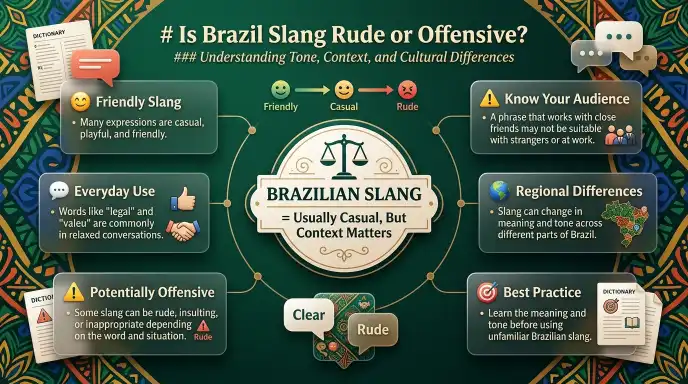
Brazil slang is not automatically rude or offensive. Many expressions are simply casual ways to communicate with friends, classmates, or online communities.
However, some slang can become insulting depending on the word, tone, and situation. A friendly expression between close friends may sound disrespectful when directed at a stranger.
For example, “mano” can sound friendly when used between friends. A strong insult, however, should not be treated as ordinary casual slang.
When you are unsure about an expression, consider:
- Who are you talking to?
- How well do you know the person?
- Is the situation formal or casual?
- Is the expression regional?
- Could the person understand it differently?
For language learners, neutral Brazilian Portuguese is usually the safest starting point.
Where Is Brazil Slang Commonly Used?
Brazilian slang can appear in both spoken and written communication.
Texting and Messaging
Friends often use informal expressions in private messages. Words such as “valeu,” “mano,” and “beleza” can make a message sound relaxed.
TikTok and Instagram
Brazilian creators may use slang in captions, comments, videos, memes, and replies. Online trends can also help expressions reach a wider audience.
Gaming and Discord
Gaming communities often use informal Brazilian Portuguese alongside gaming vocabulary. Players may use slang when reacting to teammates, matches, wins, losses, or funny moments.
Music and Entertainment
Music and popular entertainment can introduce informal expressions to large audiences. Some expressions may become familiar outside the group or region where they first became popular.
Everyday Conversation
Everyday speech remains one of the most important places to hear Brazilian slang. Friends, family members, classmates, and coworkers may use different expressions depending on their relationship.
Real-Life Brazil Slang Examples
Brazilian slang becomes easier to understand when you see it in natural sentences.
Friendly Conversation
“E aí, mano? Tudo bem?”
Meaning: “Hey, bro! How are you?”
Saying Thanks
“Valeu! Te vejo amanhã.”
Meaning: “Thanks! See you tomorrow.”
Making Plans
“Vamos dar um rolê hoje?”
Meaning: “Want to hang out today?”
Talking About Money
“Estou sem grana para sair.”
Meaning: “I don’t have money to go out.”
Reacting to Something Good
“Que massa!”
Meaning: “That’s awesome!”
Explaining a Joke
“Calma, foi só zoeira.”
Meaning: “Relax, it was just a joke.”
Origin and History of Brazil Slang
Brazilian slang does not have one single origin or starting date. The term covers a large range of informal Brazilian Portuguese expressions that have developed through different communities, regions, age groups, and social settings.
In Portuguese, “gíria” is the common word for slang. It can describe informal vocabulary associated with particular groups or everyday communication. Some slang expressions come from ordinary Portuguese words that later develop a special informal meaning.
Brazil’s large size also plays an important role. Informal vocabulary can develop differently in different parts of the country. Music, sports, local communities, television, and internet culture can also help spread expressions beyond their original setting.
Because of this, it is not accurate to say that all Brazilian slang came from the internet or from young people. Many expressions were used in spoken language long before TikTok, Instagram, and other modern platforms became popular.
Does Brazil Slang Vary by Region?
Yes. Brazilian slang can vary significantly by region, city, age group, and social community.
Brazil has a large geographic area with many regional speech patterns. A word that sounds completely normal in one part of the country may be less familiar or less common somewhere else.
Regional differences can affect:
- The words people choose
- Pronunciation
- Nicknames
- Expressions for everyday activities
- Words for food and drinks
- Ways of addressing friends
- Internet and youth vocabulary
This means that learning a slang list is only part of learning Brazilian Portuguese. Listening to real speakers helps you understand which expressions fit a particular place and situation.
Regional Context Matters
Some informal words are strongly associated with particular areas. For example, “massa” is often associated with informal speech in northeastern Brazil, although its meaning and use can be understood more broadly.
A learner should therefore avoid assuming that one expression represents the speech of all Brazilians.
Is Brazil Slang Used on Social Media?
Yes. Brazilian slang is widely used in online communication, including social media, messaging, gaming, and online communities.
Platforms such as TikTok, Instagram, WhatsApp, YouTube, and Discord can help informal expressions spread quickly. A phrase may become popular because of a meme, video, song, creator, or online trend.
However, online popularity does not always mean that an expression is used equally in everyday speech.
For example, a slang phrase may become common in comments because it fits a popular meme. That does not necessarily mean people use the same phrase frequently when talking with family or coworkers.
Brazil Slang on TikTok
TikTok encourages short, expressive, and playful communication. Brazilian users may use slang in captions, comments, jokes, and reaction videos.
The meaning often depends on the video and the surrounding conversation.
Brazil Slang on Instagram
Instagram slang can appear in captions, comments, Stories, and direct messages. Friends may use informal expressions to make their messages sound more relaxed.
Brazil Slang on WhatsApp
WhatsApp is especially important for everyday communication in Brazil. Informal expressions are common in chats between friends, relatives, classmates, and other groups.
Brazil Slang on Discord and Gaming
Gaming communities often create their own communication styles. Brazilian players may combine local slang with English gaming terms, abbreviations, and expressions used by online communities.
Is Brazil Slang Appropriate at Work?
Brazilian slang can be appropriate in some relaxed workplace conversations, but it is not the safest choice in formal professional situations.
A workplace with a friendly culture may use casual language in team chats. However, job interviews, official emails, reports, presentations, and communication with clients usually call for more neutral Portuguese.
| Situation | Recommended language |
| Job interview | Formal or neutral |
| Business proposal | Formal |
| Official email | Neutral or formal |
| Team group chat | Depends on the workplace |
| Lunch with coworkers | Casual language may be fine |
| Message to a close coworker | Informal language may be fine |
| Academic paper | Standard Portuguese |
If you are learning Portuguese for work, learn standard Brazilian Portuguese first. Then add slang as you become more comfortable with the language.
Similar Brazil Slang and Related Expressions
Brazilian slang contains many expressions that serve similar conversational purposes.
| Expression | Common meaning | Tone |
| mano | bro, dude | Friendly |
| cara | guy, man, dude | Casual |
| parceiro | buddy, partner | Friendly |
| valeu | thanks | Casual |
| beleza | okay, cool | Casual |
| legal | cool, nice | Informal |
| massa | awesome, cool | Informal |
| grana | money, cash | Casual |
| rolê | hangout, outing | Casual |
| zoeira | joking, messing around | Playful |
These are not perfect synonyms. Their meaning can change depending on the sentence, speaker, region, and relationship.
For example, “cara” and “mano” can both work when speaking casually to or about someone, but they do not always have the same feeling. “Mano” often suggests greater familiarity, while “cara” can be more general.
When Should You Avoid Using Brazilian Slang?
You should avoid unfamiliar or strong slang when you do not understand its full meaning or social context.
This is especially important when speaking with people you have just met.
Avoid slang when:
- You are writing a formal email.
- You are attending a job interview.
- You are writing an academic assignment.
- You are speaking to an official.
- You are communicating with a client.
- You are unsure if an expression could sound insulting.
- You do not know if a word is regional.
- You are copying an expression only because you saw it online.
There is also a difference between understanding slang and using it. You can recognize a slang expression without needing to use it yourself.
For language learners, this is often the best approach. First understand the word. Then listen to native speakers using it in different situations. Only after that should you decide if it fits your own conversation.
Polite Alternatives to Brazil Slang
When you need a safer or more neutral option, Brazilian Portuguese has standard expressions that can replace many casual words.
Valeu → Obrigado or Obrigada
“Valeu” is casual. “Obrigado” or “obrigada” is more neutral and appropriate in many settings.
Example:
“Obrigado pela ajuda.”
Meaning: “Thank you for the help.”
Grana → Dinheiro
“Grana” is informal. “Dinheiro” is the standard word for money.
Example:
“Não tenho dinheiro suficiente.”
Meaning: “I don’t have enough money.”
Rolê → Passeio or Saída
Depending on the meaning, “passeio” or “saída” can be more neutral than “rolê.”
Mano → Neutral Address
Instead of “mano,” you can simply use the person’s name or another appropriate form of address.
This is useful when you are unsure how casual the conversation should be.
Why Do People Use Brazilian Slang?
People use Brazilian slang because it can make communication feel more natural, relaxed, friendly, or expressive.
Slang can also create a sense of connection between people. A particular expression may show that speakers belong to the same social group, region, generation, or online community.
Another reason is efficiency. A short informal word can communicate an attitude or feeling without a long explanation.
For example, “valeu” can quickly communicate thanks. “Que massa!” can show excitement or approval. “Foi só zoeira” can explain that something was intended as playful rather than serious.
Slang can also add personality to conversation. This is one reason it is common in music, social media, comedy, gaming, and casual messaging.
Common Misunderstandings About Brazil Slang
One common mistake is thinking that Brazilian slang is the same as internet slang. It is not.
Brazilian slang includes spoken expressions that may have existed long before modern social media.
Another misunderstanding is assuming that every Brazilian uses the same words. Regional and social differences can be important.
A third mistake is translating slang word-for-word.
For example, “legal” may look like an English word with a similar spelling, but in everyday Brazilian Portuguese it can mean “cool” or “nice.”
It is also easy to assume that an expression is always friendly because you saw someone use it jokingly online. Tone, relationship, and context can change how a phrase feels.
Frequently Asked Questions About Brazil Slang
Q1. What is the most common Brazilian slang?
There is no single “most common” slang word used by everyone in Brazil. Expressions such as “cara,” “mano,” “valeu,” and “beleza” are widely recognized in casual Brazilian Portuguese, but usage varies by region and social group.
Q2. What does “mano” mean in Brazilian slang?
“Mano” commonly means “bro,” “dude,” or “man.” It is informal and is often used between friends or people communicating in a relaxed way.
Q3. What does “valeu” mean in Brazilian slang?
“Valeu” is a casual way to say “thanks” or “thank you.” It is common in friendly conversation, texting, and other informal situations.
Q4. What does “beleza” mean in Brazilian slang?
“Beleza” can mean “okay,” “all right,” or “cool” in casual Brazilian Portuguese. Its exact meaning depends on the sentence and context.
Q5. Is Brazilian slang different from Portuguese slang in Portugal?
Yes. Brazilian Portuguese and European Portuguese have different vocabulary, pronunciation, expressions, and slang. A casual expression common in Brazil may sound unusual or have a different meaning in Portugal.
Q6. Is Brazilian slang used by young people only?
No. Some slang is associated with younger speakers, but many informal expressions are used by people of different ages. Usage depends on the expression, region, community, and situation.
Q7. Can foreigners use Brazilian slang?
Yes, but it is better to learn the context before using it. Start with widely understood, mild expressions and listen to native speakers to understand how they sound in real conversations.
Q8. Is Brazilian slang appropriate in formal writing?
Usually not. Formal emails, academic writing, official documents, and professional communication generally require standard or neutral Brazilian Portuguese rather than casual slang.
Conclusion: Understanding Brazil Slang
Brazilian slang is a broad part of informal Brazilian Portuguese, not a single fixed vocabulary list. Expressions such as “mano,” “cara,” “valeu,” “beleza,” “grana,” and “rolê” can make casual communication sound more natural, but their meaning and popularity can vary by context and region.
The safest way to learn Brazilian slang is to understand both the word and the situation in which people use it. Casual expressions can work well with friends and online communities, while formal situations usually call for neutral Portuguese.
If you are learning Brazilian slang, focus on meaning, tone, region, and context rather than memorizing words alone. That approach will help you understand Brazilian conversations more naturally and avoid using an expression in the wrong situation.

I’m Emily Carter, and I enjoy writing about slang, internet language, and modern English expressions. My goal is to explain word meanings in a simple, clear, and easy-to-understand way so anyone can learn with confidence.