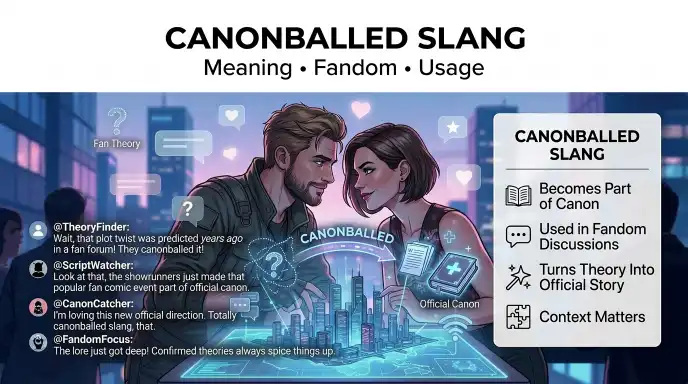
Canonballed slang is an informal fandom expression for something that becomes part of a fictional story’s canon. Fans may use it for a character detail, relationship, theory, prediction, or story event that later gets official support.
The term comes from “canon,” which means the official parts of a fictional story or universe. People may use canonballed in fandom chats, social media posts, and online discussions.
Since the term remains niche, its meaning can change slightly between communities. This guide explains what canonballed means, how fans use it, and how it differs from canon, headcanon, fanon, and other fandom terms.
Quick Answer: What Does Canonballed Mean?
Canonballed slang describes something that becomes part of a fictional story’s canon or receives official support from the story. Fans may use it for a character detail, relationship, fan theory, prediction, or story event that once seemed uncertain.
For example, fans might create a theory about two characters. Later, an official episode confirms the theory. Fans may jokingly say that the theory “got canonballed.”
The term mainly appears in casual fandom conversations. Since canonballed is niche slang, context can affect its meaning. For a general audience, “became canon” or “was officially confirmed” usually sounds clearer.
What Does Canonballed Mean in Slang?
Canonballed is an informal term built around the word “canon.” In fiction, canon refers to the official parts of a story or fictional universe.
Fans may use canonballed when an idea moves from speculation into official story material. The idea might involve a character, relationship, backstory, theory, or major event.
For example:
“That fan theory got cannonballed in the latest episode.”
The speaker means that the episode supported or confirmed the theory.
The term has a casual and playful tone. It fits online fandom discussions better than formal writing. People may also use simpler phrases such as “became canon,” “got confirmed,” or “was made official.”
Where Does the Word Canonballed Come From?
Canonballed appears to come from the common fandom word “canon.” Fans have used canon for many years to describe the official events, characters, facts, and relationships within a fictional work.
The “-balled” ending gives the word a playful action-based feel. It suggests that something moved into canon or gained official support.
However, no widely accepted source gives a specific creator, date, or origin for canonballed. Because the word remains niche internet slang, different fandoms may use it in slightly different ways.
Some fans may use canonballed for humor, while others may simply say that something “became canon.” The context usually makes the intended meaning clear.
What Does Canon Mean in Fandom?
In fandom, canon means the information that the official story establishes as true. This can include characters, events, relationships, locations, backstories, and other story details.
For example, if a TV show clearly confirms that two characters are dating, their relationship becomes part of the story’s canon.
The same idea applies to character information. If an official episode reveals a character’s real name or family history, fans can treat that information as canon.
Canon differs from fan ideas. A fan may believe that two characters have a secret connection, but that belief remains a theory or headcanon until the official story supports it.
Understanding this difference makes the meaning of canonballed easier to understand.
How Is Canonballed Used in Fandom?
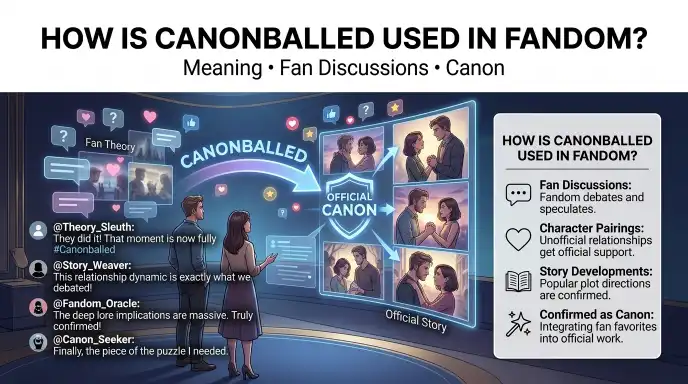
Fans use cannonballs in casual conversations about fictional stories, characters, theories, and relationships.
The term often appears when something starts as a fan idea and later receives support from official content.
For example, fans may discuss a possible relationship between two characters for months. Then, a new episode confirms that they have romantic feelings for each other. Fans may say:
“They finally got canonballed!”
Fans can also use the term for theories and character details. Someone might say:
“Our theory got canonballed!”
The phrase can show excitement, surprise, or humor. However, fans should not assume that every popular theory becomes canon. Official story material must support the idea.
Canonballed Examples
Canonballed can describe several fandom situations. Here are some simple examples.
A Fan Theory
“That fan theory got cannonballed in the latest episode.”
This means the official episode supported a theory that fans had discussed before.
A Character Detail
“Her childhood headcanon got canonballed in the new chapter.”
Here, the speaker says that the official story confirmed a detail that fans had previously imagined.
A Relationship
“The writers finally cannonballed their relationship.”
This means the story officially supported or confirmed the relationship.
A Fan Prediction
“I can’t believe our prediction got canonballed.”
The speaker feels surprised because the official story matched their earlier prediction.
A Headcanon
“They really canonballed that headcanon.”
This means the official story later supported an idea that a fan had previously imagined.
These examples show the informal nature of the word. Fans may use it differently depending on their community.
What Does Canonballed Mean in Texting?
People can use cannonballed in text messages when they discuss fictional stories, characters, or fandom theories.
For example:
“They actually cannonballed our theory!”
The speaker means that official story content confirmed the theory.
Another example:
“That ship got canonballed 😭”
Here, the speaker means that the fictional relationship they supported became official or received strong confirmation.
Canonballed works best when both people understand the fandom. Someone outside that community may not understand the term immediately.
For general conversations, “became canon” or “was officially confirmed” gives a clearer meaning.
Canonballed Meaning on Social Media
Fans may use canonballed on social media after a new episode, chapter, movie, or game release confirms an idea.
For example:
“The new episode canonballed this theory!”
The writer means that the episode gave official support to a theory that fans had discussed.
Fans may also use the term when talking about relationships:
“Our favorite ship just got canonballed.”
Social media users often use fandom slang in a playful way. Therefore, canonballed may not always follow one strict definition.
Look at the surrounding post or comment to understand what the speaker means.
Can a Relationship Be Canonballed?
Yes. Fans may use canonballed when a relationship moves from fan speculation into the official story.
For example, fans might ship two characters because they share strong chemistry. The story may later confirm that the characters have romantic feelings for each other.
A fan could then say:
“They finally got canonballed!”
The phrase shows excitement about the relationship becoming official.
However, shipping does not automatically make a relationship canon. Fans can support a ship even when the official story never confirms it.
The story needs to provide clear support before fans can reasonably describe the relationship as official.
Can a Fan Theory Be Canonballed?
Yes. Fans may call a theory cannonballed when official story material confirms or strongly supports it.
For example, imagine that fans predict that one character secretly belongs to another character’s family. A later episode reveals the family connection.
Fans might say:
“Our theory got canonballed!”
The phrase highlights the fact that fans predicted something that the official story later confirmed.
Still, not every correct prediction needs the term. Sometimes a theory simply happens to match the story. The official material should provide enough evidence to support the claim.
Canonballed vs Canon
Canon and canonballed connect to the same idea, but they do not mean the same thing.
Canon refers to information that the official story accepts as true.
Canonballed works as an informal expression for something becoming part of that canon or receiving official support.
For example:
“Their relationship is canon.”
This simply states that the relationship exists officially in the story.
“Their relationship got canonballed.”
This gives the statement a more playful fandom tone. It suggests that the relationship moved from speculation or fan support into official story status.
For general readers, “became canon” usually gives a clearer meaning.
Canonballed vs Canonical
Canonical is an established term for something that belongs to a story’s official canon.
For example:
“The event is canonical.”
This means the event forms part of the official story.
Canonballed has a more casual meaning. Fans may use it when an idea, theory, or relationship receives official support.
For example:
“That theory became canonical.”
sounds more formal than:
“That theory got canonballed.”
The two expressions can describe a similar situation, but canonical works as a standard descriptive term. Canonballed works better in casual fandom conversations.
Canonballed vs Canonized
Canonized and canonballed can sound similar, but they have different tones.
Canonized is a more established word. In fandom discussions, it can describe something that becomes accepted as part of a story’s canon.
Canonballed is an informal and playful expression. Fans may use it when a theory, headcanon, relationship, or prediction receives official support.
For example:
“The new episode canonized their relationship.”
This sounds more formal.
“The new episode cannonballed their relationship.”
This sounds more casual and playful.
If you write for a general audience, “became canon” or “was officially confirmed” usually communicates the idea more clearly.
Canonballed vs Headcanon
Headcanon means a fan’s personal belief or interpretation about a fictional story.
A fan might believe that a character secretly loves another character, has a certain hobby, or had a particular childhood experience. If the official story never confirms the idea, it remains a headcanon.
Canonballed describes a different situation. Fans may use it when an idea that started as a headcanon later receives official support.
For example:
“I always had a headcanon that they were siblings.”
If the story later confirms that they are siblings, the fan might say:
“My headcanon got canonballed.”
So, a headcanon starts with the fan. Canonballed describes an informal move from a fan idea toward official story status.
Canonballed vs Fanon
Fanon refers to ideas that fans create or widely accept within a fandom. These ideas can become common among fans even when the official story never confirms them.
For example, many fans might agree that a character has a specific personality trait that the original story never clearly establishes. That idea can become part of the fandom’s fanon.
If the official story later confirms the same detail, fans might jokingly call it canonballed.
The main difference is simple:
Fanon comes from the fan community.
Canon comes from the official story.
Canonballed can describe an idea moving from fan discussion toward official canon.
Canonballed vs Non-Canon
Non-canon means something does not belong to the official story continuity.
Fanfiction, alternate versions, fan theories, and some deleted or unused ideas may fall outside canon.
Canonballed describes a very different situation. Fans may use it when an idea receives official support or becomes part of the story.
For example:
“That scene is non-canon.”
This means the scene does not form part of the official story.
“The new episode cannonballed that theory.”
This means the episode supported a theory that fans had discussed.
So, non-canon describes something outside official continuity, while canonballed can describe an idea moving toward official canon.
Canonballed vs Retcon
A retcon, or retroactive continuity, happens when later story material changes, adds to, or reinterprets information that the story already established.
For example:
“The writers retconned his backstory.”
This means later content changed how fans should understand his earlier history.
Canonballed has a different focus. Fans may use it when an idea or theory receives official support.
For example:
“The new episode cannonballed the fan theory.”
A retcon can change existing canon. Canonballed usually describes an idea gaining support from canon.
Therefore, these terms can appear in the same fandom discussion, but they do not mean the same thing.
Why Do People Say Canonballed?
Fans may use canonballed because it gives them a playful way to describe an idea becoming official.
The term can show excitement when a fan theory turns out to be correct. It can also add humor to conversations about fictional characters and relationships.
For example:
“Our theory got canonballed!”
This sounds more playful than:
“The writers confirmed our theory.”
Fans may also use the term when an old headcanon suddenly appears in official content.
Because canonballed remains niche slang, some fans may prefer more familiar phrases such as “became canon” or “was confirmed.”
Is Canonballed a Common Slang Term?
Canonballed is a niche and informal expression. It does not have the same broad recognition as terms such as canon, headcanon, or fanon.
You will most likely see it in fandom communities and online discussions about fictional stories.
Different communities may also use the word in slightly different ways. Some fans may use it to mean “became canon,” while others may use it more loosely for an idea that received strong support from the story.
If your audience does not know fandom slang, explain the term or use a clearer phrase.
Where Is Canonballed Commonly Used?
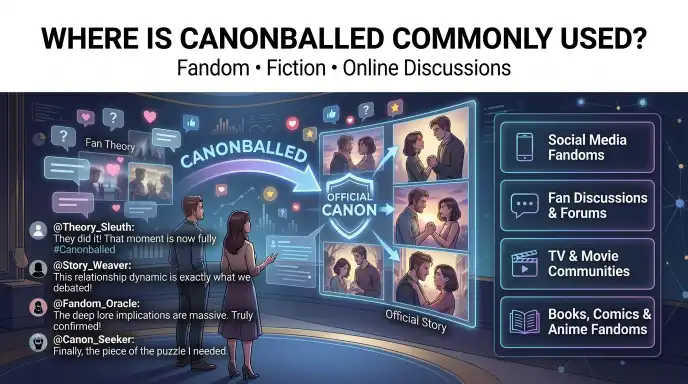
Canonballed fits informal online fandom spaces.
You may see people use it in:
- Social media posts
- Fandom communities
- Discord chats
- Reddit discussions
- Fan forums
- Fanfiction communities
- Character discussions
- Shipping conversations
Fans may use the term after a new episode or chapter changes how they understand a character or story.
For example:
“That theory got canonballed!”
The speaker likely means that new official content supported the theory.
The term remains casual, so “became canon” often works better for people outside the fandom.
How to Understand Canonballed From Context
Context can help you understand canonballed because the term does not have one fixed meaning across every fandom.
First, look at what the fans are discussing. The topic may involve a character, relationship, theory, prediction, or story event.
Next, check if official content supports the idea.
For example, if fans discuss a theory and a new episode confirms it, canonballed probably refers to that confirmation.
Common context clues include:
- A new episode or chapter
- An official story reveal
- A fan theory
- A character detail
- A relationship or ship
- A creator statement
- A change in story continuity
These clues can help you separate canonballed from headcanon, fanon, and non-canon.
Canonballed in Different Types of Fiction
Fans can use the idea behind canonballed across many types of fictional media.
TV Shows
Fans may use it when a new episode confirms a theory, character detail, or relationship.
Movies
A movie or sequel may confirm an idea that fans previously considered speculation.
Books
A later chapter or book may establish information that readers had only guessed before.
Comics and Manga
New issues or chapters may confirm character connections, histories, or relationships.
Anime
Fans may use cannonballed when an episode confirms a popular theory or ship.
Video Games
Story updates, dialogue, or new releases may establish details about characters or the fictional world.
The basic idea stays the same: an informal fandom expression describes an idea moving from uncertainty or fan discussion toward official story status.
How Is Canonballed Used in Online Fandom Communities?
Online fandom communities often react quickly to new story developments. Fans may use canonballed when official content confirms something they previously discussed.
For example, fans might spend months debating if two characters share a secret connection. A new episode could finally confirm that connection.
Someone might then write:
“We got canonballed.”
The phrase can express excitement, surprise, or humor.
Fans may also use it during live reactions to new episodes, chapters, or game updates.
However, people should not treat every fan theory as canon. Official content still needs to support the idea.
When Should You Use Canonballed?
Canonballed works best in casual fandom conversations.
You can use it when:
- Talking with other fans
- Discussing a new episode
- Reacting to a new chapter
- Talking about fan theories
- Discussing character relationships
- Commenting on fandom posts
- Chatting on social media
For example:
“Our headcanon got canonballed!”
This sentence has a playful fandom tone.
For formal writing, use clearer alternatives such as “became canon,” “was officially confirmed,” or “became part of the official storyline.”
Common Misunderstandings About Canonballed
People can confuse canonballed with several other fandom terms.
First, canonballed does not simply mean canon. Canon describes official story information, while canonballed describes an informal process or development toward that status.
Second, a popular fan theory does not automatically become canonballed. Official story material needs to support the theory.
Third, canonballed does not mean headcanon. A headcanon comes from a fan’s personal interpretation.
It also does not mean fanon. Fanon comes from ideas that fans create or widely accept.
Finally, canonballed does not only describe romantic relationships. Fans can use the term for character details, story events, backstories, theories, and other fictional elements.
Canonballed and Shipping
Shipping means supporting or imagining a romantic relationship between fictional characters.
Fans may ship two characters even when the official story never confirms a relationship. They might base the ship on chemistry, shared scenes, or romantic hints.
If the official story later confirms the relationship, fans may say:
“We shipped them for years, and now they got canonballed.”
The phrase shows that the fan-supported relationship has entered the official storyline.
However, shipping alone does not make a relationship canon. A ship remains a fan idea until the story provides official support.
Is Canonballed Appropriate for Formal Writing?
Canonballed works best in informal writing and casual fandom discussions.
You can use it in:
- Social media posts
- Fan discussions
- Online comments
- Chats
- Fandom blogs
- Casual articles for fandom audiences
Formal writing usually benefits from clearer wording.
Instead of:
“The relationship got canonballed.”
You could write:
“The relationship became canon in the latest episode.”
You could also say:
“The latest episode officially confirmed their relationship.”
These phrases make the meaning clear to readers who do not know fandom slang.
What Is the Opposite of Canonballed?
Canonballed does not have one fixed opposite. The best alternative depends on what happens in the story.
If the story never confirms an idea, you could say:
- “The theory remained unconfirmed.”
- “The idea remained a headcanon.”
- “The idea remained fanon.”
- “The theory stayed non-canon.”
- “The story debunked the theory.”
If official content directly proves an idea wrong, “was debunked” may fit best.
Therefore, the opposite of canonballed depends on the exact situation.
How to Use Canonballed Correctly
Use canonballed when you talk casually about an idea, theory, character detail, or relationship that receives official support from a fictional story.
For example:
“Our theory got canonballed after the latest episode.”
This sentence clearly connects the fan theory with a new official development.
Do not use canonballed as a general replacement for canon.
If something already forms part of the official story, say:
“It is canon.”
If the story just confirmed something, say:
“It was officially confirmed.”
For a general audience, these phrases often work better than niche fandom slang.
Canonballed in a Sentence
Here are several natural examples:
- “That fan theory got cannonballed in the latest episode.”
- “I can’t believe they cannonballed our favorite ship.”
- “My old headcanon just got canonballed.”
- “The writers canonballed what fans predicted months ago.”
- “That character detail got cannonballed in the new chapter.”
- “We joked about it before, and now it got canonballed.”
- “The new reveal cannonballed the theory everyone discussed.”
- “Our favorite prediction finally got canonballed.”
- “The new episode cannonballed the relationship theory.”
- “Fans thought it was only a headcanon, but the story canonballed it.”
These examples show how fans can use the term in casual conversations about fictional stories.
Similar Fandom Words to Know
Several fandom terms often appear in the same discussions.
Canon
Canon refers to official information within a fictional story.
Canonical
Canonical describes something that belongs to the official canon.
Headcanon
Headcanon describes a fan’s personal interpretation or belief.
Fanon
Fanon describes an idea that fans create or widely accept without official confirmation.
Non-Canon
Non-canon describes something outside the official story.
Retcon
Retcon describes a later change or reinterpretation of earlier story information.
Shipping
Shipping means supporting or imagining a romantic pairing between fictional characters.
Canon Event
A canon event refers to an event that officially happens within a fictional story.
These terms can appear together, but they do not mean the same thing.
Canonballed: Simple Comparison Table
| Term | Simple Meaning | Story Status |
| Canon | Official information in a fictional story | Official |
| Canonical | Something that belongs to canon | Official |
| Canonballed | Informal term for an idea gaining official story support | Context-dependent |
| Canonized | Made part of accepted canon | Official |
| Headcanon | A personal fan belief or interpretation | Not necessarily official |
| Fanon | A fan-created or fan-accepted idea | Not necessarily official |
| Non-canon | Something outside the official story | Not official |
| Retcon | A later change or reinterpretation of story information | Depends on the new continuity |
The simplest way to remember these terms is this: canon and canonical describe official story information. Headcanon and fanon describe fan ideas. Canonballed describes an informal situation where a fan idea or uncertain detail moves toward official story status.
FAQs About Canonballed Slang
Q1. What does canonballed mean in slang?
Canonballed is an informal fandom expression for something that becomes part of a fictional story’s canon or receives official support. Fans may use it for theories, relationships, character details, predictions, or story events.
Q2. Is canonballed a real slang word?
Canonballed is a niche internet and fandom expression. It does not have the same widespread use as terms such as canon or headcanon. Different fandom communities may also use it in slightly different ways.
Q3. What does canonballed mean in fandom?
In fandom, canonballed can describe an idea that starts as speculation, a theory, or a fan interpretation and later receives support from official story content.
Q4. Is canonballed the same as canon?
No. Canon refers to official information within a fictional story. Canonballed is an informal expression that can describe an idea becoming part of canon or receiving official support.
Q5. Is canonballed the same as headcanon?
No. A headcanon comes from a fan’s personal interpretation. Canonballed can describe what happens when that type of idea later receives official support from the story.
Q6. Is canonballed the same as fanon?
No. Fanon consists of ideas that fans create or widely accept. Canonballed may describe an idea moving from fan discussion toward official story status.
Q7. Can a relationship be canonballed?
Yes. Fans may use canonballed when a relationship that they previously supported or speculated about becomes officially established in the story.
Q8. Can a fan theory be canonballed?
Yes. Fans may use the term when an official episode, chapter, movie, or game confirms a theory that they previously discussed.
Conclusion:
Canonballed slang is a niche and informal fandom expression for an idea, theory, relationship, character detail, or story event that receives official support or becomes part of a fictional story’s canon.
The word connects with several common fandom terms, including canon, canonical, headcanon, fanon, non-canon, shipping, and retcon. However, each term has a different meaning.
Fans can use canonballed in casual chats, social media posts, and online fandom discussions. The term adds a playful tone when a fan idea becomes part of the official story.
For formal writing or a general audience, “became canon” or “was officially confirmed” usually works better. These phrases give readers the same basic meaning without relying on niche fandom slang.

I’m Emily Carter, and I enjoy writing about slang, internet language, and modern English expressions. My goal is to explain word meanings in a simple, clear, and easy-to-understand way so anyone can learn with confidence.