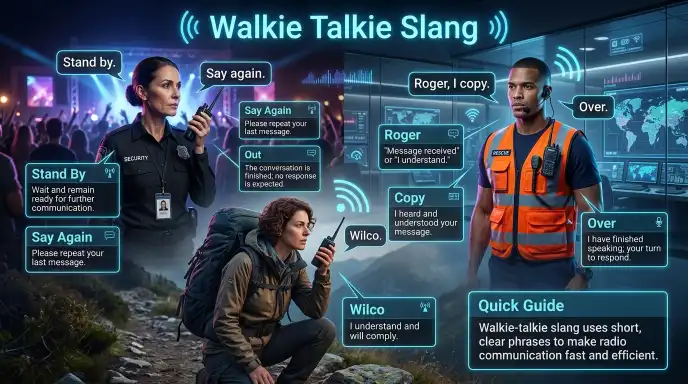
Walkie talkie slang refers to the short words, phrases, and radio codes people use to communicate quickly over two way radios. Walkie talkie slang often includes terms such as “Roger,” “Copy,” “Over,” “Out,” and “10-4,” which help speakers send clear messages without long explanations.
People search for walkie talkie slang because radio conversations can sound very different from normal speech. Words such as “Roger” or “Wilco” may seem unusual if you have never used a walkie talkie before.
These expressions are common in settings where quick and clear communication matters, such as outdoor activities, events, security work, emergency services, construction, and role playing games.
Quick Answer: What Is Walkie Talkie Slang?
Walkie talkie slang is the informal language and set of radio expressions used during two way communication. Common terms include “Roger” for a received message, “Copy” for understanding, “Over” when finished speaking, and “Out” when ending the communication.
What Does Walkie Talkie Slang Mean?
Walkie talkie slang means the special vocabulary used to make radio communication faster and easier to understand.
Unlike a normal conversation, only one person can usually speak clearly at a time on a basic two way radio channel. Because of this, radio users often use short expressions to show that they heard a message, want someone to speak, or have finished talking.
For example:
“Meet me at the entrance. Over.”
The word “over” tells the other person that the speaker has finished talking and expects a reply.
Another example is:
“Copy that.”
This means the speaker received and understood the message.
Walkie talkie language is not one single official slang system. Different groups may use different expressions, and some radio codes have specific meanings in particular industries.
Common Walkie Talkie Slang Words
Several radio expressions are widely recognized. Their meanings are easier to understand when you see them in context.
Roger
“Roger” means that a message has been received.
Example:
“Meet at the north gate.”
“Roger.”
Here, the second speaker is confirming that the message was received.
“Roger” does not always mean “yes” or “I agree.” Its main radio meaning is closer to “I received your message.”
Copy
“Copy” means that the speaker heard or understood the message.
Example:
“Copy. I’ll head over now.”
It is common in casual radio communication and is especially easy to understand because it sounds natural in modern speech.
Over
“Over” means the speaker has finished speaking and expects the other person to respond.
Example:
“I’m at the parking area. Over.”
The speaker is signaling that the other person can now reply.
“Over” is useful because radio users do not have the same natural turn taking cues that people have during face to face conversations.
Out
“Out” means the speaker has finished the conversation and does not expect a reply.
Example:
“Everything is clear. Out.”
A useful distinction is:
- “Over” = I finished speaking; your turn.
- “Out” = I finished communicating; no reply needed.
Because of this difference, saying “over and out” is generally unnecessary in precise radio communication. The two words signal different things.
Affirmative
“Affirmative” means yes.
Example:
“Are you at the main entrance?”
“Affirmative.”
It is more formal and clear than simply saying “yeah.”
Negative
“Negative” means no.
Example:
“Did you find the equipment?”
“Negative.”
It tells the listener that the answer is no.
Wilco
“Wilco” is short for “will comply.”
It means the speaker received the instruction and intends to follow it.
Example:
“Move to the west entrance.”
“Wilco.”
This is different from “Roger.” “Roger” confirms receipt of a message, while “Wilco” communicates an intention to follow an instruction.
Walkie Talkie Slang Codes
Some radio users also use numerical codes. The best known examples are 10-codes.
10-4
“10-4” is commonly understood as “message received” or “OK.”
Example:
“Meet us at the loading area.”
“10-4.”
It is strongly associated with radio communication and has also entered general popular culture.
However, 10-codes are not universal. Their meanings can vary between organizations and regions. A person should not assume that every 10-code means exactly the same thing everywhere.
10-20
“10-20” is commonly used to ask for or give someone’s location.
Example:
“What’s your 10-20?”
This means:
“Where are you?”
Because 10-codes can vary, the exact meaning should be confirmed when using them in a professional setting.
Why Is Walkie Talkie Language So Short?
Radio communication needs to be quick and clear.
A long sentence can take more time and may block another person from using the same channel. Short expressions help speakers communicate important information with fewer words.
For example:
“I received your message and understand what you told me.”
can become:
“Copy.”
The shorter response saves time and keeps the channel available.
This is especially useful when several people share one radio channel.
Walkie Talkie Slang vs. Normal Conversation
Walkie talkie communication has a different rhythm from everyday speech.
| Walkie talkie term | Simple meaning | Example |
| Roger | Message received | “Roger.” |
| Copy | I heard/understood | “Copy that.” |
| Over | Your turn to speak | “I’m outside. Over.” |
| Out | Conversation finished | “The area is clear. Out.” |
| Affirmative | Yes | “Affirmative.” |
| Negative | No | “Negative.” |
| Wilco | I will comply | “Wilco.” |
| 10-4 | Message received / OK | “10-4.” |
| 10-20 | Location | “What’s your 10-20?” |
These terms make radio conversations sound different from normal texting or face to face speech.
Where Is Walkie Talkie Slang Commonly Used?
Walkie talkie slang can appear anywhere two way radios are used.
Events
Event staff may use radios to coordinate entrances, equipment, schedules, or crowd movement.
Example:
“Copy. I’m heading to the front gate.”
Construction
Workers may use radios to coordinate tasks and locations.
Example:
“Can you bring the equipment to the west side?”
“Affirmative.”
Security
Security teams often need short and clear communication.
Example:
“Do you need assistance?”
“Negative. The situation is clear.”
Outdoor Activities
Hikers, campers, guides, and outdoor groups may use walkie talkies when mobile phone service is limited.
Example:
“We’re back at camp. Over.”
Film and Event Production
Crew members can use radios to coordinate different parts of a production.
Example:
“The camera is ready.”
“Copy.”
Gaming and Role Playing
Players may imitate radio language in games, role playing communities, or military style simulations.
Example:
“The team is moving toward the objective. Over.”
In these settings, some expressions are used for atmosphere as much as for practical communication.
Is Walkie Talkie Slang the Same Everywhere?
No. Walkie talkie language can vary by group, country, industry, and organization.
Some expressions are widely recognized, while others are specific to a particular workplace or radio system.
This matters especially with numerical codes. A code that has one meaning in one organization may have another meaning somewhere else.
For casual use, familiar terms such as “copy,” “over,” and “out” are generally easy to understand. For professional radio work, users should follow the communication rules established by their organization.
Is Walkie Talkie Slang Rude or Offensive?
Most walkie talkie slang is neutral.
Words such as “Roger,” “copy,” “over,” “out,” “affirmative,” and “negative” are communication tools rather than insults or offensive slang.
Tone can still affect a conversation. A person can sound impatient, sarcastic, or unfriendly even when using completely neutral radio terms.
For example:
“Copy.”
can be a simple confirmation.
But:
“Yeah, copy.”
said in an irritated voice may sound dismissive.
The words themselves are usually harmless. The speaker’s tone and situation matter more.
Walkie Talkie Slang in Modern Texting
Some radio expressions have moved beyond actual walkie talkies.
People may use “copy,” “Roger,” or “10- 4” jokingly in texts and online chats.
For example:
Friend: “Pick me up at 7.”
Reply: “10-4.”
The person is not actually using a radio. They are borrowing radio style language to make the response sound playful.
“Copy that” can also be used normally in texting to mean “I understand.”
However, these expressions are still informal. They are more suitable for casual messages than formal communication.
Real-Life Examples of Walkie Talkie Slang
The easiest way to understand radio slang is to see how it works in real conversations. The same expression can sound serious, casual, or playful depending on the setting.
Friendly Conversation
Person A: “I’m at the picnic area. Can you see me?”
Person B: “Copy. I’m walking over now.”
Here, “copy” simply means the second person received and understood the message.
Casual Radio Use
Person A: “We’ll meet near the entrance at six.”
Person B: “Roger that. Over.”
The speaker confirms the information and signals that the other person can respond.
Work Setting
Person A: “Can you check the back entrance?”
Person B: “Affirmative. I’m going there now.”
“Affirmative” means yes.
Gaming Context
Player A: “Team, move to the east side.”
Player B: “Wilco.”
The player is saying that they received the instruction and will follow it.
Outdoor Context
Person A: “What’s your 10-20?”
Person B: “Near the main trail.”
Here, “10-20” is being used to ask for a location.
Ending a Radio Conversation
Person A: “Everything is ready. We can start.”
Person B: “Copy. Out.”
The final speaker indicates that the communication is finished.
Humorous Text Message
Friend A: “Don’t forget to bring snacks.”
Friend B: “10-4 😂”
Here, “10-4” is used playfully to mean “OK” or “Got it.”
Walkie Talkie Slang in Gaming and Online Communities
Radio style language is popular in games that involve teams, missions, military themes, emergency situations, or tactical communication.
Players may use terms such as:
- Copy
- Roger
- Over
- Out
- Wilco
- Affirmative
- Negative
- 10-4
These terms can make communication faster, but they can also add to the game’s atmosphere.
For example:
“Enemy spotted near the bridge. Over.”
“Copy. Moving now.”
The conversation sounds like radio communication even though the players may actually be using voice chat.
This style is also common in role playing communities. Players may intentionally use radio language to make their characters sound like security workers, emergency crews, pilots, soldiers, or other radio users.
Origin and History of Walkie Talkie Slang
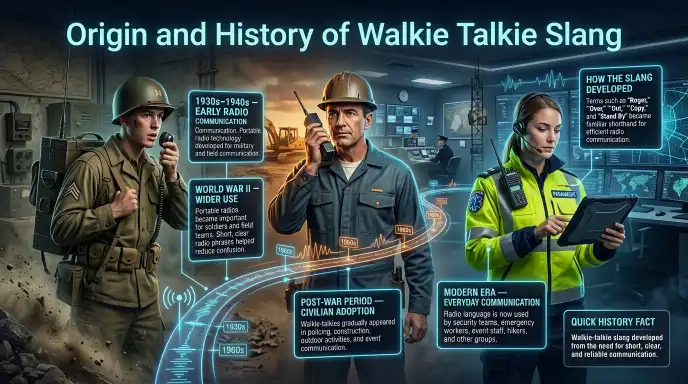
Walkie talkie language developed from the wider history of two way radio communication.
Some expressions were created to solve practical communication problems. Radio users needed short, clear words that could be understood despite background noise, weak signals, or interruptions.
“Roger” is a good example. In earlier radio communication, “Roger” was used to represent the letter R in a phonetic spelling system. Since R was associated with “received,” the word became connected with acknowledging a message.
The meaning later became part of everyday radio vocabulary.
Other terms, such as “over” and “out,” developed from the need to clearly manage turns during radio communication.
The history of numerical codes is more complicated. 10-codes became associated with radio communication, particularly in public safety and related settings, but their meanings have not always been universal. Different organizations have used different code systems.
For that reason, it is better to treat 10-codes as context dependent rather than assuming every group uses them in exactly the same way.
Walkie Talkie Slang vs. Military Radio Language
Walkie talkie slang and military radio language can overlap, but they are not the same thing.
A person using a walkie talkie casually may say:
“Copy that.”
A specialized radio operator may follow a much more detailed communication procedure.
Military, aviation, emergency, and professional radio systems can have their own rules, terminology, call signs, and procedures. Popular movies and games often simplify these systems for entertainment.
This is why not every phrase that sounds “military” is actually a formal military radio term.
For everyday use, simple expressions such as “copy,” “over,” and “out” are usually enough.
Similar Walkie Talkie Terms
Several expressions have related meanings, but they should not be treated as identical.
Copy vs. Roger
Both can confirm that a message was received.
“Copy” is often used to mean “I heard or understood you.”
“Roger” traditionally confirms receipt of a message.
In casual conversations, people may use them almost interchangeably.
Roger vs. Wilco
These two terms are more different.
“Roger” means the message was received.
“Wilco” means the message was received and the speaker will comply.
So if someone gives an instruction, “Wilco” can communicate more than simple acknowledgment.
Over vs. Out
These terms have different purposes.
“Over” means the speaker has finished and expects a response.
“Out” means the communication is finished and no response is expected.
Remembering this difference can prevent confusion.
When Should You Avoid Using Walkie Talkie Slang?
Walkie talkie slang is usually harmless, but it is not always the clearest choice.
Avoid unfamiliar radio expressions when:
- You are writing a formal document.
- The audience does not know radio terminology.
- A message could be misunderstood.
- You are communicating important instructions.
- You are working in a professional radio environment without knowing its rules.
- You are using 10-codes without knowing how your group defines them.
For example, saying “10-4” to someone who has never heard the expression may create confusion.
In a formal message, simply saying “Understood” may be clearer.
The goal of radio language is better communication. If a slang term makes the message harder to understand, use plain English instead.
Polite Alternatives to Walkie Talkie Slang
Most walkie talkie terms are not impolite. You may still want simpler alternatives depending on the situation.
| Radio expression | Clear alternative |
| Roger | Understood |
| Copy | I understand |
| Affirmative | Yes |
| Negative | No |
| Wilco | I will do that |
| Over | Please respond |
| Out | We are finished |
| 10-4 | Okay / Understood |
| 10-20 | Where are you? |
Plain English is often better when speaking with people who are unfamiliar with radio communication.
Why Do People Use Walkie Talkie Slang?
The main reason is efficiency.
Radio users often need to communicate quickly. Short expressions reduce unnecessary words and help keep the communication channel available.
There is also a clarity benefit. Words such as “affirmative” and “negative” make yes or no answers very clear.
Radio language can also become part of a group’s culture. Workers, hobbyists, gamers, and outdoor groups may develop familiar ways of speaking that make communication feel natural.
Online, these expressions can serve another purpose: humor.
Someone who replies “Roger that” to a simple text may be intentionally making the conversation sound like a radio exchange.
Common Misunderstandings About Walkie Talkie Slang
“Roger” Does Not Mean “I Agree”
“Roger” generally means the message was received. It does not automatically mean the speaker agrees with it.
“Copy” Does Not Mean Literal Copying
When someone says “copy,” they usually mean they heard or understood the message.
“Over” Does Not Mean Goodbye
“Over” signals that the speaker has finished talking and expects a response.
“Out” Does Not Mean the Radio Is Broken
“Out” indicates that the speaker has finished the communication.
10-Codes Are Not Universal
This is one of the most important points. Numerical radio codes can have different meanings across organizations and systems.
If you are using them in a professional setting, follow the terminology used by your own organization rather than relying on a general internet list.
Is Walkie Talkie Slang Still Used Today?
Yes. Walkie talkie language is still used wherever two way radio communication is useful.
It can be heard in workplaces, outdoor activities, events, security settings, production environments, gaming, and hobby radio communities.
Some expressions have also become familiar outside radio use. “Copy that” and “10-4,” for example, are recognizable to many people even when no radio is involved.
Their use in everyday speech is often informal or humorous.
Frequently Asked Questions
Q1. What is walkie talkie slang?
Walkie talkie slang is the short vocabulary used during two way radio communication. It includes expressions such as “Roger,” “Copy,” “Over,” “Out,” and “Wilco.”
Q2. What does “Roger” mean on a walkie talkie?
“Roger” generally means that the speaker has received the message. It does not necessarily mean that the speaker agrees with the message.
Q3. What does “copy” mean on a walkie talkie?
“Copy” usually means “I heard you” or “I understood the message.” It is a common acknowledgment in radio style communication.
Q4. What does “over” mean in walkie talkie slang?
“Over” means the speaker has finished talking and expects the other person to respond. It helps manage turns during radio communication.
Q5. What does “out” mean on a walkie talkie?
“Out” means the speaker has finished the communication and does not expect a reply. It signals the end of the exchange.
Q6. What does 10-4 mean in walkie talkie slang?
“10 4” is commonly used to mean that a message was received or understood, or simply “OK.” However, numerical radio codes can vary between organizations.
Q7. Is walkie talkie slang still used?
Yes. Radio expressions are still used in many two way communication settings. Some terms are also used casually in texting, gaming, and online conversations.
Q8. Is walkie talkie slang rude?
Most walkie talkie slang is neutral and practical. Terms such as “Roger,” “Copy,” “Over,” and “Out” are not normally offensive.
Conclusion: Walkie Talkie Slang
Walkie talkie slang makes two way radio communication short, clear, and easy to manage. Common expressions such as “Roger,” “Copy,” “Over,” “Out,” “Affirmative,” and “Wilco” each have a specific purpose.
Some terms have also moved into everyday texting and gaming. A person might say “10-4” in a message simply to mean “Okay,” or use “Roger that” as a playful way to confirm an instruction.
The most important thing to remember is that radio terminology can vary by group and setting. This is especially true for numerical codes such as 10-codes.
If you are using walkie talkie language casually, context is usually enough. In professional communication, always follow the terminology and procedures used by your organization.