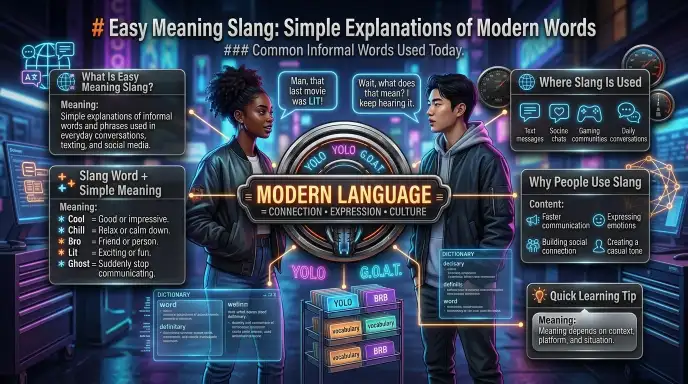
Easy meaning slang refers to simple explanations of informal words, phrases, and expressions people use in everyday conversations, texting, and online communication. Many users search for easy meaning slang because they see unfamiliar words on social media, chats, gaming platforms, or conversations and want to understand what they mean quickly.
Slang changes over time, and new terms often appear on platforms like TikTok, Instagram, Snapchat, Reddit, Discord, and messaging apps. Understanding slang helps students, writers, parents, and online users communicate better and avoid confusion.
This guide explains what easy meaning slang means, why people use slang, where it appears, and how to understand different slang expressions in real situations.
Quick Answer: Easy Meaning Slang
Easy meaning slang means a simple explanation of informal words or phrases used by people in casual conversations, texting, and online communication. It helps readers understand modern expressions without complicated definitions.
What Does Easy Meaning Slang Mean?
Easy meaning slang is a way of explaining slang words using simple language. Instead of giving a difficult dictionary definition, it focuses on what a slang term means in real conversations.
Slang is informal language that often develops within groups, communities, or online spaces. People use it to express emotions, create connections, save time while texting, or show belonging to a certain culture or trend.
For example:
- “Lit” can mean something exciting or impressive.
- “Broke” can mean having little or no money.
- “Ghosted” means someone suddenly stopped replying.
An easy meaning explanation tells users what the word means, how it sounds, and when it is appropriate to use.
Why Do People Search for Easy Meaning Slang?
People often come across slang they do not recognize. A phrase may appear in a social media comment, a text message, a video caption, or an online game chat.
Common reasons people search for slang meanings include:
- Understanding conversations with younger generations.
- Learning internet language.
- Understanding TikTok or Instagram trends.
- Helping students improve vocabulary.
- Explaining unfamiliar words to parents or teachers.
- Writing content that matches modern communication styles.
Slang can be confusing because one word may have different meanings depending on the situation. The same phrase can sound funny among friends but inappropriate in a professional setting.
Full Meaning and Definition of Slang
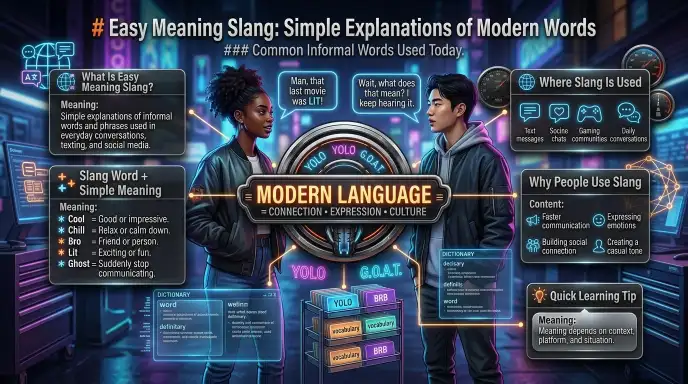
Slang is informal vocabulary used in casual communication. It is different from formal language because people usually use it with friends, online communities, or specific groups rather than official situations.
Slang can include:
- Shortened words
- Abbreviations
- Internet expressions
- Regional phrases
- Gaming terms
- Social media trends
Some slang terms become popular worldwide, while others remain limited to certain communities.
For example:
| Slang Type | Example | Meaning |
| Internet slang | LOL | Laughing out loud |
| Social slang | Bestie | Close friend |
| Gaming slang | GG | Good game |
| Text slang | BTW | By the way |
| Reaction slang | OMG | Surprise or shock |
Easy meaning slang guides help people understand these expressions without needing deep language knowledge.
Different Types of Easy Meaning Slang
Slang appears in many forms. Each type has its own purpose and audience.
Internet Slang
Internet slang develops through online communication. People use it in comments, messages, forums, and social platforms.
Examples include:
- LOL : used when something is funny.
- BRB : means “be right back.”
- FOMO : fear of missing out.
These terms are common in texting and online conversations.
Social Media Slang
Social media slang spreads quickly through platforms such as TikTok, Instagram, Snapchat, and Reddit.
Examples:
- “Viral” : something becoming very popular online.
- “Trending” : gaining attention from many users.
- “Ratio” : when replies receive more attention than the original post.
Social media slang often changes faster than traditional language.
Gaming Slang
Gaming communities create many unique expressions used during online games and chats.
Examples:
- AFK : away from keyboard.
- Noob : a beginner player.
- GG : good game.
Gaming slang helps players communicate quickly during matches.
Texting Slang
Text slang is designed for fast communication. Many terms use fewer letters to save time.
Examples:
- IDK : I don’t know.
- TTYL : talk to you later.
- IMO : in my opinion.
These abbreviations are common in casual messages.
Is Easy Meaning Slang Rude, Offensive, or Neutral?
Easy meaning slang itself is neutral. The meaning depends on the specific slang word, the speaker, and the situation.
Some slang is friendly and harmless:
- “Cool”
- “Awesome”
- “Bestie”
Some slang may be rude or offensive depending on context:
- Insults
- Mocking expressions
- Words connected to stereotypes
- Strong curse words
Before using slang, consider:
- Who you are talking to.
- Where you are using it.
- If the person understands the meaning.
- If it could sound disrespectful.
A slang word used between close friends may not be acceptable in school, work, or formal communication.
Where Is Easy Meaning Slang Commonly Used?
Slang appears almost everywhere people communicate casually.
Social Media Platforms
Platforms like TikTok, Instagram, Snapchat, and Reddit are major places where new slang spreads.
Users create trends through:
- Videos
- Comments
- Memes
- Hashtags
- Online communities
A slang term can become popular worldwide within days because of viral content.
Messaging Apps
Texting platforms use slang because people want quick and simple communication.
Common places include:
- Group chats
- Private messages
- Online communities
Short forms and abbreviations are especially common in these spaces.
Gaming Communities
Gaming chats often rely on slang because players need fast communication during matches.
Terms like “GG” or “AFK” allow players to share information quickly without typing long sentences.
Why Do People Use Easy Meaning Slang?
People use slang because it makes communication faster, more personal, and more expressive. Slang often carries feelings that regular words may not show clearly.
For example, saying “That movie was amazing” sounds normal, but saying “That movie was fire” shows excitement and a stronger emotional reaction in casual conversations.
Common reasons people use slang include:
- Creating a sense of connection with others.
- Showing membership in a group or community.
- Making conversations more relaxed.
- Expressing emotions in a shorter way.
- Following online trends and popular culture.
Slang also helps people create their own communication style. Teenagers, gamers, online communities, and different social groups often develop words that represent their shared experiences.
How Does Slang Change Over Time?
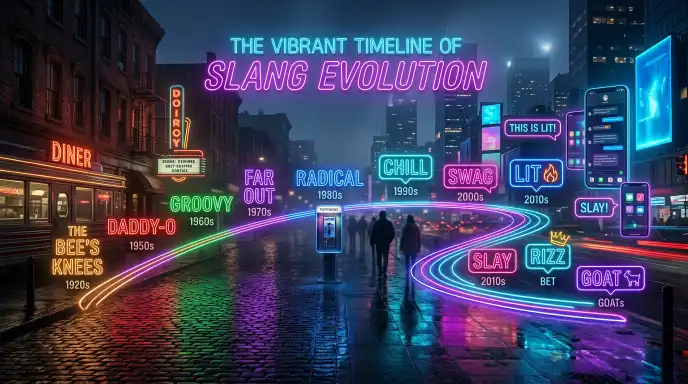
Slang has a natural life cycle. Some terms become popular for years, while others disappear quickly after a trend ends.
A slang word may go through these stages:
New and Emerging
A new expression appears inside a small group, online community, or specific culture.
For example, a phrase may first become popular among gamers, creators, or social media users.
Popular and Widely Used
If many people start using the term, it may spread through platforms like TikTok, Instagram, Reddit, and YouTube.
At this stage, even people outside the original group may understand it.
Old or Less Common
Some slang becomes less popular over time. Younger users may replace older terms with newer expressions.
This does not always mean the word is wrong. It simply means language changes with culture and communication habits.
Easy Meaning Slang in Texting and Online Chats
Texting is one of the biggest places where slang is used. Because messages are usually short and informal, people often choose quick expressions instead of complete sentences.
Common examples include:
| Slang | Meaning | Example |
| LOL | Laughing out loud | “That video was LOL.” |
| IDK | I don’t know | “IDK what happened.” |
| BTW | By the way | “BTW, are you coming?” |
| TBH | To be honest | “TBH, I liked the first one more.” |
| FYI | For your information | “FYI, the meeting changed.” |
These terms are common in casual chats but may not fit professional emails or formal writing.
Easy Meaning Slang on TikTok, Instagram, and Other Platforms
Social media has a major influence on modern slang. Many words become popular because users repeat them in videos, comments, and memes.
TikTok Slang
TikTok often creates or spreads expressions quickly. Users may use slang to react to trends, jokes, or viral content.
Examples:
- “Rizz” : charm or ability to attract someone.
- “Delulu”: jokingly describes unrealistic thinking.
- “NPC” : someone acting predictable or lacking originality in a joke context.
Meanings can change depending on the trend and community using them.
Instagram and Snapchat Slang
Instagram and Snapchat users often use short phrases in captions, stories, and messages.
Examples:
- “Vibe” : a feeling, mood, or atmosphere.
- “Mood”: saying something represents how someone feels.
- “Slay” : doing something impressively well.
Reddit and Discord Slang
Communities on Reddit and Discord often develop their own language.
Different groups may create slang related to:
- Gaming
- Technology
- Hobbies
- Online discussions
A word that is common in one community may be confusing in another.
Real-Life Examples of Easy Meaning Slang Usage
Understanding slang becomes easier when you see it in real conversations.
Friendly Conversation
Friend 1: “That new restaurant is on fire.”
Friend 2: “Really? I need to try it.”
Meaning: The restaurant is excellent or impressive.
Casual Text Message
Person 1: “Are you coming tonight?”
Person 2: “IDK yet. I’ll let you know.”
Meaning: The person does not know yet.
Social Media Context
Comment: “This outfit is a slay.”
Meaning: The outfit looks stylish or impressive.
Gaming Context
Player 1: “GG everyone.”
Player 2: “Good match!”
Meaning: A respectful way to say “good game” after playing.
Argumentative Context
Person 1: “You keep ignoring my messages.”
Person 2: “I wasn’t ghosting you. I was busy.”
Meaning: “Ghosting” refers to suddenly stopping communication.
Common Misunderstandings About Slang
Many people misunderstand slang because they focus only on the word instead of the situation.
A slang term may have:
- A positive meaning among friends.
- A negative meaning in another group.
- A different meaning online compared with real life.
For example, “sick” traditionally means unhealthy, but slang users may use it to describe something amazing.
The best way to understand slang is to look at:
- The speaker.
- The audience.
- The platform.
- The surrounding conversation.
Context often matters more than the word itself.
Comparison Between Slang and Formal Language
| Slang | Formal Language |
| Casual and relaxed | Professional and structured |
| Common with friends | Used in workplaces and official settings |
| Changes quickly | Changes more slowly |
| Often shortened | Usually complete words |
| Shows personality | Focuses on clarity |
Example:
Slang: “That idea is awesome.”
Formal: “That idea is excellent.”
Both communicate a positive opinion, but the tone is different.
When Should You Avoid Using Slang?

Slang is not suitable for every situation. Knowing when to avoid it helps prevent misunderstandings.
Avoid slang when:
- Writing a formal email.
- Speaking in a job interview.
- Communicating with customers.
- Writing academic assignments.
- Talking to someone who may not understand the expression.
For example, saying “This report is fire” may sound friendly with coworkers but may not sound professional in a business presentation.
Can Slang Be Used at Work?
Slang can sometimes be acceptable in workplaces, but it depends on the environment and relationship between people.
Casual workplaces may allow light slang in conversations between coworkers.
However, professional communication usually requires clearer language.
A good rule is:
- Use casual slang with friends and familiar coworkers.
- Use standard language with managers, clients, and official documents.
Understanding your audience is more important than avoiding all slang.
Polite Alternatives to Informal Slang
If a slang term sounds too casual, you can replace it with a clearer word.
| Slang | Polite Alternative |
| Cool | Great / Excellent |
| Fire | Amazing / Impressive |
| Bro | Friend / Colleague |
| Chill | Relax |
| Mad (meaning very) | Extremely / Very |
These alternatives work better in formal situations while keeping the meaning clear.
Impact of Using Slang in Communication
Slang can make conversations feel more natural and friendly. It can help people build connections and express emotions quickly.
Positive effects include:
- Faster communication.
- Stronger group identity.
- More emotional expression.
- Creative use of language.
However, slang can also create problems when:
- Someone does not understand the term.
- The meaning changes between groups.
- The word sounds disrespectful.
Good communication requires choosing words that match the situation.
Is Easy Meaning Slang Safe for Social Media?
Easy meaning slang is generally safe for social media when people use it in the right context. Most slang terms are harmless and simply help users express emotions, reactions, opinions, or humor in a shorter way.
However, online communication can reach different types of audiences. A slang word that sounds funny between friends may confuse or offend someone who does not understand the meaning.
Before using slang on platforms like TikTok, Instagram, Snapchat, Reddit, or Discord, think about:
- Who will read or hear it?
- If the term has another meaning.
- If it matches the situation.
- If it could sound disrespectful.
Using slang responsibly helps people communicate clearly while still enjoying modern online language.
Common Categories of Modern Slang
Slang appears in many forms depending on the community, platform, and purpose. Understanding these categories makes it easier to recognize new expressions.
Friendship and Social Slang
Friendship slang is used in casual conversations to show closeness, comfort, or connection.
Examples:
- Bestie : a close friend.
- Bro : a casual way to address a friend.
- Squad : a group of friends.
These terms usually create a friendly and relaxed tone.
Reaction Slang
Reaction slang helps people quickly show emotions in messages and comments.
Examples:
- LOL : used when something is funny.
- OMG : used for surprise or shock.
- No way : used to show disbelief.
These expressions are common in texting and social media conversations.
Trend-Based Slang
Trend-based slang spreads through viral videos, memes, and online communities.
Examples:
- Viral : something that becomes very popular online.
- Trending : receiving a lot of attention.
- Iconic : something considered memorable or impressive.
Some trend-based slang stays popular, while other terms disappear quickly.
Why Is Understanding Slang Important?
Understanding slang helps people follow modern conversations and avoid confusion. Many expressions are easy to misunderstand if you only know the literal meaning.
Learning slang can help:
- Students understand online discussions.
- Parents understand expressions used by younger people.
- Writers create realistic dialogue.
- Teachers understand language trends.
- Social media users communicate more naturally.
Knowing slang does not mean you need to use every popular term. It simply helps you understand what others mean.
Easy Meaning Slang vs Internet Slang
Although these terms are related, they focus on different things.
| Easy Meaning Slang | Internet Slang |
| Explains slang in simple words | Refers to slang created or spread online |
| Helps users understand meanings | Used mainly in digital communication |
| Can include regional expressions | Often connected to online communities |
| Focuses on learning | Focuses on usage |
Easy meaning slang helps explain expressions, while internet slang describes the type of language people use online.
How to Learn New Slang Meanings
Learning slang becomes easier when you focus on real examples instead of memorizing lists.
Helpful ways to learn include:
- Reading real conversations.
- Watching how people use words online.
- Checking meanings before using new terms.
- Observing different communities.
- Comparing slang with standard English.
A good slang guide explains not only the meaning but also the tone, context, and appropriate situations.
Frequently Asked Questions About Easy Meaning Slang
Q1: What does easy meaning slang mean?
Easy meaning slang means a simple explanation of informal words and phrases used in everyday conversations, texting, and online communication. It helps people understand modern expressions without complicated definitions.
Q2: Why do people search for slang meanings?
People search for slang meanings because they often see unfamiliar expressions on social media, messages, gaming chats, or conversations. They want to understand what the words mean and how to use them correctly.
Q3: Is slang the same as normal English?
No, slang is a type of informal English. It is commonly used with friends and online communities but is usually avoided in formal writing and professional communication.
Q4: Where is slang commonly used?
Slang is commonly used in texting, social media platforms like TikTok and Instagram, gaming communities, Discord chats, Reddit discussions, and casual conversations.
Q5: Can slang words have different meanings?
Yes, many slang words can have different meanings depending on the context, community, and platform where they are used. The situation around the word often determines its meaning.
Q6: Should I use slang in professional communication?
Usually, it is better to avoid slang in professional communication. Clear and standard language is safer for workplaces, interviews, emails, and formal discussions.
Conclusion:
Easy meaning slang helps people understand informal expressions used in modern communication, social media, texting, and online communities. It makes unfamiliar words easier to understand by explaining their meaning, tone, and proper usage.
Slang can make conversations more relaxed and expressive, but context is always important. A phrase that works well with friends may not fit in school, work, or formal situations.
The best way to understand slang is to look at how people use it in real conversations. Learning these expressions improves communication and helps people stay connected with changing language trends.