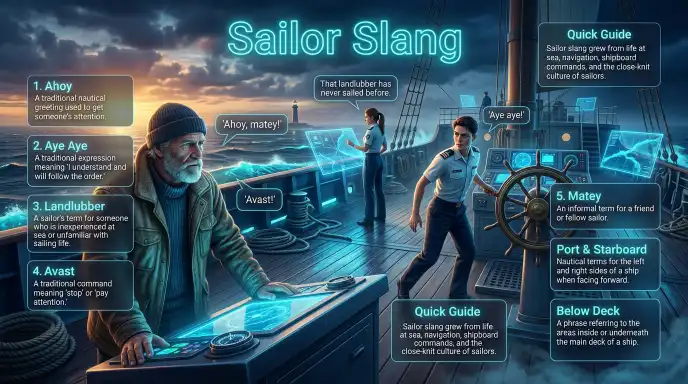
Sailor slang means the informal words, nicknames, and phrases traditionally used by sailors and people who work at sea. Some terms describe shipboard life, while others have become part of everyday English.
Sailor slang can be confusing because not every nautical word is actually slang. Some are formal maritime terms, while others are casual expressions, old sailor nicknames, or phrases that later spread into general speech.
For example, “Jack Tar” is an old term for a sailor, while “all hands on deck” can now describe any situation where everyone is needed. Understanding this difference makes sailor slang much easier to follow. In this guide, you will learn the common meanings, origins, modern uses, tone, examples, and situations where these expressions fit best.
Quick Answer: What Is Sailor Slang?
Sailor slang is the informal language linked to sailors, ships, and life at sea. It includes old sailor nicknames, colorful expressions, commands, and phrases that describe maritime life. Some are still used today, while others mainly appear in historical, humorous, or nautical settings.
What Does This Slang Mean?
Sailor slang refers to informal speech associated with sailors and maritime communities. It grew from the daily life of people who worked and lived together aboard ships.
Sailors needed short and clear ways to communicate. Over time, their work, travel, humor, and shared experiences created a large set of words and expressions.
Sailor slang can include:
- Names for sailors
- Words for people unfamiliar with the sea
- Informal shipboard expressions
- Traditional commands
- Terms connected with food and work
- Expressions about weather and sailing
- Phrases that later entered everyday English
It is also useful to separate sailor slang from nautical terminology. A nautical term may be a formal word used to describe a ship, direction, job, or sailing task. Sailor slang is more casual and often reflects the social culture of sailors.
Sailor slang vs. nautical terms
| Type | What it means | Example |
| Sailor slang | Informal language linked to sailors | Jack Tar |
| Nautical term | A formal maritime word | Aft |
| Nautical phrase | An expression connected with ships or sailing | All hands on deck |
| Everyday expression | A nautical phrase used outside sailing | Know the ropes |
This distinction is important because people often call every unusual ship-related word “sailor slang.” That is not always accurate.
Common Sailor Slang Words and Phrases
Sailor slang contains many colorful expressions. Some are still familiar today, while others sound old-fashioned.
| Sailor slang | Meaning |
| Ahoy | A traditional call used to get someone’s attention |
| Avast | Stop or hold |
| Jack Tar | An old term for a sailor |
| Tar | An old slang term for a sailor |
| Landlubber | A person who is unfamiliar with life at sea |
| Scuttlebutt | Gossip or rumor |
| Salty | Experienced, tough, or strongly associated with sailors |
| All hands on deck | Everyone is needed to help |
| Batten down the hatches | Secure things and prepare for difficult conditions |
| Know the ropes | Understand how something works |
| Aft | Toward the back of a ship |
| Aloft | Up above, especially in a ship’s rigging |
| Adrift | Floating without control or direction |
| Even keel | Stable or balanced |
Not all of these expressions are equally common today. Some remain part of normal English, while others are mostly used for historical or humorous effect.
Jack Tar
“Jack Tar” is an old slang term for a sailor. The shorter word “tar” was also historically used for a sailor.
The expression is mainly historical today. You may see it in books, articles about naval history, or stories set during earlier periods.
Avast
“Avast” traditionally means “stop” or “hold.” It is strongly associated with old sailor speech.
Today, the word often sounds playful or theatrical. A person may say “Avast!” while joking about pirates or pretending to speak like an old sailor.
Scuttlebutt
“Scuttlebutt” means gossip or rumor. It is one of the maritime expressions that moved beyond life at sea.
For example:
“There is some scuttlebutt about a new manager.”
The speaker means that people are sharing rumors about the manager.
Landlubber
“Landlubber” describes someone who is not used to the sea or sailing.
It can be friendly and humorous when used between people who are comfortable with the joke.
For example:
“I’m a complete landlubber, so you’ll have to teach me how to sail.”
The word can also be used more broadly for someone who prefers staying on land.
Where Is Commonly Used?
Sailor slang is most closely connected with ships, sailing, naval history, and maritime communities. However, many expressions have moved into ordinary English.
You may find these terms in:
- Sailing communities
- Naval history
- Maritime books
- Sea stories
- Movies and television
- Pirate-themed entertainment
- Video games
- Social media
- Online communities
- Everyday conversations
The setting can change the tone of the same phrase.
Sailor slang in texting
In text messages, sailor expressions are usually used for humor or style rather than serious communication.
For example:
“Ahoy! Are you coming to dinner?”
The person is not claiming to be on a ship. “Ahoy” simply gives the message a playful nautical feel.
Sailor slang on TikTok and Instagram
On TikTok and Instagram, nautical expressions may appear in captions, jokes, costumes, travel posts, sailing videos, or pirate-themed content.
A creator might use “Ahoy, mateys!” to create a fun sea-themed mood.
Sailor slang on Discord and gaming platforms
Nautical language can be especially common in games involving ships, pirates, oceans, or naval battles.
For example:
“All hands on deck! The enemy is coming.”
In this context, the phrase means everyone needs to help.
Sailor slang in the workplace
Most sailor expressions are not offensive, but many sound informal, old-fashioned, or playful.
A phrase such as “know the ropes” is widely understood and can work in casual workplace conversation. Words such as “avast” may sound too theatrical for a formal email or business report.
Is Rude, Offensive, or Harmless?
Sailor slang is generally harmless, but the tone depends on the specific word and context. Many traditional expressions are simply colorful ways to describe sailors, ships, or life at sea.
A few things are worth remembering:
- Old sailor slang may sound dated.
- Some expressions can sound insulting if aimed at a person.
- Pirate-style language may be humorous rather than authentic sailor speech.
- Formal workplaces usually favor plain, modern language.
- The meaning can change depending on tone and context.
For example, calling a friend a “landlubber” as a joke is usually lighthearted. Using it to mock someone’s lack of knowledge may feel rude.
The safest approach is to consider who you are talking to and why you are using the expression.
Real-Life Examples of Sailor Slang
Here are natural examples showing how these expressions can work in different situations.
Friendly conversation
“Ahoy! Haven’t seen you in ages.”
Here, “ahoy” is being used as a playful greeting.
Talking about someone inexperienced
“I’m still a landlubber when it comes to sailing.”
The speaker is joking about being inexperienced at sea.
Talking about rumors
“What’s the scuttlebutt about the new project?”
Here, “scuttlebutt” means gossip or informal information.
Giving a playful command
“Avast! Nobody has touched the cake yet.”
The speaker is jokingly using “avast” to mean stop.
Using a common phrase
“We need all hands on deck before the event starts.”
This means everyone needs to help.
Describing experience
“She’s a salty sailor who has spent years at sea.”
Here, “salty” suggests someone experienced and strongly connected with life at sea.
Origin and History of Sailor Slang
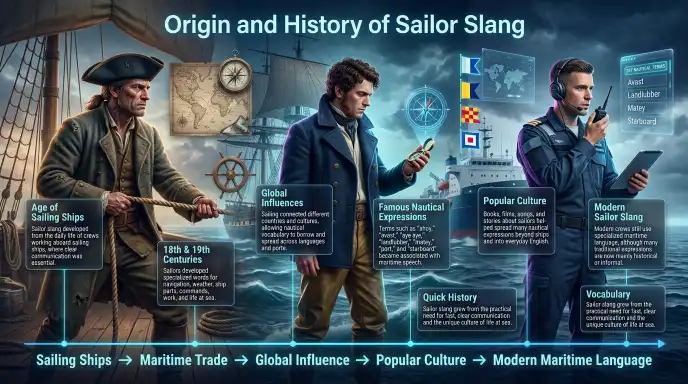
Sailor slang developed over centuries of maritime travel. Sailors worked in close groups and often spent long periods away from home, so shipboard communities developed their own vocabulary, jokes, nicknames, and expressions.
English sailor language was also shaped by contact with other languages and cultures. Ships traveled between ports across Europe, Africa, Asia, and the Americas, bringing sailors into contact with different words and speech styles.
Some terms have very old records, while the exact starting point of others is unclear. It is better to avoid giving one exact origin date to every sailor expression.
Why sailor slang became distinctive
Life at sea created situations that were different from ordinary life on land. Sailors needed words for:
- Ship positions
- Weather conditions
- Sailing tasks
- Food and supplies
- Other crew members
- Work routines
- Commands
- Life in ports
Some of this vocabulary was practical rather than slang. Other expressions became informal parts of sailor culture.
How sailor slang entered everyday English
Some maritime expressions became common outside ships.
For example, “know the ropes” can now mean understanding how to do something. “All hands on deck” can describe a situation where everyone must help, even when no ship is involved.
This shift is important because modern speakers may use these expressions without knowing their maritime background.
How This Slang Is Used in Modern Times
Sailor slang still appears today, but much of it is used differently from the past. Modern sailors do not necessarily speak like characters from old pirate movies.
Today, traditional sailor expressions are often used for humor, storytelling, history, entertainment, or nautical identity.
Modern maritime use
People involved in sailing, boating, naval history, or maritime work may still use specialized maritime vocabulary. However, formal crews generally rely on clear and established terminology rather than exaggerated “pirate talk.”
Historical use
Sailor slang is common in writing about earlier periods of naval and maritime history.
Historical novels may use words such as “Jack Tar” or “landlubber” to help create the language of an earlier setting.
Entertainment and pop culture
Movies, television shows, books, and games often use sailor or pirate expressions to create a strong sea-related atmosphere.
This can sometimes make old sailor language seem more common today than it really is.
A character saying “Avast!” may sound natural in a pirate-themed story but unusual in an ordinary conversation.
Similar Slang and Related Nautical Terms
Sailor slang is connected to many other forms of maritime language. Knowing a few related expressions can make nautical conversations easier to understand.
| Term | Simple meaning |
| Matey | A friendly way to address a companion, often with a nautical or pirate tone |
| Landlubber | Someone inexperienced with the sea |
| Jack Tar | An old term for a sailor |
| Scuttlebutt | Gossip or rumor |
| Ahoy | A traditional call for attention |
| Avast | Stop or hold |
| Aft | Toward the rear of a ship |
| Bow | The front of a ship |
| Stern | The back of a ship |
| Port | The left side of a ship when facing forward |
| Starboard | The right side of a ship when facing forward |
Some words in this table are technical nautical terms rather than slang. That distinction is useful when learning maritime vocabulary.
Sailor slang and pirate slang
Sailor slang and pirate slang are related, but they are not identical.
Pirates were sailors, but not every sailor was a pirate. Pirate-themed entertainment has also popularized expressions that may sound nautical without representing normal historical sailor speech.
For example, “Ahoy” has a genuine maritime history, while the exaggerated way pirate characters speak in movies is often a form of entertainment.
When Should You Avoid Using this Slang?
You should avoid sailor slang when the setting requires very formal, precise, or professional language.
For example, traditional expressions may not fit well in:
- Formal business reports
- Academic assignments
- Official letters
- Professional presentations
- Legal documents
- Serious workplace communication
There is no general rule that sailor slang is offensive. The main issue is usually tone and appropriateness.
If you are writing to a teacher, manager, client, or official organization, plain English is usually the safer choice.
When sailor slang works well
It can work naturally in:
- Casual conversations
- Creative writing
- Historical stories
- Sailing discussions
- Nautical-themed events
- Jokes
- Social media captions
- Games
- Informal online chats
The key is to match the expression to the situation.
Polite Alternatives to Sailor Slang
Most sailor slang does not need a direct replacement because it is not inherently rude. However, you may want a more neutral phrase in formal situations.
| Sailor expression | Neutral alternative |
| Ahoy | Hello |
| Avast | Stop |
| Scuttlebutt | Rumor or gossip |
| Landlubber | Inexperienced person |
| All hands on deck | Everyone needs to help |
| Know the ropes | Understand how it works |
| Batten down the hatches | Prepare for problems |
For example, instead of saying “Avast!” in a formal meeting, simply say “Please stop.”
In casual conversation, however, the nautical version can add personality and humor.
Why Do People Use Sailor Slang?
People use sailor slang for several reasons. The most common is to create a nautical feeling or add humor to a conversation.
To sound playful
Words such as “ahoy” and “avast” can make ordinary speech sound funny or dramatic.
To show nautical interest
Sailors, boat owners, historians, and maritime fans may use sea-related vocabulary to reflect their interests.
To create a historical mood
Writers can use older sailor expressions to make a story feel connected to a particular period.
To make language more colorful
Expressions such as “scuttlebutt” are more vivid than simply saying “gossip.”
To build group identity
Specialized language can help people in a shared activity feel connected. Maritime communities have long had their own vocabulary because their work involves specific tasks and experiences.
Common Misunderstandings About Sailor Slang
One common mistake is assuming that every nautical expression is sailor slang. That is not true.
Words such as “port,” “starboard,” “bow,” and “stern” are standard nautical terms. They identify parts or directions on a vessel and are not simply casual slang.
Another misunderstanding is that all sailor slang is pirate language. Pirates were part of maritime history, but sailor culture was much broader than piracy.
People also sometimes assume that old sailor expressions are still common among modern sailors. Many traditional terms are now mainly historical, humorous, or literary.
Is “salty” always sailor slang?
No. “Salty” has several meanings in modern English.
In a maritime context, it can describe someone who is experienced or strongly shaped by life at sea. In other contexts, “salty” can mean angry, irritated, or bitter.
The surrounding conversation tells you which meaning is intended.
Is “matey” formal sailor language?
“Matey” is strongly associated with nautical and pirate-style speech, but it is not a standard formal term for professional communication.
Today, it is often used jokingly or to create a playful nautical mood.
Frequently Asked Questions
Q1. What does sailor slang mean?
Sailor slang is informal language associated with sailors, ships, and life at sea. It includes old sailor nicknames, expressions, commands, and colorful phrases.
Q2. What is a common example of sailor slang?
“Jack Tar” is a well-known historical example. It was used as a term for a sailor. “Scuttlebutt,” meaning gossip or rumor, is another maritime expression that entered wider English.
Q3. Is sailor slang still used today?
Yes, but much of the traditional vocabulary is now used less often in everyday speech. It remains common in sailing, maritime history, fiction, games, humor, and nautical-themed content.
Q4. Is sailor slang the same as pirate slang?
No. Sailor slang is broader. Pirates were sailors, but sailor language also developed among naval crews, merchant sailors, fishermen, and other maritime workers.
Q5. Is sailor slang rude?
Most sailor slang is not inherently rude. Some expressions may sound teasing, old-fashioned, or theatrical depending on how they are used.
Q6. Can I use sailor slang at work?
You can use familiar expressions such as “know the ropes” in casual workplace conversation. However, unusual or theatrical terms such as “avast” may not fit formal communication.
Q7. What does “landlubber” mean in sailor slang?
“Landlubber” refers to someone who is unfamiliar with the sea or sailing. It is often used humorously, especially when someone has little experience with boats.
Q8. What is the difference between sailor slang and nautical terms?
Sailor slang is informal language connected with sailor culture. Nautical terms are often standard words used to describe ships, directions, equipment, or sailing tasks. Some maritime expressions can overlap both categories.
Conclusion:
Sailor slang is a broad group of informal words and expressions connected with life at sea. Some terms, such as “Jack Tar” and “avast,” have strong historical roots, while others, such as “know the ropes” and “all hands on deck,” have become familiar in everyday English.
The most important point is context. A phrase may sound normal in a sailing group, historical story, or playful chat but unusual in a formal setting. Sailor slang is usually harmless, but older expressions can sound dated or theatrical.
If you understand the setting, tone, and meaning behind the words, sailor slang becomes much easier to recognize and use naturally.

I’m Emily Carter, and I enjoy writing about slang, internet language, and modern English expressions. My goal is to explain word meanings in a simple, clear, and easy-to-understand way so anyone can learn with confidence.