Venezuelan slang bad words are informal or offensive expressions used in Venezuela, often to show anger, frustration, surprise, or strong emotion. Their meaning and intensity depend on context. Venezuelan slang bad words are informal, rude, or offensive words and phrases commonly used in Venezuela.
Their meaning depends on the situation, tone of voice, and relationship between the speakers. Some words are used jokingly among friends, while others can easily insult or offend someone.
Venezuelan slang bad words are popular because many people want to understand conversations, movies, social media posts, or messages from Venezuelan friends.
In this guide, you’ll learn what these expressions mean, when they are used, if they are offensive, and when you should avoid using them. This article also explains the cultural context behind these words so you can understand them without accidentally offending someone.
Quick Answer:Venezuelan Slang Bad Words
Venezuelan slang bad words are informal expressions that may be vulgar, insulting, or highly casual in Venezuelan Spanish. Some are used playfully between close friends, while others are considered offensive. Always pay attention to the context, the speaker’s tone, and your relationship with the other person before using them.
What Do Venezuelan Slang Bad Words Mean?
Venezuelan slang bad words are words or phrases that people in Venezuela use to express strong emotions such as anger, surprise, frustration, excitement, or humor. Unlike standard Spanish, these expressions often have meanings that change depending on the conversation.
For example, a word that sounds insulting in one situation may simply be friendly teasing between close friends. Because of this, learning only the direct translation is not enough. Understanding the context is just as important.
Many of these expressions appear in:
- Everyday conversations
- Text messages
- Social media comments
- Memes
- Comedy shows
- Music lyrics
- Online gaming chats
Visitors and Spanish learners often hear these words but may not understand if they are meant as jokes or insults.
Different Types of Venezuelan Slang Bad Words
Not every bad word has the same purpose. Venezuelan slang includes several categories of expressions.
Mild insults
These words are used to show annoyance or mild frustration. Some people also use them jokingly with close friends.
Examples include:
- Foolish person
- Lazy person
- Annoying person
These expressions are usually less offensive than stronger profanity.
Strong profanity
Some Venezuelan slang words contain sexual or vulgar language. These are among the strongest expressions in Venezuelan Spanish and should generally be avoided by visitors and language learners.
People may use them during:
- Arguments
- Road rage
- Heated sports discussions
- Emotional situations
Friendly teasing
Certain expressions sound rude but become friendly jokes among family members or longtime friends.
The same word may be acceptable in one friendship but highly offensive if spoken to a stranger.
Emotional expressions
Some slang words are not directed at another person. Instead, they express emotions like:
- Surprise
- Shock
- Pain
- Excitement
- Frustration
These are similar to saying “Wow!” or “Oh no!” in English, although some versions are much stronger.
Common Venezuelan Slang Bad Words
The table below introduces several well-known Venezuelan slang terms. Some are mild, while others are highly offensive.
| Slang | General Meaning | Offensive Level |
| Guevón | Fool, idiot, or friend depending on context | Medium |
| Coño | Strong exclamation showing surprise or frustration | High |
| Carajo | Used to express anger or emphasis | High |
| Pendejo | Fool or naive person | Medium |
| Ladilla | Something annoying or irritating | Low to Medium |
| Mamagüevo | Very offensive insult | Very High |
| Maldito | Damned or cursed | Medium |
| Idiota | Idiot | Medium |
Remember that meanings can change depending on who says the word and how it is said.
Where Are Venezuelan Slang Bad Words Commonly Used?
These expressions appear in many informal settings but are generally avoided in formal communication.
Everyday conversations
Friends sometimes use slang casually, especially among people who know each other well.
Social media
You may see these words on:
- TikTok
- X
They often appear in memes, jokes, or emotional reactions.
Messaging apps
Many Venezuelans use slang while chatting on apps such as:
- Telegram
- Messenger
Messages between friends usually contain more informal language than conversations with family elders or coworkers.
Music and entertainment
Some Venezuelan songs, comedy videos, podcasts, and online creators include slang to sound authentic and relatable.
This is one reason many Spanish learners search for the meanings of these expressions.
Are Venezuelan Slang Bad Words Rude, Offensive, or Harmless?
Some Venezuelan slang bad words are harmless in the right setting, while others are extremely offensive.
The table below gives a general guide.
| Situation | Appropriate? |
| Talking with close friends who use the same slang | Sometimes |
| Speaking with strangers | Usually No |
| Workplace conversations | No |
| School or university presentations | No |
| Speaking with teachers | No |
| Speaking with parents or older relatives | Usually No |
| Professional emails | Never |
A good rule is to understand these expressions before trying to use them. Knowing the meaning is useful, but using them incorrectly can create misunderstandings or offend someone.
In addition, some words that friends use jokingly may become serious insults if spoken with an angry tone. Context always matters more than the literal translation.
Real Life Examples
The best way to understand Venezuelan slang bad words is to see how they appear in everyday conversations. These examples show the general idea without encouraging offensive language.
Friendly conversation
Friend A: “¡Qué guevón eres!”
Friend B: “I know. I forgot my keys again.”
Here, the word is used jokingly between close friends rather than as a serious insult.
Text message
Person A: “That traffic was a real ladilla today.”
Meaning: The traffic was very annoying.
Social media
Comment: “Coño, that goal was amazing!”
In this case, the word expresses surprise or excitement rather than insulting someone.
Argument
Person A: “Don’t call people names when you’re angry.”
Some strong Venezuelan slang words are used during arguments and can quickly make the situation worse.
Family setting
Many families avoid using vulgar slang around children or older relatives because it may be seen as disrespectful.
Origin and History
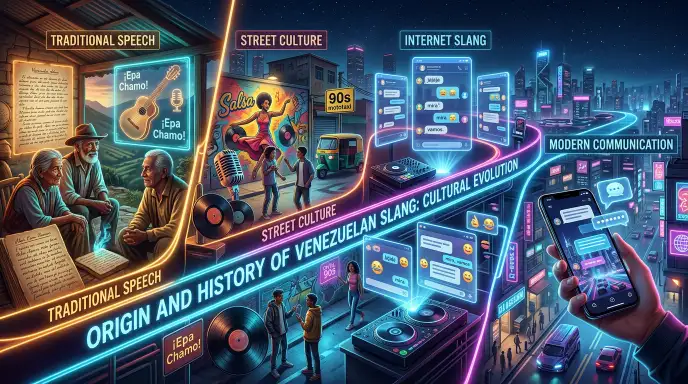
Venezuelan slang has developed over many generations through everyday speech, regional traditions, and cultural influences from Spain, Indigenous communities, and other Latin American countries.
Some bad words are shared with other Spanish speaking countries but have different meanings or levels of offensiveness in Venezuela. Others are unique to Venezuelan culture or have taken on local meanings over time.
Modern media has also helped spread Venezuelan slang beyond the country. Today, people may encounter these expressions through:
- Social media videos
- Online gaming
- Streaming platforms
- Venezuelan music
- Comedy shows
- YouTube creators
Because slang changes over time, new expressions appear while older ones become less common.
Similar Slang or Related Terms
If you’re learning Venezuelan Spanish, you may also come across these related slang categories.
| Type | Description |
| Friendly nicknames | Casual words used between friends. |
| Regional slang | Expressions unique to different parts of Venezuela. |
| Everyday slang | Informal words that are not offensive. |
| Internet slang | Terms popular on social media and messaging apps. |
| Latin American slang | Words shared across several Spanish speaking countries, sometimes with different meanings. |
Remember that a word considered mild in one country may be much stronger in another.
When Should You Avoid Using Venezuelan Slang Bad Words?
Even if you understand these expressions, that does not mean you should use them.
Avoid them in situations such as:
- At work
- In school
- During job interviews
- Speaking with teachers
- Talking to customers
- Meeting someone for the first time
- Formal events
- Professional emails
- Public speeches
If you are learning Spanish, it is usually better to recognize these words than to use them yourself.
Polite Alternatives
Instead of using offensive slang, choose respectful expressions that communicate your message clearly.
| Instead of insulting | Try saying |
| Calling someone a bad name | “That wasn’t a good idea.” |
| Strong profanity | “Oh no!” or “Wow!” |
| Angry insults | Explain why you’re upset calmly. |
| Vulgar language | Use neutral Spanish or English expressions. |
Polite language helps you communicate effectively without risking misunderstandings.
Why Do People Use Venezuelan Slang Bad Words?
People use these expressions for different reasons, depending on the situation.
Common reasons include:
- Showing frustration
- Expressing surprise
- Adding humor
- Teasing close friends
- Showing strong emotions
- Sounding more natural in casual conversations
- Reflecting local identity and culture
However, the same expression may be friendly in one conversation and deeply offensive in another. Tone of voice, facial expression, and the relationship between the speakers all play a major role.
Common Misunderstandings
Many Spanish learners assume that every bad word always has the same meaning. That is not true.
Some common misunderstandings include:
Thinking every slang word is an insult
Some expressions simply show surprise or frustration without targeting another person.
Assuming meanings are the same everywhere
A word used casually in Venezuela may be much more offensive in another Spanish-speaking country.
Using slang after learning only the translation
Direct translations often miss the cultural meaning. Understanding context is just as important as knowing the dictionary definition.
Believing slang is appropriate in every conversation
Most Venezuelan slang bad words are informal and should not be used in professional or academic settings.
Frequently Asked Questions
Q1. What are Venezuelan slang bad words?
Venezuelan slang bad words are informal, rude, or vulgar expressions commonly used in casual conversations in Venezuela. Some are playful among friends, while others are highly offensive.
Q2. Are Venezuelan slang bad words always offensive?
No. Some words are used jokingly between close friends, but the same words can become offensive if used with strangers or in an angry tone.
Q3. What is the most common Venezuelan slang bad word?
One of the most commonly heard words is “guevón.” Depending on the situation, it can mean “friend,” “fool,” or “idiot.” Its meaning changes with context and tone.
Q4. Is it okay for tourists to use Venezuelan slang bad words?
It is usually better to understand these words rather than use them. Since many have different meanings depending on the situation, visitors can easily offend someone by mistake.
Q5. Are Venezuelan slang bad words used on social media?
Yes. They are common on TikTok, Instagram, Facebook, X, Reddit, YouTube comments, and WhatsApp chats, especially in memes and informal conversations.
Q6. Can Venezuelan slang bad words be used at work?
No. Most Venezuelan slang bad words are not appropriate in workplaces, business meetings, professional emails, or formal conversations.
Q7. Why do Venezuelans use slang bad words?
People use them to express emotions like anger, surprise, excitement, frustration, or humor. Some also use them to sound more natural in casual conversations with friends.
Q8. Are Venezuelan slang bad words the same as Spanish swear words?
Not always. Some swear words are shared across Spanish-speaking countries, but their meanings, popularity, and offensiveness can be very different in Venezuela.
Conclusion:
Venezuelan slang bad words are part of everyday informal speech in Venezuela, but their meanings depend heavily on context, tone, and the relationship between the speakers. Some expressions are harmless jokes among close friends, while others are strong insults that should be avoided.
If you are learning Venezuelan Spanish, focus on understanding these words rather than using them. Knowing when a term is appropriate and when it is not will help you communicate respectfully and avoid misunderstandings.