Boxing terms slang refers to informal words and expressions used to describe boxers, punches, fighting styles, tactics, strength, weaknesses, and moments during a fight.
If you are searching for boxing terms slang, you may have seen words such as “glass jaw,” “southpaw,” “gatekeeper,” “gassed,” or “iron chin” and wondered what they mean. Some of these expressions are true slang, while others are standard boxing terms that fans also use in casual conversations.
Boxing language can be confusing because one word may have a special meaning inside the ring but a different meaning in everyday English. A term can also sound positive when used about one fighter and negative when used about another.
This guide explains common boxing slang in simple English. You will learn the meaning, tone, context, examples, and proper use of popular boxing expressions.
Quick Answer: Boxing Terms Slang
Boxing terms slang are informal expressions used by fighters, trainers, commentators, and fans to talk about boxing. Common examples include “glass jaw” for someone who is easily hurt, “iron chin” for someone who can take hard punches, and “gatekeeper” for an experienced fighter who tests rising boxers.
What Does Boxing Terms Slang Mean in Text?
Boxing terms slang in text means informal boxing words used in messages, comments, social media posts, forums, and online conversations.
For example, someone might text:
“That guy has an iron chin.”
They are not talking about a literal chin made of iron. They mean the boxer can take strong punches without being knocked out easily.
Another person might write:
“He got gassed in the later rounds.”
Here, “gassed” means the fighter became very tired and struggled to maintain the same pace.
Boxing slang can describe many parts of the sport, including:
- A fighter’s skill
- Punching power
- Defense
- Stamina
- Fighting style
- Experience
- Weaknesses
- Ring position
- Fight strategy
- A result or important moment
The context usually tells you which meaning is intended.
Common Boxing Terms Slang You Should Know
There are many expressions used in boxing conversations. Some are positive, some are negative, and others are simply descriptive.
Glass Jaw
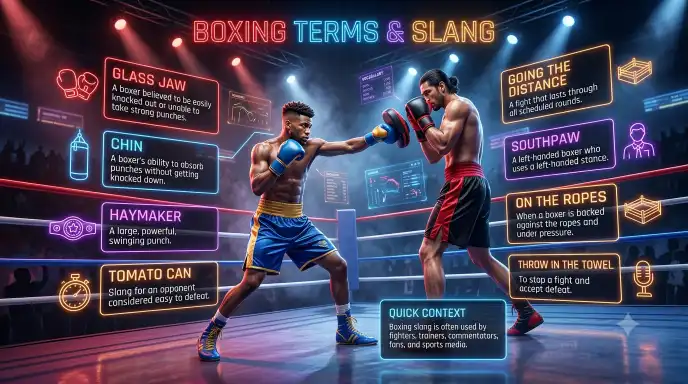
“Glass jaw” is informal boxing slang for a fighter who is believed to be easily hurt or knocked out.
The expression suggests that the fighter’s ability to absorb punches is weak.
Example:
“His power is impressive, but some fans think he has a glass jaw.”
This is usually a negative comment about a fighter’s durability.
Iron Chin
“Iron chin” is almost the opposite of “glass jaw.”
It describes a fighter who can take powerful punches without being knocked out or badly affected.
Example:
“He took several clean punches and kept moving forward. He has an iron chin.”
This is generally praised.
Chinny
“Chinny” is casual boxing slang for a fighter who appears easy to hurt or knock down.
It is usually negative and can sound mocking.
Example:
“He has great speed, but people keep calling him chinny.”
The word is more common in casual fan discussions than in respectful professional analysis.
Gatekeeper
A “gatekeeper” is an experienced boxer who often faces promising or rising fighters.
The idea is that a prospect must beat the gatekeeper to show that they are ready for a higher level of competition.
A gatekeeper is not necessarily a bad fighter. In many cases, such a boxer has strong experience and can give a developing fighter a difficult test.
Example:
“He is a tough gatekeeper who has tested several young prospects.”
Journeyman
A “journeyman” is a professional boxer who often fights regularly and may face more highly ranked or developing opponents.
The word does not automatically mean the fighter is poor. A journeyman can have years of professional experience and may still be difficult to beat.
Example:
“The young prospect faced an experienced journeyman in his first major test.”
The term is generally used as a boxing career description rather than a simple insult.
Tomato Can
“Tomato can” is informal and often insulting boxing slang for an opponent considered weak or easy to defeat.
Fans may use the expression when they believe a fighter has been matched against an opponent who poses little danger.
Example:
“Fans complained that the champion was given a tomato can.”
Because it dismisses another fighter’s ability, this term is best understood as fan slang rather than respectful professional language.
Bum
“Bum” can be used in boxing discussions to insult a fighter who is viewed as poor, unskilled, or undeserving of their reputation.
For example:
“He called the opponent a bum after the disappointing performance.”
This is strongly dependent on the speaker’s opinion. It is not an objective description of a professional boxer.
Boxing Slang for Fighting Styles
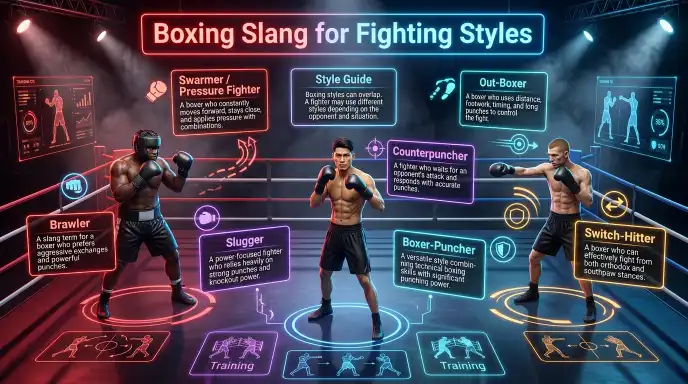
Boxing fans use many informal terms to explain how a fighter approaches a fight.
Brawler
A “brawler” is a fighter who prefers aggressive exchanges and often fights at close range.
Brawlers may rely heavily on power, toughness, and pressure.
Example:
“He is a powerful brawler who enjoys trading punches.”
The word is usually descriptive, although it can sometimes suggest a less technical style.
Pressure Fighter
A pressure fighter constantly tries to move forward and make the opponent fight under pressure.
The goal may be to reduce the opponent’s space and force them into uncomfortable exchanges.
Example:
“She is a pressure fighter who never gives her opponent much time to relax.”
This is normally a neutral or positive description.
Outboxer
An “outboxer” usually prefers to control distance rather than stay in constant close-range exchanges.
Movement, timing, accuracy, and long-range punches are often important to this style.
Example:
“The outboxer kept moving and landed clean punches from a distance.”
Counterpuncher
A counterpuncher waits for an opponent to attack and then looks for an opening to respond.
For example, a boxer may make an opponent miss and immediately throw a punch in return.
Example:
“He is a smart counterpuncher who waits for mistakes.”
Slick
“Slick” is positive boxing slang for a fighter who moves smoothly and uses skillful defense, timing, or footwork.
Example:
“Her defense looked really slick in the second half of the fight.”
Calling a boxer “slick” is generally praised.
Switch-Hitter
A “switch-hitter” is a boxer who can fight effectively from both the orthodox and southpaw stances.
This can make a fighter harder to predict because they can change their stance during a fight.
Example:
“He is a talented switch-hitter who changes stance without losing balance.”
Boxing Slang for Punches
Some boxing expressions describe powerful punches or combinations.
Haymaker
A “haymaker” is a large, powerful swinging punch.
Because it is usually wide, it can create an opening if it misses.
Example:
“He threw a huge haymaker but missed completely.”
The term is informal but widely understood in boxing conversations.
Bomb
“Bomb” is casual boxing language for a very powerful punch.
It does not describe one specific punch technique. Instead, it emphasizes how hard the punch was.
Example:
“He landed a bomb in the final round.”
Body Shot
A body shot is a punch aimed at the body rather than the head.
Body punches can affect a fighter’s movement, breathing, and stamina.
Example:
“The body shot slowed him down in the later rounds.”
Combination
A combination is a series of punches thrown together.
A boxer might throw a jab, cross, and hook as one combination.
Example:
“She finished the exchange with a fast combination.”
Unlike terms such as “tomato can” or “glass jaw,” “combination” is primarily a standard boxing term rather than slang.
Boxing Slang for Defense and Toughness
Some of the most common boxing expressions describe a fighter’s ability to survive pressure.
On the Ropes
A fighter is “on the ropes” when they are close to or against the ropes while facing pressure from an opponent.
Example:
“The challenger had him on the ropes near the end of the round.”
The phrase can also be used outside boxing to describe someone who is in serious difficulty.
Saved by the Bell
A fighter is “saved by the bell” when a round ends while they are in serious trouble.
The break gives them time to recover before the next round.
Example:
“He was badly hurt but was saved by the bell.”
This expression is also used in everyday English when someone narrowly avoids a difficult situation.
Gassed
A boxer is “gassed” when they become very tired during a fight.
Example:
“He looked strong early but got gassed after several hard rounds.”
“Gassed” is informal and is also common in other sports.
Hurt
When a boxing commentator says a fighter is “hurt,” it usually means a punch has seriously affected them.
It does not always mean the boxer has suffered a lasting injury. The word can describe a temporary loss of balance, control, or ability to respond effectively.
Example:
“He was hurt by the right hand but managed to recover.”
Boxing Stance Terms That Are Often Confused With Slang
Some words appear in searches for boxing terms slang but are actually standard boxing terminology.
| Term | Meaning | Typical tone |
| Orthodox | A stance with the left side generally forward | Neutral |
| Southpaw | A stance with the right side generally forward | Neutral |
| Switch-hitter | A boxer who can use both main stances effectively | Positive |
| High guard | A defensive position with the hands held high | Neutral |
| Peek-a-boo | A defensive style using a compact guard and head movement | Neutral |
For example, if someone says:
“He is a southpaw.”
They are not necessarily using slang. They are identifying the fighter’s stance.
This distinction is important because boxing vocabulary includes a mix of formal technical terms, informal slang, fan expressions, and older sports language.
Is Boxing Terms Slang Rude, Offensive, or Neutral?
Boxing slang can be neutral, positive, or insulting. The specific term matters more than the general category of “boxing slang.”
Usually Neutral
These terms are generally descriptive:
- Southpaw
- Orthodox
- Counterpuncher
- Pressure fighter
- Outboxer
- Switch-hitter
Usually Positive
These expressions often show admiration:
- Slick
- Iron chin
- Knockout artist
- Ring IQ
Often Negative
These terms can criticize or insult a fighter:
- Glass jaw
- Chinny
- Tomato can
- Bum
A fan may use a negative term casually online, but that does not make it respectful. If you are speaking directly to a boxer, trainer, or professional, neutral language is usually the better choice.
Where Is Boxing Terms Slang Commonly Used?
Boxing slang is used in many places, but the tone can change depending on the setting. A term used by a trainer may be technical, while the same word used by a fan can be humorous or insulting.
Boxing Gyms
Boxers and trainers use boxing language every day when discussing punches, defense, footwork, stamina, and tactics.
For example:
“Keep your guard up and work behind the jab.”
This is normal training language, not necessarily slang.
Texting and Group Chats
Fans often use shorter expressions when discussing a fight with friends.
“He’s completely gassed. I think the next round could end it.”
The informal wording makes the conversation quick and natural.
Boxing fans often use terms such as “glass chin,” “gatekeeper,” “robbery,” “ducking,” and “ring IQ” when debating fighters and fight results.
Because Reddit discussions can be highly opinion-based, a label such as “glass jaw” should not automatically be treated as an established fact about a fighter.
TikTok and Instagram
Boxing slang often appears in short videos, captions, comments, memes, and fight reactions.
A creator might describe a knockout as:
“He just got caught by a bomb.”
The expression adds excitement without describing a specific technical punch.
Discord
Boxing communities on Discord may use casual terms while watching a fight together or debating fighters.
The tone can range from serious analysis to playful trash talk.
Snapchat and Private Messages
Friends may use boxing expressions casually when discussing sports or even ordinary situations.
For example:
“That exam had me on the ropes.”
Here, the speaker is using a boxing expression metaphorically.
Real-Life Examples of Boxing Terms Slang
The same boxing expression can sound different depending on the situation and tone.
Friendly Example
“That guy has an iron chin. I don’t know how he stayed standing.”
The speaker is praising the fighter’s toughness.
Casual Example
“He got gassed after the sixth round.”
This simply means the fighter became very tired.
Argumentative Example
“Calling him a tomato can is unfair. He has beaten several good fighters.”
Here, the speaker is challenging a negative label.
Social Media Example
“That counterpunch was slick!”
“Slick” expresses admiration for the fighter’s skill.
Fan Discussion Example
“I think he’s more of a gatekeeper than a real title contender.”
The speaker is discussing the fighter’s place in the sport.
Everyday Example
“After three hours of work, I was on the ropes.”
Here, “on the ropes” is being used outside boxing to mean being under pressure or struggling.
Boxing Slang vs. Standard Boxing Terms
Not every word associated with boxing is slang. This is one of the most important points for beginners.
| Type | Examples | Purpose |
| Standard boxing terms | Jab, hook, uppercut, knockdown | Describe techniques or fight actions |
| Stance terms | Orthodox, southpaw | Describe fighting position |
| Informal boxing slang | Glass jaw, chinny, tomato can | Judge or describe a fighter informally |
| Fan expressions | Bomb, slick, iron chin | Add opinion or emotion |
| Career terms | Gatekeeper, journeyman | Describe a fighter’s role or career pattern |
This difference prevents confusion when reading boxing articles or watching fight commentary.
For example, “uppercut” has a specific technical meaning. “Tomato can” is a judgmental informal label.
Origin and Background of Boxing Slang
Boxing vocabulary has developed over many years through fighters, trainers, sports writers, commentators, fans, and popular culture.
Some terms have deep roots in boxing itself. Others became popular because they are colorful ways to describe what happens during a fight.
For example, “southpaw” is an established term for a left-handed boxing stance. “Glass jaw,” on the other hand, is a figurative expression used to suggest that a fighter does not take punches well.
The growth of sports media and online communities has also helped spread boxing expressions beyond gyms and professional fights. Fans can now discuss fighters instantly through social platforms, forums, video comments, and group chats.
Because slang changes with communities and time, some expressions may be common among older boxing fans while others become popular through newer online discussions.
Why Do People Use Boxing Slang?
People use boxing slang because it makes complicated ideas faster and easier to express.
Saying:
“He has an iron chin.”
is much shorter than explaining that the fighter has repeatedly absorbed powerful punches without being knocked down.
Similarly:
“He got gassed.”
quickly tells other boxing fans that the fighter’s energy and work rate dropped because of fatigue.
Boxing slang also adds emotion. Words such as “bomb,” “slick,” and “glass jaw” can make a discussion sound more lively than purely technical language.
Fans also use slang to show that they understand boxing culture and its common vocabulary.
Impact of Using Boxing Slang in Communication
Boxing slang can make conversations more natural when everyone understands the sport.
It can help people:
- Discuss fights quickly
- Describe a fighter’s style
- Explain a major moment
- Share opinions
- Add humor
- Connect with other fans
However, slang can also cause misunderstandings.
Calling a boxer a “bum” or saying they have a “glass jaw” is not a neutral statement. It expresses a judgment.
This matters especially when discussing real people online. A fan opinion should not be presented as an objective fact.
For example, instead of writing:
“He definitely has a glass jaw.”
A more careful statement would be:
“Some fans question his ability to take clean punches.”
The second version makes it clear that the statement is an opinion.
When Should You Avoid Boxing Slang?
You should avoid certain boxing slang when speaking in formal, professional, or sensitive situations.
When Speaking to a Professional Boxer
Calling someone a “bum,” “tomato can,” or “chinny” may sound disrespectful.
In Professional Writing
Sports journalism and serious analysis usually benefit from precise language. A writer should explain the actual performance rather than rely only on insulting labels.
In Workplace Conversations
Boxing slang is fine when discussing a fight with colleagues who enjoy boxing, but insulting terms about real people should still be used carefully.
When You Are Not Sure About the Meaning
Do not use a term simply because you saw it online. Some boxing expressions are highly context-dependent.
If you are unsure, use a neutral phrase such as:
“The fighter looked tired.”
instead of:
“He got gassed.”
Both may communicate a similar idea, but the first is clearer to a general audience.
Polite Alternatives to Negative Boxing Slang
You do not always need slang to express an opinion about a fighter.
| Negative slang | More neutral alternative |
| Glass jaw | Struggles to absorb clean punches |
| Chinny | Has shown vulnerability to punches |
| Bum | Low-level or poorly performing fighter |
| Tomato can | Overmatched opponent |
| Gassed | Became fatigued |
| Weak | Less physically effective |
| Scrub | Inexperienced or lower-level fighter |
Neutral alternatives are especially useful in articles, school assignments, professional conversations, and respectful discussions.
Comparison With Similar Boxing Expressions
Several terms can sound similar but describe different things.
| Expression | Meaning | Tone |
| Glass jaw | Easily hurt or knocked out | Negative |
| Iron chin | Handles heavy punches well | Positive |
| Gassed | Extremely tired | Informal/neutral |
| Chinny | Easily hurt | Negative |
| Slick | Smooth and skilled | Positive |
| Gatekeeper | Experienced fighter who tests prospects | Usually neutral |
| Tomato can | Considered an easy opponent | Negative |
| Brawler | Aggressive close-range fighter | Neutral |
| Outboxer | Uses distance and movement | Neutral |
| Counterpuncher | Attacks after an opponent’s attack | Neutral |
Knowing these differences makes boxing conversations much easier to understand.
Is Boxing Slang Safe for Social Media?
Yes, most boxing slang is harmless when it is used to discuss the sport. However, some terms can become insulting when directed at real fighters.
Terms such as “southpaw,” “counterpuncher,” “outboxer,” and “pressure fighter” are generally safe and descriptive.
Words such as “bum,” “tomato can,” “chinny,” and “glass jaw” are more judgmental. They can still appear in fan discussions, but users should understand that they may be disrespectful.
A good rule is to match the language to the audience. Casual slang may work in a fan chat, while neutral wording is better for professional or educational content.
Common Misunderstandings About Boxing Terms Slang
One major misunderstanding is assuming that every boxing term is slang.
That is not true.
Words such as “jab,” “hook,” “uppercut,” and “knockdown” are established boxing terminology. They have specific meanings within the sport.
Another mistake is treating fan labels as proven facts.
For example, “glass jaw” is an opinion about a fighter’s ability to take punches. It should not automatically be treated as a medical or objective assessment.
The same applies to words such as “bum” or “tomato can.” They express the speaker’s view rather than an official boxing classification.
Frequently Asked Questions About Boxing Terms Slang
Q1. What are boxing terms slang?
Boxing terms slang are informal expressions used by boxers, trainers, commentators, and fans to describe fighters, punches, fighting styles, tactics, and fight situations.
Q2. What does “glass jaw” mean in boxing?
“Glass jaw” is informal slang for a fighter who is considered easy to hurt or knock out. It is usually a negative judgment about a fighter’s durability.
Q3. What does “iron chin” mean in boxing?
“Iron chin” describes a fighter who can take powerful punches without being easily knocked out or seriously affected. It is generally a compliment.
Q4. What does “gassed” mean in boxing?
“Gassed” means a fighter has become very tired and can no longer maintain the same pace or energy. The word is informal and common in sports conversations.
Q5. What does “gatekeeper” mean in boxing?
A gatekeeper is an experienced fighter who often tests rising prospects. Beating such a fighter can show that a developing boxer is ready for stronger competition.
Q6. Is boxing slang rude?
Some boxing slang is neutral or positive, while other expressions can be insulting. Words such as “bum,” “chinny,” and “tomato can” are more negative than terms such as “southpaw” or “counterpuncher.”
Q7. Is boxing slang used on social media?
Yes. Boxing fans use slang on TikTok, Instagram, Reddit, Discord, group chats, and other online spaces to discuss fights, fighters, knockouts, and tactics.
Q8. Can boxing slang be used in professional writing?
Some boxing terms can be used in professional writing, but insulting labels should be handled carefully. Technical and neutral terms are usually better for formal articles and serious analysis.
Conclusion: Boxing Terms Slang
Boxing terms slang gives fans and fighters a quick way to describe what happens inside and around the ring. Expressions such as “iron chin,” “glass jaw,” “gassed,” “gatekeeper,” “slick,” and “tomato can” can add useful meaning, but they do not all have the same tone.
Some words are technical boxing terms rather than slang, while others are informal labels based on opinion. Understanding that difference helps you avoid confusion and use boxing language more accurately.
The safest approach is to consider the context before using a term. Descriptive words such as “southpaw” or “counterpuncher” are generally neutral, while terms such as “bum” or “glass jaw” can sound insulting. When in doubt, choose clear and respectful language.