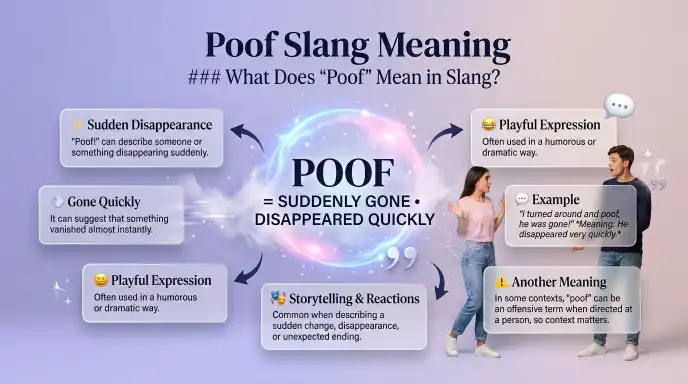
“Poof” slang meaning is a sudden disappearance or vanishing act like saying someone or something disappeared, vanished, or was gone instantly. It is often used in a playful way to describe a sudden change, exit, or disappearance.
People may search for poof slang after seeing the word in a text, TikTok caption, Discord chat, Snapchat message, or online comment. The meaning is usually easy to understand from the context, but the word can also be used as a sound effect or playful expression.
In this guide, you will learn what poof slang means, where it is used, how it sounds in different situations, and if it is rude or safe to use. You will also see simple examples that show how people use it naturally.
Quick Answer: Poof Slang Meaning
In slang and casual texting, “poof” often describes someone or something disappearing suddenly, as if it vanished in an instant. It can also be used as a playful sound effect for a quick change or action.
Quick Answer: What Does Poof Slang Mean?
Poof slang means “suddenly gone” or “disappeared quickly.” It is a casual expression that often makes a sudden disappearance sound funny, dramatic, or magical.
For example:
“I looked away for one second and poof, my cookies were gone.”
Here, “poof” shows that the cookies disappeared very quickly.
The word does not usually have a hidden or complex meaning. Its exact feeling depends on the conversation.
What Does Poof Slang Mean in Text?
In texting, poof slang commonly describes a sudden disappearance or change.
Someone may write “poof” when:
- A person leaves suddenly.
- Something disappears.
- A problem suddenly ends.
- Something changes very quickly.
- A person stops replying.
- Something is removed or deleted.
For example:
“He was online five minutes ago, and now poof, he’s gone.”
The word adds a playful tone to the message. Instead of simply saying “he disappeared,” the person uses “poof” to make the moment sound sudden.
Poof as a playful reaction
People can also use “poof” as a reaction to an unexpected change.
“I finished my homework and poof, the whole evening was gone.”
Here, the speaker is not saying anything literally vanishes. They mean the evening seemed to disappear quickly.
Full Form or Definition of Poof Slang Meaning
“Poof” is not normally an abbreviation, so it does not have a standard full form.
It is better understood as an expressive word or sound-effect-like expression.
Depending on context, it can mean:
- Suddenly disappeared
- Gone in an instant
- Changed very quickly
- Suddenly ended
- Appeared or happened quickly
- A playful magical effect
The most common casual meaning is connected to sudden disappearance.
Different Meanings of Poof Slang Meaning
The word can have more than one casual use. These meanings should be understood separately.
1. Poof Means “Suddenly Gone”
This is one of the most common uses in casual online conversation.
“My motivation was here this morning. Poof, it’s gone.”
The speaker means their motivation disappeared quickly.
2. Poof as a Sound Effect
“Poof” can imitate the sound or idea of something happening instantly.
“I clicked the button and poof, the page changed.”
It does not mean that the button literally made a “poof” sound. The word simply makes the action feel sudden.
3. Poof Means “Suddenly Changed”
Sometimes people use “poof” when something changes unexpectedly.
“One update later and poof, the whole design looked different.”
This use focuses on the sudden change rather than disappearance.
4. Poof as a Magical Expression
Because “poof” is often linked with magic, people may use it jokingly when something happens almost instantly.
“Add some decorations, and poof, the room looks amazing.”
This gives the sentence a playful and dramatic feeling.
Where Is Poof Slang Commonly Used?
“Poof” is flexible and can appear in many casual settings. It is not limited to one social media platform.
| Platform or Setting | Common Use |
| Texting | Something suddenly disappears |
| TikTok | Funny captions or sudden changes |
| Playful descriptions and captions | |
| Snapchat | Casual reactions |
| Discord | Gaming or chat-related disappearance |
| Informal comments and jokes | |
| Gaming | Characters, items, or effects disappearing |
| Group chats | Funny reactions to sudden events |
The tone is usually informal. People use it more freely with friends than in formal communication.
Is Poof Slang Rude, Offensive, or Harmless?
Poof is generally harmless and not offensive when it is used to describe a sudden disappearance or change.
It is usually playful rather than insulting.
For example:
“Poof! The weekend is already over.”
This is completely casual.
However, context still matters. A word can sound different depending on the sentence and the person using it. If someone uses “poof” to mock another person, the overall message could feel rude even though the word itself is not normally offensive.
Is poof appropriate at work?
“Poof” is usually too casual for formal writing.
In a friendly workplace chat, it may be fine:
“The file was there earlier, then poof, it disappeared.”
But in a formal email, a clearer phrase is better:
“The file appears to have disappeared.”
Real-Life Examples of Poof Slang
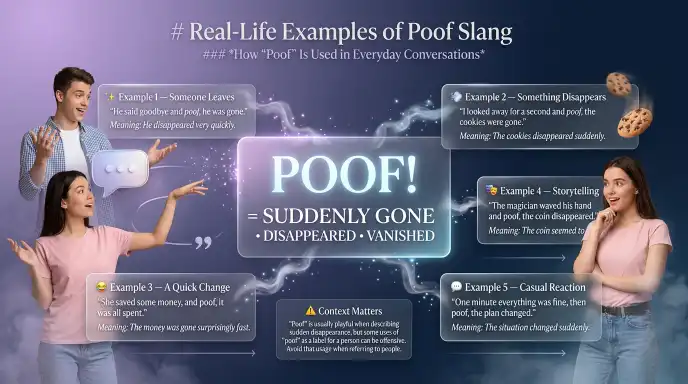
Seeing examples makes the meaning much easier to understand.
Friendly conversation
“I put the cake on the table, and poof, everyone showed up.”
The speaker is joking about how quickly people appeared when food was available.
Casual texting
“My battery was at 20%, then poof, my phone died.”
Here, “poof” means the battery level disappeared quickly.
Funny conversation
“I opened the fridge to get the leftovers. Poof. Someone already ate them.”
The word adds humor to the situation.
Social media caption
“New haircut and poof, new personality.”
This is a playful exaggeration. The person is joking that the haircut changed their whole look.
Gaming context
“The boss dropped the item, and poof, another player grabbed it.”
Here, “poof” highlights how quickly the item was gone.
Discord chat
“He joined the voice chat, said hi, and poof, left again.”
The expression makes the sudden exit sound funny.
Argumentative context
“Poof” is less common in serious arguments, but it can still appear:
“You promised to help, and then poof, you disappeared.”
Here, the tone is more critical. The speaker is annoyed about someone’s sudden absence.
Poof Slang in Different Contexts
The same word can feel different depending on the situation.
| Context | Example | Meaning |
| Funny | “Poof, my snacks are gone.” | Disappeared quickly |
| Casual | “Poof, the day is over.” | Passed very quickly |
| Gaming | “Poof, the enemy vanished.” | Disappeared suddenly |
| Social media | “New outfit, poof, new vibe.” | Sudden change |
| Serious | “He said he’d stay, then poof.” | Suddenly left |
| Magical/playful | “Add the finishing touch and poof!” | Instant result |
The surrounding sentence tells you which feeling the writer intends.
Origin and Background of Poof Slang Meaning
“Poof” is an old expressive English word rather than a slang term created by modern social media.
It has long been used as a sound-like expression for something happening suddenly, especially something appearing or disappearing in a magical or dramatic way. The spelling and exact use can vary, but the basic idea of suddenness has remained familiar in English.
Modern texting and social media have made this type of expressive word especially easy to use. People can type “poof” to replace a longer explanation such as “it suddenly disappeared.”
There is no reliable reason to claim that TikTok, Gen Z, or another single online community invented “poof.” Its casual use is older than today’s social-media platforms.
Poof Slang vs. Similar Expressions
Several casual expressions can communicate a similar idea.
| Expression | Meaning | Tone |
| Poof | Suddenly gone or changed | Playful |
| Gone | No longer there | Neutral |
| Vanished | Disappeared | Neutral |
| Disappeared | No longer visible or present | Neutral |
| Bye-bye | Leaving or ending | Playful |
| Just like that | Something happened quickly | Casual |
| And it’s gone | Something disappeared | Funny/casual |
“Poof” stands out because it creates a visual or magical feeling. It makes the disappearance feel almost instant.
When Should You Avoid Using Poof?
Although poof slang is harmless in most casual situations, it is not suitable everywhere.
Avoid it when:
- Writing a formal report.
- Speaking in a highly professional setting.
- Explaining a serious event.
- Writing academic work.
- Communicating with someone who may not understand the expression.
- You need precise wording rather than a playful tone.
For example, instead of:
“The payment went poof.”
A formal message would be clearer:
“The payment disappeared from the account.”
The best choice depends on how serious and formal the situation is.
Polite and Clear Alternatives to Poof
If you want a more professional expression, use:
- Suddenly disappeared
- Vanished
- Was gone
- Disappeared quickly
- Suddenly left
- Changed instantly
- Was removed
- Ended suddenly
For example:
Casual:
“Poof, the message was gone.”
Clear:
“The message suddenly disappeared.”
Formal:
“The message was no longer visible.”
Why Do People Use Poof Slang?
People use “poof” because it is short, expressive, and easy to understand.
It can make an ordinary sentence more fun.
Compare these:
“My free time disappeared.”
and:
“My free time went poof.”
The second sentence feels more playful.
People also use it because it creates a mental image. The reader can imagine something disappearing instantly, almost like a magician’s trick.
Common Misunderstandings About Poof
Is poof an acronym?
No. In common slang use, “poof” is not an acronym with a standard full form.
Does poof always mean disappeared?
No. Disappearance is a common meaning, but “poof” can also describe a sudden change, quick result, or playful magical effect.
Is poof only used online?
No. People can use “poof” in everyday speech as well as texting and social media.
Is poof a Gen Z word?
Not specifically. The expression existed long before Gen Z and modern social media. Younger users may use it online, but they did not create the word.
Is poof the same as “gone”?
They can communicate a similar idea, but “poof” adds a playful sense of suddenness.
Is Poof Safe for Social Media?
Yes. In its usual meaning, poof slang is generally safe for social media.
It is not normally a profanity or offensive expression. You may see it in:
- Captions
- Comments
- Memes
- Text messages
- Gaming chats
- Short videos
- Group conversations
Still, the complete sentence matters. “Poof” itself is generally harmless, but any expression can take on a different tone when used sarcastically or to mock someone.
Frequently Asked Questions About Poof Slang Meaning
Q1. What does poof mean in slang?
Poof usually means that someone or something suddenly disappeared or was gone very quickly. It can also describe a sudden change or instant result.
Q2. What does poof mean in texting?
In texting, “poof” is often a playful way to say that something suddenly disappeared, ended, or changed.
Q3. Is poof a slang word?
Yes, “poof” can be used as an informal or slang-like expression. It is also a standard expressive word used outside slang.
Q4. Is poof rude or offensive?
No. “Poof” is generally harmless. The tone depends on the sentence and situation, but the word itself is not normally offensive.
Q5. Is poof used on TikTok and Instagram?
Yes. People may use “poof” in captions, comments, and videos to describe something disappearing or changing quickly.
Q6. What is another word for poof?
Depending on the context, alternatives include “vanished,” “disappeared,” “gone,” “suddenly left,” or “just like that.”
Q7. Is proof appropriate for work?
It can work in a casual workplace chat, but it is better to avoid it in formal emails, reports, and professional documents.
Q8. Does poof have a full form?
No. “Poof” does not have a standard full form because it is not normally an abbreviation.
Conclusion:
Poof slang is a simple, playful expression that usually means something suddenly disappeared, ended, or changed. It can also work like a sound effect when describing something that happens almost instantly.
The word is generally harmless and works well in casual texts, social media posts, gaming chats, and conversations with friends. Its playful tone makes a sentence feel more lively.
For formal writing, however, clearer words such as “disappeared,” “vanished,” or “was removed” are usually better.
The key is context. When you see “poof” in a message, look at what happened before and after the word. In most casual conversations, it simply means “suddenly gone” or “just like that.”

I’m Emily Carter, and I enjoy writing about slang, internet language, and modern English expressions. My goal is to explain word meanings in a simple, clear, and easy-to-understand way so anyone can learn with confidence.