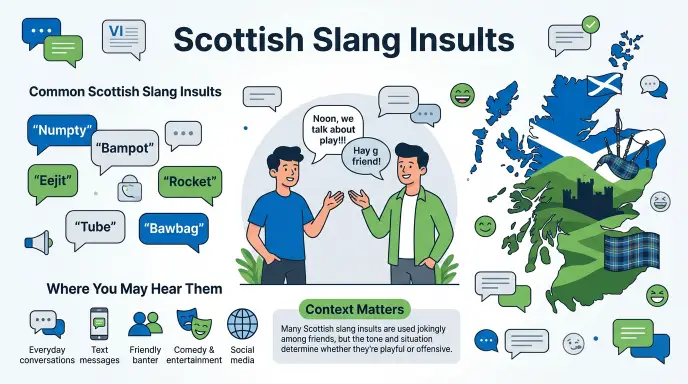
Scottish slang insults are well known for being creative, witty, and full of personality. Many people search for these expressions after hearing them in Scottish conversations, movies, TV shows, social media videos, or online gaming chats.
While some insults are genuinely offensive, others are used jokingly between friends and are not always meant to hurt someone’s feelings.
Understanding Scottish slang insults can help you avoid misunderstandings and appreciate Scottish humor. Like many regional expressions, the meaning often depends on the speaker’s tone, relationship, and situation. A word that sounds harsh to outsiders may be playful among close friends in Scotland.
Quick Answer: Scottish Slang Insults
Scottish slang insults are informal words or phrases used in Scotland to tease, criticize, or joke about someone. Their meaning depends on context, and some are friendly while others are genuinely offensive.
What Does Scottish Slang Insults Mean in Text?
Scottish slang insults are informal expressions used to describe someone in a negative, humorous, or sarcastic way. Unlike internet abbreviations, there is no single full form because this is a category of slang rather than one specific word.
People may use these insults to:
- Joke with close friends
- Show frustration
- Mock someone’s behavior
- Express disagreement
- Add humor to conversations
The same insult can sound friendly in one conversation and offensive in another. Tone of voice and the relationship between the speakers matter more than the words alone.
Scottish Slang Insults Definition
Scottish slang insults are regional expressions commonly used in Scotland to criticize, tease, or joke about another person. Some are playful, while others should be avoided because they can be offensive.
Scottish Slang Insults Full Form
Since “Scottish slang insults” is a general phrase rather than an abbreviation, it does not have a full form.
People sometimes search for:
- Scottish slang insults full form
- Scottish slang insults meaning slang
- What does Scottish slang insults stand for
The answer is simple: it is a collection of insulting or teasing slang words used in Scottish English.
Is Scottish Slang Insults Rude, Offensive, or Neutral?
Not every Scottish insult is equally offensive. They generally fall into three groups.
Friendly
These are often exchanged between close friends as jokes. The speaker usually has no intention of causing harm.
Examples include playful teasing during sports, gaming, or casual conversations.
Mildly Offensive
These insults express annoyance or criticism but are usually not considered extremely rude.
People often use them when someone behaves foolishly or makes repeated mistakes.
Highly Offensive

Some Scottish insults contain strong profanity or target someone’s character. These should be avoided unless you fully understand the cultural context because they can easily offend others.
Where Are Scottish Slang Insults Commonly Used?
Scottish slang insults are most common in everyday conversations across Scotland, but they also appear online and in popular culture. Their meaning often changes depending on the situation and the relationship between the people involved.
You may come across them in:
- Everyday conversations
- Family and friend groups
- Football discussions
- Comedy shows
- Scottish TV series and films
- TikTok videos
- Reddit discussions
- Discord servers
- Instagram comments
- Snapchat messages
- Online gaming chats
People outside Scotland may not always understand these expressions, so using them without knowing the context can create confusion.
Popular Scottish Slang Insults and Their Meanings
Scottish slang has hundreds of regional expressions. Some are playful, while others are much stronger. Here are a few well known examples.
Numpty
Meaning
A harmless way to call someone silly, clumsy, or foolish.
Example
“You forgot your keys again, you numpty.”
Tone
Usually friendly and humorous.
Bam
Meaning
Someone who behaves wildly, foolishly, or causes trouble.
Example
“Stop acting like a bam.”
Tone
Can be playful or insulting depending on the conversation.
Rocket
Meaning
A person acting in a ridiculous or embarrassing way.
Example
“Only a rocket would try that.”
Tone
Usually light hearted but still critical.
Tube
Meaning
Someone considered unintelligent or lacking common sense.
Example
“Don’t be a tube.”
Tone
Normally mild and informal.
Eejit
Meaning
A Scottish and Irish variation of “idiot.” It often sounds softer than the standard English word.
Example
“You absolute eejit, that was the wrong bus.”
Tone
Often friendly among people who know each other.
Fud
Meaning
A rude insult used to describe an annoying or unpleasant person.
Example
“He was acting like a complete fud.”
Tone
Moderately offensive.
Walloper
Meaning
Someone viewed as foolish, annoying, or ridiculous.
Example
“Ignore him. He’s a walloper.”
Tone
Usually humorous.
Dafty
Meaning
A person behaving in a silly or absent-minded way.
Example
“You dafty, the answer was obvious.”
Tone
Generally affectionate rather than insulting.
Real Life Examples of Scottish Slang Insults
Different situations can completely change how these expressions are understood.
Friendly Conversation
Friend 1: “You left your phone at home again.”
Friend 2: “I know. I’m such a numpty.”
In this case, the insult is self deprecating and humorous.
Casual Conversation
“I’m not listening to that rocket anymore.”
The speaker is criticizing someone’s behavior without using extremely offensive language.
Argument
“Stop acting like a bam and listen for once.”
Here, the insult shows frustration and is more likely to offend.
Gaming Chat
“You rushed in by yourself again, you absolute eejit.”
Players often use mild Scottish slang while joking with teammates, although strangers may not appreciate it.
Origin and Background of Scottish Slang Insults
Scottish slang has developed over hundreds of years through a mix of Scottish English, the Scots language, and Scottish Gaelic influences. Different regions of Scotland have their own local expressions, so an insult that is common in Glasgow may be unfamiliar in Aberdeen or the Highlands.
Many Scottish slang insults began as everyday descriptions of people’s behavior rather than serious offensive words. Over time, some became humorous nicknames, while others grew stronger in meaning.
Today, these expressions continue to evolve through:
- Everyday conversations
- Football culture
- Scottish comedy
- Television and films
- TikTok and Instagram videos
- Reddit communities
- Discord servers
- Online gaming
- Text messaging
Because language changes over time, some older insults are becoming less common, while newer expressions continue to appear.
Scottish Slang Insults vs Similar Slang
| Scottish Slang | Meaning | Strength | Common Use |
| Numpty | Silly or foolish person | Mild | Friends, family |
| Eejit | Foolish person | Mild | Casual conversation |
| Bam | Troublemaker or foolish person | Medium | Arguments, casual speech |
| Rocket | Someone acting ridiculously | Mild | Everyday conversation |
| Tube | Foolish or clueless person | Mild | Friendly teasing |
| Fud | Annoying or unpleasant person | Medium to Strong | Arguments |
| Dafty | Silly person | Very Mild | Friends and family |
When Should You Avoid Using Scottish Slang Insults?
Even mild slang can offend someone if used in the wrong situation. It is best to avoid Scottish insults when:
- Speaking to someone you do not know well.
- Talking in professional or workplace settings.
- Writing business emails.
- Speaking with teachers or customers.
- Posting comments that could be misunderstood.
- Communicating with people unfamiliar with Scottish culture.
Remember that humor does not always translate across cultures. What sounds funny to one person may sound rude to another.
Polite Alternatives to Scottish Slang Insults
If you want to express disagreement without offending someone, these alternatives are safer.
| Scottish Slang Insult | Polite Alternative |
| Numpty | Mistaken |
| Eejit | A little confused |
| Bam | Acting carelessly |
| Rocket | Being unreasonable |
| Tube | Not thinking clearly |
| Fud | Difficult person |
| Dafty | Silly |
These alternatives work better in schools, workplaces, and formal conversations.
Why Do People Use Scottish Slang Insults?
People often use Scottish slang insults for reasons other than simply offending someone.
Some common reasons include:
- Adding humor to conversations.
- Showing frustration.
- Teasing close friends.
- Expressing personality.
- Creating a relaxed atmosphere.
- Reflecting Scottish culture and identity.
- Making conversations feel more natural.
Among friends, these words are often signs of familiarity rather than hostility. However, strangers should be more careful because the same words can easily sound disrespectful.
Impact of Using Scottish Slang Insults in Communication
Scottish slang insults can make conversations feel more natural and authentic, especially among people who share the same culture. They often add humor, emotion, and personality to everyday speech. However, using them without understanding the context can lead to misunderstandings.
Here are some possible effects:
- They can create friendly banter between close friends.
- They may strengthen a sense of local identity.
- They can express frustration quickly.
- They may offend someone if used with the wrong tone.
- They can confuse people who are unfamiliar with Scottish slang.
The safest approach is to consider who you are speaking to and if the situation is casual or formal.
Is It Safe to Use Scottish Slang Insults on Social Media?
It depends on the word and the context.
Many mild Scottish slang insults appear on platforms such as TikTok, Reddit, Instagram, Discord, Snapchat, and gaming communities. Friends may use them jokingly in comments or messages.
However, you should avoid using stronger insults because they can:
- Be misunderstood by a wider audience.
- Violate community guidelines on some platforms.
- Lead to arguments or negative reactions.
- Damage your online reputation.
If you are unsure if an expression is offensive, it is better to choose a more respectful alternative.
Frequently Asked Questions
Q1:What are Scottish slang insults?
Scottish slang insults are informal words and phrases used in Scotland to tease, criticize, or joke about someone. Their meaning depends on the situation and the relationship between the speakers.
Q2:Are all Scottish slang insults offensive?
No. Some, such as “numpty” or “dafty,” are often used playfully among friends, while others are much stronger and can be offensive.
Q3:Do Scottish slang insults have a full form?
No. “Scottish slang insults” is a general phrase, not an abbreviation, so it does not have a full form.
Q4:Can I use Scottish slang insults in text messages?
Yes, but only if you know the other person understands the meaning and is comfortable with that type of humor.
Q5:Why are Scottish slang insults popular online?
They are entertaining, memorable, and often appear in Scottish comedy, football discussions, TikTok videos, Reddit threads, gaming chats, and other social media conversations.
Q6:Should I use Scottish slang insults at work?
No. Professional communication should remain polite and respectful. Slang insults are best avoided in workplaces, schools, and formal situations.
Q7. What are some Scottish slurs?
Some common Scottish insults include numpty (fool), eejit (idiot), bampot (aggravating person), and rocket (silly person). Most are playful but can be rude depending on the situation.
Q8. What does “I dinna fash” mean?
“I dinna fash” means “I don’t worry” or “I don’t bother.” It is a traditional Scottish phrase used to show someone is not concerned.
Q9. What does “shut your geggy” mean?
“Shut your geggy” means “shut your mouth” or “be quiet.” Geggy is Scottish slang for a person’s mouth.
Q10. What are some Scottish slangs?
Popular Scottish slang includes aye (yes), wee (small), ken (know), bairn (child), and bonnie (beautiful). These words are widely used in everyday Scottish conversations.
Conclusion
Scottish slang insults are a unique part of Scottish culture and everyday language. Some are light-hearted expressions used between friends, while others can be genuinely offensive. Understanding the meaning, tone, and context behind these words is more important than simply knowing their definitions.
If you hear Scottish slang insults in conversations, movies, social media, or online games, remember that the speaker’s intention and relationship with the listener often determine how the words are understood.
When in doubt, choose respectful language, especially in professional or public settings. Using slang thoughtfully helps you communicate more clearly while appreciating the richness and humor of Scottish English.

I’m Emily Carter, and I enjoy writing about slang, internet language, and modern English expressions. My goal is to explain word meanings in a simple, clear, and easy-to-understand way so anyone can learn with confidence.