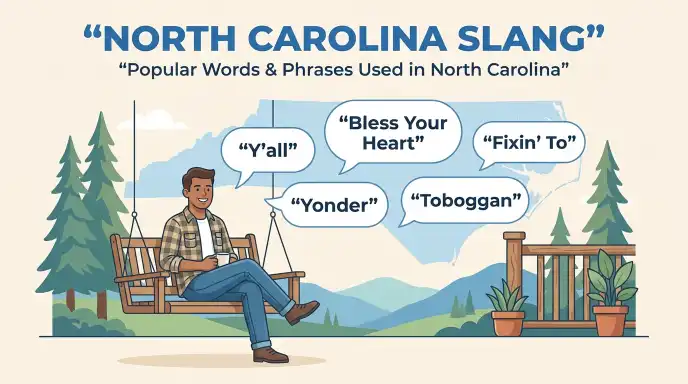
North Carolina slang means the informal words, phrases, and regional expressions used by people in North Carolina. In simple terms, it is local speech or regional language that can make everyday conversations sound different from standard American English.
If you are searching for North Carolina slang, you may want to understand expressions such as “y’all,” “fixin’ to,” “over yonder,” or “Cackalacky.” North Carolina does not have one single slang style. Speech can vary between the mountains, Piedmont, and coast, and some expressions are shared with the wider South while others are strongly tied to particular communities.
This guide explains common North Carolina slang, what each expression means, how people use it, and if it sounds modern, casual, or old-fashioned. You will also learn about regional differences, real-life examples, and the history behind some of the state’s most recognizable expressions.
Quick Answer: North Carolina Slang
North Carolina slang is a mix of Southern expressions and local regional words used in different parts of the state. Common examples include “y’all,” “fixin’ to,” “over yonder,” and “Cackalacky,” while some terms are mainly heard in mountain or coastal communities.
What Does North Carolina Slang Mean?
North Carolina slang refers to informal language associated with people and communities in North Carolina.
The term does not describe one fixed list of words. North Carolina is a large and geographically diverse state, so local speech changes from one region to another.
Some expressions are common across the South. Others are much more local.
For example, “y’all” is widely used throughout the Southern United States, including North Carolina. By contrast, words such as “sigogglin’” have stronger regional ties and may be unfamiliar to someone from another part of the state.
This makes North Carolina slang especially interesting. A person from the Outer Banks may use an expression that someone from western North Carolina has never heard.
Is North Carolina Slang Different From Southern Slang?
Yes, but the two overlap heavily.
North Carolina is part of the broader Southern speech region, so many expressions found in the state are also used in places such as South Carolina, Georgia, Tennessee, and Virginia.
At the same time, North Carolina has its own regional vocabulary and pronunciation patterns.
A useful way to think about it is:
| Type | Example | Meaning |
| Southern expression | Y’all | You or you all |
| Southern expression | Fixin’ to | About to do something |
| Regional expression | Over yonder | Over there |
| Mountain term | Sigogglin’ | Crooked or uneven |
| Coastal term | Dingbatter | A tourist |
| State nickname | Cackalacky | Playful name for North Carolina |
So, calling every North Carolina expression “Southern slang” would miss some of the state’s local language history.
Popular North Carolina Slang Words and Phrases
Here are some of the expressions you are most likely to encounter when learning about North Carolina speech.
Y’all
“Y’all” is a shortened form of “you all.”
It is used when speaking to two or more people, although speakers sometimes use it when talking casually to one person as well.
Example:
“Are y’all coming with us?”
“Y’all” is not considered offensive. It is a normal part of casual Southern speech and is also increasingly common outside the South.
All Y’all
“All y’all” adds emphasis to the idea of addressing everyone in a group.
Example:
“Are all y’all ready to leave?”
The expression is very informal. It may sound playful to people who do not normally use Southern speech.
Fixin’ to
“Fixin’ to” means “about to” or “getting ready to.”
Example:
“I’m fixin’ to make some coffee.”
Someone using this phrase is not talking about repairing something. Here, “fixin’ to” describes an action that is about to happen.
This expression is common in Southern American English and is not exclusive to North Carolina.
Over Yonder
“Over yonder” means “over there.”
Example:
“Your shoes are over yonder beside the chair.”
The phrase has a distinctly rural or Southern feel. You may hear it more often in informal conversations than in professional settings.
Poke
In some Appalachian and Southern communities, “poke” can mean a bag.
Example:
“Put the apples in that poke.”
This meaning can confuse people because “poke” has many other meanings in modern English. Regional context tells you which meaning is intended.
Sigogglin’
“Sigogglin’” describes something crooked, uneven, or out of alignment.
Example:
“That shelf is sigogglin’.”
The term is especially associated with western North Carolina and the Smoky Mountain region.
It is much more regional than words such as “y’all” or “fixin’ to,” so not every North Carolinian will use it.
North Carolina Slang by Region
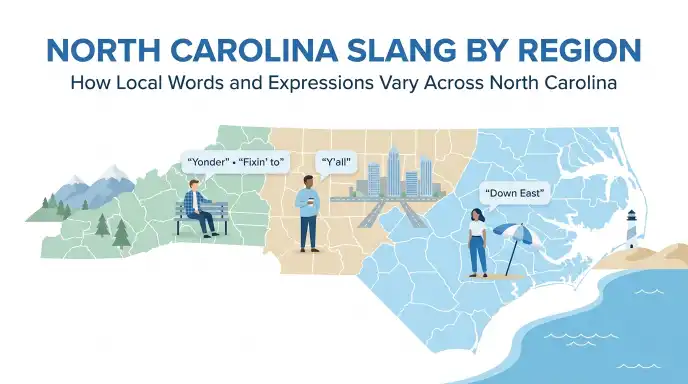
North Carolina has several speech regions. The words you hear can depend on where someone lives or grew up.
Western North Carolina
Mountain communities have strong connections with Appalachian English.
You may encounter expressions and pronunciations that are less common in the state’s cities or coastal areas.
“Sigogglin” is one example of a regional word associated with the Smoky Mountains.
Mountain speech can also preserve older words and expressions that have become uncommon elsewhere.
The Piedmont
The Piedmont includes many of North Carolina’s major inland communities.
Speech here often combines broader Southern expressions with local vocabulary.
You are more likely to hear familiar expressions such as “y’all” and “fixin’ to,” along with regional pronunciation patterns.
Because the Piedmont contains large cities and universities, speech can also be less strongly marked as Southern than in some rural areas.
The Coastal Plain
Eastern North Carolina has its own speech traditions.
Some words and expressions can sound unusual to people from other regions of the country. Coastal communities have also developed vocabulary influenced by their history and geography.
The Outer Banks
The Outer Banks has some of the most distinctive traditional speech in North Carolina.
The Ocracoke area is known for a traditional dialect often called the Ocracoke brogue or “Hoi Toider” speech.
Its development was influenced by the area’s geographic isolation and historical contact with different varieties of English.
North Carolina Slang Examples in Everyday Conversation
North Carolina expressions make more sense when you see them in context.
Friendly Conversation
“Are y’all staying for dinner?”
“Yeah, we’re fixin’ to eat soon.”
Here, both expressions are casual and friendly.
Talking About Location
“I left your bag over yonder.”
This simply means the bag is somewhere over there.
Talking About Something Crooked
“Why is that picture hanging sigogglin’?”
The speaker means that the picture is crooked or uneven.
Talking About a Tourist
“That dingbatter just asked me where the beach is.”
In parts of the Outer Banks, “dingbatter” can refer to a visitor or tourist.
The word is regional, so someone outside the area may not understand it.
What Does “Dingbatter” Mean in North Carolina?
“Dingbatter” is a regional Outer Banks term for a tourist or visitor.
It is associated particularly with the traditional speech of the Outer Banks.
The tone can be humorous or teasing rather than seriously insulting. However, tone matters. Calling an unfamiliar person a “dingbatter” may not be received the same way as using the word jokingly with friends.
Because it is highly regional, do not assume that every person from North Carolina uses or recognizes it.
Is North Carolina Slang Rude or Offensive?
Most common North Carolina slang is harmless and informal.
Words such as “y’all,” “fixin’ to,” and “over yonder” are generally not offensive. They simply give a conversation a Southern or regional flavor.
Some less common words can be teasing or insulting depending on how they are used.
The safest approach is to consider:
- Who you are talking to
- Where they are from
- if the word is commonly used today
- Your tone of voice
- if the situation is formal or casual
A regional expression can sound friendly among local speakers but strange or disrespectful when used by someone who is unfamiliar with the culture.
Is North Carolina Slang Appropriate at Work?
Common expressions such as “y’all” are usually fine in casual workplace conversations.
However, very regional or old-fashioned expressions may not fit formal writing.
For example, saying “Are y’all ready?” in a friendly team chat is usually natural. Writing “I’m fixin’ to send the report” in a formal business document would sound much more casual.
For professional communication, use standard English when clarity and formality matter most.
Is North Carolina Slang Still Used Today?
Yes, but not every expression has the same level of popularity.
Some expressions remain common in everyday Southern speech. Others are strongly regional, traditional, or associated with older generations.
This distinction matters.
“You all” and “y’all” are still widely understood. “Sigogglin’,” on the other hand, is much more specialized.
Some traditional coastal and mountain terms may also be less familiar to younger speakers than they were to previous generations.
Regional slang has a lifecycle. A word can remain culturally important even when fewer people use it in ordinary conversation.
More North Carolina Slang Words and Sayings
North Carolina has many expressions that sound natural to locals but may confuse visitors. Some are common Southern phrases, while others are tied to mountain, rural, or coastal communities.
The meaning also depends on location. A phrase that is familiar in the western part of the state may be rare on the coast.
Airish
“Airish” describes weather that feels cool, chilly, or breezy.
Example:
“It’s a little airish outside this morning.”
The word is a good example of regional vocabulary that may sound unfamiliar to people from outside the area.
Pizer
“Pizer” is a regional pronunciation of “porch.”
Example:
“Come sit on the pizza for a while.”
It is especially associated with speech traditions in parts of eastern North Carolina and the Outer Banks.
Mommuck
“Mommuck” is a regional term meaning to bother, annoy, or harass someone.
Example:
“Stop mommuckin’ around and help me with this.”
This is not a word you should expect every North Carolinian to use. It is strongly regional.
Buddyrow
“Buddyrow” is a regional word for a good friend or close companion.
Example:
“That’s my old buddyrow from back home.”
It has a friendly, informal tone and is more likely to appear in local or traditional speech than in formal communication.
Slam Full
“Slam full” means completely full or packed.
Example:
“The restaurant was full last night.”
The expression can be understood from context, even by people who have never heard it before.
Halfback
In western North Carolina, “halfback” can refer to a person who moved from the Northeast to Florida but later moved halfway back to the Carolinas.
Example:
“My neighbors are halfbacks who settled here after living in Florida.”
The term is connected with migration patterns and is not simply another word for a football player.
North Carolina Slang You May Hear in the Mountains
Mountain communities have preserved speech features that are different from those found in other parts of the state.
One well-known example is “sigogglin’,” which describes something crooked or not straight.
You may also encounter forms such as “yuns,” a regional form used for addressing more than one person.
North Carolina Slang From the Coast
Coastal North Carolina has its own linguistic history.
The Outer Banks are particularly interesting because some communities developed distinctive speech patterns while being geographically separated from larger population centers.
The traditional Ocracoke brogue is one example.
Some local words have also become part of the cultural identity of the area. “Dingbatter,” for example, has been used for a tourist or visitor.
These terms may appear in stories about local culture, but that does not mean they are common in everyday speech across the entire state.
North Carolina Slang vs. Internet Slang
One important difference is that North Carolina slang is not necessarily internet slang.
Internet slang usually spreads through platforms, messaging, gaming, and online communities. Regional slang develops mainly through local speech and community history.
For example:
| Expression | Type | Typical context |
| Y’all | Southern regional expression | Everyday conversation |
| Fixin’ to | Southern expression | Casual speech |
| Sigogglin’ | Regional dialect word | Mountain speech |
| Dingbatter | Coastal regional term | Outer Banks culture |
| Cackalacky | Regional nickname | Casual or humorous use |
| LOL | Internet abbreviation | Texting and social media |
This distinction prevents a common misunderstanding: not every slang word associated with North Carolina originated online.
How North Carolina Slang Is Used Online
Traditional regional expressions can appear online even though they began as spoken language.
People may use them in:
- Text messages
- Facebook posts
- TikTok captions
- Instagram comments
- Reddit discussions
- Discord chats
- Online community groups
For example:
“Y’all better get here before the game starts.”
A North Carolina user might type “y’all” exactly as they would say it.
On social media, regional expressions can also be used intentionally to show local identity. Someone may write “Cackalacky” as a playful way to refer to North Carolina.
However, online usage does not automatically make a traditional regional word “internet slang.”
Is “Y’all” Considered North Carolina Slang?
“Y’all” is strongly associated with Southern speech, including North Carolina, but it is not unique to the state.
It is now widely recognized across the United States.
The word has also become common online because it provides a simple way to address a group of people.
For example:
“Are y’all watching the game tonight?”
The expression is casual, friendly, and generally harmless.
It can even appear in professional conversation when the setting is relaxed. Still, “you all” may be a better choice in very formal writing.
Is “Cackalacky” a Real North Carolina Slang Word?
Yes. “Cackalacky” is a recognized informal nickname associated with North Carolina and the Carolinas.
Its exact origin is not completely settled. Historical and linguistic discussions have proposed different explanations, so it is better not to claim one definite origin as proven fact.
The word has also changed in social meaning over time. What was once used negatively by some outsiders became a playful regional identity term for many people.
Today, “Cackalacky” usually has a humorous, affectionate, or proudly local tone.
Example:
“I’ll always call North Carolina home, or Cackalacky, as my friends say.”
Are These Words Used by Younger People?
Some are, but usage varies.
Younger North Carolinians may naturally use common expressions such as “y’all” without thinking of them as slang.
Other regional terms may be less familiar to younger speakers.
Social media can sometimes bring older regional words back into public attention. A traditional word may suddenly appear in a video or local post and gain interest even if it is not something most young people say every day.
This means recognition and everyday use are not always the same thing.
A person may know what “sigogglin’” means without ever using it in conversation.
When Should You Avoid Using North Carolina Slang?
Most North Carolina expressions are harmless, but regional language should be used with some awareness.
Avoid forcing a Southern accent or regional vocabulary if you are not familiar with how local speakers actually use it. Artificially copying a dialect can sound mocking rather than friendly.
You should also avoid using highly local words in situations where the audience may not understand them.
For example, a formal report should use “porch” rather than “pizer” unless the regional word is specifically relevant to the subject.
It is also better to explain an unusual term when writing for a national audience.
A simple rule is:
Use regional slang naturally with people who understand it, but choose clear standard English when your audience is unfamiliar with the expression.
North Carolina Slang in School and Family Conversations
Common expressions such as “y’all” are generally fine in casual conversations with family, friends, and classmates.
A student might say:
“Are y’all going to the library after school?”
There is nothing inherently rude about the expression.
Teachers may also hear regional vocabulary from students whose families have used those words for generations.
However, students should understand the difference between casual speech and formal academic writing. A regional expression can be perfectly normal in conversation while still being inappropriate for an essay or formal assignment.
Can You Use North Carolina Slang With Parents or Teachers?
Yes, common regional expressions can be used with parents or teachers when the relationship and setting are casual.
For example:
“Y’all ready for the field trip?”
That can sound friendly and natural.
But very informal or highly regional words may not fit every situation. When speaking to a teacher, supervisor, or other authority figure, context matters more than the word itself.
The safest approach is to match the level of formality already being used.
Common Misunderstandings About North Carolina Slang
One common mistake is assuming that every North Carolinian speaks the same way.
They do not.
A person from Asheville may use different expressions from someone who grew up in the Outer Banks. Someone living in a major city may also have a different speech style from someone in a small rural community.
Another misunderstanding is assuming that regional slang is automatically old-fashioned.
Some expressions remain part of everyday speech, while others are mainly associated with older speakers or particular communities.
A third mistake is treating every Southern expression as uniquely North Carolinian.
Words such as “y’all” and “fixin’ to” are broader Southern English expressions. They can be heard far beyond North Carolina.
Similar Southern Slang Related to North Carolina Slang
If you are learning North Carolina expressions, you may also encounter other Southern terms.
| Expression | Meaning |
| Y’all | You all |
| All y’all | Everyone in the group |
| Fixin’ to | About to |
| Over yonder | Over there |
| Ain’t | Informal form used in several contexts |
| Bless your heart | Context-dependent Southern expression |
| Reckon | Think or suppose |
| Might could | Might be able to |
| Down yonder | Somewhere farther away |
| Howdy | Informal greeting |
Not all of these are uniquely North Carolinian. They are included because they often appear in the same Southern speech environment.
Why Do People Use North Carolina Slang?
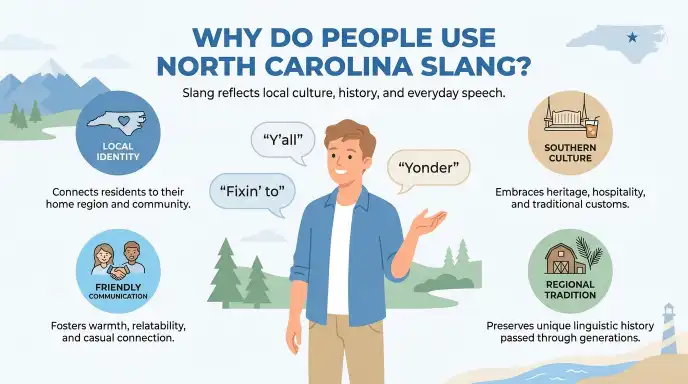
People use regional expressions for the same basic reason they use many forms of informal language: it feels natural.
Regional words can also communicate where someone grew up or which community they identify with.
A familiar expression can create a sense of connection.
For example, “y’all” may simply be someone’s normal word for addressing a group. A word such as “Cackalacky” can carry a stronger sense of local pride or humor.
Regional speech can therefore communicate more than literal meaning. It can also provide clues about place, community, history, and identity.
Does North Carolina Slang Have One Fixed Meaning?
No.
The meaning of a regional expression can depend on location and context.
For example, “poke” can mean a bag in certain regional speech traditions, while many other English speakers know “poke” from completely different meanings.
Likewise, “dingbatter” may be familiar to someone from the Outer Banks but unknown to another North Carolinian.
This is why context is especially important when interpreting regional slang.
If you hear an unfamiliar expression, look at the whole sentence instead of assuming it has the most common dictionary meaning.
How North Carolina Slang Sounds in Different Settings
North Carolina slang can sound natural in one situation and out of place in another. The meaning may stay the same, but the tone changes with the setting.
In a conversation with friends, “y’all” or “fixin’ to” can sound completely normal. In a school paper, business report, or formal email, standard English is usually a better choice.
Social media gives people more freedom. A North Carolina user may deliberately use a regional expression in a post to show humor, personality, or local pride.
Texting
Text messages are informal, so common regional expressions fit easily.
Example:
“Are y’all still coming over?”
This sounds natural and friendly.
TikTok and Instagram
Regional expressions can be used in captions, comments, and short videos.
A creator might use “Cackalacky” to highlight North Carolina identity or use “y’all” because it matches their normal speaking style.
Discord and Gaming
Gaming chats are usually relaxed, so regional expressions can appear naturally.
Example:
“Y’all better get back to the base!”
The regional wording adds personality but does not change the basic message.
Workplace Chat
A phrase such as “y’all” may be perfectly acceptable in a relaxed team chat.
More specialized expressions such as “sigogglin’” or “pizer” may confuse coworkers who are unfamiliar with them.
For a national or formal workplace audience, clear standard English is usually the safest option.
Which North Carolina Slang Words Are Still Common?
The most familiar expressions are generally the ones shared with broader Southern English.
“Y’all” remains highly recognizable and widely used. “Fixin’ to” is also familiar in many Southern communities.
Highly regional words are different.
Terms connected with the Outer Banks or Appalachian communities may be known mainly by people who live in or have strong connections to those areas.
This creates three useful groups:
| Usage level | Examples | What to expect |
| Very familiar | Y’all | Widely understood |
| Southern regional | Fixin’ to, over yonder | Common in Southern speech |
| Highly local | Sigogglin’, pizer, dingbatter | More likely to be regional |
A word being less common does not make it incorrect. It may simply belong to a smaller speech community.
Are Any North Carolina Slang Words Outdated?
Yes. Some traditional expressions are less common among younger speakers or outside their original communities.
That does not mean they have disappeared.
A regional word can survive in family conversations, local storytelling, community events, or cultural writing even when it is not part of everyday speech for most residents.
This is especially important with older Appalachian and coastal vocabulary.
If you use a traditional word today, it may sound:
- Local
- Folksy
- Playful
- Old-fashioned
- Unusual to outsiders
The reaction depends on the listener.
For that reason, do not assume that an old regional term is either completely common or completely obsolete.
North Carolina Slang and Southern Identity
Regional speech can be part of a person’s sense of place.
Someone may use “y’all” simply because it is the natural word they grew up with. Another person may use “Cackalacky” as a playful way to express pride in North Carolina.
These expressions can also appear in jokes, stories, local businesses, music, and social media.
Still, regional identity should not be reduced to an accent or a few slang words. North Carolina has many communities, and residents do not all speak alike.
That is why it is better to describe these expressions as parts of North Carolina’s varied language traditions rather than as a single statewide dialect.
How to Understand North Carolina Slang You Have Never Heard
If someone uses an unfamiliar expression, context is your best clue.
First, listen to the rest of the sentence. Then consider where the speaker is from and if the conversation is casual.
if someone says:For example,
“Your coat is over yonder.”
The surrounding words make it easy to understand that “over yonder” means “over there.”
If a speaker says:
“That table is sigogglin’.”
You can infer that they are describing the table’s position or shape as crooked or uneven.
You do not need to know every regional word in advance. Most expressions become clear when you consider the situation.
North Carolina Slang vs. Standard English
Regional slang is not “bad English.” It is a form of informal language.
The key difference is where and why you use it.
| Situation | Regional slang | Standard English |
| Talking with friends | Good fit | Also fine |
| Family conversation | Good fit | Also fine |
| Social media | Often natural | Also common |
| Casual texting | Good fit | Good fit |
| School essay | Usually avoid | Better choice |
| Formal report | Usually avoid | Better choice |
| Job application | Avoid | Best choice |
| Professional presentation | Usually avoid | Better choice |
The goal is not to remove regional language from your speech. It is to know when your audience expects informal or formal communication.
When Should You Avoid North Carolina Slang?
You should avoid highly regional slang when your audience may not understand it or when the situation requires formal language.
This includes:
- Formal academic papers
- Job applications
- Legal documents
- Official reports
- Professional presentations
- Formal business emails
- Communication with an unfamiliar audience
You should also avoid pretending to speak in a regional dialect as a joke.
Using a local word naturally is different from exaggerating an accent or copying someone’s speech to make fun of them.
If you are writing for a broad audience, explain an unusual regional term the first time you use it.
For example:
“The local word ‘sigogglin’’ means crooked or uneven.”
That gives every reader enough information to follow the discussion.
Polite Alternatives to Regional Slang
Most North Carolina slang does not need a polite replacement because it is not inherently rude.
The issue is usually formality or clarity.
| Regional expression | More neutral alternative |
| Y’all | You all |
| Fixin’ to | About to |
| Over yonder | Over there |
| Poke | Bag |
| Sigogglin’ | Crooked |
| Pizer | Porch |
| Mommuck | Bother |
| Slam full | Completely full |
You can choose the neutral version when speaking to an audience unfamiliar with regional language.
Real-Life North Carolina Slang Examples
Here are some natural examples showing how these expressions can work in everyday situations.
With Friends
“Are y’all meeting us at six?”
This is a casual way to ask a group of friends about their plans.
At Home
“I’m fixin’ to clean the kitchen.”
The speaker means they are about to start cleaning.
Giving Directions
“Your backpack is over yonder by the sofa.”
The phrase simply means “over there.”
Describing an Object
“That picture frame looks sigogglin’.”
The speaker thinks the frame is crooked.
Talking About a Bag
“Put the clothes in that poke.”
Here, “poke” has the regional meaning of a bag.
Talking About a Tourist
“That dingbatter looks lost.”
In the relevant coastal context, the speaker is referring to a tourist or visitor.
These examples show why context is essential. A regional word can be perfectly clear to one community and unfamiliar to another.
Frequently Asked Questions
Q1. What is the most common North Carolina slang word?
“Y’all” is one of the most familiar Southern expressions used in North Carolina. It means “you all” and is commonly used when speaking to a group.
Q2. What does “fixin’ to” mean in North Carolina slang?
“Fixin’ to” means “about to” or “getting ready to do something.” It is a common Southern expression and is not unique to North Carolina.
Q3. What does “Cackalacky” mean?
“Cackalacky” is a playful nickname for North Carolina or the Carolinas. It is informal and is often used with humor or regional pride.
Q4. Is “y’all” rude?
No. “Y’all” is normally a casual and friendly expression. It is widely understood and is not inherently disrespectful.
Q5. What does “over yonder” mean?
“Over yonder” means “over there.” It has a Southern or rural feel and may sound more regional than standard everyday English.
Q6. What does “sigogglin’” mean?
“Sigogglin’” means crooked, uneven, or not straight. It is especially associated with mountain speech in western North Carolina.
Q7. What does “dingbatter” mean in North Carolina?
“Dingbatter” is a regional Outer Banks term for a tourist or visitor. Its use is strongly connected with local coastal speech.
Q8. Is North Carolina slang used on social media?
Yes. Regional expressions such as “y’all” can appear in posts, comments, captions, videos, and messages. People may use them naturally or to show their connection to Southern or North Carolina culture.
Conclusion:
North Carolina slang is much more varied than a simple list of Southern words. It includes familiar expressions such as “y’all” and “fixin’ to,” along with more local terms such as “sigogglin’,” “pizer,” and “dingbatter.”
The most important thing to remember is context. Some expressions are widely understood across the South, while others belong mainly to a particular North Carolina region or community. A word may also sound natural in a friendly conversation but too informal for school or professional writing.
If you hear an unfamiliar North Carolina expression, look at the situation, the speaker’s region, and the surrounding words. That usually reveals the intended meaning.
North Carolina slang is best understood as a reflection of the state’s diverse communities and speech traditions, not as one fixed vocabulary used by everyone.
I’m Emily Carter, and I enjoy writing about slang, internet language, and modern English expressions. My goal is to explain word meanings in a simple, clear, and easy-to-understand way so anyone can learn with confidence.