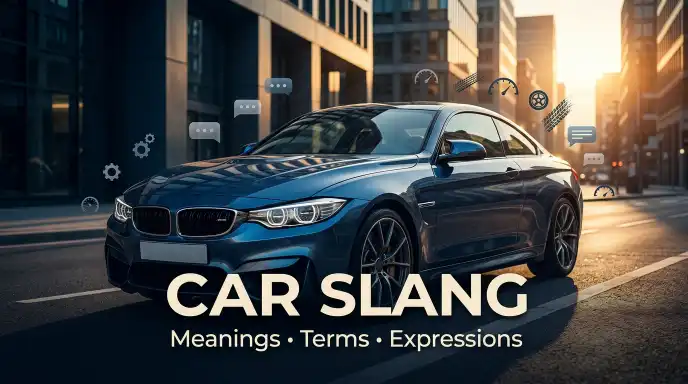
Car slang refers to informal words and phrases people use when talking about cars, vehicles, driving, or car culture. Common examples include ride, whip, wheels, beater, and hooptie. These terms can describe a car’s style, condition, value, or performance.
People search for car slang when they hear unfamiliar words in conversations, movies, music, texting, gaming, or social media. A word that sounds strange at first may simply be a casual way to say “car.” However, some terms can also suggest that a vehicle is old, damaged, expensive, powerful, or stylish.
This guide explains car slang in simple English. You will learn what the most common terms mean, how their tone changes by context, where people use them, and which expressions are better avoided in formal situations.
Quick Answer: What Does Car Slang Mean?
Car slang means informal language used to describe cars, vehicles, driving, or car culture. Words such as ride, whip, wheels, beater, and hooptie are common examples, but each term has its own meaning and tone.
What Does Car Slang Mean?
Car slang is casual language that people use instead of more formal words such as “car,” “automobile,” or “vehicle.”
Some terms simply replace the word car. Others tell you something specific about the vehicle.
For example, ride can mean almost any car, while beater usually suggests an old or worn vehicle. A sleeper, on the other hand, describes a car whose performance is much stronger than its ordinary appearance suggests.
Car slang can therefore communicate more than the type of vehicle. It can show the speaker’s attitude toward the car.
A person might say:
“That’s a nice ride.”
This usually shows approval.
But:
“That old clunker barely runs.”
This suggests the speaker thinks the car is old or unreliable.
The context makes the difference.
Common Car Slang Terms
Here are some common expressions you may hear when people talk about cars.
| Car slang | Meaning | Typical tone |
| Ride | A car or vehicle | Casual, neutral |
| Whip | A car, often one seen as stylish | Casual |
| Wheels | A car or transportation | Casual |
| Beater | An old or worn car | Humorous, casual |
| Hooptie | An old or poorly maintained car | Humorous, informal |
| Clunker | An old or unreliable car | Negative, humorous |
| Junker | A cheap or worn-out car | Negative, casual |
| Lemon | A car with serious problems | Negative |
| Sleeper | A car with hidden performance | Positive |
| Cruiser | A vehicle suited to relaxed driving | Neutral, positive |
| Bucket | An old or rough car | Informal |
| Pimped-out | A car heavily customized for appearance | Casual |
Not all of these words are interchangeable.
For example, calling a car a lemon focuses on serious problems. Calling it a beater focuses more on its worn appearance or age.
What Does “Ride” Mean in Car Slang?
Ride is one of the most common informal words for a car.
When someone says, “My ride is outside,” they usually mean, “My car is outside.”
The word does not necessarily tell you whether the car is expensive, old, fast, or attractive. It can describe almost any vehicle.
Examples
“My ride needs some new tires.”
“I’m taking my ride to the shop tomorrow.”
Because ride is widely understood, it is one of the safest car slang terms for casual conversation.
You may hear it in conversations, texts, social media posts, music, and entertainment.
What Does “Whip” Mean in Car Slang?
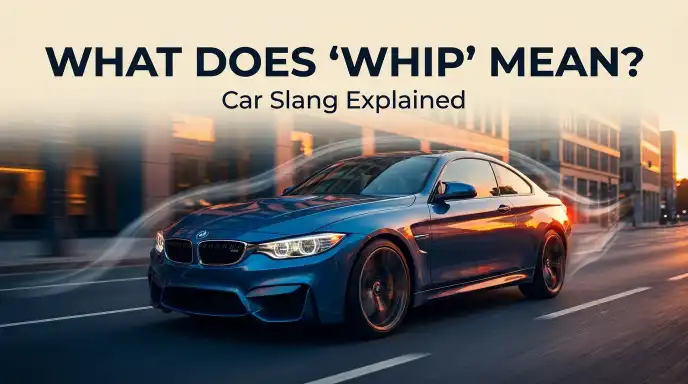
Whip is informal slang for a car. It often carries a sense of style, pride, or admiration.
Someone might say:
“Check out my new whip.”
They simply mean:
“Check out my new car.”
The word is more slang-heavy than ride, so it sounds more casual.
Examples
“She pulled up in a clean whip.”
“His new whip looks amazing.”
The tone can be positive, playful, or simply casual. It does not always mean the car is expensive.
Because whip is strongly informal, it is better suited to casual conversations than professional writing.
What Does “Wheels” Mean in Car Slang?
Wheels can be used as a casual way to talk about a car or transportation.
For example:
“I need some wheels tonight.”
The speaker usually means they need a car or another way to travel.
Context matters because wheels can also mean the actual wheels on a vehicle.
Examples
“Do you have wheels for the trip?”
“I finally got my own wheels.”
This expression is generally harmless and casual.
What Does “Beater” Mean in Car Slang?
A beater is an old car that is worn, damaged, or unattractive but still useful.
The term is often used for a vehicle that someone does not worry about scratching, parking outside, or driving in bad weather.
A beater might have:
- Dents
- Rust
- Scratches
- Faded paint
- An old interior
- High mileage
- Cosmetic damage
Being old alone does not automatically make a car a beater. The word usually suggests that the vehicle looks or feels worn.
Examples
“I use my beater when I go camping.”
“My old beater still gets me to work.”
People often use the term humorously when talking about their own car.
It can sound insulting if you use it about someone else’s vehicle, especially when they are proud of it.
What Does “Hooptie” Mean in Car Slang?
Hooptie, also written hoopty, is informal US slang for an old car that is in poor condition.
The word is commonly associated with an unreliable, beat-up, or cheaply maintained vehicle. It can be used with humor or affection, especially when someone is talking about their own car.
The term also has documented connections to African American slang, so it should not be described simply as a recent internet invention.
Examples
“My old hooptie somehow made it through the road trip.”
“Don’t laugh at my hooptie. It still runs.”
The tone depends heavily on the speaker.
A person may proudly call their own vehicle a hooptie. Saying it about another person’s car can sound rude.
What Does “Clunker” Mean?
A clunker is an informal term for an old, poorly working, or unreliable car.
It usually suggests that the car is not in good shape.
Examples
“He finally sold that old clunker.”
“That clunker makes a strange noise every morning.”
The term can be negative, but people also use it jokingly.
For example, someone might call their first car a clunker while remembering it fondly.
What Does “Junker” Mean?
Junker is another casual term for an old, cheap, or poorly maintained car.
It is close to clunker and beater, but the speaker may use it simply to emphasize that the vehicle is low-value or worn.
Examples
“My first car was a little junker.”
“I don’t want to take that junker on a long trip.”
The word can sound disrespectful when aimed at another person’s car.
What Does “Lemon” Mean in Car Slang?
A lemon is a car that has serious or repeated problems, especially mechanical or quality problems.
This is different from simply calling a vehicle old.
A brand-new car can be a lemon if it has serious defects or ongoing problems.
Examples
“I thought I bought a great car, but it turned out to be a lemon.”
“She’s had so many repairs that she thinks the car is a lemon.”
The word is especially useful when discussing a vehicle that repeatedly fails or needs major repairs.
What Does “Sleeper” Mean in Car Slang?
A sleeper is a car that looks ordinary or unremarkable but has unusually strong performance.
The surprise is the key idea.
A sleeper may look like a normal family sedan from the outside while having a powerful engine or major performance upgrades.
Examples
“That old sedan is actually a sleeper.”
“Don’t race him. His car looks slow, but it’s a sleeper.”
This term is usually positive among car enthusiasts because it describes hidden performance.
What Does “Cruiser” Mean?
A cruiser is a car that is comfortable or enjoyable for relaxed driving.
The term can refer to vehicles that people use for long drives, road trips, or easy weekend driving.
Examples
“This is a great cruiser for highway trips.”
“I want a comfortable cruiser for the summer.”
Unlike beaters or clunkers, cruisers are generally positive or neutral.
Car Slang by Meaning
Different slang terms can describe different parts of the car experience.
| If you want to describe… | Possible slang |
| Your car generally | Ride, whip, wheels |
| An old car | Beater, hooptie, clunker |
| A badly maintained car | Junker, hooptie |
| A troublesome car | Lemon, clunker |
| A powerful car that looks normal | Sleeper |
| A comfortable driving car | Cruiser |
| A customized stylish car | Pimped-out ride |
This distinction is useful because using the wrong term can change your meaning.
For example, calling a perfectly maintained luxury car a junker would usually sound sarcastic or insulting.
Where Is Car Slang Commonly Used?
Car slang appears in many forms of casual communication.
Texting
Friends may use short expressions such as:
“Nice whip!”
“Where’s your ride?”
Texting encourages casual language, so slang fits naturally.
TikTok and Instagram
Car-related posts often use informal terms when showing vehicles, modifications, road trips, or car collections.
A creator might call a customized vehicle their whip or describe an old project car as a beater.
Discord and Gaming
Car slang can also appear in gaming communities, especially when people discuss racing games or driving simulators.
Players may use words such as ride, whip, or sleeper when talking about virtual cars.
Reddit and Online Car Communities
Car communities often use more specialized language. Terms such as sleeper, beater, project car, and daily driver can carry specific meanings that regular slang users may not know.
Everyday Conversation
You can hear basic terms such as ride, wheels, and beater in ordinary conversations between friends and family members.
Workplace Chat
Some casual terms are fine when talking informally with coworkers, but they are not ideal for formal documents.
For example, “My ride broke down” is fine in a casual message to a coworker.
In a formal report, “My car broke down” is clearer and more professional.
Is Car Slang Rude or Offensive?
Most common car slang is not inherently offensive.
Terms such as ride, whip, and wheels are usually harmless.
Some words, however, can sound negative because they describe a vehicle as old, damaged, cheap, or unreliable.
These include:
- Beater
- Hooptie
- Clunker
- Junker
- Lemon
The safest rule is simple: consider who owns the car and how they feel about it.
Calling your own vehicle a beater can be funny. Calling someone else’s beloved car a beater may not be received the same way.
Car Slang: More Terms You Should Know
Car slang includes many expressions beyond basic words such as ride and whip. Some terms describe how a car looks, while others describe speed, modifications, ownership, or how often someone uses the vehicle.
Understanding these differences helps you know whether a person is praising a car, making a joke, or criticizing it.
Daily Driver
A daily driver is a car that someone uses regularly, often for work, school, shopping, or everyday travel.
“My old sedan is my daily driver.”
“I don’t want to modify my daily driver too much.”
This term is common in car communities and is usually neutral.
Project Car
A project car is a vehicle that someone is working on, restoring, repairing, or modifying over time.
“My project car is finally running.”
“I bought an old Mustang as a project car.”
A project car does not have to be in terrible condition. The main idea is that the owner is actively working on it.
Modded
Modded means modified. It describes a car that has been changed from its original factory setup.
“My car is heavily modded.”
“He bought a modded sports car.”
Modifications can include changes to the engine, suspension, wheels, exhaust, interior, or appearance.
Stock
In car talk, stock usually means the vehicle remains close to its original factory configuration.
“Is that car stock?”
“No, it has a modified engine.”
This word is especially common among car enthusiasts.
Car Slang for Fast or Powerful Cars
Some expressions focus on performance rather than appearance.
Beast
A beast is a casual way to describe a very powerful, fast, or impressive car.
“That thing is a beast.”
“Her new car is an absolute beast.”
It is usually a compliment.
Rocket
Rocket can describe a very fast vehicle in informal speech.
“That little car is a rocket.”
The term is usually playful and positive.
Monster
A monster can describe a car with impressive power or performance.
“That engine turned the car into a monster.”
Like a beast, this is generally praised.
Car Slang for Attractive Cars
People also use slang when they want to compliment a car’s appearance.
Clean
In car culture, clean means a car looks well-kept, attractive, or tastefully modified.
“That ride is clean.”
“Your car looks really clean.”
Here, clean does not necessarily mean the car has just been washed. It can describe the overall appearance and styling.
Fresh
Fresh can mean stylish, new-looking, or attractive.
“That car looks fresh.”
“Those wheels make the whole ride look fresh.”
This is casual praise.
Sick
In informal car culture, sickness can mean extremely cool or impressive.
“That car is sick.”
“The new build looks sick.”
This may confuse people because sick normally means ill. In this context, it is positive slang.
Car Slang for Customized Vehicles
Car enthusiasts often use special terms for modified vehicles.
Built
When someone says a car is built, they may mean it has been heavily modified, especially for performance.
“That Civic is built.”
“His car is fully built for the track.”
The exact meaning can vary. In some conversations, it may refer specifically to engine modifications.
Tuned
A tuned car has had changes made to its engine control or performance setup.
“My car is tuned for better performance.”
“The tuned car feels much faster.”
This term is more technical than general slang, but it is common in casual car discussions.
Stanced
Stanced describes a particular customized look involving the car’s stance, wheels, suspension, and overall appearance.
“That car is heavily stanced.”
“His stanced build gets a lot of attention.”
This is a style-specific term, so it should not be used for every modified vehicle.
What Does “Daily” Mean in Car Slang?
Car enthusiasts may shorten daily drivers to simply daily.
For example:
“This is my daily.”
That means:
“This is the car I use every day.”
It is common in casual car conversations.
A person might own several cars but call only one their daily because that is the one they regularly drive.
What Does “Project” Mean in Car Slang?
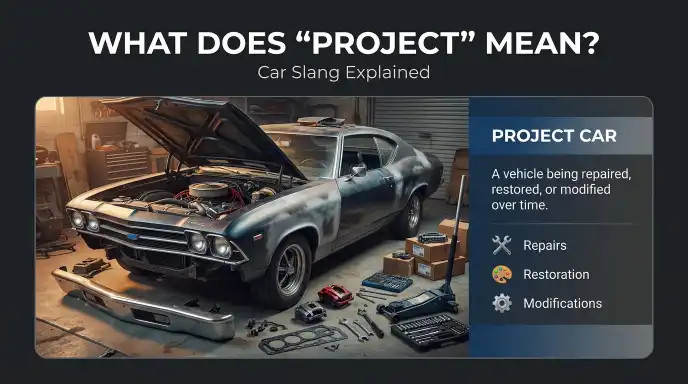
In car conversations, project can be short for project car.
For example:
“I’m working on my project.”
The speaker may mean they are repairing or modifying a particular vehicle.
The term often suggests that the car needs time, money, parts, or mechanical work.
It can also describe a long-term hobby rather than a simple repair.
Car Slang for Old Cars
Old cars have many informal names. Some are playful, while others are clearly negative.
| Term | Meaning | Tone |
| Beater | Old or worn car | Casual |
| Hooptie | Old, rough car | Humorous |
| Clunker | Old or poorly working car | Negative/humorous |
| Junker | Cheap or worn vehicle | Negative |
| Bucket | Old or rough car | Informal |
| Rust bucket | Car with substantial rust | Negative/humorous |
A person may use these terms about their own vehicle without meaning anything harsh.
For example:
“My little rust bucket has been with me for years.”
That sentence can show affection even though the words sound negative.
What Does “Rust Bucket” Mean?
A rust bucket is an informal term for a vehicle with a lot of visible rust.
It is usually used humorously or negatively.
Examples
“My first car was a rusty old rust bucket.”
“I wouldn’t take that rust bucket on a long road trip.”
The phrase is not normally appropriate in formal automotive writing because it is descriptive slang rather than a technical term.
Car Slang for Expensive or Luxury Cars
Some slang focuses on status or appearance.
Flex
Flex means to show something proudly, often to impress other people.
If someone says:
“He’s flexing his new car.”
They mean the person is showing off the car.
The word does not specifically mean an expensive car. It describes the act of showing something off.
Balling
Balling is informal slang associated with living or spending in a way that appears wealthy or luxurious.
Someone might say:
“He’s balling with that new car.”
This is very casual and can sound playful or exaggerated.
What Does “Sleeper” Mean in Car Culture?
A sleeper deserves special attention because its meaning is more specific than many other car terms.
A sleeper usually looks ordinary but has performance that surprises people.
For example, an ordinary-looking sedan might have a heavily upgraded engine.
Someone seeing it may expect a slow family car. The surprise comes when the vehicle performs like a much faster car.
Example
“I thought it was a normal sedan, but it’s a sleeper.”
“That old wagon is secretly a sleeper.”
The term is usually positive among car enthusiasts.
Car Slang and Driving Terms
Car slang is not limited to the vehicle itself. People also use informal expressions for driving.
Floor It
Floor means to press the accelerator hard, usually to accelerate quickly.
“He floored it when the light turned green.”
This is a common informal driving language.
Punch It
Punching can also mean accelerating quickly.
“Punch it when you’re ready.”
This is casual and should not be confused with a recommendation to drive dangerously.
Peel Out
Peel out refers to accelerating hard enough that the tires lose traction and spin.
It is often used when describing a dramatic or noisy departure.
Because this can be unsafe and may be illegal in some places, it is better understood as a description rather than something to copy on public roads.
Is Car Slang Appropriate at Work?
Some car slang is perfectly understandable in casual workplace conversation, but formal writing should use standard terms.
For example:
Casual:
“My ride broke down this morning.”
Formal:
“My car broke down this morning.”
Casual:
“I just bought a new whip.”
Formal:
“I recently purchased a new vehicle.”
The choice depends on the situation.
A message to a coworker may comfortably use a ride. A business report, application, or official document should normally use a car or vehicle.
Is Car Slang Appropriate for School?
Car slang is fine in casual conversation with classmates and friends.
However, avoid slang in school assignments unless your teacher specifically asks you to analyze slang or informal language.
For example, this works in a conversation:
“My new whip is really nice.”
For a formal essay, this is clearer:
“My new car is reliable and comfortable.”
The issue is not that slang is “bad.” The issue is whether the situation calls for informal or formal language.
Car Slang on Social Media
Car slang is especially common in online car communities.
On TikTok, Instagram, Reddit, Discord, and other social spaces, users may describe vehicles as:
- Clean
- Sick
- Fresh
- Beast
- Sleeper
- Whip
- Ride
- Built
- Stock
- Modded
The same term may have a slightly different feel depending on the community.
A casual social media post may say:
“Rate my whip.”
A car enthusiast may instead write:
“Rate my build.”
Both ask for an opinion, but build focuses more on the modifications and work done to the vehicle.
Common Misunderstandings About Car Slang
Car slang can be confusing because many words have ordinary meanings outside car culture.
“Sick” Does Not Always Mean Ill
In car slang, sick can mean impressive or cool.
“That car is sick.”
The speaker is usually praising the vehicle.
“Lemon” Does Not Mean Fruit
When someone calls a vehicle a lemon, they mean it has serious problems.
The word has a special meaning in automotive conversations.
“Clean” Does Not Only Mean Washed
A clean car may be physically clean, but car enthusiasts can also use the word to describe attractive styling.
“Whip” Does Not Mean an Actual Whip
When someone says “nice whip,” they are talking about a car.
The meaning comes from slang, not the literal object.
“Beast” Does Not Mean an Animal
A car described as a beast is usually powerful or impressive.
How Car Slang Changes by Context
The same word can sound friendly in one situation and insulting in another.
| Situation | Example | Likely meaning |
| Praising a car | “Nice ride!” | Compliment |
| Talking about your car | “My whip is outside.” | Casual car reference |
| Joking about an old car | “My beater still runs.” | Humor |
| Criticizing a car | “That’s a junker.” | Negative |
| Discussing performance | “It’s a sleeper.” | Hidden power |
| Discussing modifications | “It’s heavily modded.” | Customized |
| Formal communication | “My vehicle needs service.” | Professional |
This is why understanding the speaker’s intent is more useful than memorizing isolated definitions.
Why Do People Use Car Slang?
People use car slang because it makes conversation shorter, more expressive, and more personal.
Instead of saying:
“My old car, which has many dents and scratches, still works well.”
Someone might simply say:
“My beater still runs great.”
Slang can also show membership in a community. Car enthusiasts may use terms such as build, sleeper, stock, and modded because those words communicate ideas quickly to people who understand car culture.
Slang can also make conversations feel relaxed.
A phrase like “Nice whip!” sounds more casual than “Your automobile looks attractive.”
Polite Alternatives to Car Slang
If you are unsure whether a slang term is appropriate, use a simple standard word.
| Slang | Polite or neutral alternative |
| Ride | Car |
| Whip | Car |
| Wheels | Car / transportation |
| Beater | Older car |
| Hooptie | Old car |
| Clunker | Older or unreliable car |
| Junker | Poor-condition car |
| Lemon | Problematic vehicle |
| Sleeper | High-performance car with an ordinary appearance |
| Daily | Daily driver |
These alternatives work well when speaking with teachers, employers, customers, or people who may not know car slang.
Car Slang: Positive vs. Negative Terms
Knowing whether a term is positive or negative can prevent awkward conversations.
Usually Positive
Ride : casual and neutral
Whip : often stylish or proud
Clean : attractive or well-presented
Fresh : stylish
Sick : very cool
Beast : powerful
Sleeper : surprisingly powerful
Cruiser : comfortable and enjoyable
Often Negative
Junker : cheap or worn
Clunker : old or unreliable
Rust bucket : heavily rusted
Lemon : seriously problematic
Hooptie : rough or poorly maintained
The speaker’s tone still matters. Someone can use a negative-sounding word affectionately when talking about their own car.
When Should You Avoid Car Slang?
Avoid car slang when precision and professionalism matter.
This includes formal reports, legal documents, school essays, official vehicle records, and professional sales material.
You should also be careful when describing another person’s vehicle. Calling someone’s prized car a junker, clunker, or hooptie may come across as disrespectful.
When you are unsure, car and vehicle are safe choices.
Frequently Asked Questions
Q1. What is the most common car slang?
Ride is one of the most common informal terms for a car. Other familiar terms include whip, wheels, and beater.
Q2. What does “whip” mean in car slang?
Whip means a car. It is informal and often carries a sense of style or pride.
Q3. What does “ride” mean in slang?
Ride can mean someone’s car or vehicle. It is casual and usually neutral.
Q4. What does “beater” mean for a car?
A beater is an old or worn car that is still usable. People often use the word humorously when describing their own vehicle.
Q5. What does “hooptie” mean?
A hooptie is informal US slang for an old or poorly maintained car. It is often humorous but can sound insulting when used about someone else’s vehicle.
Q6. What does “lemon” mean in car slang?
A lemon is a vehicle with serious or repeated problems. The term focuses on the car’s reliability rather than simply its age.
Q7. What does “sleeper” mean in car slang?
A sleeper is a car that looks ordinary but has surprisingly strong performance.
Q8. Is “whip” a bad word?
No. Whip is generally harmless slang for a car. However, it is informal and may not fit professional situations.
Conclusion:
Car slang is a broad collection of informal expressions used to talk about vehicles and car culture. Words such as ride, whip, and wheels can simply mean “car,” while terms such as beater, hooptie, clunker, and junker describe older or rougher vehicles.
Other expressions are more specific. A sleeper has hidden performance, a daily is a regularly used vehicle, and a modded car has been changed from its original setup.
The key is context. Some slang sounds like praise, some is humorous, and some can sound insulting. If you are speaking casually with friends, car slang can make conversation more natural. In formal situations, simple words such as car and vehicle are usually the better choice.