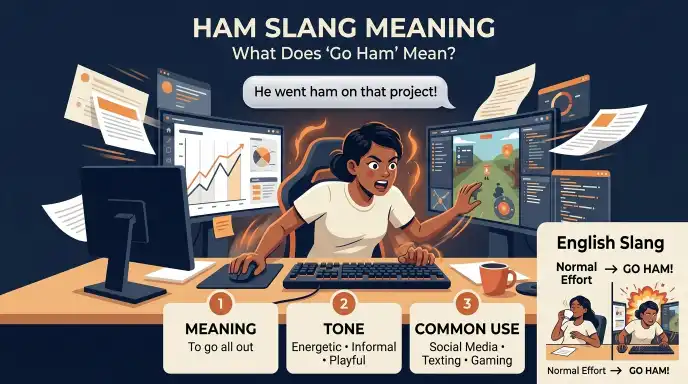
Ham slang meaning usually refers to the phrase “go ham,” which means to go all out, give something your full effort, or act with a lot of energy. The exact meaning can change slightly depending on the context.
You may see “ham” in texts, social media comments, gaming chats, or casual conversations. Someone might say they “went ham” at the gym, on a game, at a party, or even while eating. That can make the phrase confusing if you only know the regular meaning of “ham” as food.
If you are searching for the ham slang meaning, this guide explains what “ham” means, how people use it, where the expression came from, and if it is appropriate in different situations.
Quick Answer: Ham Slang Meaning
In slang, “ham” means to go all out, act with extreme energy, or put maximum effort into something. The phrase “go ham” is often used when someone gives something their full effort or behaves with intense enthusiasm.
What Does “Ham” Mean in Slang?
“Ham” is informal slang most commonly seen in the phrase “go ham.” When someone says, “I’m going ham,” they usually mean they are going all out.
The exact feeling can change with context. It may describe someone working very hard, partying intensely, eating a lot, playing aggressively, or putting huge effort into an activity.
For example:
- “She went ham at the gym today.”
- “He went ham on that project.”
- “Everyone went ham at the party.”
In each case, the idea is similar: there is no holding back.
The word does not always mean something negative. It can sound funny, excited, approving, or slightly critical depending on the situation.
What Is the Full Form of HAM in Slang?
There is no single universally accepted full form of “HAM” in modern slang.
You may see people explain “go HAM” as “Hard As a Mother*er.”** This is a popular backronym, but it should not be treated as the original or only meaning of the expression.
The phrase “go ham” has also been connected to the idea of going all out or acting with extreme intensity. Because explanations of its origin differ, it is safer to focus on the established usage rather than claiming one certain full form.
For everyday use, the simple meaning is:
Go ham = go all out or give something maximum effort.
Different Meanings of “Ham” in Slang
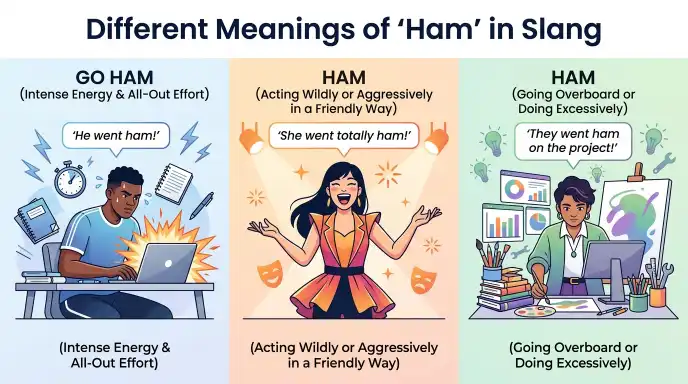
“Ham” can have slightly different meanings depending on how it appears.
1. Go All Out
This is the most common slang use.
Someone who “goes ham” gives an activity a lot of energy or effort.
Example:
“I went ham on my final exam review last night.”
Here, the speaker means they studied very hard.
2. Act With Extreme Energy
“Ham” can also describe someone behaving with unusually high energy.
Example:
“Those kids went ham when the music started.”
The sentence suggests that they became very energetic and excited.
3. Play or Compete Aggressively
In sports and gaming, “go ham” can describe playing very aggressively.
Example:
“Mike went ham in the final round.”
This means Mike played with strong effort and intensity.
4. Do Something Excessively
Sometimes “ham” suggests that someone has gone too far.
Example:
“You really went ham with the decorations.”
This could be praise, teasing, or mild criticism. The surrounding tone tells you which one it is.
Where Is “Ham” Commonly Used?
“Ham” is most useful in casual speech and online conversation. It can appear in:
- Text messages
- Instagram captions
- TikTok comments
- Reddit discussions
- Discord chats
- Gaming conversations
- Sports discussions
- Casual conversations with friends
It is especially common in the phrase “go ham.”
Ham on Social Media
On social media, someone might write:
“Bro went ham on this edit.”
That means the person put a lot of effort and energy into the edit.
Another example:
“She went ham with the birthday setup.”
Here, “ham” suggests that she made the setup big, detailed, or impressive.
Ham in Gaming
Gamers may use “go ham” when someone attacks aggressively or plays with maximum effort.
For example:
“Go ham this round!”
The speaker is encouraging the player to play hard and aggressively.
However, “ham” is not a special gaming abbreviation. It is general informal slang that can be used in gaming contexts.
Is “Ham” Rude, Offensive, or Harmless?
“Ham” is generally harmless and informal.
The expression “go ham” is not normally considered a swear word. However, some explanations of the phrase connect HAM to a profanity-based expansion. That does not mean every use of “ham” contains a swear word.
Tone matters.
| Situation | Tone |
| “Go ham at the gym!” | Encouraging |
| “He went ham in that game.” | Casual |
| “You went ham with the food.” | Playful |
| “She went ham on him.” | Potentially aggressive |
| Workplace email | Too informal |
With friends, the phrase is usually fine. In formal writing, a clearer phrase such as “go all out” or “put in maximum effort” is better.
Real-Life Examples of “Ham” Slang
The best way to understand slang is to see it in natural situations.
Friendly Conversation
“Are you coming to the game?”
“Yeah, and I’m going ham tonight.”
Here, the person means they plan to give the game their full effort.
Casual Texting
“I got ham on that pizza.”
This can mean the person ate a lot of pizza.
Gaming
“Don’t hold back. Go ham!”
The speaker is telling the player to attack or play with maximum intensity.
Social Media
“Bro went ham with this video edit.”
This praises someone for putting a lot of work into their content.
Sports
“She went ham during the last five minutes.”
This means she played with great energy and effort.
Party Context
“Everyone went ham when the DJ played that song.”
Here, the phrase suggests people became very energetic and excited.
Mildly Critical Use
“You went ham buying snacks.”
This may suggest the person bought far more snacks than needed.
Origin and History of “Go Ham”
The exact origin of “go ham” is not completely settled, so it is important not to present one explanation as proven fact.
The expression became widely recognized in American slang and popular culture, especially from the late 2000s onward. It later spread through music, entertainment, social media, and everyday online communication.
One commonly repeated explanation connects the phrase to the rap and hip-hop world. Another popular explanation treats “HAM” as an acronym based on profanity. However, acronym explanations are often retrospective rather than proof of where a phrase originally came from.
For that reason, the safest explanation is that “go ham” developed as an informal expression for going extremely hard or giving maximum effort, while its exact origin remains debated.
“Ham” vs. Similar Slang Terms
Several slang expressions can communicate a similar idea.
| Slang | Meaning | Tone |
| Go ham | Go all out | Casual |
| Go hard | Give strong effort | Casual |
| Go to be aggravated | Act with extreme energy | Casual |
| Go all out | Give maximum effort | Neutral |
| Send it | Commit fully to something | Casual |
| Turn up | Become more energetic or excited | Casual |
| Crush it | Perform very well | Positive |
“Go ham” is often more intense than simply saying “try hard.”
For example, “I studied hard” sounds normal. “I went ham studying” sounds more energetic and exaggerated.
When Should You Avoid Using “Ham”?
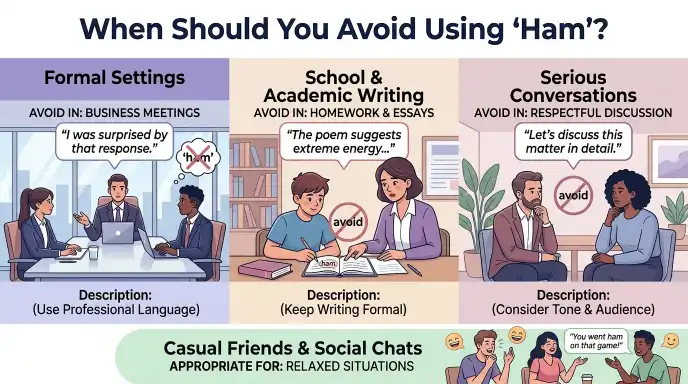
Although “ham” is usually harmless, it is still slang. That means it does not fit every situation.
Avoid it when you need a formal or professional tone.
Avoid “ham” in:
- Formal business emails
- Academic essays
- Job applications
- Official reports
- Professional presentations
- Formal communication with clients
Instead of:
“We went ham on the new campaign.”
Use:
“We put significant effort into the new campaign.”
The second version is clearer and more professional.
You should also be careful with phrases such as “go ham on him.” Depending on context, this can suggest attacking or treating someone aggressively. The surrounding conversation is important.
Polite Alternatives to “Ham”
If you want the same general idea without slang, you can use:
- Go all out
- Give it your best
- Put in maximum effort
- Work very hard
- Give it everything
- Put a lot of effort into it
- Go full force
- Give it your all
For example:
Slang:
“I’m going ham on this project.”
Neutral:
“I’m putting a lot of effort into this project.”
Professional:
“I’m giving this project my full attention.”
Why Do People Say “Go Ham”?
People use “go ham” because it is short, expressive, and energetic.
Instead of saying:
“I am going to put a very large amount of effort into this.”
Someone can simply say:
“I’m going ham.”
The slang adds personality to the message. It can make a statement sound more excited, confident, humorous, or intense.
It also works well in online spaces because short phrases are easy to use in captions, comments, chats, and gaming messages.
How Does the Meaning Change With Context?
Context is especially important with “ham.”
| Example | Likely meaning |
| “I went ham at the gym.” | Worked extremely hard |
| “He went ham on the food.” | Ate a lot |
| “They went ham at the party.” | Got very energetic |
| “She went ham in the game.” | Played aggressively or intensely |
| “He went ham with the decorations.” | Did something in an excessive or elaborate way |
The same slang can therefore describe effort, eating, partying, gaming, or excess.
Look at the words around “ham” before deciding what the speaker means.
Is “Ham” Still Used Today?
“Go ham” is still understandable and used in informal English, especially in casual online conversation and speech.
However, slang popularity changes over time. It may not sound as fresh to every younger speaker as newer expressions. Some people may use it naturally, while others may see it as older internet or pop-culture slang.
That does not make the phrase incorrect. It simply means its tone can depend on the speaker, age group, and community.
Common Misunderstandings About “Ham”
“Ham” does not always mean food
The ordinary meaning of ham is the meat from a pig. But in “go ham,” the word has a completely different slang function.
“HAM” is not always an acronym
You may find claims that HAM officially stands for a particular phrase. These explanations are not universally accepted as the true origin.
“Go ham” is not automatically aggressive
Someone can “go ham” on homework, cooking, exercise, decorating, or gaming. The activity determines the meaning.
The tone can be positive or negative
“Go ham!” can be encouragement.
“You went ham with that purchase” can be playful criticism.
The context makes the difference.
Frequently Asked Questions
Q1. What does “ham” mean in slang?
In slang, “ham” usually appears in “go ham,” meaning to go all out, use a lot of energy, or give something maximum effort.
Q2. What does “go ham” mean in texting?
“Go ham” in texting means to do something with extreme effort or energy. For example, “I’m going ham on this workout” means the person is working very hard.
Q3. Is “ham” a bad word?
No. “Ham” is generally harmless slang. However, some explanations of “HAM” connect it with a profanity-based phrase, so the expression may carry a slightly rougher tone for some speakers.
Q4. Is “go ham” appropriate at work?
Usually, no. It is casual slang, so professional phrases such as “go all out,” “work hard,” or “give it your best” are safer choices in formal settings.
Q5. Does “ham” mean aggressive?
Sometimes. In gaming, sports, or phrases such as “go ham on him,” it can suggest intense or aggressive action. But it can also simply mean putting in a lot of effort.
Q6. What is another word for “go ham”?
Common alternatives include “go all out,” “go hard,” “give it your all,” “send it,” and “give it everything.” The best choice depends on the situation.
Conclusion:
The ham slang meaning is usually connected to the phrase “go ham,” which means to go all out, act with intense energy, or give something maximum effort. It can describe exercise, gaming, sports, food, parties, creative work, and many other casual situations.
The phrase is generally harmless, but it is informal. It works well in texts, social media, gaming chats, and conversations with friends. For school assignments, business writing, or formal communication, use a clearer phrase such as “go all out” or “give it your best.”
The key is context. When you see “ham,” look at what the person is doing and how the sentence is written. That will usually reveal if the speaker means hard work, excitement, excess, or intense action.

I’m Emily Carter, and I enjoy writing about slang, internet language, and modern English expressions. My goal is to explain word meanings in a simple, clear, and easy-to-understand way so anyone can learn with confidence.