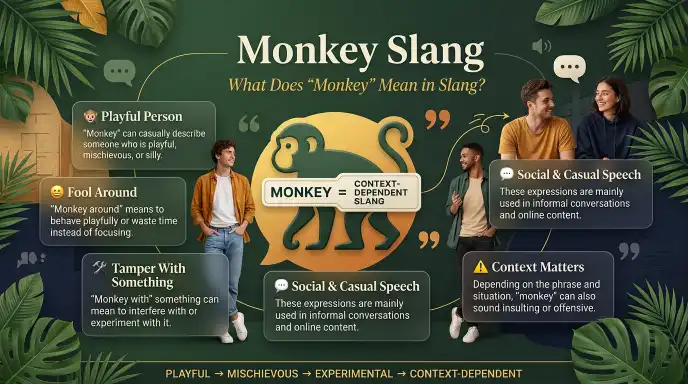
Monkey slang can mean a person who is acting silly, playful, mischievous, or foolish. However, the meaning depends strongly on context, tone, and who is being described.
In some settings, “monkey” can also have an offensive racial meaning, so readers should be careful with it.
People often search for “monkey slang” after seeing the word in a text, comment, meme, caption, or online conversation. The word can sound friendly when used between close friends, but it can also be insulting in other situations. That is why the surrounding message matters.
This guide explains the common slang meanings of “monkey,” where people use it, how its tone changes, and when it is better to avoid the term. It also covers examples so you can understand what someone likely means when they use “monkey” in a casual conversation.
Quick Answer: What Does Monkey Slang Mean?
Monkey slang usually describes someone as silly, playful, mischievous, or foolish. Among friends, it can be a teasing or affectionate nickname, but in some contexts, “monkey” can be offensive, especially when used toward a person in a racialized way.
What Does Monkey Slang Mean in Text?
In texting, “monkey” most often refers to someone who is behaving in a silly, playful, or mischievous way.
For example, a friend might call you a “monkey” after you make a funny mistake or act unusually energetic. The word does not always mean that the person is actually foolish. It can simply show playful teasing.
The meaning depends on the relationship between the speakers.
Playful meaning
When used between friends or family members, “monkey” can describe someone who is fun, energetic, or mischievous.
Example:
“You little monkey, you ate the last cookie!”
Here, the speaker is probably teasing rather than seriously insulting the person.
Foolish or silly meaning
“Monkey” can also suggest that someone is acting foolishly or not thinking carefully.
Example:
“Stop acting like a monkey and finish your homework.”
The tone is more critical in this sentence. The speaker is calling attention to silly behavior.
Affectionate meaning
Parents and relatives may also use “monkey” as a playful nickname for a child.
Example:
“Good morning, little monkey! Did you sleep well?”
In this context, the word is affectionate and has no insulting meaning.
Is Monkey a Slang Word or a Nickname?
“Monkey” is a normal English word, but it can take on a slang-like meaning when people use it as an informal label for a person.
The difference comes from context.
When “monkey” refers to an animal, it has its literal meaning. When it describes a person’s behavior, it becomes figurative language.
For example:
- “The monkey climbed the tree.” : literal meaning
- “You are such a monkey.” : playful or teasing meaning
- “Stop being a monkey.” : possibly critical meaning
This is why seeing the word alone is not enough to determine the speaker’s intention.
Different Meanings of Monkey Slang
“Monkey” does not have one fixed slang meaning. Its sense can change depending on the conversation.
Monkey meaning playful or mischievous
This is one of the most common informal uses.
Someone may call another person a “monkey” when they are energetic, naughty, funny, or difficult to keep still.
Example:
“My little brother is such a monkey today.”
The speaker is describing his behavior rather than making a serious insult.
Monkey meaning silly or foolish
The word can also describe someone who is behaving in a foolish way.
Example:
“Why are you jumping around like a monkey?”
This can be humorous among friends, but it may sound rude if said seriously.
Monkey as an affectionate nickname
Some people use “monkey” as a pet name for a child, partner, sibling, or close friend.
Example:
“Come here, monkey. I have something for you.”
The relationship and tone make the difference.
Monkey as an insult
“Monkey” can also be used negatively to call someone foolish, annoying, or badly behaved.
Example:
“That guy is acting like a monkey.”
This sounds less friendly because the speaker is judging the person’s behavior.
Is Monkey Slang Rude or Offensive?
“Monkey” can be harmless in a playful conversation, but it can also be rude or deeply offensive in certain contexts.
The most important point is that you should not assume the word is always harmless simply because people sometimes use it as a nickname.
When it is usually harmless
It may be harmless when:
- Close friends use it jokingly.
- A parent uses it for a child.
- Someone describes playful behavior.
- The conversation clearly has an affectionate tone.
- The people involved understand the joke.
For example:
“You’re such a monkey 😂”
Between close friends, this may simply mean “You’re being silly.”
When it can be offensive
The word has also been used as a racist insult against Black people and other racialized groups. Because of this history, calling a person a “monkey” can be extremely offensive when race is part of the context.
This is very different from calling a child “little monkey” in an affectionate family setting.
If you are unsure about someone’s intent, look at:
- Who said it?
- Who was it directed at?
- What was being discussed?
- Was race involved?
- Was the tone playful or hostile?
- Was the person being singled out because of their identity?
Context matters greatly here.
Where Is Monkey Slang Commonly Used?
“Monkey” can appear in many types of informal communication, but its meaning may change with the setting.
Texting
In texts, “monkey” is often playful.
Example:
“You forgot your keys again, you monkey 😂”
The emoji and casual relationship make the teasing tone clear.
Instagram and TikTok
On social media, “monkey” may appear in captions, comments, memes, or jokes about someone’s funny behavior.
Example:
“My friends when they get together: absolute monkeys.”
Here, the speaker is likely describing a group behaving loudly or playfully.
Snapchat
Snapchat messages often use informal nicknames and teasing language. “Monkey” can therefore appear as a friendly nickname between people who know each other.
Discord
On Discord, the meaning depends heavily on the community.
Friends may use it as harmless teasing, while an argument can make the same word sound insulting.
Example:
“Bro, you are such a monkey for doing that.”
The speaker may be joking about a bad move in a game.
Gaming
In gaming chats, “monkey” may describe someone who makes a silly play, behaves unpredictably, or causes chaos.
Example:
“Our whole team turned into monkeys that round.”
This usually refers to poor or chaotic gameplay rather than the players literally being called animals.
Monkey Slang Meaning Across Different Platforms
| Platform | Common tone | Example use |
| Texting | Playful or teasing | “You little monkey 😂” |
| Funny or affectionate | “My monkey brother” | |
| TikTok | Meme-like or humorous | “We were acting like monkeys” |
| Snapchat | Casual | “Stop being a monkey” |
| Discord | Teasing or insulting | “What was that monkey play?” |
| Gaming | Humorous or critical | “We played like monkeys” |
| Workplace chat | Usually inappropriate | Better to use clear language |
The same word can therefore feel completely different depending on the platform and relationship.
Monkey Slang in Different Social Situations
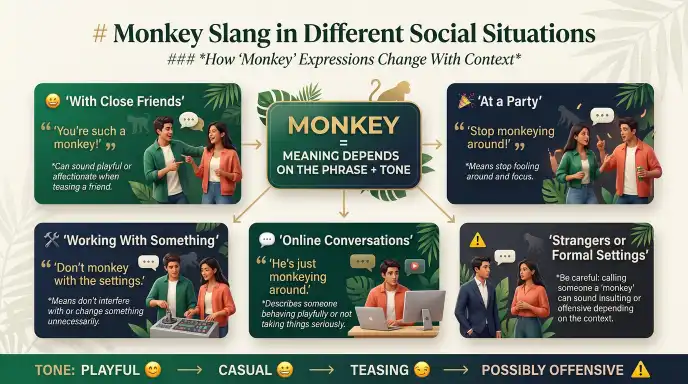
The safest way to understand the term is to consider the social situation.
Between close friends
“Monkey” can be a light joke.
“You absolute monkey. How did you miss that?”
This could be friendly teasing if both people normally joke this way.
Between strangers
The same phrase can sound insulting.
“You are a monkey.”
Without a friendly relationship or clear joking context, the statement may be offensive.
Between parents and children
“Monkey” can be affectionate.
“Come on, little monkey. It’s bedtime.”
Here, the word usually expresses warmth or playful affection.
During an argument
The word can become an insult.
“You’re acting like a monkey.”
In an argument, the speaker is more likely criticizing the other person’s behavior.
Real-Life Examples of Monkey Slang
Understanding the tone is easier when you see the word in natural sentences.
Friendly example
“You little monkey! You hid my phone again.”
This sounds playful if the speakers are close.
Casual example
“My cousins were acting like monkeys at the party.”
The speaker means they were energetic, loud, or silly.
Teasing example
“Bro, you’re such a monkey for pressing that button.”
The word is being used to tease someone about a foolish action.
Gaming example
“I played like a monkey that whole match.”
Here, the speaker is making fun of their own poor or chaotic performance.
Social media example
“Look at this little monkey dancing 😂”
The meaning may be playful, but the exact context still matters.
Negative example
“Stop acting like a monkey.”
This can sound rude because the speaker is directly criticizing someone’s behavior.
Monkey Slang and Tone
Tone is one of the most important parts of understanding this word.
A simple phrase such as “you monkey” can have very different meanings.
| Phrase | Possible tone |
| “You little monkey!” | Affectionate or playful |
| “You silly monkey!” | Friendly teasing |
| “Stop acting like a monkey.” | Critical |
| “That guy is a monkey.” | Insulting |
| “Monkeys 😂” | Humorous, depending on context |
Text messages can make tone harder to understand because you cannot hear the speaker’s voice.
Emojis, punctuation, previous conversations, and the relationship between the people can provide useful clues.
Is Monkey Slang Used by Gen Z?
Yes, younger internet users may use “monkey” in memes, jokes, gaming conversations, and casual chats, but it is not a slang term that belongs only to Gen Z.
The playful use of “monkey” is much older than current social media culture. Modern platforms have simply given people more places to use and reinterpret familiar informal expressions.
That means you should not assume that seeing “monkey” online automatically makes it Gen Z slang.
Is Monkey Slang Appropriate at School or Work?
“Monkey” is usually not the best choice in professional communication because the intended tone can be unclear.
With close friends, playful teasing may be understood. At school or work, however, calling someone a “monkey” could easily sound disrespectful or insulting.
A safer approach is to describe the behavior directly.
Instead of:
“You’re acting like a monkey.”
You could say:
“You’re being a little silly.”
Or:
“That was a funny mistake.”
This avoids confusion and keeps the message friendly.
When Should You Avoid Using Monkey Slang?
Avoid using “monkey” for a person when you are unsure how the other person will understand it.
Be especially careful when:
- You are speaking to someone you do not know well.
- The conversation is already tense.
- You are communicating professionally.
- The person may interpret it as a personal insult.
- Race or ethnicity is part of the conversation.
- You are posting publicly and cannot explain your intention.
- You are talking about someone who is not present.
A word that sounds funny among close friends may not have the same effect with strangers.
Origin and Background of Monkey Slang
The slang use of “monkey” comes from the long-standing habit of comparing human behavior with animal behavior. In English, monkeys have often been associated with playfulness, curiosity, mischief, and uncontrolled energy. That is why people may use “monkey” as a playful label for someone who is acting silly or mischievous.
There is also an important distinction between the playful meaning and offensive uses of the word. Historically, animal terms have sometimes been used to dehumanize racial groups. Because “monkey” has been used as a racist insult, the word can carry a very different meaning when directed at a person in a racial context.
For that reason, there is no single origin date for “monkey slang.” Its playful use developed over a long period, while individual online communities have created their own variations and jokes around it.
Similar Slang and Related Terms
Several informal words can describe someone who is silly, playful, or mischievous. However, they do not all carry the same tone.
| Slang or phrase | General meaning | Typical tone |
| Monkey | Silly, playful, or mischievous person | Playful or teasing |
| Goofball | Someone who acts silly | Friendly |
| Goof | A silly person or mistake | Casual |
| Clown | Someone acting foolishly | Teasing or insulting |
| Jokester | Someone who likes making jokes | Positive |
| Trouble-maker | Someone who causes problems | Negative or playful |
| Wild one | Someone energetic or hard to control | Playful |
| Silly goose | Someone acting foolishly | Affectionate |
“Monkey” is closest to terms such as “goofball” when the speaker is being friendly. It becomes less friendly when the speaker uses it during an argument or to put someone down.
When Should You Avoid Using Monkey Slang?
You should avoid calling someone a “monkey” when the relationship, tone, or context is unclear.
This is especially important in public spaces. A private joke between friends may be understood differently by strangers who cannot hear the speaker’s tone or know the relationship.
Avoid it when:
- You are talking to a stranger.
- You are writing a professional message.
- You are speaking to a teacher, manager, or client.
- You are already having an argument.
- You are commenting on someone’s race or identity.
- You do not know how the other person feels about teasing.
- The word could be misunderstood as a personal attack.
If you want to describe funny behavior without risk, choose a clearer word such as “silly,” “playful,” or “goofy.”
Polite Alternatives to Monkey
If your goal is to say that someone is being funny, energetic, or mischievous, several safer alternatives are available.
“Silly”
This is one of the easiest choices.
“You are being silly.”
It usually sounds light and friendly.
“Goofy”
“Goofy” describes someone who behaves in a funny or slightly foolish way.
“You were being goofy all morning.”
It is often safer than “monkey” because it does not carry the same racial history.
“Playful”
Use “playful” when you want to focus on positive behavior.
“He was being playful with his friends.”
This works well in many settings.
“Mischievous”
This describes someone who enjoys causing small amounts of trouble.
“She has a mischievous sense of humor.”
It is more descriptive and less likely to sound insulting.
“Funny”
When you simply mean that someone’s behavior made you laugh, “funny” is very clear.
“That was really funny.”
There is no need to use slang if a simple word communicates the idea better.
Why Do People Use Monkey Slang?
People often use “monkey” because it adds emotion and personality to a conversation.
Calling someone “silly” is clear, but calling a close friend “you little monkey” can make the message feel more playful.
Common reasons include:
To tease a friend
Friends may use the word to joke about a funny mistake.
“You monkey, you knew exactly what you were doing.”
The playful exaggeration can make the message feel more personal.
To show affection
Parents and close relatives may use “monkey” as a nickname.
“My little monkey is finally awake.”
In this context, the word can express warmth rather than criticism.
To describe chaotic behavior
People sometimes use the word when a group is being loud, energetic, or difficult to control.
“We were all monkeys after the game.”
The speaker is describing the group’s behavior in a humorous way.
To make a message funnier
Slang can make ordinary communication feel less formal.
That is especially common in texting, gaming chats, memes, and social media comments.
Impact of Using Monkey in Communication
The effect of “monkey” depends more on context than on the word itself.
Among people who know each other well, it may create a playful feeling. Between strangers, it can sound rude. In a sensitive racial context, it can be seriously offensive.
This makes the word more context-dependent than simple alternatives such as “funny” or “silly.”
Before using it, consider the relationship and setting.
A useful rule is:
If you would not normally tease the person face-to-face, avoid using the slang online.
Written communication removes many clues that help people understand jokes. A short comment can therefore sound much harsher than the writer intended.
Is Monkey Slang Safe for Social Media?
“Monkey” is not automatically unsafe for social media, but using it to describe a person requires care.
A harmless example might be:
“My friends and I were acting like monkeys after winning the game.”
The sentence is about playful behavior.
A risky example would be using the word against someone because of their race or identity. That can turn a seemingly simple word into a hateful or dehumanizing insult.
When posting publicly, think about how the message could be understood by people who do not know your intention.
A safer social-media approach
Use “monkey” for yourself or a clearly playful situation when appropriate. If you are describing another person, choose a more neutral word when there is any chance of misunderstanding.
For example:
“We were being silly.”
is clearer and safer than:
“We were monkeys.”
Common Misunderstandings About Monkey Slang
“Monkey always means someone is foolish.”
Not necessarily. It can mean playful, mischievous, energetic, or silly. The surrounding conversation determines the intended meaning.
“Monkey is always an insult.”
No. Parents, friends, and partners may use it affectionately. However, it can become insulting depending on tone and context.
“Monkey is Gen Z slang.”
Not exactly. The informal use of “monkey” is much older than Gen Z. Social media has helped keep and spread the expression, but it did not create it.
“If someone uses an emoji, the word cannot be offensive.”
That is not true. An emoji can suggest joking intent, but it does not automatically remove the meaning of a harmful or insulting statement.
“Monkey is always safe because it is also an animal.”
The literal animal meaning does not make every use toward a person harmless. Context and target matter.
Monkey Slang in Text vs. Real Life
The same expression can feel different online and in person.
In real life, voice and facial expression can show if someone is joking. A smile or playful tone may make “you little monkey” sound affectionate.
In a text message, those clues disappear.
For example:
“You monkey.”
This could be a joke between close friends, but a stranger may read it as an insult.
Adding context can make your meaning clearer:
“You little monkey 😂 You hid my charger again!”
The surrounding words and emoji make the playful intention easier to understand.
Still, context does not remove the need for caution when the word could have a racial or discriminatory meaning.
How to Understand Monkey in a Message
If someone sends you a message containing “monkey,” do not judge the meaning from the word alone.
Check these clues:
- What happened before the message?
- Is the person a friend or stranger?
- Are they joking?
- Are there laughing emojis?
- Are they criticizing your behavior?
- Is the conversation about race or identity?
- Is the word directed at you or used generally?
For example:
“You little monkey 😂”
from a close friend is likely playful.
But:
“You’re a monkey.”
from someone during a hostile argument can be an insult.
The words are similar, but the social meaning is different.
Frequently Asked Questions About Monkey Slang
Q1. What does monkey mean in slang?
A monkey can describe someone who is silly, playful, mischievous, energetic, or foolish. The exact meaning depends on the relationship and tone. Among close friends or family members, it can be an affectionate nickname. In a hostile or racial context, it can be deeply offensive.
Q2. Is monkey a rude word?
Monkeys are not always rude. It can be playful when used between people who are comfortable teasing each other. However, calling a stranger a monkey can sound insulting, and using it as a racial insult is offensive.
Q3. What does monkey mean in texting?
In texting, monkey often means that someone is acting silly, playful, or mischievous. Friends may use phrases such as “you little monkey” as a joke. The meaning becomes clearer when you consider the rest of the message, emojis, and relationship between the speakers.
Q4. Is monkey Gen Z slang?
No. The informal use of “monkey” is older than Gen Z and existed before modern social media. Gen Z users may use the word in memes, chats, gaming, and social posts, but they did not create this slang meaning.
Q5. Can I use monkeys at work?
It is better to avoid calling a coworker a “monkey,” especially in formal communication. The word can sound disrespectful or be misunderstood. Words such as “silly,” “playful,” or “funny” are usually clearer choices.
Q6. Why do people call someone a monkey?
People may use “monkey” because they think the person is playful, mischievous, energetic, or silly. It can also be an affectionate nickname. However, the word can have a harmful meaning when used as a racial insult, so context is essential.
Q7. Is monkey safe to use on social media?
It can be harmless when used in a clearly playful context, especially when referring to your own behavior or a friendly situation. Avoid using it against someone in a way that could be racial, degrading, or insulting.
Q8. What are polite alternatives to monkey?
Good alternatives include “silly,” “goofy,” “playful,” “funny,” and “mischievous.” These words can communicate a similar idea without the same risk of being misunderstood.
Conclusion: Understanding Monkey Slang
Monkey slang can describe someone who is silly, playful, mischievous, energetic, or foolish. In a close relationship, it may work as a friendly nickname or playful joke. In a tense conversation, however, it can sound insulting.
The word also deserves extra care because it has been used as a racist insult. That meaning is very different from the affectionate use of “little monkey” between family members or friends.
The safest approach is to look at the full context before deciding what “monkey” means. If you are unsure how your message will sound, choose a clearer word such as “silly,” “goofy,” or “playful.”