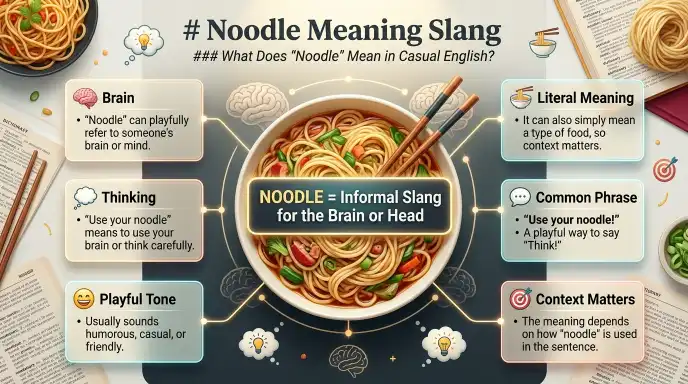
Noodle meaning slang usually refers to “head” or “brain.” It is an informal, playful expression often heard in phrases such as “use your noodle,” meaning “use your head” or “think carefully.”
If you searched for the noodle meaning slang, you may have seen the word in a text, comment, meme, or casual conversation and wondered why someone was talking about food. In slang, “noodle” can refer to a person’s head or brain instead of pasta.
The word can also describe a silly or foolish person in some contexts. That meaning is different from using “noodle” to mean the head, so the surrounding sentence matters.
Quick Answer: Noodle Meaning Slang
The noodle meaning slang is usually “head” or “brain.” For example, “Use your noodle” means “use your head” or “think.” The expression is informal and playful, and it can sound somewhat old-fashioned in modern conversation.
What Does Noodle Mean in Slang?
In slang, “noodle” can mean a person’s head or brain.
This meaning is most familiar in phrases such as:
- “Use your noodles.”
- “I bumped my noodle.”
- “My noodle is tired.”
- “That idea finally reached my noodle.”
For example:
“Come on, use your noodle and check the instructions.”
Here, the speaker means:
“Use your brain and think carefully.”
The expression is usually playful rather than serious. It may sound friendly when used between people who know each other well.
Dictionary sources also identify “noodle” as an informal word for the head or brain. Some dictionaries mark this usage as old-fashioned, especially in American English.
Noodle as “Head”
When “noodle” means “head,” it is a humorous replacement for the normal word.
For example:
“I hit my noodle on the cabinet.”
The speaker means:
“I hit my head on the cabinet.”
This use does not usually suggest that the person’s head literally resembles a noodle. It is simply a playful way to describe the head.
Noodle as “Brain”
“Noodle” can also mean the brain or a person’s ability to think.
For example:
“Give me a minute to figure this out.”
This means:
“Give my brain a minute to figure this out.”
This meaning is especially clear in the expression “use your noodle.”
Full Meaning of Noodle Slang
“Noodle” has no full form because it is not an abbreviation or acronym.
As an informal expression, it can have several related meanings:
| Meaning | Explanation | Tone |
| Head | A playful word for the head | Casual |
| Brain | A humorous word for the brain or mind | Casual |
| Foolish person | A silly or simple person | Mildly negative |
| Think | Used in phrases such as “use your noodle” | Playful |
These meanings should not be treated as identical.
When someone says “I hurt my noodle,” they are talking about their head. When someone says “You silly noodle,” they may be describing a person as foolish or silly.
Different Meanings of Noodle Slang
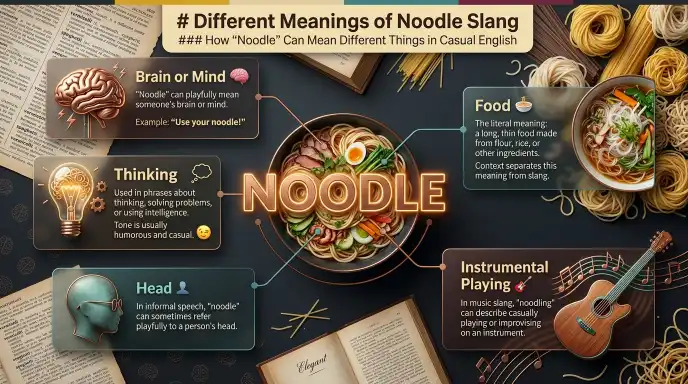
The context around the word tells you which meaning is intended.
Noodle Means “Head”
This is one of the established informal meanings of the word.
“That ball nearly hit me in the noodle.”
The person means:
“That ball nearly hit me in the head.”
This use is light and humorous.
Noodle Means “Brain”
A person can also use “noodle” when talking about thinking.
“My noodles are not working today.”
This means:
“My brain is not working well today.”
Someone might say this after a long day, difficult homework, or a tiring task.
Noodle Means a Silly Person
In some contexts, “noodle” can describe a foolish or simple person.
For example:
“You silly noodle! The keys are on the table.”
This is often playful teasing rather than a serious insult.
However, the relationship between the speakers matters. A phrase that sounds funny between friends could sound disrespectful when directed at a stranger.
Where Is Noodle Slang Commonly Used?
The slang meaning of “noodle” is not strongly tied to one social media platform. It is an older informal expression that can appear in everyday speech, humor, texting, and online conversations.
In Everyday Conversation
A parent, friend, or family member might say:
“Use your noodles!”
This usually means “think about it.”
In Text Messages
People can use the word jokingly in texts.
“My noodles are done after that exam.”
Here, “noodle” means “brain.”
On TikTok and Instagram
The word may appear in humorous captions, comments, or videos. It is not a special TikTok or Instagram abbreviation, however.
If someone writes:
“My noodle cannot process this.”
They are simply making playful comments about their brain.
On Reddit and Discord
Users may use “noodle” as casual humor or when discussing something difficult.
For example:
“Give me a second. My noodle is still loading.”
The meaning is clear from the context: the person needs time to think.
At School or With Family
“Use your noodle” can sound friendly when encouraging someone to solve a problem.
It may be especially common in playful speech with children, although it is not limited to children.
At Work
The expression is understandable, but it can sound informal or old-fashioned.
In a professional message, “think it through” or “use your judgment” is usually clearer.
Is Noodle Slang Rude, Offensive, or Harmless?
“Noodle” is generally harmless slang. However, it can become mildly insulting when it is used to describe someone’s intelligence.
Using it to mean “head” is normally harmless:
“I bumped my noodle.”
Using it to mean “brain” is also usually harmless:
“My noodle needs a break.”
But calling someone “a noodle” can suggest that they are foolish:
“Don’t be such a noodle.”
The tone can range from affectionate teasing to mild criticism.
| Expression | Likely tone |
| “Use your noodle.” | Playful |
| “I bumped my noodle.” | Harmless |
| “My noodle is tired.” | Humorous |
| “You silly noodle.” | Light teasing |
| “You’re a noodle.” | Potentially insulting |
“Noodle” is not normally considered a serious offensive term or slur. Still, context and tone always matter.
Real-Life Examples of Noodle Slang
Seeing the word in different sentences makes its meaning easier to understand.
Friendly Conversation
“Use your noodles. You already know how to solve it.”
Meaning: Use your brain and think.
Text Message
“I can’t answer that right now. My noodle is exhausted.”
Meaning: My brain is tired.
Family Conversation
“Watch your head! You almost hit your noodle.”
Meaning: You almost hit your head.
Playful Teasing
“You silly noodle, the answer was right in front of you.”
Meaning: You are being silly.
Social Media Comment
“My noodle completely stopped working after that math problem.”
Meaning: I could not think clearly after the difficult problem.
Casual Online Conversation
“Give me five minutes. My noodle needs to process this.”
Meaning: I need some time to understand or think about this.
Origin and History of Noodle Slang
The slang use of “noodle” is much older than modern internet language. Dictionary sources trace the informal meaning connected with the head or brain back to the 18th century.
Some sources connect this sense with the older word “noddle,” which was used for the head. The exact origin is not completely certain, so it is better not to present one explanation as proven fact.
This is also important because the slang meaning has a separate history from the food meaning of “noodle.” The fact that both words are spelled the same does not mean the slang sense simply came from pasta.
The expression later became part of familiar phrases such as “use your noodle.” Today, the phrase is still understandable, but it often has a playful or old-fashioned feel.
Is “Use Your Noodle” Still Common?
“Use your noodle” is still recognized, but it is not among the most common modern slang expressions.
It may sound:
- Playful
- Humorous
- Informal
- Old-fashioned
- Family-friendly
Modern speakers are often more likely to say:
“Use your head.”
or:
“Think about it.”
That does not make “use your noodle” incorrect. It simply means the phrase has a more playful style than many modern alternatives.
Noodle Slang vs. Similar Words
Several informal words can refer to a person’s head or brain.
| Word | Meaning | Tone |
| Noodle | Head or brain | Playful, somewhat old-fashioned |
| Noggin | Head | Casual, playful |
| Noddle | Head | Old-fashioned |
| Bean | Head | Informal |
| Head | Head or mind | Common, neutral |
| Brain | Brain or thinking ability | Common, direct |
“Noodle” and “noggin” are especially close in tone. Both can make a simple statement sound more humorous.
When Should You Avoid Using Noodle Slang?
“Noodle” is generally safe to use, but there are situations where a more direct word is better.
Avoid relying on it when:
- You are writing a formal report.
- You are speaking in a serious professional setting.
- You are talking to someone you do not know well.
- You are describing a serious head injury.
- You need precise medical language.
- You are unsure if the listener understands the expression.
For example, after a serious accident, saying:
“He hurt his noodle.”
would sound too casual.
A clearer sentence would be:
“He injured his head.”
The same rule applies when “noodle” is used to tease someone. If you are not sure how the person will react, choose a neutral word instead.
Why Do People Use “Noodle” as Slang?
People use “noodle” because it makes ordinary ideas about the head or brain sound playful and less serious. Saying “use your noodle” can feel warmer or funnier than simply saying “use your brain.”
The word also works well in casual speech because its unusual image makes the expression memorable. A person may choose to joke about being tired, confused, or slow to understand something.
Common reasons include:
- Making a conversation more humorous
- Softening a mild criticism
- Playfully describing the brain
- Teasing a friend without sounding too harsh
- Making a simple sentence more expressive
For example, a teacher might jokingly say, “Use your noodle,” while helping a student solve a simple problem. Between friends, “My noodle is fried” can mean “I am mentally exhausted.”
The key point is that the word usually adds personality rather than a completely new idea.
Impact of Using Noodle Slang in Communication
Using “noodle” can make informal communication sound friendly, humorous, or playful. However, its effect depends heavily on who says it and why.
With close friends or family, it can create a relaxed tone:
“My noodle is not ready for another meeting.”
In a formal setting, the same sentence may sound childish or out of place.
The expression can also soften criticism. Compare these two sentences:
“Use your brain.”
“Use your noodles.”
The first can sound direct or impatient. The second usually sounds more playful.
Still, playful wording is not always appropriate. If someone is upset, confused, or discussing a serious problem, clear language is often better.
Is Noodle Slang Safe for Social Media?
Yes. The slang use of “noodle” is generally harmless for social media, texting, and casual online conversations.
It is not normally a profanity, slur, or dangerous coded term. A post such as “My noodle stopped working after that exam” is simply a humorous way to say that the person is mentally tired.
On platforms such as TikTok, Instagram, Reddit, Snapchat, and Discord, the meaning is usually understood from the surrounding sentence.
However, “safe” does not mean appropriate in every situation. Avoid using playful slang when discussing serious medical issues, formal matters, or someone else’s condition.
Noodle Slang on Different Platforms
The meaning usually stays the same across platforms, but the style can change.
| Platform | Typical use | Tone |
| TikTok | Jokes, captions, comments | Playful |
| Captions and casual comments | Humorous | |
| Snapchat | Messages with friends | Casual |
| Jokes and discussions | Informal | |
| Discord | Gaming and group chats | Casual |
| Texting | Messages between friends or family | Friendly |
| Workplace chat | Occasional joke | Informal |
“Noodle” is not a platform-specific abbreviation. If you see it online, you normally need to read the sentence around it to understand if it means head, brain, or a silly person.
Common Misunderstandings About Noodle Slang
A few points can cause confusion when people first encounter this expression.
It Does Not Usually Mean Pasta
If someone says:
“Use your noodles.”
they are almost certainly not talking about food.
The context changes the meaning from the ordinary food sense to an informal reference to the brain or head.
It Is Not an Abbreviation
“Noodle” does not stand for a longer phrase.
There is no standard “full form” of noodle slang. It is simply a normal English word that also developed informal meanings.
It Is Not Always an Insult
Calling someone a “silly noodle” can be teasing rather than genuinely insulting.
Tone matters. A close friend may say it affectionately, while a stranger could make it sound dismissive.
It Is Not Purely Internet Slang
The informal use of “noodle” existed long before TikTok, Instagram, Reddit, or Discord.
Modern users may use it online, but social media did not create the slang meaning.
Can You Use Noodle Slang at Work?
You can use it in a relaxed workplace conversation if your workplace culture is informal, but it is not the best choice for formal communication.
For example, joking with a close coworker:
“My noodle needs coffee before I tackle this spreadsheet.”
may be perfectly fine.
But in a report, email to a client, or official document, use clearer wording such as:
“I need some time to think through the problem.”
The safest rule is simple: use “noodle” for friendly conversation, not for important formal writing.
Can You Use Noodle Slang With Teachers or Parents?
Yes, but the relationship and setting matter.
A student might hear a teacher jokingly say:
“Use your noodle and look at the question again.”
That usually means “think carefully.”
A child might also use “noodle” while talking with a parent:
“I hit my noodle on the door.”
Here, the child simply means “head.”
However, students should not assume every teacher prefers slang. In formal classroom writing, “head” or “brain” is clearer.
Polite Alternatives to Noodle Slang
Because “noodle” is already mild, you usually do not need to replace it for safety reasons. You may want an alternative when you need a more direct or professional tone.
When You Mean “Brain”
Use:
- Brain
- Mind
- Thinking
- Memory
Example:
“My brain is tired.”
This is clearer than:
“My noodle is tired.”
When You Mean “Head”
Use:
- Head
- Skull more specific and sometimes medical
- Mind only when referring to thoughts, not the physical head
Example:
“I bumped my head.”
This is better than “I bumped my noodle” when describing an actual injury.
When You Mean “Think”
Use:
- Think
- Consider it
- Think it through
- Use your judgment
For professional communication, “think it through” is usually much more natural than “use your noodle.”
Noodle Slang: Formal vs. Informal Use
The word is strongly associated with casual language when it carries its slang meanings.
| Situation | Is “noodle” suitable? |
| Chatting with friends | Yes |
| Family conversation | Yes |
| Casual texting | Yes |
| Funny social media post | Yes |
| Gaming chat | Usually |
| School conversation | Usually |
| Formal essay | No |
| Business report | No |
| Medical communication | No |
| Serious injury discussion | No |
This distinction helps prevent misunderstandings. A word can be perfectly harmless but still unsuitable for a particular setting.
Frequently Asked Questions
Q1. What does noodle mean in slang?
Noodle can mean a person’s head or brain. In “use your noodle,” it means “use your head” or “think.” The expression is informal and playful.
Q2. Is noodle a slang word for the brain?
Yes. “Noodle” can be used informally to mean the brain or a person’s thinking ability. For example, “My noodle is tired” means “My brain is tired.”
Q3. What does “use your noodle” mean?
“Use your noodle” means “use your brain” or “think about the problem.” It is usually a playful way to encourage someone to think.
Q4. Is calling someone a noodle an insult?
It can be a mild insult, but it is often playful. “You silly noodle” normally sounds like light teasing, while the same phrase can feel rude if used aggressively or toward someone you do not know.
Q5. Is noodle slang used on social media?
Yes, people can use “noodle” on social media, especially in humorous posts, comments, and casual conversations. However, it is not a special social media abbreviation.
Q6. Is noodle slang appropriate at work?
It can work in a relaxed conversation with coworkers, but it is not ideal for formal emails, reports, or professional documents. Use “head,” “brain,” or “think” when clarity matters.
Q7. Where did the slang use of noodle come from?
The informal use of “noodle” for the head or brain is old and predates modern internet slang. The exact origin is not completely certain, although dictionaries connect it with older informal terms for the head.
Q8. Does noodle have a full form in slang?
No. “Noodle” is not an acronym, so it does not have a standard full form. Its slang meanings come from informal English usage rather than from letters standing for another phrase.
Conclusion: Noodle Meaning Slang
The noodle meaning slang is mainly connected with the “head” or “brain.” The familiar phrase “use your noodle” means “use your head” or “think,” while expressions such as “my noodle is tired” use the word as a playful reference to the brain.
The term is generally harmless and works best in casual conversations, jokes, texts, and informal online posts. It can also describe someone as a “silly noodle,” but that use depends more strongly on tone and relationship.
“Noodle” is not a new internet abbreviation. Its informal meanings have a much older history, even though people can still use them online today.
The best takeaway is simple: if you see “noodle” in a casual sentence, check the context. It usually refers to the head, brain, or a silly person not the food.

I’m Emily Carter, and I enjoy writing about slang, internet language, and modern English expressions. My goal is to explain word meanings in a simple, clear, and easy-to-understand way so anyone can learn with confidence.