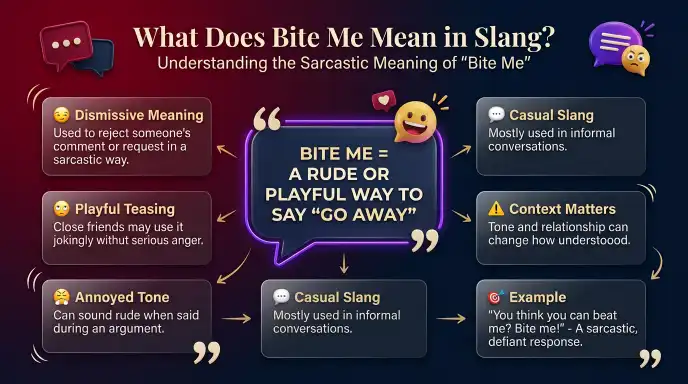
What does bite me mean in slang? “Bite me” is an informal phrase used to show annoyance, defiance, or dismissal. It can mean “leave me alone,” “I don’t care,” or “back off,” depending on the tone and situation.
The phrase is usually not meant literally. If someone says “bite me” after being teased, criticized, or challenged, they are often pushing back in a bold or slightly rude way. Between close friends, it can sometimes be playful. In a serious argument, however, it may sound disrespectful or hostile.
This is why context matters when you see “bite me” in a text, comment, video, or conversation. In this guide, you will learn what does bite me mean slang, its different uses, how people use it online, if it is rude, and when it is better to choose a more polite expression.
Quick Answer: What Does Bite Me Mean Slang?
“What does’ bite me ‘mean in slang?” In slang, “bite me” is a dismissive or defiant response that can mean “leave me alone,” “I don’t care,” or “back off.” It is informal and can sound rude, although close friends may use it jokingly.
What Does Bite Me Mean in Slang?
“Bite me” is mainly used as a sharp comeback. A person may say it after someone teases them, criticizes them, gives unwanted advice, or keeps bothering them.
The expression can communicate ideas such as:
- Leave me alone.
- Stop bothering me.
- I do not care.
- Back off.
- I disagree with you.
- Your opinion does not affect me.
- I am not going to do what you say.
The exact meaning depends on the situation.
For example:
“You should not wear that jacket.”
“Bite me.”
Here, the speaker is rejecting the criticism. They are not asking the other person to literally bite them.
Tone changes the meaning
Tone is very important with “bite me.” The same words can sound funny between friends or aggressive during an argument.
| Situation | Likely meaning | Tone |
| Friend teasing you | “Whatever, stop it.” | Playful |
| Someone criticizing you | “I don’t care.” | Defiant |
| Someone annoying you | “Leave me alone.” | Irritated |
| An argument | “Back off.” | Rude |
| A formal conversation | Strong rejection | Inappropriate |
Because of this, you should not judge the phrase only by the words. The relationship, situation, and tone all help reveal what the speaker means.
Is “Bite Me” a Full Form or Abbreviation?
No. “Bite me” is not a full form, abbreviation, or acronym.
It is an idiomatic expression. In slang, the words usually carry a figurative meaning rather than referring to actual biting.
The phrase has a history in informal American English. Historical language records show related uses before the modern slang sense became established, but the exact path from earlier expressions to the modern comeback is not completely certain.
For that reason, it is better to describe its origin carefully rather than claim that one person, website, or exact event created the phrase.
Different Meanings of “Bite Me” in Slang
The expression has one main idea: rejecting or dismissing someone. However, it can express that idea in several ways.
“Leave me alone”
Someone may use “bite me” when another person keeps annoying them.
“Stop asking me about my test score.”
“Bite me.”
The speaker wants the other person to stop.
“I don’t care”
It can also show that someone does not care about another person’s opinion.
“Everyone thinks you should quit.”
“Bite me. I’m staying.”
Here, the speaker is showing defiance.
“Back off”
During an argument, the phrase can tell someone to stop pushing or criticizing.
“You need to explain yourself.”
“Bite me. I don’t owe you an explanation.”
This use is more confrontational.
Playful teasing
Close friends may use “bite me” as a joke.
“You ate the last slice of pizza again.”
“Bite me!”
If both people are joking, the phrase may sound playful rather than genuinely angry.
Where Is “Bite Me” Commonly Used?
“Bite me” is mainly used in casual English. You may hear it in everyday conversations or see it in texts, comments, memes, entertainment, and informal online discussions.
It is not specific to one social media platform.
Bite me in texting
In text messages, “bite me” can be a quick comeback.
“You still owe me lunch.”
“Bite me 😂”
The laughing emoji can make the response feel more playful. Without that context, the same words may sound more hostile.
Bite me on TikTok and Instagram
On TikTok and Instagram, the phrase can appear in captions, comments, memes, jokes, and short videos.
Someone might use it to respond to teasing or to create a bold attitude in a caption.
Bite me on Discord and gaming chats
In gaming or group chats, “bite me” may be used after friendly teasing.
For example:
“You lost again. I told you to pick a better character.”
“Bite me 😂”
Among friends, this may simply be playful banter.
Bite me at work
“Bite me” is generally not a good choice for professional communication. Even if you intend it as a joke, a coworker, manager, client, or teacher may hear it as disrespectful.
For workplace conversations, use a calmer response such as “I disagree,” “I’d rather not,” or “Please leave it there.”
Is “Bite Me” Rude, Offensive, or Harmless?
“Bite me” is usually considered rude or impolite, but it is not normally a serious insult or a highly offensive expression.
Its strength depends on context.
With a close friend, it may be harmless teasing. With a stranger, teacher, parent, manager, or customer, it can sound disrespectful.
When it sounds playful
The phrase is more likely to be playful when:
- Friends already joke with each other.
- The speaker is smiling or laughing.
- An emoji shows humor.
- The conversation is light.
- Both people understand the joke.
When it sounds rude
It can sound rude when:
- Someone is already angry.
- It is directed at a stranger.
- It follows an argument.
- It dismisses someone’s serious concern.
- It is used toward someone in authority.
So, “bite me” is not automatically offensive. The safest description is informal, dismissive, and potentially rude.
Real-Life Examples of “Bite Me”
Friendly teasing
“You really think you’re the best cook here?”
“Bite me!”
The response may be playful between friends.
Text message
“You forgot to bring my book again.”
“Bite me 😭”
The emoji and relationship can make the reply sound like joking frustration.
During an argument
“You never listen to anyone.”
“Bite me.”
Here, the phrase sounds defensive and rude.
Responding to criticism
“That haircut looks terrible.”
“Bite me. I like it.”
The speaker is rejecting the criticism.
Setting a boundary
“Come on, tell me everything.”
“Bite me. It’s private.”
In this situation, the phrase is a blunt way to tell someone to stop asking.
Origin and History of “Bite Me”
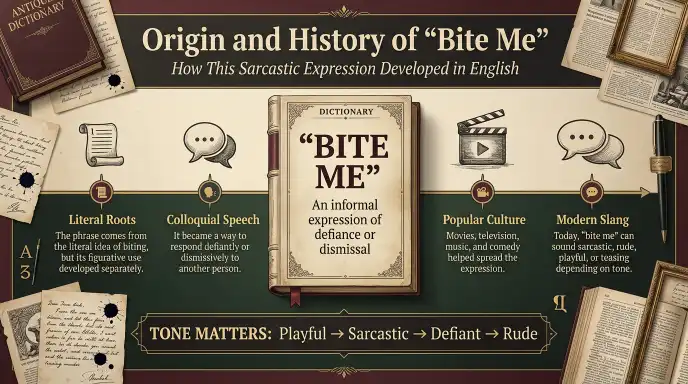
“Bite me” has a longer history than its modern slang use might suggest. The literal phrase simply describes biting, but the dismissive expression developed as an informal comeback.
The exact origin of the modern slang meaning is not fully certain. Historical discussions of the phrase connect it with related expressions that were already used to tell someone to go away or show contempt. By the late 20th century, “bite me” was established as an informal American expression of defiance or annoyance.
It is therefore safer to describe “bite me” as an informal expression that developed over time rather than assign it to one person or one exact date.
How the meaning changed
The phrase moved from a literal idea of biting toward a figurative response.
Today, when someone says:
“Bite me.”
they usually mean something closer to:
“Leave me alone.”
or:
“I don’t care what you think.”
The modern expression is especially common in casual speech and fictional dialogue.
Is “bite me” old-fashioned?
The phrase is still understood today, but its use can depend on age, personality, and context.
It is not a new internet abbreviation. People used the expression in spoken English before social media became common.
Today, it may sound bold, sarcastic, humorous, or slightly dated depending on who says it and how it is delivered.
Similar Slang and Related Expressions
Several informal expressions can communicate a similar attitude. However, they do not all have exactly the same tone.
| Expression | Basic meaning | Tone |
| Bite me | Leave me alone or I don’t care | Rude or playful |
| Whatever | I don’t care | Dismissive |
| Back off | Stop bothering me | Firm |
| Leave me alone | Stop bothering me | Direct |
| Get lost | Go away | Rude |
| Give me a break | Stop criticizing or pressuring me | Informal |
| So what? | I don’t care about that | Defiant |
| Forget it | Stop the discussion | Informal |
“Bite me” is usually stronger than “whatever,” but it is often less harsh than some direct insults.
Bite me vs. whatever
“Whatever” can show that someone does not care, while “bite me” adds a stronger sense of defiance.
“Whatever.”
This may sound dismissive.
“Bite me.”
This sounds more confrontational.
Bite me vs. back off
“Back off” directly tells someone to stop or give you space.
“Bite me” is more of a comeback. It rejects the other person’s attitude rather than simply giving an instruction.
When Should You Avoid Saying “Bite Me”?
You should avoid “bite me” when you need to sound respectful or professional.
The phrase can easily be misunderstood, especially in writing where the listener cannot hear your tone.
Avoid it in situations such as:
- Job interviews
- Formal emails
- School assignments
- Conversations with teachers
- Customer service
- Professional meetings
- Serious discussions
- Conversations with people you do not know well
Even when you mean it as a joke, the other person may not understand your intention.
When is it safer to use?
“Bite me” is more suitable when you are talking casually with close friends who understand your humor.
Still, context matters. If someone is discussing a serious problem, using “bite me” can make you appear dismissive or uncaring.
Polite Alternatives to “Bite Me”
If you want to express the same basic idea without sounding rude, choose a phrase that matches the situation.
| Instead of “bite me” | Try saying |
| Leave me alone | “Please give me some space.” |
| I don’t care | “I don’t really mind.” |
| Back off | “Please stop.” |
| I disagree | “I see it differently.” |
| Stop criticizing me | “I’d rather not discuss that.” |
| That’s not your concern | “I’d prefer to keep that private.” |
| Give me a break | “Please don’t pressure me.” |
These alternatives are better for school, work, family discussions, and other situations where respect matters.
Why Do People Say “Bite Me”?
People usually say “bite me” because they want to push back quickly. It can be an easy way to reject teasing, criticism, or unwanted advice.
To show confidence
Someone may use it to show that another person’s opinion does not bother them.
To respond to teasing
Friends may use the phrase as playful banter.
To express annoyance
A person who feels irritated may use it to tell someone to stop.
To sound sarcastic
The expression can add a sarcastic edge to a response.
To create humor
In a light conversation, “bite me” can be funny because it is exaggerated and unexpected.
The speaker’s relationship with the listener makes a big difference. The same phrase can be funny among close friends and insulting when directed at a stranger.
Common Misunderstandings About “Bite Me”
One common misunderstanding is that “bite me” always means the speaker is angry. That is not necessarily true.
Friends may use it while laughing or joking.
Another misunderstanding is that the phrase always has a sexual meaning. In ordinary slang use, “bite me” is generally a dismissive or defiant expression. Its meaning comes from the conversation and tone.
It is also easy to confuse the slang meaning with the literal meaning. If someone says:
“The dog might bite me.”
that is literal.
If someone says:
“Oh, bite me!”
that is usually figurative and expresses annoyance or defiance.
Does “bite me” mean “I hate you”?
Not necessarily. It usually means that the speaker is rejecting what someone said or wants them to stop bothering them.
Is “bite me” a swear word?
No. “Bite me” is not a swear word. However, it can still sound rude or disrespectful.
Is “bite me” safe to use online?
It is generally not a dangerous expression, but it can create conflict because it sounds dismissive. Use it carefully, especially when speaking to people you do not know well.
Frequently Asked Questions
Q1. What does “bite me” mean in slang?
“Bite me” is an informal comeback that usually means “leave me alone,” “back off,” or “I don’t care.” It can be playful between friends but rude in a serious conversation.
Q2. Is “bite me” a bad word?
No, “bite me” is not a swear word. However, it is informal and can sound rude, dismissive, or disrespectful depending on the situation.
Q3. Is “bite me” an insult?
It can function as a mild insult or hostile comeback, but it does not always mean the speaker is directly insulting someone. Among friends, it may simply be playful teasing.
Q4. What does “bite me” mean in a text?
In a text, “bite me” usually means “leave me alone,” “I don’t care,” or “back off.” Emojis and the relationship between the people can help show if it is meant seriously or jokingly.
Q5. Can “bite me” be used jokingly?
Yes. Close friends may use “bite me” as playful banter. A laughing tone, emoji, or friendly conversation can make the phrase sound less serious.
Q6. Can I say “bite me” at work?
It is better to avoid it at work. Even if you intend it as a joke, it can sound disrespectful. A polite response such as “I disagree” is safer.
Q7. Does “bite me” have a sexual meaning?
Usually, no. In normal slang use, “bite me” is a dismissive or defiant expression. The intended meaning should be judged from the surrounding context.
Q8. What is a polite alternative to “bite me”?
Depending on the situation, you can say “Please leave me alone,” “I disagree,” “Please give me some space,” or “I’d rather not discuss that.” These sound more respectful.
Conclusion: What Does Bite Me Mean Slang?
“What does’ bite me ‘mean in slang?” The short answer is that “bite me” is an informal and often dismissive comeback. It can mean “leave me alone,” “back off,” or “I don’t care,” while close friends may use it playfully.
The phrase is not a swear word, but it can still sound rude. Tone, relationship, and situation are the key factors. It may fit a joking conversation with a close friend but is a poor choice for a teacher, manager, customer, or formal setting.
If you want to sound respectful, choose a softer phrase such as “I disagree” or “Please give me some space.” Understanding the tone behind “bite me” will help you know when it is playful and when it may come across as disrespectful.