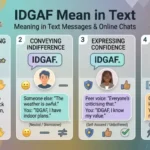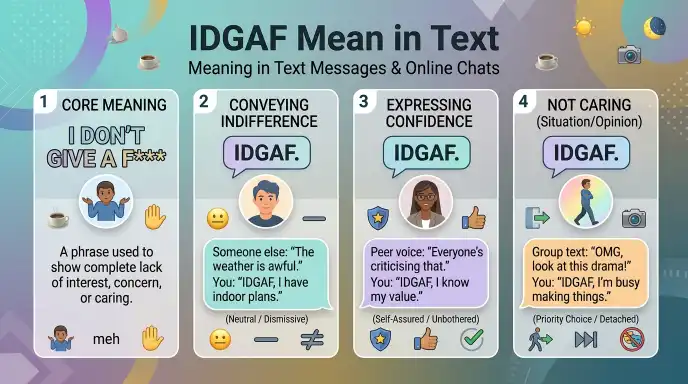
IDGAF mean in text is a blunt slang acronym that means “I don’t give a f*,”** used to say that someone does not care about something. You may see it in texting, TikTok, Snapchat, Instagram, WhatsApp, and online comments.
People often search for IDGAF meaning in text because the acronym can sound strong or confusing if you see it for the first time. It is also common in casual online conversations, memes, captions, and posts.
The expression usually shows indifference, confidence, frustration, or a strong refusal to care. However, its tone depends on the situation and the relationship between the people talking.
Because IDGAF contains profanity, it is more important to understand when it is appropriate and when it should be avoided than with milder texting abbreviations.
IDGAF Meaning in Text
IDGAF stands for “I don’t give a f*.”** It is an acronym made from the first letters of the words in the phrase.
In everyday texting, people use it to mean “I really don’t care” or “It does not matter to me.” The wording is much stronger than simply saying “I don’t care.”
For example:
“Everyone is talking about my outfit, but IDGAF.”
Here, the person is saying that other people’s opinions about their outfit do not bother them.
Another example is:
“IDGAF what they think.”
This means:
“I really don’t care what they think.”
The important thing to understand is that IDGAF is not usually a neutral expression. It carries a strong emotional tone because of the profanity in the original phrase.
Is IDGAF an Acronym or Slang?
IDGAF is both an acronym and a slang expression.
Technically, it is an acronym formed from the words I Don’t Give A F***. In online communication, it functions as slang because people use it informally to express a particular attitude.
You will normally see it in casual conversations, rather than formal writing.
What Does IDGAF Mean in Everyday Chat?
In a normal conversation, IDGAF can communicate several related ideas:
- I don’t care.
- I’m not bothered.
- Your opinion doesn’t matter to me.
- I’m ignoring the situation.
- I’m done worrying about it.
The exact meaning depends on the context.
Someone might use IDGAF jokingly with a close friend. Another person might use it during an argument to sound dismissive or angry.
Where People Use IDGAF
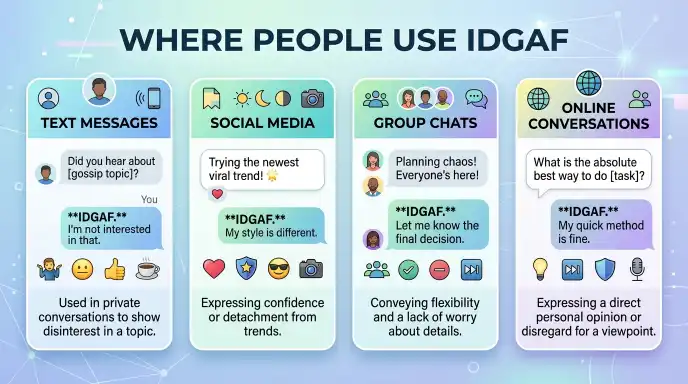
IDGAF appears across many forms of online communication. Its meaning generally stays the same, although the tone can change depending on the platform.
IDGAF on TikTok
On TikTok, IDGAF can appear in captions, comments, memes, videos, and replies.
People may use it to show a carefree attitude or to say that they are not worried about other people’s opinions.
For example:
“They said I shouldn’t dance in public. IDGAF.”
A creator might also use the phrase as part of a humorous or confident caption.
Because TikTok content often uses casual language, strong slang acronyms such as IDGAF can appear frequently in certain types of posts.
IDGAF on Snapchat
On Snapchat, people may use IDGAF in private messages, captions, or text added to a Snap.
For example:
“I forgot what they said. IDGAF 😂”
The expression can sound less serious when combined with an emoji or used between close friends.
Still, the profanity remains part of the original phrase, so it is not automatically appropriate for every audience.
IDGAF on Instagram
On Instagram, IDGAF may appear in comments, captions, Stories, Reels, or direct messages.
Someone might write:
“IDGAF about the comments.”
The person is expressing that they are not concerned about what other users are saying.
It can also be used humorously in memes where the phrase represents a carefree or rebellious attitude.
IDGAF on WhatsApp
On WhatsApp, IDGAF is mostly used in informal private chats.
For example:
“They don’t like my decision, but IDGAF.”
A friend might understand the phrase immediately, especially if both people regularly use internet slang.
However, sending it to someone you do not know well can make the message sound dismissive or disrespectful.
IDGAF in SMS
IDGAF can also appear in regular SMS texting.
Text messages often use abbreviations because they are quick to type. Someone might send:
“IDGAF anymore. Let’s just leave it.”
In this situation, the acronym may communicate frustration as well as indifference.
Real Chat Examples
The following examples show how IDGAF can sound in different everyday conversations.
Ignoring Opinions
A: Everyone says you shouldn’t wear that.
B: IDGAF 😂
A: Fair enough, wear what you like.
Here, B means that other people’s opinions do not matter to them.
A Small Argument
A: He’s still mad about yesterday.
B: IDGAF anymore.
A: Maybe give him some time.
In this example, IDGAF shows frustration and indifference.
Fashion
A: Isn’t that shirt too bright?
B: Maybe, but IDGAF. I like it.
A: Honestly, it looks good.
Here, the speaker is confidently ignoring criticism.
Social Media Comments
A: Did you see what people commented on your post?
B: Yeah. IDGAF what random people say.
A: That’s probably the best attitude.
The acronym shows that the person is not bothered by online criticism.
Plans Changing
A: They’re not coming tonight.
B: IDGAF, we can still have fun.
A: Exactly.
Here, the expression means the person does not care about the change in plans.
School Situation
A: What if everyone laughs at your presentation?
B: IDGAF. I’m just going to do it.
A: Good luck!
This use communicates confidence and determination.
Relationship Discussion
A: She said you should text her back.
B: IDGAF right now. I need some space.
A: Okay, I understand.
Here, the acronym expresses a stronger emotional reaction.
Gaming Chat
A: You lost the match again.
B: IDGAF 😂 It was just a game.
A: True. Let’s play another.
The phrase is being used casually and humorously.
Gossip
A: People are talking about us again.
B: IDGAF. Let them talk.
A: That’s what I was thinking.
Here, the speaker says that the gossip does not concern them.
Being Done With a Situation
A: Are you still worried about what happened?
B: No. IDGAF anymore.
A: Good. Move on and enjoy your day.
This example shows indifference after frustration.
How to Reply When Someone Says “IDGAF”
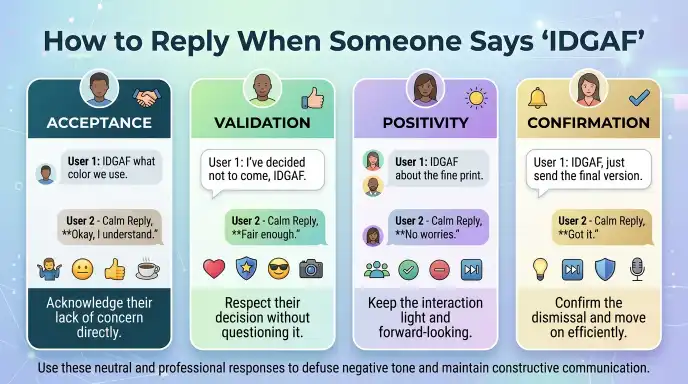
Your response should depend on the person’s tone and the subject of the conversation.
If they are joking, you can respond playfully. If they sound angry, a calm response may work better.
Funny Replies
You can use humor when you know the person well.
- “Okay, CEO of not caring 😂”
- “Message received.”
- “That was very clear 😂”
- “Not even 1%?”
- “You really don’t care, huh?”
These replies work best in friendly conversations.
Casual Replies
For a relaxed conversation, you could say:
- “Fair enough.”
- “Okay, I get you.”
- “No worries.”
- “That’s your choice.”
- “Alright, let’s move on.”
These responses do not add unnecessary tension.
Friendly Replies
If you want to keep the conversation positive, try:
- “I understand how you feel.”
- “That’s okay, don’t stress about it.”
- “Do what makes you comfortable.”
- “No pressure.”
- “I get where you’re coming from.”
These replies are useful when the other person is frustrated.
Neutral Replies
When you do not want to argue, keep your answer simple:
- “Okay.”
- “Understood.”
- “Got it.”
- “Alright.”
- “I hear you.”
A neutral response can prevent a small disagreement from becoming a bigger one.
Is IDGAF Rude or Offensive?
IDGAF can be rude or offensive, depending on how and where you use it.
The reason is simple: the full phrase contains strong profanity.
Using it with a close friend may be completely normal within that friendship. However, saying it directly to a stranger, teacher, customer, manager, or older family member may sound disrespectful.
Is IDGAF Safe to Use?
It is generally safe to understand and recognize the term, but using it requires attention to context.
Private conversations between friends are different from public or professional communication.
If you are unsure about the audience, a softer phrase such as “I don’t care,” “I’m not worried about it,” or “It doesn’t bother me” is safer.
Is IDGAF Appropriate at School?
In most school settings, IDGAF is not a good choice for formal communication because it represents profanity.
Students may see it in casual group chats or social media, but that does not mean it belongs in an essay, presentation, email, or conversation with a teacher.
Is IDGAF Appropriate at Work?
You should generally avoid IDGAF in professional emails, reports, meetings, customer communication, and workplace messages.
Even when you genuinely mean “I don’t care,” a professional alternative sounds more respectful.
For example, instead of:
“IDGAF what they decide.”
You could write:
“I don’t have a preference about the decision.”
The second version communicates the idea without sounding aggressive.
Who Uses This Term?
IDGAF is mostly associated with informal internet and texting culture.
It can be used by different age groups, but its presence is especially noticeable among people who regularly communicate through social media and online messaging.
Gen Z Usage
Gen Z users may encounter IDGAF in memes, comments, captions, chats, and short-form videos.
The acronym fits online communication because it expresses a complete attitude in just a few letters.
However, not every Gen Z user uses profanity or internet acronyms. Individual communication styles vary considerably.
Common Online Platforms
You may encounter IDGAF on:
- TikTok
- Snapchat
- Discord
- Text messages
- Online gaming chats
Its meaning generally remains the same across these platforms.
How Often Does IDGAF Appear Online?
IDGAF is a well-known internet acronym, but usage varies by community, age group, and conversation style.
It is more likely to appear in casual, humorous, emotional, or argumentative conversations than in formal online communication.
Origin of IDGAF Mean in Text
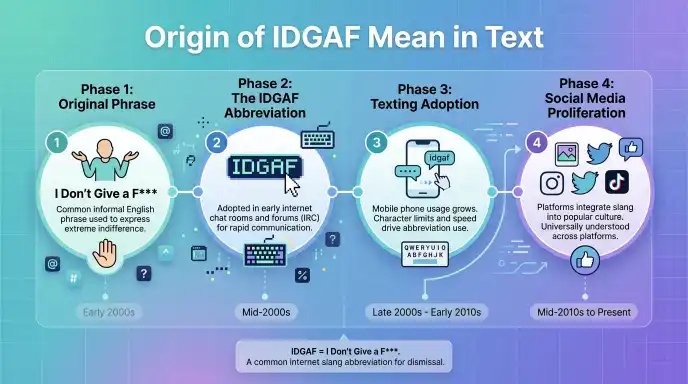
The exact origin of IDGAF is difficult to assign to one specific person, website, or moment.
The underlying phrase “I don’t give a f*”** has existed in informal English for a long time. The acronym developed as part of the broader growth of internet shorthand and text messaging.
As people began communicating through limited-length messages, chat rooms, forums, instant messaging, and mobile phones, shortening longer phrases became convenient.
IDGAF fits this pattern because the full phrase is reduced to four letters.
Online culture also helped spread the acronym through memes, social media posts, comments, music-related discussions, and casual conversations.
Its origin is therefore better understood as part of the development of digital slang rather than as a term with one clearly documented creator.
IDGAF vs IDK, IDC, IMO, and BRB
These acronyms can all appear in text messages, but their meanings are different.
| Term | Meaning | Type | Usage | Popularity |
| IDGAF | I don’t give a f*** | Slang acronym | Strong indifference or dismissal | Common |
| IDK | I don’t know | Text abbreviation | Uncertainty or lack of knowledge | Very common |
| IDC | I don’t care | Text abbreviation | Indifference | Common |
| IMO | In my opinion | Text abbreviation | Sharing an opinion | Very common |
| BRB | Be right back | Text abbreviation | Temporarily leaving a chat | Very common |
The biggest difference is tone.
IDC can simply mean “I don’t care,” while IDGAF is much stronger and contains profanity.
For example:
“IDC which movie we watch.”
This sounds relatively casual.
But:
“IDGAF which movie we watch.”
The second sentence sounds much more forceful and may suggest irritation or a stronger lack of interest.
IDK is about not knowing something, while IMO introduces an opinion. BRB tells someone that you are temporarily leaving the conversation.
So, although these abbreviations are all common in texting, they should not be treated as interchangeable.
Real-World Usage Example
Imagine two friends are shopping together.
One friend chooses a bright jacket, but several people nearby comment that the jacket looks unusual.
The friend responds:
“IDGAF. I like it.”
In this situation, the person is not literally saying that they have no feelings about anything. They are saying that other people’s opinions about the jacket do not matter to them.
The expression adds emotional strength to the statement.
A milder version would be:
“I don’t care what they think. I like it.”
The meaning is similar, but the second version is more appropriate in many situations because it avoids profanity.
This example shows why understanding tone and context matters when interpreting slang.
Frequently Asked Questions
Q1. What does IDGAF mean in text messages?
IDGAF means “I don’t give a f*.”** It is used to strongly say that someone does not care about something.
Q2. What does IDGAF mean on TikTok?
On TikTok, IDGAF usually expresses indifference, confidence, frustration, or a carefree attitude in captions, comments, and videos.
Q3. Is IDGAF slang?
Yes. IDGAF is a slang acronym commonly used in informal texting, social media, online conversations, and memes.
Q4. Is IDGAF rude or offensive?
It can be rude or offensive because the full phrase contains profanity. Its effect depends on the audience, context, and relationship between the people using it.
Q5. How should you reply to IDGAF?
You can reply with “Fair enough,” “Okay, I understand,” or a humorous response if the conversation is friendly. A neutral reply is safest when the tone is unclear.
Conclusion:
IDGAF means “I don’t give a f*”** and is used in texting and social media to express strong indifference, confidence, frustration, or dismissal.
You may see it on TikTok, Snapchat, Instagram, WhatsApp, SMS, and other online platforms. Its meaning is usually easy to understand from the surrounding conversation, but its strong tone is important to recognize.
Because the original phrase contains profanity, IDGAF is best kept for informal situations where that style of language is accepted. It is generally better to avoid it in school assignments, professional communication, formal messages, and conversations where respectful language is expected.
If you only want to express that you do not care, softer alternatives such as “I don’t care,” “I’m not bothered,” or “It doesn’t matter to me” can communicate the same basic idea without the strong language.