What is Greek slang is a common question among people learning Greek, traveling to Greece, or trying to understand Greek conversations online.
Like every language, Greek has informal words and expressions that are different from formal textbook Greek. These slang terms help people sound more natural, friendly, and connected in everyday conversations.
Greek slang can be heard among friends, young people, social groups, and online communities. It appears in casual chats, social media comments, messaging apps, and sometimes even in movies and music. Some expressions are playful, while others may depend heavily on tone and situation.
Understanding Greek slang helps learners communicate better and avoid confusion when they hear words that are not usually taught in language classes.
Quick Answer: What Is Greek Slang?
Greek slang refers to informal Greek words and expressions used in everyday conversations. It often shows friendship, humor, emotion, or cultural identity rather than following formal language rules.
What Does Greek Slang Mean in Text?
Greek slang in text refers to informal Greek expressions people use while messaging, chatting online, or communicating casually. These words are usually shorter, more relaxed, and more emotional than standard Greek.
Just like English speakers use words such as “bro,” “cool,” “chill,” or “awesome,” Greek speakers have their own informal vocabulary.
Greek slang may include:
- Friendly nicknames
- Funny expressions
- Shortened words
- Street language
- Youth expressions
- Internet-style phrases
The meaning of Greek slang often depends on:
- Who is saying it
- The relationship between people
- The situation
- The tone of the message
A word that sounds rude between strangers may sound friendly between close friends.
Greek Slang Full Form / Definition
Unlike abbreviations such as “LOL” or “BRB,” most Greek slang does not have a “full form.” Instead, it consists of informal words and phrases that developed naturally through everyday communication.
Greek slang can come from:
- Traditional Greek expressions
- Regional dialects
- Youth culture
- Foreign language influences
- Internet communication
For example, Greek speakers may create playful versions of common words to make conversations feel warmer or more casual.
Slang is not usually used in:
- Business documents
- Academic writing
- Formal speeches
- Official communication
However, it is very common in:
- Friend groups
- Family conversations
- Social media
- Text messages
Is Greek Slang Rude, Offensive, or Neutral?
Greek slang can be neutral, friendly, funny, or offensive depending on the expression and context.
Not all slang words are bad. Many Greek slang terms are simply casual ways to talk with friends.
Neutral Greek Slang
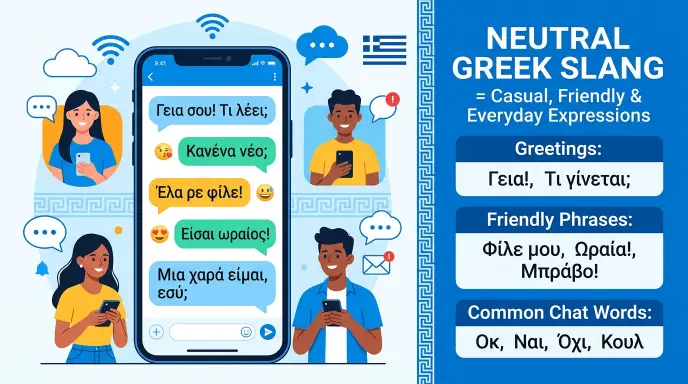
Some slang expressions are just informal versions of everyday language.
Example:
A friend might use a casual nickname instead of someone’s real name.
This creates a relaxed feeling without being disrespectful.
Friendly Greek Slang
Among close friends, slang can show:
- Trust
- Humor
- Familiarity
- Friendship
Friends often use playful words that would sound strange in formal situations.
Offensive Greek Slang
Some slang terms can become offensive if they:
- Insult someone
- Attack a person’s identity
- Are used aggressively
- Are said to strangers
Before using Greek slang, it is important to understand the relationship between speakers.
Where Is Greek Slang Commonly Used?
Greek slang is mostly used in informal environments where people feel comfortable expressing themselves.
Everyday Conversations
Greek speakers commonly use slang when talking with:
- Friends
- Classmates
- Family members
- Coworkers they know well
Casual conversations often include expressions that are not found in beginner Greek textbooks.
Texting and Messaging
Greek slang appears frequently in:
- WhatsApp chats
- Messenger conversations
- Group messages
- Casual texting
People often use slang because it makes messages feel faster and more personal.
For example, instead of writing a formal sentence, friends may use a short slang expression to show excitement, surprise, or humor.
Social Media Platforms
Greek slang can also appear on platforms like:
- TikTok
- Snapchat
- Discord
Young users often mix Greek slang with English internet terms.
A Greek social media comment may include:
- Greek informal words
- English online expressions
- Emojis
- Shortened phrases
This combination reflects modern digital communication.
Gaming Communities
Greek gamers may use slang while communicating during online games.
Common situations include:
- Team conversations
- Competitive matches
- Gaming communities
- Streaming chats
Gaming slang is usually fast, emotional, and informal.
Origin and Background of Greek Slang
Greek slang has developed over many generations. It is influenced by Greece’s history, culture, and contact with other languages.
Some Greek slang comes from:
Ancient and Traditional Expressions
Greek has a long linguistic history, and some informal expressions are connected to older language forms.
Regional Dialects
Different areas of Greece have unique ways of speaking. A word that is common in one region may sound unusual somewhere else.
Youth Culture
Young Greeks often create new slang to express:
- Humor
- Creativity
- Group identity
Foreign Influences
Modern Greek slang also includes influences from languages such as:
- English
- Italian
- Turkish
- French
Global media, music, movies, and the internet continue to introduce new expressions.
Why Do People Use Greek Slang?
People use slang because it makes communication feel more natural and personal.
Common reasons include:
To Sound More Friendly
Formal language can sometimes feel distant. Slang creates a relaxed atmosphere.
To Show Belonging
Using the same slang as a group can make people feel connected.
To Express Emotions
Slang often carries stronger emotions than formal words.
It can show:
- Excitement
- Surprise
- Humor
- Frustration
To Save Time
In texting, shorter informal expressions are easier and faster to type.
Real Life Examples of Greek Slang Usage
Greek slang is best understood through examples because many expressions change meaning depending on tone and situation. A phrase between close friends may sound completely different when used with strangers.
Below are examples showing how informal Greek expressions work in everyday communication.
Friendly Conversation Examples
Example 1: Talking With Friends
Situation: Two friends are making plans.
Friend A: “Are you coming tonight?”
Friend B: “Of course! I’m coming. Don’t worry!”
In casual Greek conversations, friends often use relaxed expressions instead of formal language. The goal is not only to share information but also to create a friendly connection.
Example 2: Showing Excitement
Situation: Someone shares good news.
Person A: “I passed my exam!”
Person B: “That’s amazing!”
Greek speakers often use informal words and emotional expressions to show happiness. These expressions can make conversations feel warmer and more natural.
Casual Greek Slang Examples
Example: Between Close Friends
A person may use a playful nickname or informal expression when speaking with someone they know well.
Meaning:
“I feel comfortable with you.”
This type of slang usually shows friendship rather than disrespect.
Example: Online Comments
A Greek user might comment casually on a friend’s post using slang instead of formal Greek.
Example situation:
Friend posts a vacation photo.
Comment:
“That looks awesome!”
The slang style makes the comment feel more personal and energetic.
Argumentative or Negative Context Examples
Greek slang can also appear during arguments. In these situations, tone becomes very important.
A word that is normally playful can become insulting if said with anger.
For example:
- A joke between friends may be acceptable.
- The same phrase from a stranger may sound aggressive.
When learning Greek slang, understanding emotion and relationship is just as important as learning vocabulary.
Gaming and Online Community Examples
Greek gamers often combine Greek slang with international gaming language.
Common online situations include:
- Team discussions
- Competitive matches
- Streaming communities
- Discord servers
Examples of communication style:
Player 1: “Nice move!”
Player 2: “Thanks, that was close!”
Gamers usually prefer quick and expressive language because conversations happen quickly during gameplay.
Comparison With Similar Slang Concepts
Greek slang works similarly to slang in many other languages. However, each culture has its own expressions and social rules.
| Language | Example of Casual Slang Style | Purpose |
| Greek | Informal expressions between friends | Builds connection and humor |
| English | “Bro,” “cool,” “awesome” | Shows friendliness |
| Spanish | “Tío,” “guay” | Casual conversation |
| Italian | “Ragazzo,” informal phrases | Friendly communication |
The important thing is not translating slang word for word. The meaning often comes from culture and context.
Greek Slang vs Formal Greek
Understanding the difference between slang and formal language helps learners choose the right words.
| Feature | Greek Slang | Formal Greek |
| Used with friends | Very common | Less common |
| Used in business | Usually avoided | Preferred |
| Tone | Relaxed and emotional | Professional |
| Found online | Very common | Less common |
| Shows personality | Often | Less often |
A Greek learner may know correct grammar but still feel confused when hearing native speakers use slang. This happens because real conversations are usually less formal than textbooks.
When Should You Avoid Using Greek Slang?
Greek slang can make conversations more natural, but it should not be used everywhere.
Avoid using slang in:
Professional Situations
Examples:
- Job interviews
- Business emails
- Official meetings
Formal Greek creates a more respectful impression.
Speaking With Strangers
Some slang expressions require a close relationship.
Using very casual words with someone you just met may sound:
- Too familiar
- Disrespectful
- Unnatural
Academic Writing
Students should avoid slang in:
- Essays
- Research papers
- Presentations
Formal vocabulary is more appropriate in educational settings.
Polite Alternatives to Offensive Greek Slang
If you are unsure if a slang expression may sound rude, choose a safer alternative.
Instead of using strong slang:
- Use standard Greek words.
- Use polite phrases.
- Follow the language style of native speakers around you.
A good rule is:
Listen first, use later.
Before using new slang, notice:
- Who uses it
- How they say it
- What situation they use it in
Impact of Using Greek Slang in Communication
Greek slang can have both positive and negative effects.
Positive Effects
Using slang can help people:
- Sound more natural
- Build friendships
- Understand Greek culture
- Join conversations more easily
For language learners, slang provides insight into how native speakers really communicate.
Negative Effects
Using slang incorrectly can cause:
- Misunderstandings
- Awkward situations
- Unintended offense
A learner may translate a slang word literally and miss its cultural meaning.
Is Greek Slang Safe for Social Media?
Most Greek slang is safe for casual social media use when used correctly.
It commonly appears in:
- Instagram captions
- TikTok comments
- Snapchat messages
- Reddit discussions
- Discord chats
However, users should be careful with slang that:
- Insults people
- Contains hateful language
- Attacks someone personally
- Is inappropriate for public spaces
Social media spreads slang quickly, but not every expression is suitable for every audience.
Popular Categories of Greek Slang
Greek slang is not just one type of language. It includes several categories.
1. Friendship Slang
Used between close people to create a relaxed feeling.
Examples:
- Nicknames
- Friendly expressions
- Playful phrases
2. Youth Slang
Often created by younger generations.
It spreads through:
- Music
- Social media
- Internet communities
Youth slang changes quickly, so some expressions become popular and later disappear.
3. Internet Slang
Digital communication has created new ways for Greeks to express themselves online.
This includes:
- Short phrases
- Mixed Greek English expressions
- Emoji-based communication
4. Street Slang
Some informal expressions come from everyday street conversations.
These may be:
- Very casual
- Regional
- Strongly connected to certain communities
Learners should be careful because street slang can vary greatly.
Frequently Asked Questions About Greek Slang
1. What is Greek slang?
Greek slang refers to informal words and expressions used in everyday Greek conversations. People use it with friends, family, online communities, and casual social groups. It is different from formal Greek because it is more relaxed, emotional, and connected to everyday culture.
2. What does Greek slang mean in text messages?
Greek slang in text messages means using informal Greek words, shortened expressions, and casual phrases while chatting online. People use it on messaging apps, social media, and online communities to communicate faster and sound more natural.
3. Is Greek slang difficult to learn?
Greek slang can be challenging because many expressions depend on context, tone, and relationships. A word may have a friendly meaning among friends but sound rude when used with strangers.
The best way to learn Greek slang is by:
- Listening to native speakers
- Watching Greek movies and videos
- Following real conversations
- Learning the situation where each expression is used
4. Is Greek slang rude?
Not all Greek slang is rude. Many slang expressions are completely friendly and normal in casual conversations. However, some slang words can be offensive depending on the meaning, tone, and situation.
Always consider:
- Who you are speaking to
- Where you are speaking
- How the phrase is normally used
5. Where can I see Greek slang online?
Greek slang appears on many online platforms, including:
- TikTok
- Snapchat
- Discord
- YouTube comments
- Messaging apps
Young Greek users often create and spread new expressions through digital communication.
6. Can tourists use Greek slang?
Yes, tourists can learn and use some Greek slang, especially friendly expressions. However, beginners should avoid using strong or offensive slang until they fully understand the meaning.
Simple, polite Greek is usually the safest choice when speaking with locals for the first time.
Tips for Learning Greek Slang Correctly
Learning slang is more than memorizing words. You need to understand the culture behind the language.
Pay Attention to Tone
The same word can have different meanings depending on:
- Voice
- Facial expression
- Relationship
- Situation
A friendly joke and an insult may use similar words but have completely different intentions.
Learn From Native Speakers
The best way to understand slang is by observing how native speakers use it.
Helpful sources include:
- Greek conversations
- Movies
- Music
- Social media
- Online communities
Avoid Direct Translation
Slang rarely translates perfectly between languages.
A Greek slang expression may not have an exact English equivalent because it reflects Greek culture and communication style.
Why Understanding Greek Slang Matters for Language Learners
Many students learn grammar and vocabulary but still struggle to understand native conversations.
This happens because everyday speech includes:
- Informal words
- Shortened phrases
- Cultural expressions
- Humor
Learning Greek slang helps learners:
- Understand real conversations
- Communicate naturally
- Connect with Greek speakers
- Enjoy Greek media more easily
Slang is a small but important part of how people actually use language.
Conclusion:
What is Greek slang? Greek slang is the informal side of the Greek language that people use to express friendship, humor, emotions, and everyday ideas. It appears in conversations, texting, social media, gaming communities, and casual situations.
Greek slang is not always rude or inappropriate. Many expressions are simply relaxed alternatives to formal language. However, meaning depends heavily on context, tone, and the relationship between speakers.
For learners, the best approach is to understand slang before using it. Listen to native speakers, notice how expressions are used, and choose words that match the situation.
When used correctly, Greek slang can help you sound more natural and understand Greek culture on a deeper level.