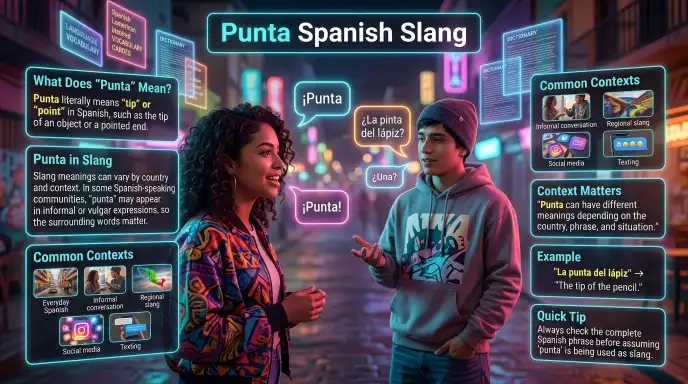
Punta Spanish slang usually refers to the Spanish word “punta,” which normally means “tip,” “point,” or “end.” On its own, punta is not usually a swear word or offensive slang. Its exact meaning depends on the sentence, phrase, and regional context.
People often search for “punta Spanish slang” after seeing the word in a text, song, video, social media post, or conversation. The confusion is understandable because Spanish has many regional expressions, and punta can appear in both ordinary Spanish and informal phrases.
It is also easy to confuse punta with the very different word puta, which can be vulgar. This guide explains the common meanings of punta, how Spanish speakers use it, if it is offensive, and how context changes its meaning. You will also see simple examples so you can recognize what someone means when you encounter punta online or in conversation.
Quick Answer: What Does Punta Spanish Slang Mean?
Punta usually means “tip,” “point,” or “end” in Spanish. It is normally a standard and neutral word, not a swear word. In some regional or informal expressions, however, its meaning can change, so the complete phrase matters.
What Does Punta Spanish Slang Mean?
The word punta is a standard Spanish noun. Its most common meanings relate to the pointed part, end, or extremity of something.
For example:
La punta del lápiz está rota.
This means:
The tip of the pencil is broken.
Here, punta has no slang meaning at all.
It can also refer to the end of a place or object:
Está en la otra punta de la ciudad.
This means:
It is at the other end of the city.
So, when someone asks about the punta Spanish, it is important to first understand that punta is not automatically slang.
Basic meanings of punta
Depending on context, punta can mean:
- Tip
- Point
- End
- Extremity
- Pointed part
- A small amount in certain expressions
The Royal Spanish Academy lists several standard uses of punta, including the pointed end of something and other context-based meanings.
Full Definition of Punta
Punta is a feminine Spanish noun, normally used with the article la.
Its most common English translations include “tip,” “point,” and “end.”
For example:
La punta de la flecha.
This means:
The tip of the arrow.
Another example is:
La punta de la mesa.
Depending on context, this can refer to the end, corner, or pointed part of a table.
The word can therefore describe physical objects, locations, and ideas expressed through common Spanish phrases.
Different Meanings of Punta
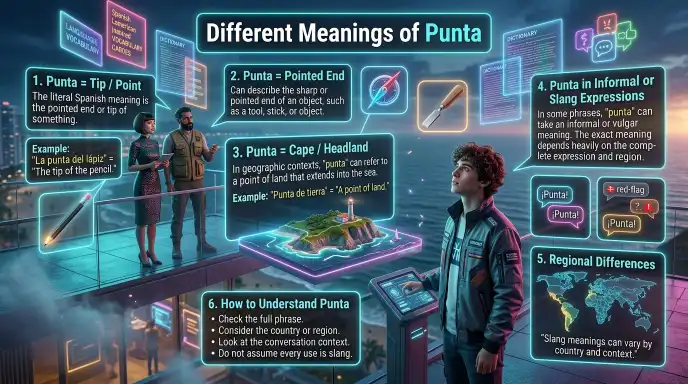
Punta has several meanings in Spanish. These meanings should be understood separately because the surrounding words determine which meaning is intended.
Punta Meaning “Tip”
This is one of the most common meanings.
It refers to the pointed or far end of an object.
For example:
La punta del cuchillo está afilada.
Meaning:
The tip of the knife is sharp.
You can also use it for the tip of a pencil, pen, arrow, stick, or similar object.
Punta Meaning “Point”
Punta can refer to the point of something.
For example:
La punta de la flecha.
Meaning:
The point of the arrow.
This is a normal Spanish usage and has nothing to do with internet slang.
Punta Meaning “End”
Punta can also describe an end or extremity.
For example:
Vivo en la otra punta de la ciudad.
Meaning:
I live at the other end of the city.
This meaning is especially useful when talking about distance or location.
Punta Meaning “Small Amount”
In some Spanish expressions, punta can refer to a small quantity of something.
For example:
Una punta de sal.
This can mean a small amount of salt.
The exact translation can vary depending on the sentence, but the basic idea is a small quantity.
Is Punta a Slang Word or a Regular Spanish Word?
Punta is primarily a regular Spanish word.
This is one of the most important points for learners. Search results may describe punta as “Spanish slang,” but the word itself is not limited to slang.
Spanish speakers use it in ordinary conversations about:
- Objects
- Places
- Clothing
- Food
- Directions
- Body parts
- Shapes
- Everyday situations
Some regional expressions may give punta a more informal meaning, but that does not change the standard meaning of the word.
Is Punta a Bad Word?
No. Punta is generally not a bad word.
If someone says:
La punta del lápiz.
They simply mean:
The tip of the pencil.
There is nothing rude or offensive about that sentence.
However, people sometimes confuse punta with puta. These are different Spanish words with different meanings.
Punta vs. Puta
| Word | Basic meaning | Tone |
| Punta | Tip, point, or end | Usually neutral |
| Puta | Vulgar term or insult | Vulgar/offensive |
The difference of one letter is important.
If you are learning Spanish, do not assume that punta is a softer version of puta. They are separate words.
Where Is Punta Commonly Used?

Punta is used across Spanish-speaking communities because it is part of standard Spanish vocabulary.
You may encounter it in:
- Spain
- Mexico
- Central America
- South America
- Caribbean Spanish
- Spanish-speaking communities in the United States
- Text messages
- Music
- Movies
- TikTok
- Online conversations
The basic meaning is widely understood, although certain expressions can have regional meanings.
This is why the country or community can matter when you are trying to understand a slang-related use.
Punta in Texting and Social Media
When you see punta in a text or social media post, do not immediately assume it is slang.
Read the whole sentence first.
For example:
Mira la punta del lápiz.
This clearly means:
Look at the tip of the pencil.
There is no hidden slang meaning.
On TikTok, Instagram, Snapchat, Reddit, or in a private message, punta can simply be normal Spanish vocabulary.
If it appears inside a regional expression, however, the meaning may be different.
How to understand it correctly
Ask yourself:
- What words appear before and after punta?
- Is the person talking about an object?
- Are they describing a place?
- Is it part of a common phrase?
- Does the speaker come from a particular Spanish-speaking region?
- Could the word have been misspelled?
Context is much more reliable than treating punta as one fixed slang definition.
Real-Life Examples of Punta
Talking About an Object
La punta del lápiz está rota.
English:
The pencil tip is broken.
Talking About a Knife
No toques la punta del cuchillo.
English:
Do not touch the tip of the knife.
Talking About Location
Mi casa está en la otra punta de la ciudad.
English:
My house is at the other end of the city.
Talking About Food
Pon una punta de sal.
English:
Add a small amount of salt.
Talking About a Body Part
Me duele la punta del dedo.
English:
The tip of my finger hurts
.
These examples show that the word is commonly used in ordinary Spanish and is not inherently offensive.
Origin and Background of Punta
Punta should not be described as a word that started on the internet or on social media.
It is an established Spanish word with standard dictionary meanings. The Royal Spanish Academy records punta as a Spanish noun with several meanings connected to a tip, point, extremity, and related uses.
That means claims such as “punta was invented as modern Spanish internet slang” would be misleading.
What can change is the use of punta inside particular expressions. Regional Spanish varieties may develop their own phrases, and informal speech can give familiar words additional meanings.
The safest approach is therefore to separate the standard meaning from any regional slang use rather than treating every occurrence as slang.
Punta Spanish Slang: Regional Context
Not every Spanish-speaking country uses informal words in exactly the same way.
A phrase that sounds normal in one country may sound unusual, old-fashioned, humorous, or different somewhere else.
This matters when researching punta Spanish slang because online sources sometimes present a regional meaning as if every Spanish speaker uses it.
That is not always accurate.
If someone tells you that punta has a particular slang meaning, check the country or region connected with that usage. Context and regional background can prevent a simple translation from becoming misleading.
How Is Punta Used in Common Spanish Expressions?
Punta appears in several established Spanish expressions. In these cases, translating the word by itself may not give the full meaning.
De Punta a Punta
“De punta a punta” means “from one end to the other.”
For example:
Caminamos de punta a punta por la ciudad.
This means:
We walked from one end of the city to the other.
The expression focuses on the two far ends of a place or area.
En la Punta de la Lengua
The phrase “en la punta de la lengua” is similar to the English expression “on the tip of my tongue.”
It describes something you almost remember or are about to say but cannot quite recall.
For example:
Tengo su nombre en la punta de la lengua.
Meaning:
I have his name on the tip of my tongue.
This is a normal idiomatic expression, not offensive slang.
A Punta de
“A punta de” can appear in expressions describing the use of something as a means or method.
Its exact English translation depends on the complete phrase, so it should not be translated by looking at punta alone.
This is another reason context matters when interpreting Spanish expressions.
Is Punta Used Differently in Different Spanish-Speaking Regions?
Yes. The basic meanings of punta are widely understood, but informal expressions can vary by region.
Spanish is spoken across many countries, and everyday vocabulary is not identical everywhere. A word may have a standard meaning while also appearing in regional phrases with a more specific tone.
For this reason, a slang website should not claim that one informal definition applies to every Spanish speaker.
If you saw punta in a particular song, video, or message, the country of the speaker can help identify the intended meaning.
Why regional context matters
Consider these factors:
- Country
- Local dialect
- Age of the speaker
- Social group
- The complete phrase
- Tone of the conversation
- If the speaker is being serious or humorous
A Spanish learner may recognize the dictionary meaning but still miss the intended meaning of a regional expression.
Is Punta Used on TikTok, Instagram, or Snapchat?
Yes. Spanish speakers can use punta on social media just as they use it in everyday speech.
However, seeing the word on TikTok or Instagram does not automatically make it internet slang.
For example:
La punta del zapato.
This is still ordinary Spanish even if it appears in a TikTok caption.
A social media platform can spread slang quickly, but it does not automatically turn every Spanish word into slang.
Punta in TikTok
On TikTok, the meaning depends heavily on the video and caption.
A fashion video may use punta when talking about the pointed front of a shoe. A travel video may use it when describing the end or edge of a location.
Punta in Instagram
Instagram captions can use punta in normal Spanish phrases, jokes, regional expressions, or song lyrics.
Punta in Snapchat and Texting
In private messages, punctuation and surrounding words may be limited, so context becomes even more important.
If someone sends only “punta,” you may need to ask what they mean rather than guessing.
Is Punta Used in Gaming or Online Chats?
Punta is not mainly a gaming slang term.
If you see it in a Spanish gaming chat, its meaning will usually come from the sentence rather than from gaming culture itself.
For example:
Mira la punta del mapa.
This could refer to the far edge or end of a game map.
Likewise, a Spanish-speaking player might use punta when talking about the tip or point of something in a game.
The word should not be treated like specialized gaming slang unless the particular community clearly gives it a special meaning.
Why Do People Search for Punta Spanish Slang?
People usually search for this phrase because they encountered punta somewhere and want to know if it has a hidden or informal meaning.
Common situations include:
- Hearing it in a Spanish song
- Seeing it in a TikTok video
- Reading it in a text message
- Finding it in a movie subtitle
- Seeing it in a social media comment
- Hearing a Spanish speaker use it
- Confusing it with another Spanish word
- Encountering a regional expression
The biggest source of confusion is often the difference between punta and puta.
Someone who is unfamiliar with Spanish may remember the sound but not the spelling. Searching for the word can then lead to very different definitions.
Common Misunderstandings About Punta
There are several mistakes people make when looking up this word.
Misunderstanding 1: Punta Is Always Slang
It is not.
Punta is a normal Spanish noun with common meanings such as “tip,” “point,” and “end.”
Misunderstanding 2: Punta Is a Swear Word
It is generally not.
A standard sentence containing punta is not automatically rude or offensive.
Misunderstanding 3: Punta Means the Same Thing Everywhere
Not necessarily.
Regional phrases can have meanings that are not obvious from a basic dictionary translation.
Misunderstanding 4: Punta and Puta Are the Same Word
They are not.
The spelling and meaning are different, and puta can be vulgar depending on context.
Misunderstanding 5: A Social Media Use Must Be Slang
Not necessarily.
Spanish speakers use ordinary vocabulary on social media every day. The platform does not determine the meaning by itself.
When Should You Avoid Using Punta?

You do not normally need to avoid the word punta.
It is a standard Spanish word and is safe in ordinary communication.
The main thing to avoid is using a regional or informal expression when you are not sure what it means.
This is especially useful when:
- Speaking to someone from a different Spanish-speaking country
- Writing for a professional audience
- Talking to someone you do not know well
- Translating content for a large audience
- Creating educational Spanish material
- Using a phrase you only learned from social media
If you know that punta is being used in its ordinary sense of “tip,” “point,” or “end,” there is generally no reason to avoid it.
Can You Use Punta at Work or School?
Yes, when you are using its standard meaning.
For example:
La punta del lápiz está dañada.
There is nothing inappropriate about this sentence in a classroom or workplace.
Similarly:
La punta de la mesa está rota.
is completely ordinary.
The only concern would be a particular informal phrase that has a regional or potentially rude meaning. In professional communication, it is better to use clear standard Spanish when you are unsure about a slang expression.
Punta vs. Similar Spanish Words
Understanding related words can make the meaning easier to recognize.
| Spanish word | Common English meaning | General tone |
| Punta | Tip, point, end | Neutral |
| Extremo | End, extreme, outer part | Neutral |
| Pico | Peak, beak, point | Neutral; context varies |
| Borde | Edge | Neutral |
| Esquina | Corner | Neutral |
| Puta | Vulgar insult/term | Offensive in many contexts |
These words are not interchangeable in every sentence.
For example, punta del lápiz means “tip of the pencil,” while borde del papel means “edge of the paper.”
Is Punta Rude or Offensive in Spanish?
In its normal meaning, punta is neutral.
It does not carry the offensive tone associated with Spanish swear words simply because it can appear in informal speech.
However, a complete phrase can sometimes have a different tone. This is common in many languages. A neutral word can become part of a joking, rude, sarcastic, or regional expression.
That is why the safest way to judge the tone is to look at the whole sentence.
A simple rule
If punta refers to a physical tip, point, end, or small amount, it is usually neutral.
If it appears in an unusual phrase, check the phrase rather than assuming the individual word is offensive.
How to Pronounce Punta
Punta is commonly pronounced approximately like:
“POON-tah”
The first vowel is similar to the “oo” sound in “food,” although English speakers may not reproduce the Spanish sound perfectly.
The Spanish “u” is important because punta and puta are spelled differently but can sound quite similar to an inexperienced listener.
Learning the spelling is therefore useful if you want to understand Spanish accurately.
Punta Spanish Slang and Cultural Context
It is important not to treat all Spanish slang as one single variety of language.
Spanish-speaking communities have their own expressions, humor, pronunciation patterns, and informal vocabulary.
A word that appears in a Mexican conversation may not carry exactly the same informal sense in Argentina, Spain, Puerto Rico, Colombia, or another Spanish-speaking community.
Punta is a good example of why context should come before a quick slang translation. The standard word is widely understood, but its phrase-level uses can depend on region.
For learners, this approach is more useful than memorizing one slang definition and applying it everywhere.
How to Tell What Punta Means in a Message
If someone sends you a message containing punta, follow these steps:
Look at the Complete Sentence
Do not translate only the individual word.
Identify the Topic
Is the person talking about an object, place, food, clothing, body part, or something else?
Check the Region
If you know the speaker’s country, use that information to understand possible regional expressions.
Look for Other Words
Words before and after punta often reveal the intended meaning.
Consider the Tone
A joke, song lyric, insult, or casual conversation may use language differently from a textbook sentence.
This method works better than assuming that every unfamiliar Spanish word is slang.
Polite Alternatives to Punta
Because punta is already a neutral word in standard Spanish, you normally do not need a polite replacement.
If you want to make the meaning especially clear, you can use a more specific word depending on the situation.
For example:
- punta = tip or point
- extremo = end or extremity
- borde = edge
- esquina = corner
- final = end or final part
The correct choice depends on what you are describing.
Why Context Matters Most
The phrase “punta Spanish slang” can make the word sound more mysterious than it really is.
In most everyday Spanish, punta is a normal word meaning “tip,” “point,” “end,” or a related idea. It is not automatically vulgar, offensive, or internet slang.
Its meaning can change when it appears in an idiom or regional expression. That is why the complete sentence, speaker, and country can matter.
If you encountered punta in a specific message, song, TikTok, or conversation, the surrounding words are usually the best clue to its intended meaning.
Frequently Asked Questions About Punta Spanish Slang
Q1. What does punta mean in Spanish slang?
Punta is not automatically slang. In standard Spanish, it commonly means “tip,” “point,” or “end.” Informal or regional expressions can give it a more specific meaning, so the full sentence matters.
Q2. Is punta a bad word in Spanish?
No. Punta is normally a neutral Spanish word. It can appear in ordinary conversations about objects, places, or physical points. A particular phrase may have a different tone, but the word itself is not generally a swear word.
Q3. What does punta mean in texting?
In texting, punta usually keeps its normal Spanish meaning unless it appears in a regional expression or informal phrase. The surrounding words are important because a single word may not provide enough context.
Q4. Is punta the same as puta?
No. Punta and puta are different Spanish words with different meanings. They are easy for some learners to confuse because their spelling and pronunciation are similar, but they should not be treated as interchangeable.
Q5. Can I use punta in a professional conversation?
Yes, when you are using its standard meaning. For example, referring to the tip of a pencil or the point of an object is completely normal in school or professional settings. Be more careful with unfamiliar regional expressions.
Q6. Is punta used on TikTok and Instagram?
Yes. Spanish speakers may use punta on TikTok, Instagram, and other platforms, but that does not make the word internet slang. Its meaning still depends on the sentence, topic, and context.
Q7. Does punta have different meanings in different Spanish-speaking countries?
The standard meanings are widely understood, but some expressions can vary by region. If you are interpreting an informal phrase, the speaker’s country and the complete expression can help you identify the intended meaning.
Q8. What is the safest way to understand punta Spanish slang?
Look at the complete sentence instead of translating punta alone. Check the surrounding words, topic, tone, and regional context. This helps you avoid confusing a normal Spanish word with slang or an entirely different word.
Conclusion: What Does Punta Spanish Slang Really Mean?
Punta is primarily a standard Spanish word, not a swear word or a slang term by default. Its common meanings include “tip,” “point,” and “end,” depending on what is being described.
The confusion usually starts when punta appears in an informal phrase, regional expression, song, or social media post. In those situations, translating the word alone may not be enough.
Remember these key points:
- Punta is generally neutral.
- It commonly refers to a tip, point, or end.
- It can appear in idiomatic and regional expressions.
- It is not the same word as puta.
- Social media use does not automatically make it slang.
- Context is the best way to identify the intended meaning.
- Standard uses are normally appropriate at school and work.
If you are learning Spanish, focus on the whole expression rather than memorizing one isolated translation. That will give you a much more accurate understanding of how punta is actually used.