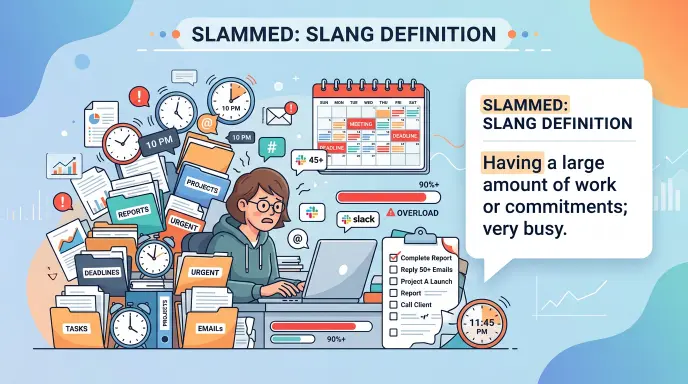
Slammed meaning slang usually describes someone who is extremely busy, overwhelmed, or dealing with a lot at once. People use “slammed” to mean different things. It can describe harsh criticism, heavy drinking, or a strong physical hit, depending on the context.
Many people search for slammed meaning slang after seeing it in text messages, social media posts, workplace chats, or conversations.
The phrase appears on platforms like TikTok, Instagram, Reddit, Discord, and even in everyday office conversations. Because it has more than one meaning, it can sometimes be confusing.
In this guide, you’ll learn what slammed meaning slang means, where people use it, if it’s rude, its origin, real life examples, and when you should avoid using it. By the end, you’ll know exactly how to understand and use the term in different situations.
Quick Answer: Slammed Meaning Slang
Slammed meaning slang most commonly means very busy or overloaded with work, school, or responsibilities.For example, when someone says, “I’m slammed today,” they mean they are very busy and have a lot to do.
However, “slammed” also has other slang meanings, including:
- Extremely busy
- Strongly criticized
- Very drunk (less common)
- Hit or affected hard by something
The correct meaning always depends on the conversation.
What Does Slammed Mean in Slang?
In modern slang, people use “slammed” to describe something that happens with a lot of force or intensity.Instead of its literal meaning of hitting something hard, it often describes situations that feel overwhelming or extreme.
The most common use of “slammed” is when people say they have too much work or too many responsibilities.
Example
“Sorry, I can’t play tonight. “I’m slammed with homework” means I have too much homework to do.
Here, the speaker means they are very busy, not physically hurt.They simply have too much work to finish.
You’ll hear this meaning among:
- Students
- Office workers
- Freelancers
- Parents
- Business owners
- College professors
- Anyone with a busy schedule
Because this meaning is so common, many people use “slammed” every day without thinking of it as slang.
Does “Slammed” Have a Full Form?
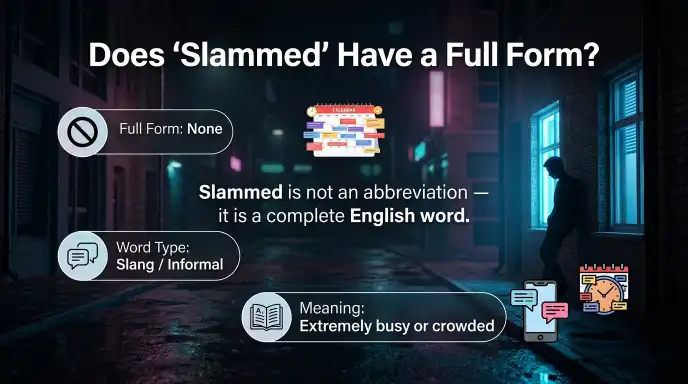
No.
Slammed is not an abbreviation or acronym. It does not stand for anything.
Instead, it comes from the regular English verb “slam,” which means to hit something forcefully or shut something with force.
Over time, English speakers began using it figuratively to describe situations that feel intense or overwhelming.
For example:
- slammed with work
- slammed by criticism
- slammed by bad weather
These uses eventually became common in everyday speech and online conversations.
Different Meanings of Slammed in Slang
One reason people search for slammed meaning slang is that it can mean different things in different situations.
The table below shows the most common meanings.
| Meaning | Tone | Example |
| Very busy | Neutral | “I’m slammed at work today.” |
| Strongly criticized | Negative | “The movie got slammed by reviewers.” |
| Very drunk | Informal | “He was completely slammed after the party.” |
| Hit hard by something | Neutral/Negative | “The town was slammed by heavy rain.” |
The surrounding words usually make the meaning obvious.
1. Slammed = Extremely Busy (Most Common)
This is by far the most popular meaning.
People use it when they have:
- Too much homework
- Too many meetings
- A packed schedule
- Tight deadlines
- Lots of responsibilities
Examples
- “I’ve been slammed all week” means I have been very busy all week.
- “We’re slammed with customer orders.”
- “She’s slammed preparing for exams.”
This meaning is common in workplaces, schools, and everyday conversation.
2. Slammed = Strongly Criticized
“Slammed” can also mean someone received harsh criticism.
You’ll often see this in:
- News headlines
- Entertainment articles
- Sports coverage
- Political discussions
Examples
- Fans slammed the actor online after his controversial statement.
- Customers slammed the company for its poor service.
- Gamers slammed the new update because it had many bugs.
In these cases, people use the word to describe strong criticism, not physical harm.
3. Slammed = Very Drunk
In some English-speaking regions, people use “slammed” to mean someone is very drunk after drinking alcohol.
Examples
- “The party left him completely drunk.”
- “Everyone became completely drunk by midnight.”
This meaning is much less common than “very busy” and usually appears in casual conversations among friends.
4. Slammed = Hit Hard
Sometimes people use the word when someone or something receives a powerful hit.
Examples include:
- The hurricane slammed Florida.
- Heavy traffic slammed the website.
- Many messages flooded my inbox this morning.
Here, the word emphasizes intensity rather than physical impact.
Where Is “Slammed” Commonly Used?
Slammed is a flexible slang term that appears in both casual and professional conversations. Although it started as a regular English word, its figurative meanings are now common in everyday speech.
Here are the places where you’re most likely to see it.
| Platform or Situation | Common Meaning | Example |
| Text messages | Very busy | “Can’t talk. I’m slammed.” |
| Workplace chat | Busy with work | “We’re slammed this afternoon.” |
| TikTok | Busy or heavily criticized | “The comments slammed her video.” |
| Busy life or criticism | “I’ve been slammed all week.” | |
| Depends on the discussion | “The game got slammed in reviews.” | |
| Discord | Busy or overwhelmed | “Sorry, I’m slammed with assignments.” |
| Gaming communities | Busy or heavily attacked (context matters) | “Our team got slammed.” |
| News headlines | Strong criticism | “The policy was slammed by experts.” |
In Text Messages
When people text “I’m slammed,” they usually mean they are too busy to chat.
Examples
Friend: “Want to hang out later?”
You: “Maybe tomorrow. I’m slammed today.”
Coworker: “Can you join another meeting?”
You: “Not today. I’m handling a lot of work until this evening.
This is one of the most common uses you’ll encounter.
On TikTok and Instagram
On social media, slammed often has two meanings:
- Extremely busy
- Receiving heavy criticism
For example:
- My viral video caused my business to receive a huge number of orders
- .People heavily criticized the influencer in the comments.
When reading posts, pay attention to the surrounding words because they help you understand the intended meaning.
On Reddit and Discord
Communities on Reddit and Discord use slammed naturally in discussions.
Examples include:
- “The servers got slammed after the update.”
- “I’m slammed with college work.”
- “The latest patch got slammed by players.”
Because these platforms cover many topics, context is especially important.
At Work
“Slammed” is surprisingly common in offices, restaurants, hospitals, customer service, and retail.
You might hear:
- “We’re slammed today.”
- “Customer support is slammed.”
- “The kitchen is slammed tonight.”
In these settings, it simply means everyone is extremely busy.
Although it’s informal, many workplaces accept it in everyday conversation.
Is “Slammed” Rude, Offensive, or Harmless?
Generally, “slammed” is harmless. It is not considered a swear word or offensive slang.
However, its tone changes depending on how it’s used.
| Meaning | Offensive? | Appropriate? |
| Very busy | No | Yes |
| Strongly criticized | No | Yes |
| Hit hard | No | Yes |
| Very drunk | Slightly informal | Best among friends |
Most of the time, you can safely use “slammed” when talking about being busy.
For example:
✅ “I’m slammed with work.”
This sounds natural and polite.
But saying someone was “slammed” by criticism can sound stronger because it emphasizes how harsh the criticism was.
Can You Use “Slammed” at Work?
Yes in most cases.
If you’re describing your workload, it sounds natural.
Examples:
- “I’ve been slammed since this morning.”
- “We’re slammed with customer requests.”
- “The support team is slammed today.”
Many managers and coworkers use the expression regularly.
However, avoid using it in highly formal writing, such as:
- Legal documents
- Academic papers
- Official government reports
Instead, choose phrases like:
- Extremely busy
- Overloaded
- Working at full capacity
- Managing a heavy workload
Can You Use It With Teachers or Parents?
Usually, yes.
For example:
“Sorry I haven’t replied. I’ve been slammed with homework.”
This sounds respectful and easy to understand.
Parents and teachers are likely to recognize the phrase because it has been common in everyday English for many years.
Does “Slammed” Sound Aggressive?
Sometimes.
Because the original meaning of slam involves force, the slang can make situations sound more intense.
Compare these examples:
- “I’m busy.”
- “I’m slammed.”
The second sentence makes it clear the person feels overwhelmed.
Likewise:
- “The movie received criticism.”
- “The movie got slammed.”
The second sentence suggests the criticism was much harsher.
Real Life Examples of “Slammed” in Slang
Seeing the phrase in real conversations makes it easier to understand.
Example 1: School
Emma: “Are you coming to the football game?”
Jake: “Not tonight. I’m slammed with assignments.”
Example 2: Workplace
Manager: “Can you help another department?”
Employee: “I’d love to, but we’re handling a lot of work today.”
Example 3: Text Message
Friend: “Why didn’t you answer?”
You: “Sorry! I’ve been handling a lot of work all day.
Example 4: TikTok
My small business has received a huge number of orders since my video went viral.
Here, slammed is actually good news because it means demand is very high.
Example 5: Reddit
Players heavily criticized the new update.
This means players strongly criticized the update.
Example 6: Gaming
Player 1: “How did the match go?”
Player 2: The other team defeated us badly.
Here, people use it to mean that the team lost badly or the opponent defeated them easily.
Example 7: Restaurant
Server: “Sorry your food took longer.”
Customer: “No worries.”
The server says, “We have been extremely busy since lunch.”
This is extremely common in restaurants.
Example 8: Family Conversation
Mom: “Can you clean your room today?”
Teen: “After dinner. I’ve been slammed with studying.”
This meaning simply shows the speaker has a full schedule.
- Why people use it
- Similar slang and related expressions
- Common misunderstandings
- When you should avoid using it
Origin and History of “Slammed”
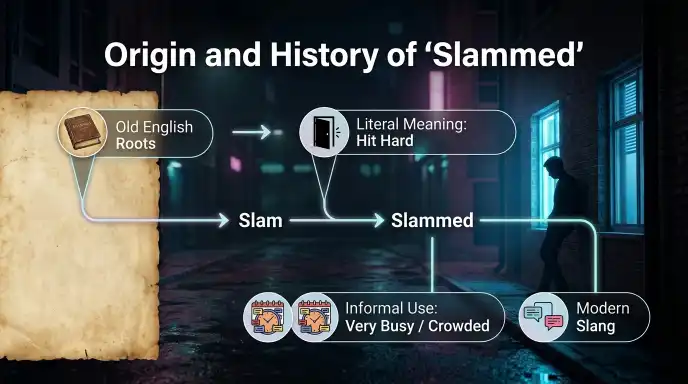
The slang “slammed” comes from the standard English verb “slam,” which means to hit something with force or to shut something hard. Over time, English speakers began using the word figuratively to describe situations that felt intense, sudden, or overwhelming.
Unlike many modern internet slang terms, “slammed” did not originate on TikTok, Discord, or Snapchat. It has been part of spoken English for decades and later became common on social media and in online conversations.
How Its Meaning Changed
The word developed several figurative meanings over time:
- Literal meaning: To hit or shut something forcefully.
- Figurative meaning: To experience something with great intensity.
- Modern slang: To be extremely busy, heavily criticized, badly defeated, or, in some contexts, very drunk.
Because these meanings evolved naturally, people now understand them through context rather than the original physical action.
Why Do People Use “Slammed”?
People use “slammed” because it is short, expressive, and paints a clear picture.Active voice version:
People use “slammed” to sound stronger than simply saying they are “busy.”
Ya zyada natural version:
People use the word “slammed” when they want to show that they are much busier than the simple word “busy” suggests.
For example:
- Busy “I have a lot to do.”
- I use “slammed” when I have so much work to do that I feel overwhelmed.
This stronger wording helps listeners quickly understand the situation.
People also use it because it:
- Sounds natural in everyday conversation.
- Adds emphasis without using rude language.
- Works in many situations.
- People of different age groups commonly understand and use it.
Similar Slang and Related Expressions
If you don’t want to repeat “slammed,” several other informal expressions have a similar meaning.
| Expression | Meaning | Example |
| Swamped | Extremely busy | “I’m swamped with work.” |
| Buried | Overloaded with tasks | “I’m buried in paperwork.” |
| Snowed under | Too much work | “She’s snowed under today.” |
| Packed | Having a full schedule | “My day is packed.” |
| Overloaded | Too many responsibilities | “I’m overloaded this week.” |
| Busy | General workload | “I’m busy right now.” |
| Tied up | Unable to do something because you’re occupied | “I’m tied up until noon.” |
Which One Is Most Similar?
Many people use “swamped” as the closest synonym for this meaning.
Compare these sentences:
- I’m handling a lot of work today.
- “I’m swamped today.”
Both mean the speaker has far too much work to do.
“Slammed” vs. “Busy”
Many learners wonder if these words mean exactly the same thing.
Not quite.
| Busy | Slammed |
| General workload | Extremely heavy workload |
| Neutral | Strong emphasis |
| Can describe any schedule | Suggests feeling overwhelmed |
| Mild expression | More dramatic expression |
For example:
Busy
“I’m busy this afternoon.”
This simply means you have plans.
slammed
This suggests your schedule is completely full, leaving little or no free time.
“Slammed” vs. “Swamped”
These two expressions are very close in meaning.
| Slammed | Swamped |
| Very common in American English | Also very common |
| Sounds energetic and intense | Sounds slightly softer |
| Often used at work | Also used at work |
| Can have several meanings | Usually means very busy |
In most conversations, you can use either one naturally.
Common Misunderstandings About “Slammed”
Because “slammed” has multiple meanings, people sometimes misunderstand it. Here are some common mistakes.
Mistake 1: Thinking It Always Means “Busy”
While being very busy is the most common meaning, it can also mean:
- Strongly criticized
- Hit hard
- Badly defeated
- Very drunk (in some informal settings)
Always read or listen to the surrounding context.
Mistake 2: Assuming It Is Always Negative
Not always.
Consider these examples:
Many customers flooded our store.
This could actually be positive because the business is attracting many customers.
Another example:
People flooded my video with likes.
Although less common, this means the video received a huge number of likes.
The word itself doesn’t always describe something bad it mainly emphasizes intensity.
Mistake 3: Believing It’s Only Internet Slang
Many people first encounter “slammed” online, but it isn’t exclusive to the internet.
You’ll hear it in:
- Restaurants
- Offices
- Schools
- Television interviews
- News reports
- Everyday conversations
It has been part of spoken English long before social media became popular.
Mistake 4: Confusing It With Physical Violence
Someone saying:
“I’m slammed.”
People do not use it to say that someone physically attacked them.
Most of the time, people use it to say that they have too much work or too many responsibilities.
When Should You Avoid Using “Slammed”?
Although “slammed” is common and generally harmless, there are situations where another word may be a better choice.
1. Formal Writing

Avoid it in:
- Academic essays
- Legal documents
- Research papers
- Official reports
Use clearer alternatives such as:
- Extremely busy
- Overloaded
- At full capacity
- Managing a heavy workload
2. International Communication
Not everyone is familiar with English slang.
If you’re writing to someone whose first language isn’t English, simpler words like busy or very busy may prevent confusion.
3. Sensitive Situations
When discussing serious events, choose your wording carefully.
For example:
Instead of:
“The hospital was slammed.”
You could say:
“The hospital experienced an unusually high number of patients.”
This sounds more precise and professional.
4. Professional Presentations
If you’re giving a presentation or writing for a formal audience, avoid slang unless you’re quoting someone directly.
Professional alternatives include:
- Heavy workload
- High demand
- Significant pressure
- Increased activity
These phrases sound more polished in business and academic settings.
- Polite alternatives
- Platform specific usage (TikTok, Snapchat, Discord, Reddit, gaming)
Polite Alternatives to “Slammed”
If you think “slammed” sounds too informal, you can use a more neutral or professional expression. The best choice depends on who you’re talking to.
| Instead of “I’m slammed” | Better for | Example |
| I’m very busy | Everyday conversations | “I’m very busy this afternoon.” |
| I have a full schedule | Work and school | “I have a full schedule today.” |
| I’m handling a heavy workload | Professional settings | “I’m handling a heavy workload this week.” |
| I’m occupied right now | Formal conversations | “I’m occupied right now but will reply later.” |
| I’m at full capacity | Business communication | “Our team is at full capacity today.” |
| I have a lot on my plate | Casual workplace | “I have a lot on my plate this week.” |
These alternatives communicate the same idea while matching different levels of formality.
Platform Specific Usage of “Slammed”
The meaning of “slammed” can change slightly depending on where you see it.People use it in different ways across various platforms.
On TikTok
On TikTok, “slammed” often describes:
- Going viral with lots of attention.
- Receiving a large number of orders.
- Commenters heavily criticize someone in the comments.
Examples
- One video slammed my shop with orders.
- People slammed the creator for that opinion.
Context tells you if the attention is positive or negative.
On Instagram
Instagram users often use “slammed” in captions and Stories to describe a busy lifestyle or a flood of engagement.
Examples
- “Been slammed with work this week.”
- “Our inbox is slammed after the launch.”
It’s a common way to explain delayed replies or a packed schedule.
On Reddit
Because Reddit covers many topics, the meaning varies by community.
Examples include:
- Critics slammed the movie.
- My teachers have slammed me with assignments.
- Heavy traffic slammed the website.
Read the surrounding comments to understand which meaning is intended.
On Discord
In Discord servers, especially gaming and study groups, “slammed” usually means:
- Extremely busy.
- Overwhelmed with tasks.
- Losing badly in a game.
Examples
- “Sorry, I’m slammed with exams.”
- “Our squad got slammed in ranked.”
In Gaming
Gamers sometimes use “slammed” to describe a one sided defeat.
For example:
- “We got slammed 10:1.”
- “The boss slammed our whole team.”
Here, it means being defeated easily or taking heavy damage.
In Text Messages
This is one of the simplest and most common uses.
Friend: “Can you call?”
Reply: “Not right now. I’m slammed.”
Most people immediately understand this as “I’m very busy.”
Can “Slammed” Have a Positive Meaning?
Yes. Although it often describes pressure or criticism, it can also refer to high demand or success.
Positive Examples
- “The bakery was slammed with customers all morning.”
- “Our online store got slammed with orders.”
- “She was slammed with interview requests after her award.”
In these cases, the speaker is busy because something is going well.
Frequently Asked Questions
Q1:What does “slammed” mean in slang?
The most common slang meaning of “slammed” is being extremely busy or overwhelmed with work, school, or responsibilities. Depending on the context, it can also mean heavily criticized, badly defeated, or very drunk
Q2:Does “slammed” always mean busy?
No. While “very busy” is the most common meaning, it can also describe receiving harsh criticism, experiencing something intense, or losing badly in sports or games.
Q3:Is “slammed” a bad word?
No. “Slammed” is not considered a swear word or offensive language. It is generally safe to use in casual conversations.
Q4:Can I use “slammed” at work?
Yes. Many professionals say things like:
- “I’m slammed today.”
- “We’ve been slammed with customer requests.”
However, for formal reports or official documents, phrases like “handling a heavy workload” or “working at full capacity” are usually more appropriate.
Q5:Is “slammed” internet slang?
Not entirely. The word existed long before the internet, but its figurative meanings have become even more popular through texting, social media, online gaming, and workplace chats.
Q6:Can “slammed” mean drunk?
Yes, in some informal conversations, “slammed” can mean very drunk. However, this meaning is less common today than using it to describe being extremely busy.
Q7:Is “slammed” suitable for children and teenagers?
Yes. The phrase itself is not inappropriate, though adults should always consider the surrounding context since the word has multiple meanings.
Conclusion:
The slammed meaning slang is most commonly being extremely busy or overwhelmed, but the word can also describe strong criticism, a heavy defeaPeople most commonly use “slammed” in slang to describe someone who is extremely busy or overwhelmed.
People use “slammed” in many everyday situations. You’ll hear it in workplaces, schools, restaurants, text messages, social media, gaming communities, and even news reports because most people understand its meaning.
It’s generally a harmless and useful expression, but it’s best to avoid it in highly formal writing where clearer, more professional alternatives work better.
If you’re ever unsure what someone means by “slammed,” look at the surrounding words and the situation. In most cases, context makes the intended meaning clear.

I’m Emily Carter, and I enjoy writing about slang, internet language, and modern English expressions. My goal is to explain word meanings in a simple, clear, and easy-to-understand way so anyone can learn with confidence.