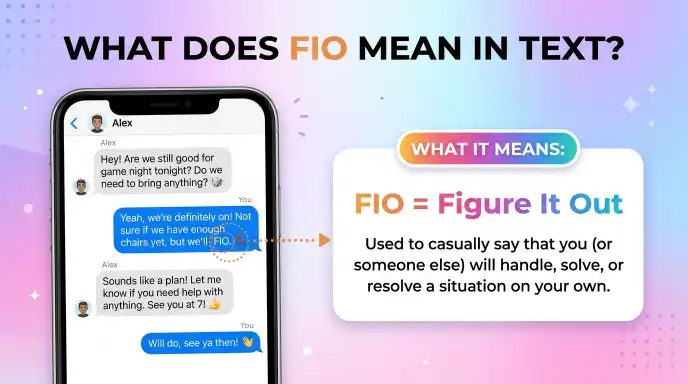
FIO usually means “Figure It Out” in text, telling someone to solve something themselves. In work messages, it can also mean “For Information Only.”
Depending on the tone, it can sound playful, direct, impatient, or slightly rude. You might see FIO in WhatsApp messages, Snapchat chats, TikTok comments, Instagram DMs, or regular text messages.
It is a short way to tell someone to work something out without giving them the answer. For example, if someone asks where to find a setting and receives “FIO,” the sender may be saying, “Figure it out yourself.”
However, FIO can have other meanings in different situations. In business messages, it may stand for “For Information Only.” The surrounding conversation helps you understand which meaning makes sense.
FIO Meaning in Text
FIO usually stands for “Figure It Out” in casual texting. It is an abbreviation made from the first letters of the phrase.
People use it when they want someone to solve a problem, understand something, or find an answer without further help.
For example:
“I already explained it twice. FIO.”
This means:
“I already explained it twice. Figure it out.”
The sender may be frustrated because they do not want to explain the same thing again. In a friendly conversation, though, it might simply be a teasing response.
FIO is not as universally recognized as common abbreviations such as IDK or BRB. Some people may understand it immediately, while others may need to ask what it means.
1. FIO Means “Figure It Out”
The most common texting interpretation is “Figure It Out.” It tells someone to use their own understanding or effort to solve a question or problem.
Consider this example:
A: How do I change my profile picture?
B: FIO, it’s pretty easy.
Here, B is telling A to work out how to change the picture.
The phrase can communicate different attitudes depending on the situation:
- Helpful: The sender believes the other person can solve the problem independently.
- Playful: Friends may use it jokingly when someone asks an easy question.
- Impatient: The sender may be tired of explaining something.
- Dismissive: The sender does not want to provide further assistance.
The words themselves are short, but the tone can change their meaning. A friendly conversation may make FIO sound harmless, while an argument can make it feel disrespectful.
2. FIO Can Mean “For Information Only”
In workplace communication, documents, emails, and business messages, FIO can also stand for “For Information Only.”
This meaning is different from the texting phrase.
When someone shares a document or update marked FIO, they are usually providing information for the recipient to read. They may not be asking the recipient to take action or respond.
For example:
“Please see the attached report. FIO.”
This means the report is being shared for information only.
You may encounter this meaning in:
- Business emails.
- Internal company updates.
- Reports and documents.
- Administrative communication.
- Professional messages.
Context makes the difference. If someone sends FIO after you ask for help with a problem, “Figure It Out” may fit. If it appears beside an attachment or business report, “For Information Only” is more likely.
3. Is FIO a Slang Word or an Abbreviation?
FIO is better described as an abbreviation or initialism than a traditional slang word.
An abbreviation shortens a longer phrase. An initialism uses the first letters of several words, with each letter pronounced separately.
FIO follows this pattern:
- F : Figure
- I : It
- O : Out
In casual online conversations, people may use it as texting shorthand. That is why it sometimes appears in slang dictionaries and abbreviation collections.
However, it is not a universally understood expression. Do not assume every person will recognize it.
4. How Does FIO Sound in a Conversation?
The tone depends on the relationship between the people chatting and the situation.
For example:
A: I can’t understand this question. Can you help?
B: FIO 😂
A: You’re no help!
Here, the sender may be joking with a friend.
Now consider another situation:
A: I’ve asked you three times. What should I do?
B: FIO. I’m not explaining again.
In this conversation, FIO sounds impatient because the sender does not want to continue helping.
The phrase is not automatically offensive, but it can sound harsh when someone genuinely needs help.
Where People Use FIO
FIO can appear on different social media and messaging platforms. Its meaning does not automatically change from one app to another.
The context, message, and relationship between the users matter more than the platform itself.
FIO on TikTok
TikTok users communicate through comments, captions, direct messages, and video replies. Someone may use FIO when another person asks a question that they believe is easy to answer.
Example:
Comment: “How did you make this video edit?”
Reply: “FIO, just explore the editing options 😂”
Meaning: The reply tells the person to work out the editing process themselves.
Depending on the conversation, the response may be playful or dismissive. A creator who wants to be helpful might instead explain the editing steps.
FIO does not have one official TikTok-specific definition. If you see it in a comment, read the surrounding discussion before deciding what the sender means.
FIO on Snapchat
Snapchat messages are often short and informal. Friends may use abbreviations when chatting quickly or teasing each other.
Example:
A: What’s the Wi-Fi password?
B: FIO 😂
A: You’re so helpful!
Meaning: B is jokingly telling A to figure out the password.
The same message could sound less friendly if the two people are arguing. A short reply can sometimes feel cold because it provides no explanation.
FIO on Instagram
Instagram users may use FIO in direct messages, comments, or replies to Stories.
For example:
“You can find the answer in the caption. FIO.”
The sender is telling the other person to look at the caption and work out the answer.
It may also appear in conversations about social media settings, photos, online shopping, or everyday questions.
If the message appears beside a shared file or professional update, consider if “For Information Only” makes more sense.
FIO on WhatsApp
WhatsApp is commonly used for personal conversations, family groups, and work chats. FIO may appear when someone wants another person to solve something independently.
Example:
A: I forgot how to download the document.
B: FIO, you did it yesterday.
A: Okay, I’ll try again.
Meaning: B is telling A to remember the steps and work it out.
In a work group, however, someone might write FIO when sharing a report.
Example:
“Sharing the updated schedule here. FIO.”
In that situation, the sender may mean “For Information Only.”
FIO in SMS Text Messages
FIO can also appear in ordinary SMS conversations. Because text messages are often brief, the sender may use the abbreviation instead of writing the complete phrase.
Example:
A: Can you tell me how to reset my phone?
B: FIO
A: Do you mean I should figure it out myself?
Meaning: B is telling A to find the solution independently.
If the message feels confusing or unusually blunt, ask the sender what they mean. It is better to clarify than to assume they are being rude.
Real Chat Examples: How FIO Is Used
These examples show how FIO may appear in everyday conversations. The meaning is based on the situation, and the tone can range from playful to impatient.
Example 1: Asking for Help
A: How do I change my username?
B: FIO, it’s not difficult.
A: I was just asking for help!
Meaning: B is telling A to figure it out independently. The response may sound a little dismissive.
Example 2: A School Assignment
A: Can you give me the answer to question five?
B: FIO 😂
A: Fine, I’ll try myself.
Meaning: B wants A to solve the question without giving away the answer. The laughing emoji makes the reply seem more playful.
Example 3: A Phone Setting
A: Where can I find dark mode?
B: Check your display settings and FIO.
A: Okay, found it!
Meaning: B is encouraging A to explore the settings and work out where the option is.
Example 4: Friends Making Plans
A: What should we do after dinner?
B: FIO, surprise me.
A: How about watching a movie?
Meaning: B wants A to come up with an idea independently.
Example 5: A Frustrated Conversation
A: I’ve tried everything, but it still isn’t working.
B: FIO. I can’t keep explaining it.
A: Okay, I’ll look for another solution.
Meaning: B sounds impatient and unwilling to provide more help.
Example 6: A Social Media Question
A: How did you add that effect to your photo?
B: FIO, explore the app.
A: I’ll have a look.
Meaning: B is telling A to discover how the effect works by exploring the app.
Example 7: A Friendly Challenge
A: Guess where we’re going tomorrow.
B: FIO! I’m not giving you any hints.
A: That’s not fair 😂
Meaning: B is asking A to work out the answer without help. The playful context makes the abbreviation sound friendly.
Example 8: A Work-Related Message
A: Why did you send me this report?
B: It’s the latest version. FIO.
A: Thanks, I’ll review it.
Meaning: Here, FIO may mean “For Information Only.” The sender is sharing the report as an update, not necessarily asking for an action.
Example 9: A Group Chat
A: Who knows the answer to this puzzle?
B: FIO, you’ve got this!
A: Okay, let me think.
Meaning: B is encouraging A to figure out the puzzle independently.
Example 10: Asking About a Website
A: How can I find the contact page?
B: It’s in the menu. FIO.
A: Got it, thanks!
Meaning: B is telling A to look through the website menu and find the page.
One important detail: FIO does not always express anger. Sometimes it is a quick challenge or joke between friends. The relationship and tone help explain the intention.
How to Reply When Someone Says FIO
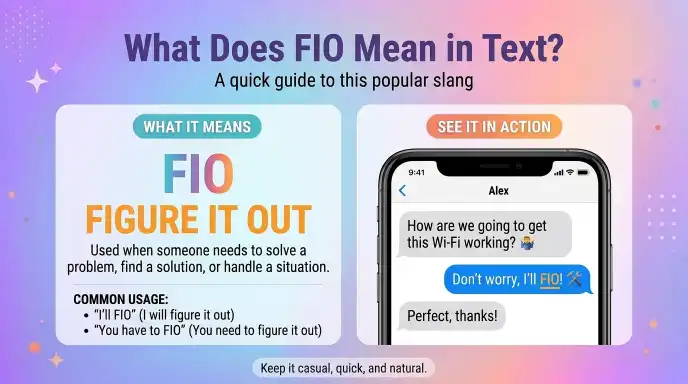
Your reply depends on how the sender uses the abbreviation. If they are joking, you can respond playfully. If they sound impatient, a calm answer may work better.
Here are some natural replies for different situations.
Funny Replies
Use these when you are chatting with a friend who enjoys jokes.
- “Wow, thanks for all that help 😂”
- “My personal assistant has left the chat!”
- “I’ll figure it out, genius!”
- “A little hint wouldn’t hurt!”
- “You’re making me work too hard!”
These responses keep the mood light without turning the conversation into an argument.
Casual Replies
If you want to keep things simple, try:
- “Okay, I’ll try.”
- “Got it.”
- “Let me work it out.”
- “I’ll have a look.”
- “No problem.”
These replies are useful when the sender is simply encouraging you to solve something yourself.
Friendly Replies
If you want to keep the conversation warm, you can say:
- “I’ll give it another try, thanks!”
- “Okay, I think I can work it out.”
- “A small hint would still be helpful.”
- “I’ll try first and ask if I get stuck.”
- “Thanks, I’ll figure it out.”
A friendly response shows that you understand the message without sounding annoyed.
Neutral Replies
Sometimes you may not understand what FIO means. In that case, ask directly.
- “What does FIO mean?”
- “Do you mean figure it out?”
- “Are you telling me to solve it myself?”
- “Does FIO mean for information only here?”
A simple clarification can prevent a misunderstanding. This is especially useful when the abbreviation appears in a work message or a conversation with someone you do not know well.
Is FIO Rude or Offensive?
FIO is not automatically rude or offensive, but “Figure It Out” can sound dismissive. The sender may simply be encouraging you to solve something independently, or they may be expressing frustration.
The tone matters more than the three letters.
When FIO Is Harmless
FIO can be harmless when friends use it as a joke or a friendly challenge.
For example:
“FIO 😂 I know you can solve this!”
The sender is encouraging the other person to try. The laughing emoji and friendly relationship make the message less serious.
It can also be neutral when used as “For Information Only” in a professional update.
When FIO May Sound Rude
The phrase may feel rude when someone uses it instead of offering help to a person who genuinely needs assistance.
For example:
“Stop asking me. FIO.”
This can sound impatient because the sender is refusing to explain further.
It may also feel dismissive when someone asks an important question and receives only those three letters.
If you want to be polite, write a complete sentence instead. For example, “Try checking the settings first. I think you’ll find it.”
Is FIO Safe to Use at School?
FIO is not a swear word, so its common “Figure It Out” meaning is not inherently inappropriate for school.
However, it can sound unhelpful if a student uses it to dismiss a classmate who needs support.
For example:
“FIO, I’m not helping you.”
This may sound unfriendly.
A more respectful alternative is:
“Try the first step yourself, and I’ll help if you get stuck.”
In school assignments and formal communication, writing the complete phrase is usually clearer.
Is FIO Appropriate at Work?
The answer depends on which meaning is intended.
When FIO means “For Information Only,” it can be suitable in workplace emails and document-sharing situations where the recipient is simply being informed.
When it means “Figure It Out,” it may sound blunt or unprofessional if used with colleagues, managers, customers, or clients.
Instead of writing:
“FIO, the instructions are already there.”
You could write:
“The instructions are included in the document. Please review them, and let me know if anything is unclear.”
The second message sounds more professional and helpful.
Who Uses FIO?
FIO is not limited to one age group. Teenagers and adults may encounter it in informal messages, online discussions, and group chats.
However, it is not as widely recognized as everyday abbreviations such as LOL, IDK, and BRB.
Do Gen Z Users Say FIO?
Some younger users may use FIO as quick texting shorthand, especially when joking with friends or responding to repeated questions.
However, there is not enough reliable evidence to call it a major Gen Z trend or claim that all young people recognize it.
Online slang changes quickly. A short form may be familiar in one friendship group but unfamiliar to people outside it.
Do Adults Use FIO?
Adults may use FIO in personal messages, workplace conversations, and online communities.
The intended meaning depends on the subject.
For example:
- A friend may use it to mean “Figure It Out.”
- A colleague may use it to mean “For Information Only.”
- A person sharing instructions may use it as a short, direct response.
The surrounding words usually make the intended meaning clearer.
Where Might You See FIO?
You may encounter this abbreviation in:
- WhatsApp chats between friends or colleagues.
- Snapchat messages during casual conversations.
- TikTok comments and replies.
- Instagram DMs about everyday questions.
- SMS messages between friends.
- Work emails when sharing information.
Is FIO Popular Online?
FIO appears in online texting and abbreviation references as “Figure It Out.” However, it is not as widely established as many common chat abbreviations.
Some slang-reference websites describe it as a relatively uncommon expression, while others list it as a texting abbreviation. These listings show possible usage, but they do not prove how frequently people use it across all platforms.
It is best described as an informal, less-common abbreviation rather than a universally understood internet expression.
Origin of FIO
FIO comes from the first letters of the phrase “Figure It Out.” It follows a simple pattern that people often use when shortening expressions for online communication.
There is no clearly established date or single person credited with creating the texting abbreviation.
How Did FIO Develop?
Online conversations encourage short and quick replies. People often shorten phrases to save time, especially when chatting with friends or responding to repeated questions.
FIO is a straightforward example of this habit. Instead of typing the full phrase, a sender can use three letters.
Over time, texting abbreviations may spread through personal conversations, online communities, and social media.
However, not every abbreviation becomes widely recognized. Some remain limited to particular groups or situations.
Did FIO Originate on TikTok?
There is no reliable evidence that FIO originated on TikTok.
The abbreviation is listed in general texting and slang references, but that does not establish a specific social media platform as its starting point.
People may use it on TikTok today, just as they may use it on WhatsApp or Snapchat. That is different from proving where it first appeared.
Why Can FIO Have Different Meanings?
FIO is made from three common letters. Those letters can represent different phrases in different fields.
In casual texting, it can mean “Figure It Out.” In professional communication, it can mean “For Information Only.”
Some user-submitted slang references also list other, less polite interpretations. These are not reliable enough to treat as standard texting meanings, so it is better to focus on the meaning supported by the conversation.
The safest approach is to use context rather than assume that FIO always means the same thing.
FIO Compared With IDK, IDC, IMO, and BRB
FIO is different from common texting abbreviations because it usually gives someone an instruction. IDK, IDC, IMO, and BRB communicate uncertainty, feelings, opinions, or an action.
| Abbreviation | Meaning | Type | Usage | Popularity |
| FIO | Figure It Out | Initialism | Telling someone to solve something independently | Less common |
| IDK | I Don’t Know | Initialism | Expressing uncertainty | Widely recognized |
| IDC | I Don’t Care | Initialism | Expressing indifference | Widely recognized |
| IMO | In My Opinion | Initialism | Sharing a personal viewpoint | Widely recognized |
| BRB | Be Right Back | Initialism | Temporarily leaving a chat | Widely recognized |
FIO vs. IDK
IDK means “I Don’t Know.” People use it when they do not know an answer or are unsure about something.
Example:
“IDK where I left my phone.”
FIO has a different purpose. It tells someone to find the answer or solve the problem independently.
FIO vs. IDC
IDC means “I Don’t Care.” It expresses a lack of interest or concern about a particular choice or situation.
Example:
“IDC which movie we watch.”
FIO does not mean that something is unimportant. It is generally an instruction to work something out.
FIO vs. IMO
IMO means “In My Opinion.” It introduces a personal view or judgment.
Example:
“IMO, this is the better option.”
FIO is not used to introduce an opinion. It tells someone to figure something out or, in another context, indicates that information is being shared for reference.
FIO vs. BRB
BRB means “Be Right Back.” People use it when they need to leave a conversation temporarily but expect to return.
Example:
“BRB, I need to answer the door.”
FIO does not communicate that someone is leaving. Its common texting meaning is about solving a problem independently.
Real-World Usage Example
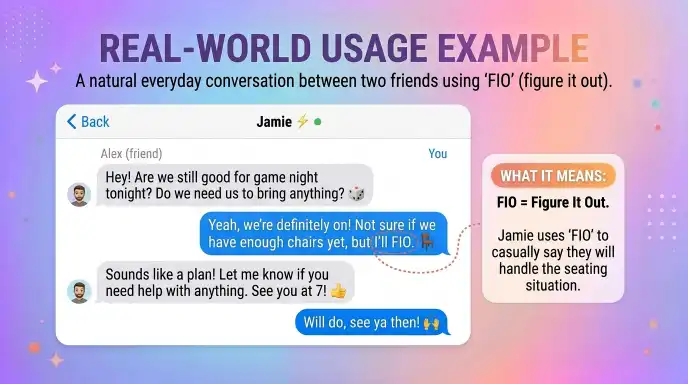
Imagine that two friends, Emma and Jake, are working on a school project together. Emma is having trouble finding a particular setting in a presentation app.
She sends Jake a message:
Emma: How do I change the background color?
Jake: Open the design menu. FIO, it’s easy.
Emma: Okay, I’ll look for it.
Jake: Let me know if you still can’t find it.
In this situation, Jake uses FIO to mean “Figure It Out.” He is encouraging Emma to explore the app and solve the problem herself.
Now imagine a different situation at work. Jake sends Emma a document with a short message:
Jake: I’ve attached the updated schedule. FIO.
Emma: Thanks, I’ll keep it for reference.
Here, FIO means “For Information Only.” Jake is sharing an update so Emma knows about it, rather than asking her to solve something.
These examples show why context is important. The same abbreviation can have different meanings in personal and professional conversations.
When you understand the subject and tone of a message, identifying the intended meaning becomes much easier.
Frequently Asked Questions
1. What does FIO mean in text messages?
FIO usually means “Figure It Out” in text messages. It tells someone to solve a problem or find an answer independently. The tone can be playful, direct, or impatient.
2. What does FIO mean on TikTok?
On TikTok, FIO can mean “Figure It Out.” Someone may use it in a comment or reply when they want another person to work out an answer or solution.
3. Is FIO slang?
FIO is an abbreviation or initialism used in informal texting. It can function as slang when people use it to mean “Figure It Out,” but it is not as widely recognized as common texting terms.
4. Is FIO rude or offensive?
FIO is not automatically offensive, but “Figure It Out” can sound dismissive or impatient. Its tone depends on the conversation and the relationship between the people chatting.
5. How should you reply to FIO?
You can reply with “Okay, I’ll try,” “Got it,” or “A little hint would help!” If you are unsure what the sender means, simply ask them to explain.
Conclusion:
FIO most commonly means “Figure It Out” in casual text messages. People use it when they want someone to solve a problem, find an answer, or work something out independently.
You may see it on TikTok, Snapchat, Instagram, WhatsApp, and in regular SMS conversations. Depending on the tone, it can sound playful, encouraging, impatient, or dismissive.
In professional communication, FIO may also mean “For Information Only,” especially when someone shares a report, document, or update.
Before replying, consider the subject and tone of the message. If the meaning is unclear, asking a quick question is better than making an assumption.
Use FIO when the other person understands it, but choose a clearer phrase in formal or sensitive conversations.

I’m Emily Carter, and I enjoy writing about slang, internet language, and modern English expressions. My goal is to explain word meanings in a simple, clear, and easy-to-understand way so anyone can learn with confidence.