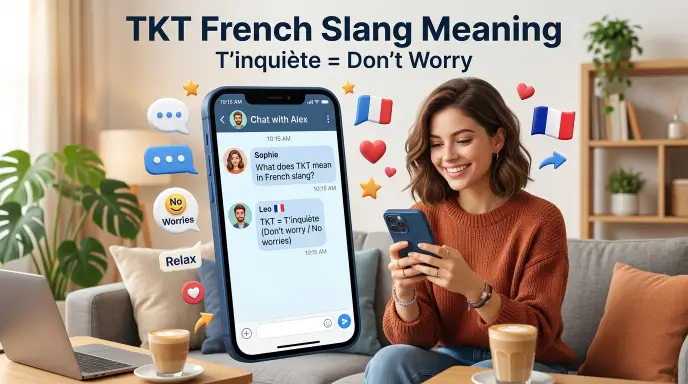
TKT French slang means “t’inquiète,” a shortened French texting expression that means “don’t worry” or “no worries.” People use tkt French slang in messages and online chats to reassure someone, show that everything is fine, or tell them not to stress.
The abbreviation TKT comes from the first letters of the French phrase “t’inquiète” and is commonly seen in casual conversations among French speakers, especially young people. Similar to English texting shortcuts like “DW” (don’t worry), tkt French slang is mainly used in informal communication.
In this guide, you will learn what TKT stands for, how it is used in texts, where it appears online, if it is rude, and how to use it correctly in different situations.
Quick Answer: What Does TKT French Slang Mean?
TKT French slang means “t’inquiète,” which translates to “don’t worry,” “no worries,” or “it’s okay” in English. It is a casual French abbreviation commonly used in text messages, social media chats, and online conversations to reassure someone.
Example:
Person 1: Désolé, je suis en retard.
(Sorry, I’m late.)
Person 2: Tkt, pas de problème.
(Don’t worry, no problem.)
What Does TKT French Slang Mean?
TKT is a French texting abbreviation for:
TKT = T’inquiète
The phrase “t’inquiète” is a shortened informal form of:
“Ne t’inquiète pas”
which means:
- Don’t worry
- Don’t stress
- It’s okay
- No problem
- Relax
French speakers often remove words and shorten phrases when texting, just like English speakers use abbreviations such as:
- LOL = Laugh Out Loud
- BRB = Be Right Back
- IDK = I Don’t Know
- BTW = By The Way
In French online communication, TKT works as a quick way to make a conversation feel relaxed and friendly.
Full Form of TKT in French
The full form of TKT is:
TKT T’inquiète
The original phrase is:
Ne t’inquiète pas
Breaking it down:
| French Expression | English Meaning |
| Ne t’inquiète pas | Don’t worry |
| T’inquiète | Don’t worry (short informal form) |
| TKT | Texting abbreviation of t’inquiète |
The abbreviation keeps only the important sounds and letters:
- T = T’
- K = inquiète (the “k” sound replaces the beginning sound of “inquiète”)
- T = the final part of the phrase
This style is common in French texting, where people shorten words to type faster.
How Is TKT Used in French Conversations?
TKT is mainly used as a reassurance phrase. It tells another person that they should not feel worried, guilty, or stressed.
Common situations include:
1. Comforting Someone
Someone may use TKT when a friend is nervous or apologizing.
Example:
Friend:
J’ai oublié de répondre hier, désolé.
(I forgot to reply yesterday, sorry.)
You:
Tkt, ça arrive.
(Don’t worry, it happens.)
2. Saying Something Is Not a Problem
TKT can replace phrases like:
- No worries
- It’s fine
- Don’t mention it
Example:
Person 1:
Merci de m’avoir aidé !
(Thanks for helping me!)
Person 2:
Tkt 🙂
(No worries.)
3. Reassuring Someone About a Situation
People may use TKT when someone is concerned about an event or problem.
Example:
Person 1:
Tu crois qu’on va réussir ?
(Do you think we’ll succeed?)
Person 2:
Tkt, on va y arriver.
(Don’t worry, we’ll make it.)
Is TKT French Slang or a Normal French Word?
TKT is considered French internet slang and texting language, not formal French.
It is commonly used in:
- Text messages
- Social media chats
- Online communities
- Gaming conversations
- Informal conversations between friends
However, it is not appropriate for every situation.
For example:
✅ Casual chat:
Tkt, je vais m’en occuper.
(Don’t worry, I’ll handle it.)
❌ Formal email:
TKT, je vais m’en occuper.
A professional email would usually use:
Ne vous inquiétez pas, je vais m’en occuper.
(Don’t worry, I will take care of it.)
Where Is TKT Commonly Used?
TKT appears mostly in informal digital communication among French speakers.
Text Messages
French speakers often use TKT in SMS and private chats because it is short and fast.
Example:
Tkt, je suis presque arrivé.
Meaning:
Don’t worry, I’m almost there.
Snapchat and Instagram
On platforms like Snapchat and Instagram, users often prefer quick abbreviations. TKT fits the casual style of short replies, reactions, and direct messages.
Example:
“J’ai raté le rendez vous 😭”
“Tkt, on peut refaire ça.”
Meaning:
“I missed the appointment 😭”
“No worries, we can do it again.”
Discord and Gaming Chats
French speaking gamers may use TKT during team conversations.
Example:
“Désolé pour la défaite.”
“Tkt, prochaine partie.”
Meaning:
“Sorry about the loss.”
“Don’t worry, next game.”
Online Communities
TKT may appear on forums, comments, and group chats where French users communicate casually.
It creates a friendly and relaxed tone.
Is TKT Used Differently by Age Groups?
Yes, TKT is more common among younger French speakers, especially teenagers and young adults, but many adults also understand and use it in casual conversations.
Like many texting abbreviations, its popularity is connected to digital communication. People who regularly use messaging apps, social media, and online communities are more likely to write TKT instead of the full phrase t’inquiète.
However, TKT is not limited to one generation. A parent, coworker, or older friend who is comfortable with texting may also use it when chatting informally.
Example:
Young person:
Tkt, j’ai déjà envoyé le fichier.
(Don’t worry, I already sent the file.)
Adult friend:
Tkt, on trouvera une solution.
(Don’t worry, we’ll find a solution.)
The key factor is not age alone. The main difference is the level of formality.
Different Meanings of TKT French Slang
Unlike some internet abbreviations that have many unrelated meanings, TKT in French slang has one main meaning: “t’inquiète” (don’t worry).
However, the feeling behind it can change depending on the situation.
| Usage | Meaning | Tone |
| Tkt | Don’t worry | Casual and friendly |
| Tkt pas | Don’t worry about it | Reassuring |
| Tkt, ça va | It’s okay, everything is fine | Comforting |
| Tkt je gère | Don’t worry, I can handle it | Confident |
Although the basic meaning stays the same, the emotional message can be different.
For example:
“Tkt.”
can mean:
- I’m not upset.
- It’s not a big deal.
- Relax.
- You don’t need to apologize.
The exact meaning depends on the conversation.
TKT vs TKT Pas: What Is the Difference?
Many French speakers also write:
TKT pas
This is another common texting version of:
“T’inquiète pas.”
Meaning:
- Don’t worry
- Don’t stress
- It’s okay
Examples:
TKT:
Tkt, je comprends.
Meaning:
Don’t worry, I understand.
TKT pas:
Tkt pas, tout va bien.
Meaning:
Don’t worry, everything is fine.
Both are informal. “Tkt pas” is often closer to the complete spoken phrase.
Is TKT French Slang Rude or Offensive?
No, TKT is generally not rude or offensive. It is usually a friendly and reassuring expression.
It is often used to make someone feel better or to show that a problem is not serious.
Examples of positive uses:
Tkt, c’est pas grave.
(Don’t worry, it’s not serious.)
Tkt, je suis là.
(Don’t worry, I’m here.)
However, tone matters.
A very short reply like:
Tkt.
may sometimes feel dismissive depending on the situation.
For example, if someone is sharing a serious emotional problem, replying only “Tkt” might seem like you are ignoring their feelings.
Compare:
Less helpful:
Tkt.
More supportive:
Tkt, je comprends. On va trouver une solution.
(Don’t worry, I understand. We’ll find a solution.)
The abbreviation itself is harmless; the surrounding conversation determines the tone.
Is TKT Appropriate at Work or School?
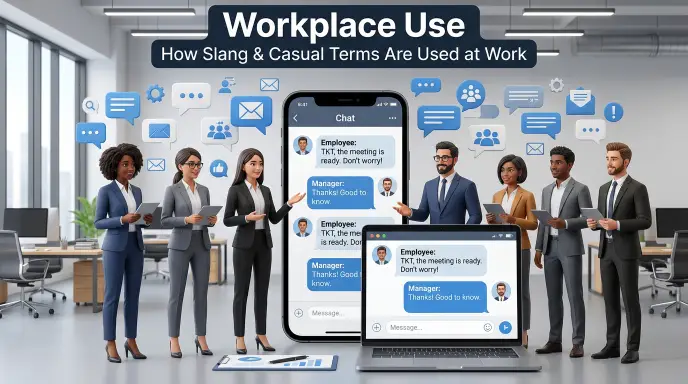
TKT is usually not suitable for formal professional communication, but it can be acceptable in relaxed workplace chats depending on the relationship.
Workplace Use
Avoid using TKT in:
- Formal emails
- Job applications
- Official documents
- Messages to clients
- Communication with unfamiliar professionals
Instead use:
- Ne vous inquiétez pas
- Pas de souci
- Aucun problème
Example:
Formal:
Ne vous inquiétez pas, votre demande sera traitée rapidement.
Informal team chat:
Tkt, je m’en occupe.
(Don’t worry, I’ll handle it.)
School Use
Among friends, TKT is normal.
Example:
Tkt, je t’envoie les notes.
(Don’t worry, I’ll send you the notes.)
But students should avoid using it in formal assignments or messages to teachers.
Instead:
Ne vous inquiétez pas, je vais vérifier.
Origin and History of TKT French Slang
TKT developed from French texting culture, where users shortened common expressions to save time while typing.
The exact first use date of TKT is difficult to verify because many online abbreviations grew naturally through everyday messaging rather than from a single creator or event.
The abbreviation became more visible with the growth of:
- SMS messaging
- Internet chat rooms
- Social networks
- Mobile messaging apps
French speakers often created shortcuts by keeping important sounds or letters from common phrases.
Other examples of French texting shortcuts include:
| Slang | Full Expression | Meaning |
| TKT | T’inquiète | Don’t worry |
| MDR | Mort de rire | Laughing out loud |
| PTDR | Pété de rire | Rolling with laughter |
| JPP | J’en peux plus | I can’t take it anymore |
| PK | Pourquoi | Why |
TKT became popular because “t’inquiète” is a very common phrase in everyday French speech.
Is TKT Still Popular or Becoming Old?
TKT is still understood and used, but like many internet abbreviations, its popularity can vary by community.
Some younger users may prefer newer expressions, emojis, or shorter replies. However, TKT remains a recognizable part of French digital communication.
It is not considered an outdated expression in the same way as some older internet slang. Many French speakers still use it naturally in casual chats.
Its continued use comes from the fact that it represents a very common human response:
“Don’t worry.”
TKT Usage Across Different Platforms
Different online spaces may use TKT with slightly different tones.
| Platform | How TKT Is Used | Typical Tone |
| Text messages | Quick reassurance | Friendly |
| Snapchat | Short replies | Casual |
| Instagram DMs | Relaxed conversations | Informal |
| TikTok comments | Quick reactions | Casual |
| Discord | Gaming/team chats | Friendly |
| Workplace chat | Depends on company culture | Informal only |
Real-Life Examples of TKT French Slang
Friendly Conversation
A:
Désolé, j’ai oublié ton anniversaire.
(Sorry, I forgot your birthday.)
B:
Tkt, ça arrive.
(Don’t worry, it happens.)
Gaming Example
Player 1:
J’ai fait une erreur pendant la partie.
(I made a mistake during the game.)
Player 2:
Tkt, on continue.
(Don’t worry, we continue.)
Social Media Example
Comment:
“J’ai supprimé mon ancienne vidéo par erreur.”
Reply:
“Tkt, tu peux en refaire une.”
(Don’t worry, you can make another one.)
Family Conversation
Child:
J’ai cassé le verre, désolé.
(I broke the glass, sorry.)
Parent:
Tkt, ce n’est pas grave.
(Don’t worry, it’s not a big deal.)
When Should You Avoid Using TKT French Slang?
Although TKT French slang is harmless and friendly in most situations, there are times when you should avoid using it.
The main reason is formality and emotional sensitivity. A short abbreviation may not always communicate the level of care or respect needed.
Avoid TKT in Formal Writing
Do not use TKT in:
- Business emails
- Official letters
- Academic documents
- Job applications
- Customer service messages
- Professional introductions
Example:
❌ Informal:
Tkt, votre problème sera réglé.
✅ Professional:
Ne vous inquiétez pas, votre problème sera réglé.
The full phrase sounds more respectful and professional.
Avoid Using Only “TKT” During Serious Situations
A simple “Tkt” can sometimes sound like you are minimizing someone’s feelings.
For example:
Someone says:
“I’m really worried about my exam results.”
Replying:
“Tkt.”
may feel too quick or uncaring.
A better response:
“Tkt, je comprends. On va voir ce qu’on peut faire.”
(Don’t worry, I understand. We’ll see what we can do.)
The issue is not the abbreviation itself. The issue is if the message shows enough support.
Polite Alternatives to TKT
If you need a more formal or respectful way to say “don’t worry” in French, use these expressions.
| French Expression | English Meaning | Usage |
| Ne vous inquiétez pas | Don’t worry | Formal |
| Ne t’inquiète pas | Don’t worry | Normal conversation |
| Pas de souci | No problem | Casual but widely accepted |
| Aucun problème | No problem | Neutral |
| Tout va bien | Everything is fine | Reassuring |
| Ce n’est pas grave | It’s not serious | Comforting |
TKT vs Similar French Slang
French internet slang has many abbreviations. Understanding the difference helps you use them naturally.
| Slang | Full Form | Meaning |
| TKT | T’inquiète | Don’t worry |
| MDR | Mort de rire | LOL / Laughing |
| JPP | J’en peux plus | I can’t take it anymore |
| PTDR | Pété de rire | Dying laughing |
| OSEF | On s’en fout | We don’t care |
| PK | Pourquoi | Why |
TKT is different because it is mainly used to comfort or reassure someone.
For example:
MDR:
This is funny.
TKT:
Everything is okay.
Common Misunderstandings About TKT
1. Some People Think TKT Means “Okay”
While TKT can sometimes feel like “okay” because it reassures someone, its direct meaning is closer to:
- Don’t worry
- Relax
- No stress
Example:
A: “Sorry I’m late.”
B: “Tkt.”
The meaning is not simply “okay.” It means:
“Don’t worry about being late.”
2. TKT Is Not a French Word Used in Formal Speech
Some learners may think TKT is an official French word.
It is not.
TKT is:
- A texting abbreviation
- Internet slang
- Informal writing
People normally say:
T’inquiète
when speaking.
They do not pronounce the letters “TKT” in everyday French conversation.
3. TKT Does Not Always Solve a Problem
TKT can provide comfort, but it does not mean the problem disappears.
Example:
“I lost my phone.”
Someone replying:
“Tkt.”
means:
“Don’t panic.”
It does not mean:
“Your phone has been found.”
The context gives the real meaning.
Why Do People Use TKT?
People use TKT French slang because it is:
Short and Fast
Typing “TKT” is quicker than writing:
Ne t’inquiète pas
or even:
T’inquiète
In fast online conversations, shorter messages are common.
Friendly and Relaxed
TKT creates a casual feeling.
Compare:
Formal:
Ne vous inquiétez pas.
Casual:
Tkt.
The second one feels more like a conversation between friends.
A Sign of Familiarity
Using TKT can show that two people have a comfortable relationship.
Friends often use abbreviations because they share the same communication style.
TKT in French Culture and Online Communication
French speakers use many shortened expressions online because digital conversations often move quickly.
Apps such as:
- Snapchat
- TikTok
- Discord
encourage short replies and casual language.
TKT fits naturally into this environment because reassurance is a common part of everyday conversation.
Someone may use it after:
- An apology
- A mistake
- A delay
- A small problem
- A worry
Can English Speakers Use TKT?
Yes, English speakers learning French may use TKT when chatting with French-speaking friends, but they should understand the context.
Using TKT with native French speakers in casual messages can show familiarity with French online culture.
Example:
“Désolé, j’ai oublié de répondre.”
“Tkt 😊”
This sounds natural in a casual chat.
However, using it in a formal French assignment or professional message would not be recommended.
Frequently Asked Questions About TKT French Slang
What does TKT mean in French texting?
TKT means “t’inquiète,” which means “don’t worry” or “no worries.” It is a casual abbreviation used in French messages and online conversations.
What does TKT stand for in French?
TKT stands for:
T’inquiète
which comes from:
Ne t’inquiète pas
meaning:
Don’t worry.
Is TKT French slang?
Yes. TKT is French texting slang. It is mainly used in informal digital conversations rather than formal writing.
Is TKT rude?
No, TKT is usually friendly and polite in casual conversations. However, replying only “TKT” during a serious situation may sound too short or dismissive.
Can I use TKT on Snapchat or TikTok?
Yes. TKT is commonly understood in casual social media conversations, including chats on platforms like Snapchat, TikTok, and Instagram.
Can I use TKT at work?
Usually, avoid it in formal workplace communication. In a relaxed team chat with coworkers you know well, it may be acceptable depending on the workplace culture.
What is the difference between TKT and TKT pas?
Both mean “don’t worry.”
- TKT = T’inquiète
- TKT pas = T’inquiète pas
“TKT pas” is closer to the complete spoken phrase.
How do you pronounce TKT?
People normally pronounce the full phrase:
T’inquiète
They usually do not say the letters “T K T” aloud.
Quick Reference Table: TKT French Slang
| Question | Answer |
| Meaning | Don’t worry |
| Full form | T’inquiète |
| Language | French |
| Type | Internet/text slang |
| Used in | Chats, social media, gaming |
| Tone | Casual and friendly |
| Formal? | No |
| Offensive? | No |
| Best used with | Friends and casual conversations |
Related French Slang Terms You Should Know
Understanding TKT French slang becomes easier when you know other common French texting expressions. French internet conversations often use abbreviations to make messages shorter and more casual.
Here are some related terms:
| French Slang | Full Expression | English Meaning | Common Use |
| TKT | T’inquiète | Don’t worry | Reassurance |
| MDR | Mort de rire | LOL / Laughing out loud | Funny moments |
| PTDR | Pété de rire | Rolling with laughter | Very funny situations |
| JPP | J’en peux plus | I can’t take it anymore | Frustration or humor |
| OSEF | On s’en fout | We don’t care | Showing lack of interest |
| PK | Pourquoi | Why | Asking questions |
| Slt | Salut | Hi | Greeting |
| A+ | À plus | See you later | Ending a chat |
TKT belongs to the category of French texting abbreviations, where common spoken phrases are shortened for quick digital communication.
How TKT Compares With English Slang
Many languages create shortcuts for online conversations. TKT has a similar role to several English expressions.
| French Slang | English Equivalent |
| TKT | Don’t worry |
| Pas de souci | No worries |
| Ça marche | Sounds good |
| MDR | LOL |
| JPP | I can’t even |
However, TKT is not a direct translation of every English phrase. Its main purpose is reassurance.
For example:
French:
Tkt, je vais t’aider.
English:
Don’t worry, I’ll help you.
Common Situations Where TKT Sounds Natural
TKT works best when the problem is small, temporary, or when someone needs reassurance.
After an Apology
Example:
Désolé d’être en retard.
(Sorry for being late.)
Reply:
Tkt, ça va.
(Don’t worry, it’s okay.)
After a Mistake
Example:
J’ai envoyé le mauvais fichier.
(I sent the wrong file.)
Reply:
Tkt, renvoie le simplement.
(Don’t worry, just send it again.)
Before a Challenge
Example:
Je suis stressé pour le match.
(I’m stressed about the game.)
Reply:
Tkt, tu vas réussir.
(Don’t worry, you’ll succeed.)
TKT French Slang in Different Countries
Because French is spoken in many regions, slang can vary.
TKT is mainly recognized in:
- France
- French speaking online communities
- Some parts of Belgium, Switzerland, and Canada
However, local slang preferences may differ.
For example, a French speaker from one region may use a different casual expression instead of TKT. Online communication has helped spread many French abbreviations beyond national borders.
The meaning remains easy to understand for most French speakers:
TKT = Don’t worry.
Does TKT Have Any Hidden Meaning?
No. In normal French online communication, TKT does not have a hidden or secret meaning.
It is simply a shortened form of:
T’inquiète
The meaning depends on the conversation, but it is usually positive and reassuring.
Example:
“J’ai peur de rater.”
“Tkt.”
Meaning:
“Don’t worry.”
It is not a code word, insult, or offensive abbreviation.
Is TKT Safe for Kids and Teenagers?
TKT is generally harmless slang.
Teenagers may use it in:
- Group chats
- Gaming conversations
- Social media messages
- Conversations with friends
Parents and teachers who see TKT in messages should understand that it normally means:
“Don’t worry.”
It is not automatically a sign of inappropriate communication.
As with any slang term, the full conversation matters more than one abbreviation.
How to Explain TKT to Someone Learning French
A simple explanation would be:
“TKT is a French texting shortcut for ‘t’inquiète,’ which means ‘don’t worry.’ French people use it online with friends when they want to reassure someone.”
Example:
“Sorry I forgot.”
“Tkt.”
Meaning:
“No worries.”
Conclusion:
TKT French slang means “t’inquiète,” a casual French abbreviation used to say “don’t worry,” “no worries,” or “it’s okay.”
It is commonly used in text messages, social media chats, gaming communities, and informal conversations. The expression is friendly, simple, and widely understood among French speakers.
The most important thing to remember is context. TKT works well with friends and casual conversations, but it should usually be replaced with a full phrase in professional or formal situations.
If you see TKT in a French message, the person is most likely trying to reassure you and say:
“Relax, everything is fine.”
Descover more!
What Is Clout Slang? Meaning, Uses, and Examples
Roast Beef Slang Meaning: Text & Chat Explained