FFB in text usually means “Follow for Follow Back.” It is a social media abbreviation used when someone wants you to follow their account and offers to follow yours in return.
You might see FFB in Instagram comments, TikTok messages, Snapchat conversations, or ordinary text messages. People often use it when they want to connect with other users or increase their social media followers.
If someone sends you “FFB?”, they are probably asking if you are interested in exchanging follows. However, the exact meaning can depend on the conversation and the platform.
In this guide, you will learn the meaning of FFB, where people use it, real chat examples, and the best ways to reply. You will also discover if this abbreviation is rude and when it is appropriate to use.
FFB Meaning in Text
FFB stands for “Follow for Follow Back” in social media conversations. It describes an arrangement in which two people follow each other’s accounts.
For example, someone might message you, “Hey, FFB?” They are usually asking if you will follow their account, with the expectation that they will follow you back.
This abbreviation is particularly relevant to people who want to increase their follower counts. Instead of writing a complete sentence, they use three letters to communicate the idea quickly.
What Does FFB Stand For?
FFB can be understood by breaking down its letters:
- F: Follow
- F: For
- B: Back
Together, the letters communicate the idea of following someone in return.
Example conversation:
Person A: FFB?
Person B: Sure, what’s your username?
Person A: It’s @examplepage. I’ll follow you now.
Meaning: Person A wants to exchange social media follows with Person B.
Is FFB Slang or an Acronym?
FFB is an internet abbreviation or acronym commonly used in social media interactions. It is not a traditional English word. Its meaning comes from the words represented by its letters.
People use abbreviations like FFB because they save time and fit naturally into short online messages. Similar expressions include F4F, which commonly means “Follow for Follow,” and SFS, which can mean “Shoutout for Shoutout” or “Spam for Spam,” depending on the community.
Although these expressions are related, they do not always describe the same activity.
What Does FFB Mean in Everyday Chat?
In everyday chat, FFB generally indicates that someone wants to exchange social media follows. The person may be trying to connect with new accounts, increase their visibility, or build a larger online audience.
For example, if someone comments “FFB” on your Instagram post, they probably want you to follow their profile in return.
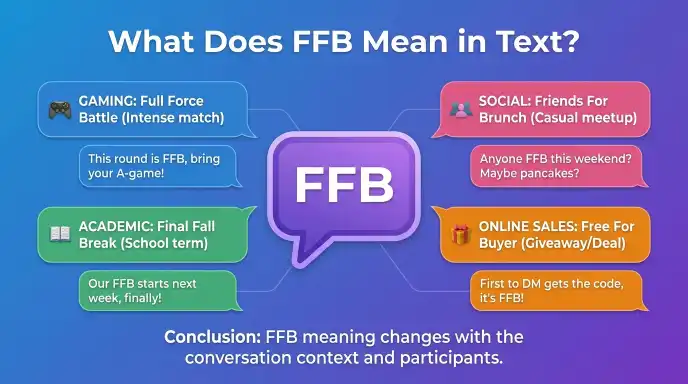
However, context matters. Acronyms can have different meanings in gaming, private communities, business discussions, or specialized groups. If the conversation has nothing to do with social media, it is better to ask what the sender means rather than assume.
Where People Use FFB
FFB is most relevant in conversations about social media followers and account growth. Its use can vary between platforms because each app has different features and communities.
FFB on TikTok
On TikTok, people may use FFB in comments, direct messages, or discussions about growing their accounts. A user might comment “FFB?” on another creator’s video to suggest exchanging follows.
Example:
Comment: Love your content! FFB?
The person is asking if the creator is interested in following each other.
However, not every TikTok user welcomes following exchanges. Some creators prefer to attract followers who genuinely enjoy their videos rather than people who follow only to receive a follow back.
If you see FFB in a TikTok comment, check the surrounding conversation before responding.
FFB on Snapchat
On Snapchat, FFB may appear in messages when people want to add each other or build their social connections.
Example conversation:
Friend: Add me on Snap, FFB.
You: Okay, send me your username.
In this situation, the sender is suggesting a mutual connection.
Snapchat users may also use similar expressions when discussing adding friends. Because Snapchat connections are not always described in exactly the same way as Instagram follows, the intended meaning depends on the conversation.
FFB on Instagram
Instagram is one of the clearest contexts for understanding FFB because following other accounts is a central part of the platform.
People may use the abbreviation in comments, direct messages, or posts intended to attract new followers.
Example:
“New account! FFB?”
This means the person is asking others to follow their account and is offering to follow them back.
Some users participate in follow exchanges to increase their follower numbers. Others avoid them because a larger follower count does not necessarily mean greater engagement or a genuinely interested audience.
If you run a creator or business account, consider if exchanged follows will help you reach people who actually care about your content.
FFB on WhatsApp
WhatsApp does not use a traditional public follower system in the same way Instagram does. Still, someone might send FFB in a private chat while discussing their Instagram, TikTok, or another social account.
Example conversation:
Friend: I made a new Instagram account.
You: Nice! What’s your username?
Friend: I’ll send it. FFB?
Here, the abbreviation refers to following each other on Instagram, even though the conversation takes place on WhatsApp.
The surrounding messages usually make the intended meaning clear.
FFB in SMS Text Messages
FFB can also appear in ordinary SMS messages, especially when friends are exchanging social media usernames.
Example:
“Follow my new page, FFB?”
The sender wants you to follow their page and is offering to follow yours in return.
However, FFB is not a universally standardized texting abbreviation. If you receive it from someone you do not know, or the message does not mention social media, ask for clarification before acting.
Real Chat Examples of FFB
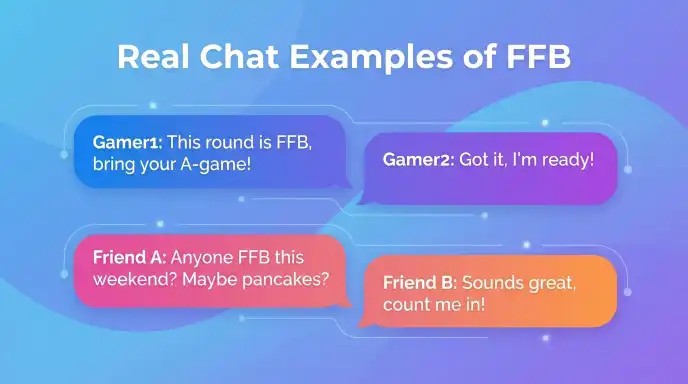
The easiest way to understand internet slang is to see how people use it in natural conversations. Here are 10 realistic examples showing different situations in which FFB might appear.
A Simple Follow Exchange
A: Hey, can you follow my Instagram?
B: Sure, what’s your username?
A: It’s @examplepage. FFB?
Meaning: A is asking B to follow the account and suggesting a follow back.
Meeting Someone on TikTok
A: Your videos are actually so good.
B: Thank you!
A: FFB? I make similar content.
Meaning: A wants to connect with B through a mutual follow.
A New Instagram Account
A: I just made a new account.
B: Send me the link.
A: Sent! FFB please.
Meaning: A wants B to follow the new account and is likely offering to follow B back.
A Friendly Conversation
A: What’s your Insta?
B: It’s @myprofile.
A: Found you. FFB?
Meaning: A has found B’s account and wants to exchange the following.
A Snapchat Discussion
A: Do you use Snapchat?
B: Yeah, every day.
A: Add me, FFB.
Meaning: A is asking B to add them and suggesting a mutual connection.
A Person Declines Politely
A: FFB?
B: Thanks, but I only follow accounts I know.
A: No worries!
Meaning: B politely declines the exchange without being rude.
A Creator Wants Genuine Followers
A: FFB? Trying to grow my page.
B: I usually follow pages that match my interests, but good luck!
A: Thanks anyway.
Meaning: A wants to grow their account, while B prefers to choose accounts based on their interests.
A WhatsApp Message
A: I started a small art page.
B: That’s awesome. What’s the name?
A: I’ll send it now. FFB?
Meaning: A wants B to follow the art page and is proposing to return the favor.
A Short and Casual Exchange
A: Follow you!
B: Just followed back.
A: Thanks, appreciate it.
Meaning: The two people have completed the following exchange.
Asking What It Means
A: Someone commented FFB on my video.
B: They’re probably asking for a follow back.
A: Ohh, got it.
Meaning: A is learning the meaning of the abbreviation from a friend.
These examples show that FFB is usually straightforward. It often appears as a short request rather than as part of a long conversation.
How to Reply When Someone Says FFB
Your reply depends on if you want to exchange follows. You do not have to agree simply because someone asks.
Here are some natural responses you can use.
Funny Replies
If you are chatting with a friend or someone who enjoys humor, a playful response can keep the conversation light.
- “Only if your memes are good!”
- “Let’s negotiate this very serious business deal.”
- “Follow first, and we’ll discuss the terms.”
- “My follow-back department is currently closed.”
- “Haha, depends on your content!”
Use these responses when the conversation is casual and you feel comfortable joking with the person.
Casual Replies
If you are happy to exchange follows, keep your answer simple.
- “Sure, what’s your username?”
- “Yeah, I’ll follow you.”
- “Okay, send me your profile.”
- “Done! Follow you back.”
- “Sure, let’s connect.”
These replies sound natural in everyday online conversations.
Friendly Replies
A friendly response works well when you want to be polite and positive.
- “Of course! I’d love to check out your page.”
- “Sure, I’ll take a look at your profile.”
- “Thanks for reaching out!”
- “Absolutely, send me your account.”
- “Happy to connect!”
You can also mention your own interests if you want to find people who share similar hobbies.
Neutral Replies
Sometimes you may want to respond without committing to anything.
Try one of these:
- “What kind of content do you post?”
- “I’ll check out your profile first.”
- “Maybe, let me have a look.”
- “What platform are you talking about?”
- “I don’t usually do follow exchanges, but thanks.”
A neutral answer gives you time to decide without creating unnecessary pressure.
What If You Do Not Want to Follow Back?
You can decline politely. There is no rule requiring you to follow someone simply because they follow you.
For example, you could say:
“Thanks, but I prefer to follow accounts I’m interested in.”
This communicates your preference without insulting the other person. You can also choose not to respond if the request seems like spam.
Is FFB Rude or Offensive?
FFB is generally not rude or offensive. In social media conversations, it is usually a straightforward request to exchange follows.
The abbreviation itself does not contain an insult or an inherently inappropriate meaning in this context. However, the way someone uses it can affect how the message feels.
For example, asking “FFB?” politely in a friendly conversation is different from repeatedly demanding a follow after someone has declined.
Is It Safe to Use?
In ordinary social media conversations, FFB is generally safe to use when you mean “Follow for Follow Back.”
Still, be careful when interacting with unfamiliar accounts. You do not need to share personal information, passwords, verification codes, or private details to exchange follows.
If a stranger sends a suspicious link or asks you to log in through an unfamiliar website, do not assume the request is trustworthy simply because it includes common internet slang.
Is FFB Appropriate at School or Work?
FFB may be fine in casual conversations with friends or classmates, particularly when discussing social media.
In professional settings, however, it is usually better to use clear language. If you want a colleague to follow a business account, you could say, “Would you like to connect with our page?”
The abbreviation may also be unsuitable in formal emails, reports, or professional messages where the reader may not understand internet slang.
The best approach is to consider your audience and choose wording that fits the situation.
Who Uses This Term?
FFB is used by people who discuss social media accounts, online connections, and follower growth. It is not limited to one particular age group, although younger internet users may be more familiar with abbreviations used in comments and direct messages.
Does Gen Z Use FFB?
Some Gen Z users may use FFB when trying to connect with other accounts or participate in social media growth communities.
However, it is important not to assume that everyone in Gen Z uses the term. Many people prefer full sentences, while others use different abbreviations depending on the platform and their online community.
FFB is better understood as a practical social media abbreviation than as a term exclusive to one generation.
Do Millennials and Older Users Understand It?
Some millennials and older social media users also understand or use follow-exchange terminology. Familiarity often depends more on platform habits than age alone.
Someone who regularly uses Instagram or TikTok may recognize FFB quickly. Another person who rarely interacts with social media comments may have never seen it before.
That is why explaining an abbreviation is often more useful than assuming everyone knows it.
Where Is It Most Common?
FFB is most relevant in places where users discuss mutual follows, including:
- Instagram comments and direct messages
- TikTok comments and creator communities
- Snapchat conversations about adding friends
- WhatsApp chats about social accounts
- Online groups focused on growing social media audiences
Its visibility varies by community, and it should not be considered a universally popular abbreviation across all platforms.
How Often Does FFB Appear Online?
There is no single reliable frequency figure that describes how often FFB appears across every social platform. Usage can change depending on trends, account-growth communities, and individual interests.
You may encounter it regularly if you browse follow-exchange posts. If your feed focuses on personal conversations, entertainment, or professional content, you might rarely see it.
Origin of the Term FFB
The exact origin of FFB is not clearly established. There is no widely confirmed single person, website, or date that can confidently be credited with creating the abbreviation in its social media sense.
Its meaning is easy to understand when viewed alongside the broader practice of exchanging social media follows.
How Did FFB Develop?
As online profiles became an important way to connect with people, users began asking others to follow their accounts. Some offered to return the favor, creating the idea commonly described as “Follow for Follow.”
Shortened forms such as F4F and FFB fit naturally into comments and messages because they communicate the request in very little space.
This kind of abbreviation reflects a wider internet habit: people shorten common phrases to make digital conversations faster.
The Influence of Social Media Culture
Social media platforms make follower counts visible, which can encourage some users to seek more followers. Following exchanges became one way to attract attention and discover other accounts.
However, the reasons for exchanging follows can vary. Some people simply want to connect with others, while others are more interested in increasing their numbers.
FFB developed within this general culture of online networking, but its precise history remains uncertain. It is better to describe its likely context than to claim an unverified origin story.
Is FFB an Old or New Term?
FFB belongs to the broader family of internet abbreviations that developed around online communication and social networking.
Its exact first-use date is unclear, so it would be misleading to assign it a specific year without reliable evidence. The phrase it represents, “Follow for Follow Back,” is more important to understanding its meaning than knowing when the three-letter form first appeared.
FFB vs. IDK, IDC, IMO, and BRB
FFB differs from many familiar texting abbreviations because it usually describes an action involving social media rather than expressing a feeling or communicating what someone knows.
The following table compares these common terms.
| Term | Meaning | Type | Usage | Popularity |
| FFB | Follow for Follow Back | Social media abbreviation | Asking to exchange follows | Varies by platform and community |
| IDK | I Don’t Know | Texting abbreviation | Expressing uncertainty | Widely recognized |
| IDC | I Don’t Care | Texting abbreviation | Expressing indifference | Widely recognized; tone can seem blunt |
| IMO | In My Opinion | Texting abbreviation | Introducing a personal view | Widely recognized |
| BRB | Be Right Back | Texting abbreviation | Saying you will return shortly | Widely recognized |
FFB vs. IDK
IDK means “I Don’t Know.” People use it when they are uncertain about something.
Example: “IDK what time the movie starts.”
FFB, by contrast, usually asks someone to exchange social media follows. The two abbreviations serve different purposes.
FFB vs. IDC
IDC means “I Don’t Care.” It can express indifference, although it may sound dismissive depending on the conversation.
FFB is generally a request or suggestion, not an expression of emotion.
FFB vs. IMO
IMO stands for “In My Opinion.” It introduces a personal view or judgment.
Example: “IMO, that was the best episode.”
FFB usually relates to connecting social media accounts rather than sharing an opinion.
FFB vs. BRB
BRB means “Be Right Back.” Someone might use it when temporarily leaving a chat.
Example: “BRB, someone is at the door.”
FFB does not communicate that someone is leaving. It generally refers to following an account in return.
Real-World Usage Example
Imagine that Sara creates an Instagram account for her handmade jewelry. She wants more people to discover her designs, so she starts interacting with other small business accounts.
One day, she notices another jewelry creator posting about a new collection. Sara comments, “Beautiful work! FFB?”
The other creator understands that Sara is asking to exchange follows. If both are interested, they can follow each other’s accounts and explore their work.
In this situation, FFB helps Sara make a quick request without writing a full sentence. The other creator can accept, decline, or simply continue the conversation.
Now imagine a different situation. Sara is preparing a professional email to a potential business partner. Writing “FFB?” would be unclear and overly casual. A complete sentence would communicate her intention more effectively.
These situations illustrate an important point: the meaning of an abbreviation may stay the same, but its suitability depends on the audience and context.
Does Following Back Guarantee More Engagement?
No. Exchanging followers may increase the number of accounts following a profile, but it does not guarantee likes, comments, sales, or meaningful engagement.
Some people may follow back as a courtesy without having much interest in the other account’s content. Others may unfollow later.
If your goal is to grow a business or creator account, focus on publishing useful content, connecting with the right audience, and building genuine relationships. A smaller group of interested followers can be more valuable than a larger group with little interest in your posts.
Frequently Asked Questions
Q1. What does FFB mean in text messages?
FFB usually means “Follow for Follow Back” in social media-related text messages. It means someone wants you to follow their account and is offering to follow yours in return.
Q2. What does FFB mean on TikTok?
On TikTok, FFB generally refers to exchanging follows. Someone may use it in a comment or direct message to ask if you will follow their account if they follow yours.
Q3. Is FFB slang?
Yes, FFB is an internet abbreviation commonly used in social media conversations. It is a shortened form of “Follow for Follow Back,” rather than a standard English word.
Q4. Is FFB rude or offensive?
No, FFB is not generally rude or offensive when used to request a mutual follow. However, repeatedly pressuring someone to follow you after they decline may come across as pushy.
Q5. How should you reply to FFB?
If you want to exchange follows, reply with something like “Sure, send me your username.” If you are not interested, you can politely say, “Thanks, but I only follow accounts I’m interested in.”
Conclusion:
FFB usually means “Follow for Follow Back” in texting and social media conversations. People use it to ask if someone will follow their account in exchange for a follow in return.
You may encounter the abbreviation on Instagram, TikTok, Snapchat, WhatsApp, or in ordinary text messages about social media. Its meaning is generally straightforward when the conversation involves usernames, profiles, or follower growth.
Although FFB is not normally rude or offensive, you do not have to accept every follow request. Choose connections that make sense for you, be respectful when replying, and use clear language in formal or professional situations.
If you see FFB in a conversation unrelated to social media, remember that abbreviations can have different meanings. Check the context or ask the sender what they mean instead of making assumptions.