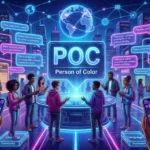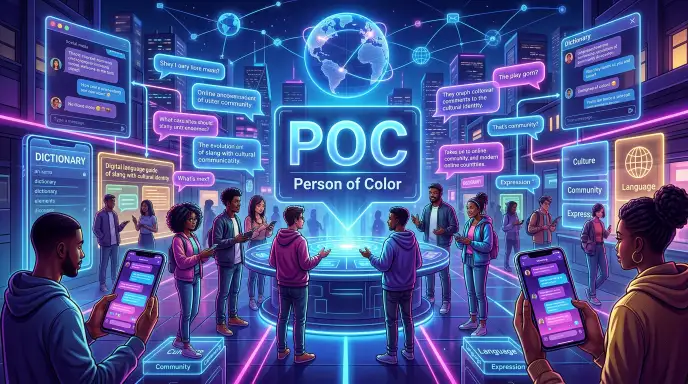
POC slang guide usually means “Person of Color,” a term used to refer to people who are not white. Its meaning can vary depending on the context. POC slang means “Person of Color” or “People of Color.” It is a respectful and widely used term that refers to individuals or communities who are not considered White.
In online conversations, social media, and everyday discussions, POC is commonly used when talking about identity, culture, diversity, or social issues. Many people search for “POC slang” after seeing it on TikTok, Reddit, Instagram, X (formerly Twitter), or in text messages.
Although some people call it slang, POC is more accurately described as an abbreviation or identity related term rather than casual internet slang. It is commonly used in conversations about representation, inclusion, equality, and shared experiences.
Understanding its meaning and context helps you use the term respectfully and avoid misunderstandings.In this guide, you’ll learn what POC means, its full form, different meanings, where it is commonly used, if it is offensive, its origin, and how to use it correctly in conversations.
Quick Answer: POC Slang Guide
POC slang usually stands for “Person of Color” or “People of Color.” It is a respectful abbreviation used to refer collectively to non White individuals or communities. While some people call it slang, it is generally considered an identity related abbreviation rather than traditional internet slang.
What Does POC Slang Mean?
POC most commonly means “Person of Color” when referring to one individual or “People of Color” when talking about a group.
The term is often used in conversations about:
- Diversity
- Representation
- Culture
- Equality
- Social issues
- Education
- Media
Unlike many internet abbreviations, POC is not used as a joke or meme. It is a respectful term that helps describe a broad group of people without listing every ethnic or racial background individually.
Context Matters
The meaning of POC depends on the conversation.
For example:
“The company wants to hire more POC leaders.”
Here, POC means “People of Color.”
Another example:
“She is a POC author.”
Here, it means “Person of Color.”
In most online conversations, this is the intended meaning.
Full Form of POC Slang Guide
The full forms of POC are:
| Full Form | Meaning |
| Person of Color | Refers to one individual |
| People of Color | Refers to multiple people or communities |
These are the most widely accepted meanings in social, educational, and online discussions.
Some industries may use “POC” to mean other things, such as “Proof of Concept” in technology or business. However, those meanings are unrelated to slang or identity discussions.
Different Meanings of POC Slang Guide
Although “Person of Color” is the most common meaning, POC can represent different phrases depending on the topic.
POC Meaning as Person of Color
This is the primary and most recognized meaning.
It refers to one individual who identifies as a member of a BIPOC or specifying racial or ethnic group.
Example:
“She is a talented POC writer.”
POC Meaning as People of Color
When discussing a group, POC may refer collectively to people from different racial and ethnic backgrounds.
Example:
“The event celebrates the achievements of POC communities.”
POC Meaning as Proof of Concept
In technology, engineering, and business, POC often means “Proof of Concept.”
Example:
“The developers built a POC before launching the project.”
This meaning is completely different from the identity related abbreviation.
Where Is POC Commonly Used?
POC is commonly used in conversations about identity, diversity, culture, education, and representation. It is not limited to one social media platform and appears in both online and offline discussions.
You may commonly see POC on:
- TikTok
- X (formerly Twitter)
- YouTube
- Discord
- Blogs and news articles
- Educational websites
- Workplace diversity programs
Social Media
On social media, people often use POC when discussing representation in movies, books, fashion, beauty, or current events.
Example:
“I’d love to see more POC creators featured on this platform.”
Text Messages
POC is less common in everyday texting than abbreviations like LOL or BRB. However, people may use it when discussing social topics or sharing articles.
Example:
“Did you read that article about POC entrepreneurs?”
Workplace
Many organizations use POC in diversity, equity, and inclusion (DEI) discussions.
Example:
“The company launched a mentorship program for POC employees.”
This is considered a respectful and professional use of the term.
Education
Schools, universities, and researchers often use POC in discussions about history, sociology, culture, and equality.
Because it is widely recognized, most readers understand its meaning in these contexts.
Is POC Rude, Offensive, or Harmless?
POC is generally considered a respectful and neutral term when used correctly. Many individuals, organizations, educators, and media outlets use it to discuss racial and ethnic diversity.
However, context and tone still matter.
When POC Is Respectful
POC is appropriate when referring to people in a respectful and inclusive way.
Examples:
- Discussing diversity
- Talking about representation
- Writing educational content
- Referring to communities respectfully
When You Should Be Careful
Although POC is widely accepted, some individuals prefer more specific identity terms, such as:
- Black
- Asian
- Latino or Latina
- Hispanic
- Indigenous
- Native American
If you know how someone identifies, using their preferred identity is often more respectful than using a broad term.
Is POC Offensive?
For most people, no.
However, opinions can vary. Some individuals feel that the term groups many different cultures and experiences together. Others appreciate it because it highlights shared experiences of racial Indigenous peoples.
For this reason, it is best to respect personal preferences whenever possible.
Real Life Examples
Here are realistic examples showing how POC is used in different situations.
Friendly Conversation
Friend A:
“Have you read that new novel?”
Friend B:
“Yes, it’s written by a POC author.”
Meaning: The author identifies as a Person of Color.
Social Media
“I’m excited to see more POC actors leading major films.”
Meaning: The user is talking about representation in entertainment.
Workplace
Manager:
“Our goal is to support more leadership opportunities for POC employees.”
Meaning: Discussing workplace diversity.
Classroom
Teacher:
“Today we’ll learn about the contributions of POC communities throughout history.”
Meaning: An educational discussion.
Reddit Discussion
User:
“Can anyone recommend books by POC writers?”
Meaning: Looking for recommendations from authors who are People of Color.
Beauty Community
“This brand expanded its foundation shades to better serve POC customers.”
Meaning: Referring to products designed for a wider range of skin tones.
Origin and History
The phrase “People of Color” has existed in different forms for many years, but its modern use became more common in the United States during the late 20th century. Community organizations, educators, and activists adopted it as an inclusive term when discussing race, equality, and representation.
Rather than referring to one specific racial or ethnic group, the term brings together many non White communities while recognizing that each group has its own unique history and experiences.
As online communication grew, the abbreviation “POC” became common because it was shorter and easier to type.
Today, you will frequently see POC used in:
- News articles
- Academic writing
- Diversity programs
- Social media discussions
- Online communities
- Podcasts and interviews
Although many people casually refer to it as slang, POC is better described as an abbreviation or identity related term than traditional internet slang.
Similar Slang or Related Terms
The table below compares POC with other commonly used identity-related abbreviations.
| Term | Meaning | Common Use |
| POC | Person/People of Color | General discussions about racial diversity |
| BIPOC | Black, Indigenous, and People of Color | Highlights Black and Indigenous communities within broader discussions |
| DEI | Diversity, Equity, and Inclusion | Workplace and education |
| AAPI | Asian American and Pacific Islander | Community and cultural discussions |
| LGBTQ+ | Lesbian, Gay, Bisexual, Transgender, Queer, and others | Gender identity and sexual orientation discussions |
Each term has a different purpose. They should not be used interchangeably unless they accurately match the context.
When Should You Avoid Using POC?
POC is generally a respectful term, but there are situations where using a more specific identity term may be better.
You should avoid using POC when:
- A person has clearly shared their preferred identity.
- A specific community is being discussed.
- The term could make individual experiences seem too general.
- You are unsure if the person identifies with the term.
For example, if someone specifically identifies as Black, Indigenous, Korean American, or another identity, using that specific description may be more accurate.
Use POC Carefully in Personal Conversations
POC is often used in broader discussions, but personal identity is individual. Not everyone has the same relationship with this term.
A respectful approach is to listen to how people describe themselves and follow their preference.
Polite Alternatives POC Slang Guide
Depending on the situation, several alternatives may be more suitable than POC.
| Alternative | When to Use |
| Person of Color | When referring to one individual in a broad way |
| People of Color | When discussing multiple communities |
| Specific identity | When someone’s background is known and relevant |
| Diverse communities | When discussing inclusion generally |
| Underrepresented groups | When talking about representation or access |
The best choice depends on the topic and the people involved.
Why Do People Use POC Slang Guide?
People use POC because it provides a simple way to discuss shared experiences among different racial and ethnic communities.
Common reasons include:
- Discussing diversity and representation.
- Talking about social experiences.
- Highlighting inclusion.
- Avoiding long lists of different groups.
- Creating conversations around equality.
For example, instead of saying:
“Black, Asian, Indigenous, Latino, and other non White communities”
someone may use:
“POC communities”
when discussing a broad topic.
However, the term should not erase the unique histories and cultures of different groups.
Common Misunderstandings About POC
Many misunderstandings happen because people assume POC has one fixed meaning in every situation.
| Misunderstanding | Correct Explanation |
| POC is just internet slang | POC is mainly an abbreviation and identity related term. |
| POC refers to one specific group | It is a broad term covering many communities. |
| Everyone prefers the term POC | Some people prefer more specific identity descriptions. |
| POC and BIPOC mean exactly the same thing | They have related but different meanings. |
| POC is always used online | It is also used in education, workplaces, and research. |
Understanding the context helps prevent incorrect use.
Is POC Safe for Social Media?
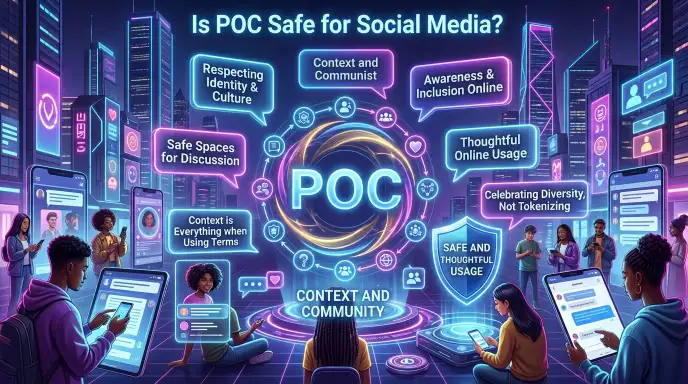
Yes, POC is generally safe to use on social media when it is used respectfully and correctly.
You may see it in discussions on:
- TikTok
- Discord
- YouTube
- X (formerly Twitter)
Common topics include:
- Representation in movies and media.
- Cultural discussions.
- Diversity in workplaces.
- Community experiences.
However, social media conversations can sometimes become sensitive. Using respectful language and avoiding assumptions about people’s identities is important.
Impact of Using POC in Communication
Using terms like POC can help people have clearer conversations about culture, identity, and representation.
Positive Effects
- Makes discussions shorter and easier.
- Helps include multiple communities.
- Supports conversations about representation.
- Creates a shared term for broad topics.
Possible Challenges
- It may feel too general for some people.
- Different communities have different experiences.
- Some people prefer specific identity labels.
Good communication depends on understanding both the word and the people behind it.
Frequently Asked Questions about POC Slang Guide
Q1. What does POC slang mean?
POC slang usually means “Person of Color” or “People of Color.” It is an abbreviation used to discuss people from non White racial and ethnic communities.
Q2. Is POC considered slang?
POC is often called slang online, but it is more accurately an abbreviation. It is commonly used in social, educational, and professional discussions.
Q3. What does POC stand for in text messages?
In text messages, POC usually stands for “Person of Color” or “People of Color” when the conversation is about identity, culture, or diversity.
Q4. Is POC offensive?
No, POC is generally considered a respectful term. However, some people prefer more specific identity terms, so context and personal preference matter.
Q5. Where is POC commonly used?
POC is commonly used on social media platforms like TikTok, Instagram, Reddit, and X, as well as in workplaces, schools, and online discussions.
Q6. What is the difference between POC and BIPOC?
POC means Person or People of Color. BIPOC specifically highlights Black and Indigenous communities while also including other People of Color.
Q7. Can I use POC at work?
Yes. POC is commonly used in professional conversations about diversity and inclusion. However, always use it appropriately and avoid making assumptions about individuals.
Q8. Does POC only refer to one race?
No. POC is a broad term that can include many racial and ethnic communities. It does not describe one single group.
Q9. Why do people say POC instead of naming every group?
People often use POC because it provides a shorter way to discuss multiple communities together when the topic is broad.
Q10. What does POC mean on TikTok?
On TikTok, POC usually means Person of Color or People of Color. Users often use it when discussing representation, creators, culture, or social topics.
Conclusion: POC Slang Guide
POC slang meaning usually refers to “Person of Color” or “People of Color.” Although many people describe it as slang, it is more accurately an abbreviation used in conversations about identity, culture, diversity, and representation.
The meaning of POC is usually clear when it appears in social media posts, workplace discussions, educational content, or online conversations. However, context matters because people have different experiences and preferences when describing identity.
Using POC respectfully means understanding that it is a broad term, not a replacement for every specific identity. When in doubt, follow the language people use to describe themselves.