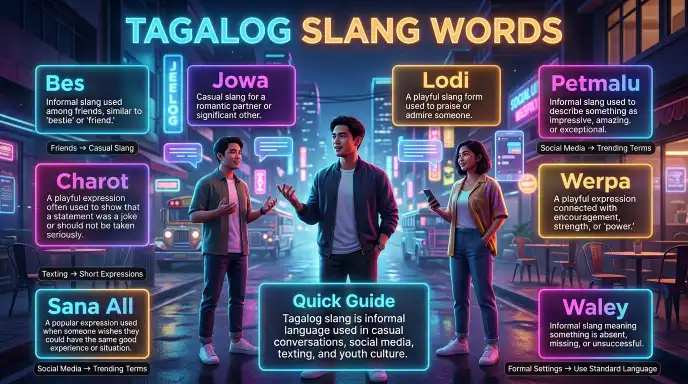
Tagalog slang words are informal words and expressions used by Filipino speakers in everyday conversations, text messages, social media, and online communities. They often have meanings that differ from standard Tagalog, making them popular among friends, younger generations, and internet users.
People search for tagalog slang words because they see them on TikTok, Facebook, Instagram, X, YouTube, Reddit, or in messages from Filipino friends and want to understand what they really mean.
Some slang words are funny, some are affectionate, and others are used to express emotions or reactions. Since slang changes over time, learning the context is just as important as learning the meaning.
In this guide, you’ll discover the most common tagalog slang words, what they mean, where they are used, if they are appropriate, and how native speakers use them in real conversations.
Quick Answer: Tagalog Slang Words
Tagalog slang words are casual Filipino expressions used in everyday speech, texting, and social media. They help speakers sound more natural, friendly, and expressive, but the meaning often depends on the situation and the people involved.
What Do Tagalog Slang Words Mean in Text?
Tagalog slang words are informal expressions that make conversations feel more relaxed and natural. Unlike formal Filipino, slang often reflects modern culture, humor, and internet trends.
Many slang words are:
- Shortened versions of existing words.
- Borrowed from English.
- Created by reversing syllables.
- Inspired by pop culture or social media.
- Unique to younger generations.
When someone uses Tagalog slang in a text message, they usually want the conversation to feel friendly instead of formal.
For example:
- “Ang astig mo!” means “You’re awesome!”
- “Petmalu!” means “Amazing!” or “Very impressive!”
- “Lodi ka talaga.” means “You’re my idol.”
These expressions are common in casual conversations but are rarely used in formal writing.
Full Form or Definition of Tagalog Slang Words
Unlike abbreviations such as LOL or BRB, tagalog slang words do not have a single full form. Instead, they are informal words or phrases that have become popular through everyday conversations and online culture.
Some slang comes from:
| Type | Example | Meaning |
| Shortened words | Jowa | Boyfriend or girlfriend |
| Reversed words | Lodi | Idol |
| English influence | G | Let’s go or I’m ready |
| Internet slang | Sana all | I wish everyone had that |
| Modern expressions | Werpa | Power or great job |
Many new slang terms spread quickly through social media before becoming part of everyday speech.
Different Meanings of Tagalog Slang Words
Not every Tagalog slang word has just one meaning. Some expressions change depending on the tone, context, or conversation.
Friendly Compliments
Some slang words are used to praise someone.
Examples include:
- Lodi
- Astig
- Petmalu
Example:
“Grabe, lodi ka talaga.”
This means the speaker admires the other person.
Funny Reactions
Some expressions simply react to something surprising or entertaining.
Examples:
- Sana all
- Char
- Edi wow
These are often used jokingly between friends.
Romantic Expressions
Some slang refers to dating and relationships.
Examples:
- Jowa
- MU (Mutual Understanding)
Example:
“May jowa na siya.”
It means someone now has a boyfriend or girlfriend.
Internet Expressions
Many slang words became popular because of memes and viral videos.
Examples include:
- Werpa
- Awit
- G
Their exact meaning can change depending on the conversation.
Is Tagalog Slang Rude, Offensive, or Neutral?
Most tagalog slang words are neutral or friendly. They are meant to make conversations feel more relaxed.
However, some slang can sound disrespectful if used with strangers, older people, teachers, or in professional settings.
The table below provides a general guide.
| Slang | Tone | Safe to Use? |
| Lodi | Positive | Yes |
| Astig | Positive | Yes |
| Jowa | Neutral | Yes |
| Sana all | Friendly | Yes |
| Char | Playful | Yes |
| Edi wow | Can sound sarcastic | Use carefully |
| Awit | Depends on context | Usually yes |
Always consider your audience before using slang.
Where Are Tagalog Slang Words Commonly Used?
Today, Tagalog slang appears almost everywhere people communicate casually.
You will often see it on:
- TikTok
- X (formerly Twitter)
- YouTube comments
- Messenger
- Discord
- Text messages
- Gaming chats
- School conversations
- Everyday conversations with friends
Platform Comparison
| Platform | Common? | Typical Use |
| Yes | Comments and memes | |
| TikTok | Yes | Videos and captions |
| Yes | Stories, captions, and comments | |
| Messenger | Yes | Daily chats |
| Yes | Personal conversations | |
| Discord | Yes | Community and gaming chats |
| Yes | Filipino communities | |
| Gaming | Yes | Team communication and jokes |
| Workplace Chat | Rare | Usually avoided unless everyone knows each other |
Most people avoid slang in formal emails, business meetings, and academic writing because standard Filipino or English sounds more professional.
Real Life Examples of Tagalog Slang Words Usage
The best way to understand tagalog slang words is to see how people actually use them in conversations. The meaning often depends on the relationship between speakers and the tone of the message.
Friendly Conversation
Friend 1: Ang galing mo sa game kanina!
Friend 2: Salamat, lodi!
Meaning: The speaker uses “lodi” to show respect or admiration.
Text Message
Person 1: May bagong trabaho na ako!
Person 2: Sana all!
Meaning: “I wish everyone had that” or “I wish I had that too.” It is usually playful, not negative.
Social Media Comment
“Petmalu naman ng travel photos mo!”
Meaning: The person is saying the photos look amazing or impressive.
Gaming Context
Player 1: Nanalo tayo sa ranked match!
Player 2: Werpa!
Meaning: A supportive expression similar to “power” or “great job.”
Argumentative Situation
Person 1: Sabi ko na nga eh.
Person 2: Edi wow.
Meaning: “Edi wow” can sound sarcastic. It may show annoyance or playful teasing depending on the relationship.
TikTok or Instagram Caption
“New haircut. Sana all may confidence.”
Meaning: The person is jokingly wishing they had the same confidence.
Origin and Background of Tagalog Slang Words
Tagalog slang has developed through many years of Filipino culture, local communities, entertainment, and online communication.
Unlike standard Filipino words, slang often changes quickly. Some expressions become popular for a few years, while others stay in everyday use.
Influence of Filipino Youth Culture
Many slang words become popular among younger Filipinos through:
- School communities
- Friend groups
- Music
- Television shows
- Movies
- Online creators
- Memes
Young speakers often create new expressions to make communication more creative and personal.
Influence of Social Media
Platforms like Facebook, TikTok, and YouTube have helped spread Filipino slang faster than before.
A phrase that starts as a joke or meme can become common across the country within a short time.
For example:
- “Sana all” became widely known through online conversations.
- “Petmalu” became popular because of Filipino wordplay.
- “Lodi” spread through internet culture as a playful way to say idol.
The exact first use of many slang terms is difficult to confirm because slang usually develops naturally in communities rather than having one clear creator.
Comparison With Similar Tagalog Slang
Different slang words can express similar ideas, but the tone may change.
| Slang Word | Meaning | Tone | Example |
| Lodi | Idol or admired person | Positive | “Lodi talaga kita.” |
| Astig | Cool or impressive | Positive | “Astig ng bike mo.” |
| Petmalu | Amazing or impressive | Playful | “Petmalu ang performance!” |
| Sana all | Wish I had that too | Funny/playful | “Sana all may vacation.” |
| Char | Just kidding | Playful | “Ang ganda ko today, char.” |
| Edi wow | Sarcastic reaction | Depends on tone | “Edi wow, ikaw na.” |
These words may look similar online, but they express different emotions.
When to Avoid Using Tagalog Slang Words
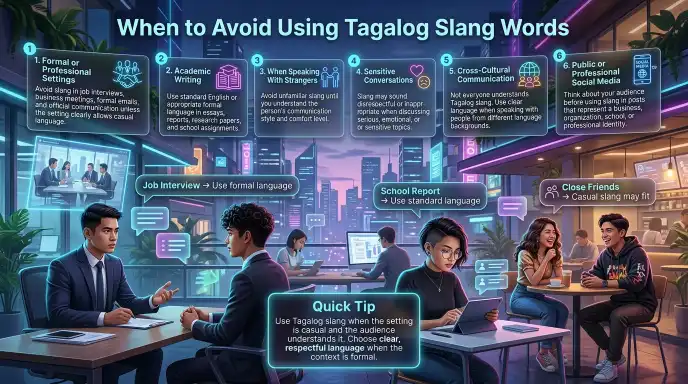
Slang is useful, but it does not fit every situation.
Avoid using casual slang when:
- Writing formal emails.
- Talking to a manager or employer.
- Submitting school assignments.
- Speaking with someone you do not know well.
- Applying for a job.
- Communicating in an official setting.
For example:
Instead of writing:
“Petmalu po yung project.”
A professional message would be:
“The project was excellent.”
The right choice depends on your audience.
Polite Alternatives to Tagalog Slang Words
If you want to sound more formal, use standard Filipino or English words.
| Slang | More Formal Alternative |
| Lodi | Idol / respected person |
| Astig | Impressive / excellent |
| Jowa | Boyfriend / girlfriend / partner |
| Sana all | I wish I had that too |
| Char | Just kidding |
| Edi wow | That’s impressive (depending on meaning) |
Using formal alternatives helps when clarity and professionalism matter.
Why Do People Use Tagalog Slang Words?
People use slang because it makes conversations feel more natural and personal.
Common reasons include:
- To create a friendly atmosphere.
- To show humor.
- To express emotions quickly.
- To feel connected with a group.
- To follow online trends.
- To make messages shorter and more casual.
Slang also helps people show personality. A simple word can communicate excitement, surprise, admiration, or humor.
For example:
“Lodi” does not only mean “idol.” It also shows respect and appreciation.
“Sana all” does not only express a wish. It often shows playful envy between friends.
Impact of Using Slang in Communication
Tagalog slang can make conversations more engaging, but it can also create confusion if the listener does not understand the expression.
Positive Effects
Slang can:
- Make conversations warmer.
- Build friendships.
- Show cultural connection.
- Add humor.
- Make online communication feel natural.
Possible Problems
Slang can:
- Be misunderstood by non native speakers.
- Sound inappropriate in formal situations.
- Change meaning over time.
- Create confusion between generations.
For example, younger Filipino users may understand a viral slang word that older speakers have never heard before.
Is Tagalog Slang Safe for Social Media?
Most Tagalog slang words are safe for social media when used appropriately.
They are commonly seen in:
- TikTok captions
- Instagram comments
- Facebook posts
- YouTube videos
- Gaming chats
- Online communities
However, users should remember:
- Context matters.
- Sarcastic slang can be misunderstood.
- Some jokes may not translate well.
- Not every slang word fits every audience.
Words like “lodi,” “astig,” and “sana all” are generally friendly. Expressions like “edi wow” need more attention because the tone can make them playful or rude.
Frequently Asked Questions
Q1. What are Tagalog slang words?
Tagalog slang words are informal Filipino expressions used in casual conversations, texting, social media, and online communities. They often make communication more relaxed, humorous, and personal.
Q2. What is the meaning of “lodi” in Tagalog slang?
“Lodi” means “idol” or someone a person admires. It comes from reversing the word “idol” and is commonly used online and in casual conversations to show respect or appreciation.
Example:
“Siya ang lodi ko sa basketball.”
Meaning: “He is my idol in basketball.”
Q3. What does “sana all” mean in Filipino slang?
“Sana all” means “I wish everyone had that” or “I wish I had that too.” Filipinos often use it jokingly when they see something they like, such as success, relationships, or achievements.
Example:
“May bagong kotse siya. Sana all!”
Q4. Are Tagalog slang words rude?
Most Tagalog slang words are not rude. Words like “lodi,” “astig,” and “petmalu” are usually positive. However, some expressions can sound sarcastic or disrespectful depending on the tone and situation.
Q5. Where are Tagalog slang words commonly used?
Tagalog slang words are commonly used in text messages, Messenger chats, TikTok, Facebook, Instagram, Reddit communities, YouTube comments, Discord servers, and casual conversations among Filipino speakers.
Q6. Can I use Tagalog slang words with Filipino friends?
Yes. Slang is very common among Filipino friends and family members. Using casual expressions can make conversations feel more natural, but it is helpful to understand the meaning and tone first.
Q7. Are Tagalog slang words appropriate at work or school?
Usually, slang should be avoided in formal work messages, official documents, and school assignments. Standard Filipino or English is better for professional and academic communication.
Q8. Why do Filipino people use slang words?
Filipino speakers use slang to express emotions, create humor, connect with friends, and make conversations feel more casual. Slang also reflects internet culture and changing communication styles.
Conclusion:
Tagalog slang words are an important part of modern Filipino communication. They appear in text messages, social media posts, gaming chats, and everyday conversations because they help people express feelings in a quick and creative way.
Words like lodi, astig, petmalu, sana all, jowa, and char each have their own meaning and tone. Some show admiration, some create humor, and others express emotions or reactions.
The most important thing to remember is that context matters. A slang word that sounds funny between friends may not be suitable in a workplace or formal setting. Learning how and when to use these expressions will help you better understand Filipino conversations and online culture.