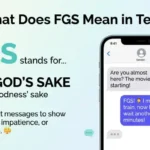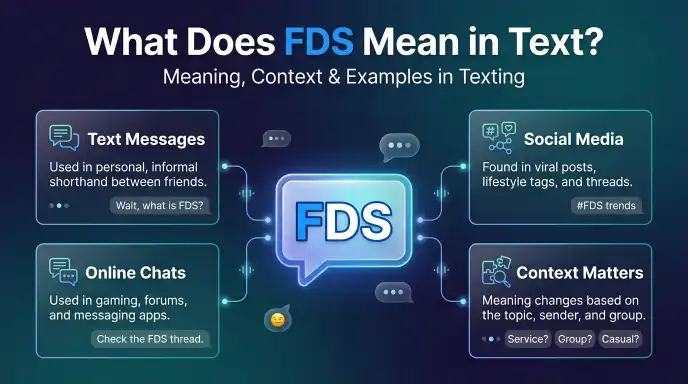
FDS in text can mean “For Damn Sure,” a casual way to say “definitely” or “absolutely,” although the abbreviation can have other meanings depending on the language and context. You may see it in texting, social media comments, or casual chats.
People often search for what FDS mean in text after seeing the three letters in a message and not knowing if they are slang, an abbreviation, or something else.
The important thing is to check the context. In English-language casual chat, FDS may be used to show strong agreement. In other languages, especially Spanish or Portuguese, fds can have completely different meanings, including “weekend.”
What Does FDS Mean in Text?
In casual English texting, FDS can mean “For Damn Sure.” It is used to show strong agreement, confidence, or certainty.
For example:
A: “Are you coming to the party?”
B: “FDS!”
Here, the person means something like “For sure!”, “Definitely!”, or “Absolutely!”
The word “damn” adds extra emphasis. Because of that, FDS sounds stronger and more informal than simply saying “for sure.”
Is FDS Slang or an Acronym?
FDS is an informal acronym or initialism when it is used for “For Damn Sure.”
It is made from the first letters of the three words:
- F = For
- D = Damn
- S = Sure
People may type it in lowercase as fds or uppercase as FDS. The meaning is usually understood from the surrounding conversation.
It is mainly suited to casual digital communication, rather than formal writing.
What Does FDS Mean in Everyday Chat?
In everyday chat, FDS can communicate a very strong yes.
Someone might use it when agreeing with a statement, confirming a plan, or showing confidence.
For example:
“You think she will come?”
“FDS.”
The intended meaning is close to “For damn sure.”
However, FDS is not one of the most universal English texting abbreviations. That means you should not automatically assume this meaning every time you see it.
FDS Can Have Different Meanings
One important point is that FDS is context-dependent.
In Spanish texting, fds can stand for “fin de semana,” meaning “weekend.” In Portuguese, fds can also mean “fim de semana,” meaning “weekend.” Portuguese internet slang also uses fds as a shortened form of a vulgar expression, so the surrounding words matter a lot.
For that reason, a message such as “What are you doing this fds?” is likely talking about the weekend, not “For Damn Sure.” Spanish texting references also list fds as “fin de semana.”
Where People Use FDS
The meaning and tone of FDS can change depending on where it appears. In English casual communication, it can be used as a strong agreement or confirmation.
FDS on TikTok
On TikTok, abbreviations can appear in comments, captions, direct messages, and replies.
Someone might use FDS to agree strongly with another person’s opinion.
Example of TikTok use:
Comment: “This is easily the best outfit in the video.”
Reply: “FDS 🔥”
The reply suggests strong agreement.
Because TikTok comments are often short, abbreviations can be convenient. Still, FDS is not universally understood, so some users may ask what it means.
FDS on Snapchat
On Snapchat, people often use short expressions when replying to friends.
FDS may appear in a quick message confirming something.
Example of Snapchat use:
Friend: “You coming with us tonight?”
Reply: “FDS.”
In this context, it can mean “For Damn Sure” or simply “Definitely.”
Snapchat is informal, so slang and shortened expressions are more natural there than in formal communication.
FDS on Instagram
On Instagram, FDS could appear in comments, DMs, or private conversations.
For example:
“That new song is going to be huge.”
“FDS.”
The person is strongly agreeing with the prediction.
Instagram also has international users, so context is especially important. If the conversation is in Spanish or Portuguese, fds may refer to the weekend instead.
FDS on WhatsApp
On WhatsApp, the meaning usually depends on the people chatting and the language they use.
In an English-speaking casual conversation, FDS may be used as an emphatic agreement.
In Portuguese-speaking conversations, however, fds commonly refers to fim de semana, meaning weekend.
So if someone says:
“What are you doing with this fds?”
they are probably asking about your weekend plans, not saying “For Damn Sure.”
FDS in SMS
Traditional SMS conversations can also contain short abbreviations.
For example:
“Are you coming tomorrow?”
“FDS.”
If both people already use this slang, the meaning may be clear from the conversation.
But when texting someone you do not know well, spelling out “for sure” or “definitely” is safer.
Real Chat Examples of FDS
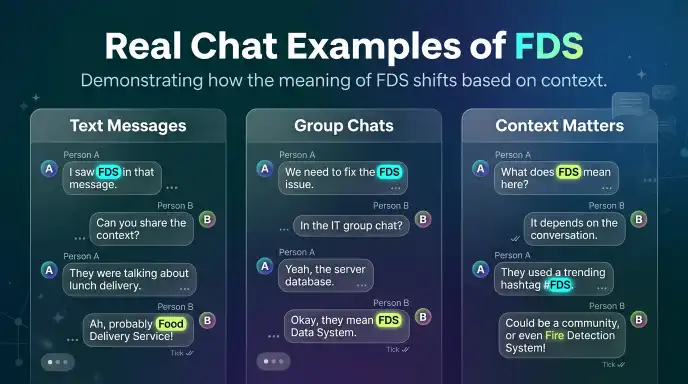
Below are realistic examples showing how FDS might appear in casual English conversations.
Confirming a Plan
A: Are you coming to the game tonight?
B: FDS.
A: Nice, see you there.
Here, FDS means “For Damn Sure” or “Definitely.”
Strong Agreement
A: That was the funniest movie ever.
B: FDS 😂
A: I knew you’d agree.
The abbreviation shows strong agreement.
Confirming an Opinion
A: Do you think he’ll win?
B: FDS.
A: Yeah, he’s been playing really well.
Here, FDS expresses confidence.
Talking About Food
A: You want pizza tonight?
B: FDS.
A: Pepperoni?
The response means absolutely.
Making Weekend Plans
A: Are you free tonight?
B: FDS.
A: Perfect. Let’s go out.
The abbreviation works as a strong confirmation.
Agreeing With a Friend
A: She’s the best singer in the group.
B: FDS.
A: Exactly what I was thinking.
Here, FDS reinforces the speaker’s opinion.
Excited Agreement
A: We should definitely go on that trip.
B: FDS 😭
A: Let’s actually plan it.
The abbreviation adds an enthusiastic tone.
Confirming Something
A: You’re serious about quitting?
B: FDS.
A: Wow, I didn’t expect that.
Here, FDS shows strong certainty.
Casual Conversation
A: Are you still watching that show?
B: FDS 😂
A: You’re obsessed.
The response indicates that the person is definitely still watching it.
Short Reply
A: Is this the right address?
B: FDS.
A: Okay, thanks.
This example shows why context matters. If someone simply sends FDS, the receiver may need more information to know exactly what the sender intended.
How to Reply When Someone Says “FDS”
Your best reply depends on the tone of the conversation. Since FDS can express strong agreement, you can answer casually without making the conversation complicated.
Funny Replies
If you’re joking with a friend, you could say:
- “Okay, I believe you 😂”
- “That confident, huh?”
- “No hesitation at all 😭”
- “You sound very sure.”
These replies work well when the original message has a playful tone.
Casual Replies
For an ordinary conversation, try:
- “Same.”
- “Definitely.”
- “Exactly.”
- “For sure.”
- “I agree.”
These responses keep the conversation simple.
Friendly Replies
If you want to sound warm and positive:
- “Haha, I knew you’d agree!”
- “Glad we’re on the same page.”
- “That’s what I was thinking too.”
- “Perfect!”
Neutral Replies
If you are not sure what the sender means, you can avoid guessing.
Try:
- “What do you mean by FDS?”
- “Do you mean ‘for sure’?”
- “Got it.”
- “Okay, sounds good.”
Asking for clarification is especially useful because FDS has several meanings across different languages and online communities.
Is FDS Rude or Offensive?
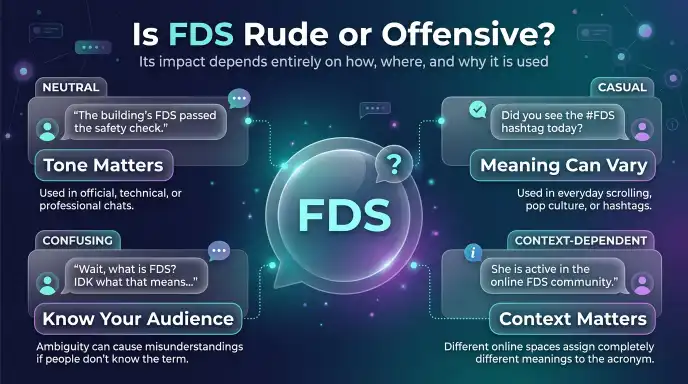
FDS can be slightly rude or inappropriate in some situations because “damn” is a mild swear word.
It is not normally an insult by itself. When someone uses FDS to mean “For Damn Sure,” they are usually expressing strong agreement or confidence, not attacking another person.
Still, the tone can vary.
Is FDS Safe to Use?
FDS is generally better suited to casual conversations with friends.
It may be fine in a private chat where both people are comfortable with informal slang.
However, slang can easily be misunderstood by people who do not know the abbreviation.
Is FDS Appropriate at School?
It is better to avoid FDS in formal school assignments, essays, presentations, or messages to teachers.
Even though the expression is not extremely offensive, the word “damn” makes it informal.
Use “definitely,” “certainly,” or “for sure” instead.
Is FDS Appropriate at Work?
FDS is generally not recommended for professional emails, reports, applications, or formal workplace communication.
A professional message should be clear and polite.
Instead of:
“FDS, I can finish it today.”
write:
“Absolutely, I can finish it today.”
That sounds more professional and leaves less room for confusion.
Who Uses This Term?
FDS is most likely to appear in informal online conversations, especially when people want a short way to show strong agreement.
Age Groups
Teenagers and young adults are more likely to experiment with abbreviations and internet slang, although people of different ages can use them.
There is no strict age group that owns the term.
Gen Z Usage
Gen Z users often communicate with abbreviations, shortened phrases, emojis, and other forms of digital shorthand.
However, FDS is not as universally recognized as abbreviations such as IDK, BRB, or IMO.
That difference matters. A person may understand common texting abbreviations immediately but still ask what FDS means.
Common Platforms
You may encounter FDS in:
TikTok, Snapchat, Instagram, WhatsApp, text messages, comments, and private chats.
The exact meaning should always be judged from the surrounding conversation.
How Often Does FDS Appear Online?
There is no reliable reason to describe FDS as one of the most common English texting abbreviations. Its use is more contextual and community-dependent.
The lowercase form fds is also used internationally with other meanings. Spanish and Portuguese texting resources commonly use it for “weekend.”
Origin of FDS in Text
The exact origin of the English slang use of FDS meaning “For Damn Sure” is not clearly established.
Like many texting abbreviations, it follows a simple pattern: taking the first letters of several words to create a shorter expression.
Digital communication has encouraged people to shorten phrases because quick messages are easier to type and read.
Expressions such as IDK, IMO, and BRB became familiar examples of this general texting style. FDS can fit the same pattern when used for “For Damn Sure.”
However, it would be inaccurate to claim that all uses of FDS came from one particular social media trend.
There is another important part of its history: fds has established uses in Spanish and Portuguese digital communication. In Spanish, it can abbreviate fin de semana, while Portuguese uses fim de semana for “weekend.”
Portuguese also has a separate vulgar internet-slang meaning for fds, so language and context are particularly important.
This is why there is no single meaning that works in every message.
FDS vs IDK, IDC, IMO, and BRB
These abbreviations can all appear in digital conversations, but they serve very different purposes.
| Term | Meaning | Type | Usage | Popularity |
| FDS | For Damn Sure | Informal acronym | Strong agreement or certainty | Less common |
| IDK | I Don’t Know | Texting abbreviation | Shows uncertainty or lack of knowledge | Very common |
| IDC | I Don’t Care | Texting abbreviation | Shows indifference | Very common |
| IMO | In My Opinion | Initialism | Introduces a personal opinion | Very common |
| BRB | Be Right Back | Texting abbreviation | Says the person will return shortly | Very common |
The biggest difference is that FDS expresses certainty, while IDK expresses uncertainty.
For example:
“Are you coming?”
FDS = Definitely.
IDK = I don’t know.
IDC = I don’t care.
IMO = In my opinion.
BRB = Be right back.
These abbreviations should not be treated as interchangeable.
Why Can FDS Have Different Meanings?
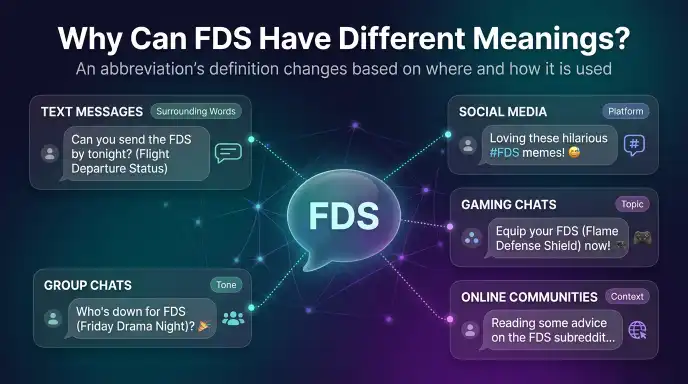
The main reason is that abbreviations are often reused.
Three letters can represent different words in different languages, communities, industries, and conversations.
For example, fds can mean “weekend” in Spanish or Portuguese texting.
This creates an important rule for readers:
Never decide what FDS means from the letters alone.
Look at the words around it.
If someone says:
“What are you doing with this fds?”
The meaning is likely weekend.
If someone replies:
“Will you definitely come?” — “FDS!”
the intended English meaning may be “For Damn Sure.”
The surrounding sentence gives you the clue.
Real-World Usage Example
Imagine two friends are making plans for a concert.
One friend sends:
“Are you actually coming to the concert tomorrow?”
The other replies:
“FDS.”
The first person could understand this as “For Damn Sure”, meaning the friend is definitely coming.
They might reply:
“Haha, okay, see you there!”
Now imagine a different conversation with someone who uses Spanish texting slang:
“¿Qué haces el fds?”
In that context, fds means “fin de semana,” or “weekend.” Spanish texting references specifically list this abbreviation for weekend plans.
The difference is clear once you look at the language and sentence around the abbreviation.
This is a good example of why internet slang should always be interpreted in context.
Capital Letters vs Lowercase FDS
You may see the abbreviation written as FDS, fds, or occasionally Fds.
Usually, capitalization does not change the meaning.
In casual texting, people often use lowercase letters because typing quickly is more important than following formal capitalization rules.
For example:
“FDS 😂”
and
“fds 😂”
can communicate the same idea.
However, if the abbreviation is being used in a different language, capitalization still may not help you determine its meaning. You need to examine the full message.
When Should You Avoid Using FDS?
You should avoid FDS when the audience may not understand internet slang.
That includes:
- Formal school assignments
- Job applications
- Professional emails
- Business documents
- Official messages
- Customer service communication
- Messages to someone you do not know well
In these situations, clear words are better.
Instead of FDS, use:
“Definitely.”
“Absolutely.”
“For sure.”
“Certainly.”
These alternatives communicate the idea without making the reader guess what the abbreviation means.
Frequently Asked Questions
Q1. What does FDS mean in text messages?
In casual English texting, FDS can mean “For Damn Sure,” expressing strong agreement or certainty. However, its meaning depends on context.
Q2. What does FDS mean on TikTok?
On TikTok, FDS may be used as a casual expression of strong agreement or certainty. It can also have other meanings depending on the creator or language.
Q3. Is FDS slang?
Yes. When FDS means “For Damn Sure,” it is an informal texting expression or acronym used mainly in casual digital communication.
Q4. Is FDS rude or offensive?
FDS is not usually an insult, but “damn” makes it informal and mildly coarse. It is better avoided in formal school or workplace communication.
Q5. How should you reply to FDS?
You can reply with “For sure,” “Definitely,” “Same,” or “Exactly.” If you do not understand the abbreviation, simply ask what the person means.
Conclusion:
So, what does FDS mean in text? In casual English chat, it can mean “For Damn Sure,” a strong way of saying “definitely,” “absolutely,” or “for sure.”
You may see it in texting, social media comments, DMs, and casual conversations. It is mainly an informal expression, so it works better with friends than in professional or academic writing.
The most important point is that FDS does not have only one meaning. In Spanish and Portuguese texting, fds can refer to the weekend, and Portuguese has another vulgar slang use as well.
When you see FDS, check the language, sentence, and surrounding conversation before deciding what it means. If you are writing for school or work, it is safer to use a clear phrase such as “definitely” or “for sure.”
I’m Emily Carter, and I enjoy writing about slang, internet language, and modern English expressions. My goal is to explain word meanings in a simple, clear, and easy-to-understand way so anyone can learn with confidence.