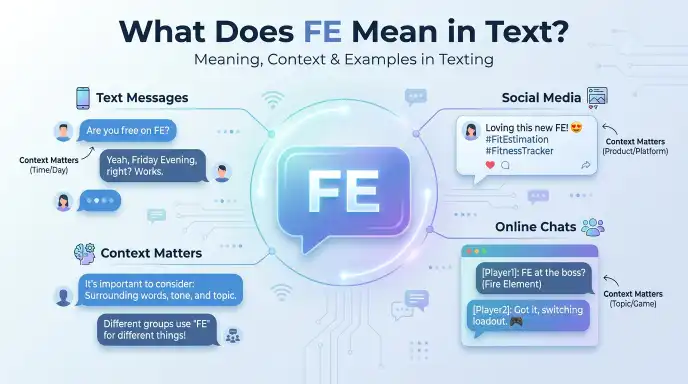
FE in text usually means “fair enough,” a casual way to show that you understand or accept someone’s point, reason, or opinion. It can appear in texting, social media chats, comments, and direct messages.
People often search for what does fe mean in text because two-letter abbreviations can be confusing without context. In a casual conversation, FE may mean “fair enough,” but the intended meaning can change depending on the topic.
You may come across FE on TikTok, Snapchat, Instagram, WhatsApp, or SMS. It is usually used as a quick response when someone gives an explanation and you think their reason is reasonable.
What Does FE Mean in Text?
The most common casual meaning of FE in text is “fair enough.”
When someone says FE, they are usually saying that they understand what you mean or accept your explanation. It can be similar to saying “Okay, that makes sense” or “I understand your point.”
For example:
A: I can’t come tonight because I have an exam tomorrow.
B: FE.
Here, B is saying “Fair enough.” They understand why A cannot come.
What Does “Fair Enough” Mean?
Fair enough is a common English expression used when you accept that someone has a reasonable point.
It does not always mean that you completely agree.
For example:
A: I don’t like going out on weekdays because I have work early.
B: FE.
B may still enjoy going out on weekdays, but B understands A’s reason.
So, FE can communicate:
“That’s reasonable.”
“I understand.”
“Okay, I can accept that.”
“That makes sense.”
Is FE Slang, an Acronym, or an Abbreviation?
In casual texting, FE is best understood as an abbreviation for “fair enough.”
It is not normally considered a traditional slang word. Instead, people shorten a familiar phrase to make their messages faster and easier to type.
This is similar to how people use short forms such as IDK, IDC, IMO, and BRB.
The exact meaning still depends on context. FE can have other meanings in different subjects or communities, so you should look at the conversation before deciding what it means.
What Does FE Mean in Everyday Chat?
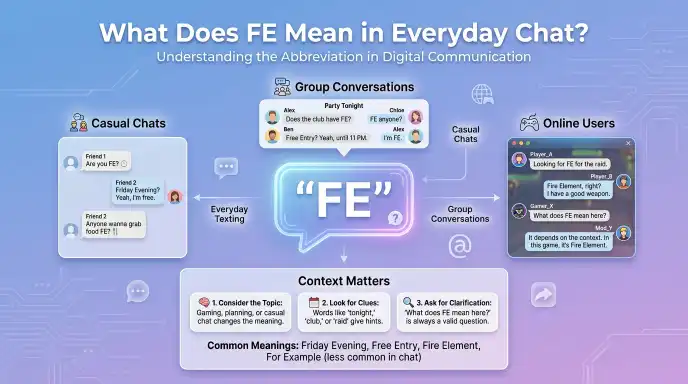
In everyday chat, FE is usually a short acknowledgment.
Imagine a friend says:
“I didn’t go to the party because I wasn’t feeling well.”
You might answer:
“FE.”
Your response basically means “Fair enough.”
It can be useful when you do not need to write a long response.
FE can also appear in a conversation where two people have different opinions.
A: I prefer the old version.
B: I actually like the new one.
A: FE.
In this situation, A is accepting B’s opinion without necessarily agreeing with it.
Where People Use FE
FE can appear across several online platforms. Its casual meaning is most likely when people are having normal conversations with friends, classmates, coworkers, or online contacts.
FE on TikTok
On TikTok, people use many short expressions in comments and messages.
If someone explains their opinion and another person replies “FE,” it can mean “fair enough.”
Example of a TikTok comment:
Person A: I stopped watching the show because the new season felt boring.
Person B: FE.
Here, Person B is saying that the reason is understandable.
However, not every FE on TikTok will have this meaning. If it appears in a particular community, caption, username, or specialized discussion, the surrounding context should be checked.
FE on Snapchat
Snapchat conversations are often quick and informal, which makes short abbreviations useful.
A person might use FE after receiving an explanation.
Example of a Snapchat chat:
Friend: Can’t meet today. My family needs me at home.
You: FE.
The response means “Fair enough.”
It is short, casual, and easy to understand when both people know the context.
FE on Instagram
On Instagram, FE may appear in direct messages, comments, or replies.
Example of an Instagram DM:
A: I’m not buying it. It’s too expensive.
B: FE.
B is accepting A’s reasoning.
You may also see FE in discussions about hobbies, entertainment, relationships, shopping, or everyday plans.
FE on WhatsApp
WhatsApp is another place where people may use FE as a quick reply.
Example of a WhatsApp conversation:
A: I’ll be late. Traffic is terrible.
B: FE, just get here safely.
In this example, FE means “fair enough.”
Because WhatsApp conversations are often informal, people may use abbreviations without explaining them.
FE in SMS
FE can also be used in regular SMS texting.
Example of an SMS conversation:
A: I can’t lend you my car tonight because I need it tomorrow morning.
B: FE.
The reply shows that B understands the reason.
In short messages, however, context is especially important. If there is not enough information around FE, you may need to ask what the person means.
Real Chat Examples of FE
Here are some realistic situations showing how FE can be used in normal conversations.
Example of Accepting a Reason
A: Why didn’t you come yesterday?
B: I had a family thing to deal with.
A: FE.
Here, A accepts B’s explanation.
Example of Understanding a Friend
A: I don’t want to go out tonight. I’m exhausted.
B: FE. You should rest.
A: Thanks.
FE shows understanding.
Example of a Small Disagreement
A: I think the old movie was better.
B: I liked the new one more.
A: FE. Everyone has different tastes.
Here, FE helps keep the disagreement friendly.
Example of Changing Plans
A: Can we meet tomorrow instead? Something came up today.
B: FE. Tomorrow is fine.
A: Perfect.
The response accepts the change of plans.
Example of a School Conversation
A: I can’t stay after class. I have to catch my bus.
B: FE.
The person understands why their friend has to leave.
Example of a Work Conversation
A: I’ll send the document tomorrow. I need to check the numbers first.
B: FE.
The reply means the delay is reasonable.
Example of Canceling Plans
A: Sorry, I have to cancel dinner tonight.
B: FE. I hope everything’s okay.
A: Yeah, everything is fine.
Here, FE makes the response understanding rather than argumentative.
Example of Different Preferences
A: I don’t really like spicy food.
B: FE. It isn’t for everyone.
The speaker accepts the other person’s preference.
Example of an Online Discussion
A: I stopped playing because the updates made the game less fun.
B: FE. I can understand that.
The response acknowledges the person’s reason.
Example of a Very Short Reply
A: I chose the blue one because it matches my room.
B: FE.
This is a very short way of saying “Fair enough.”
How to Reply When Someone Says “FE”
When someone sends FE, you usually do not need a complicated response. The best reply depends on the tone and topic of the conversation.
Funny Replies
If you are talking with a close friend, you can make your response playful.
“That’s it? FE? 😂”
“Fair enough indeed.”
“I’ll accept that.”
“Case closed, I guess.”
These responses work best when the conversation is already relaxed.
Casual Replies
For normal conversations, you can simply continue naturally.
“Exactly.”
“Yeah, pretty much.”
“True.”
“Yep.”
“That’s what I thought.”
These replies keep the conversation short and easy.
Friendly Replies
If you want to sound warmer, you could say:
“Thanks for understanding.”
“I appreciate it.”
“Exactly, that’s what I meant.”
“Glad you understand.”
These are useful when someone has accepted your explanation.
Neutral Replies
Sometimes you can simply move the conversation forward.
“Anyway, what are you doing later?”
“So, are we still meeting tomorrow?”
“Okay, sounds good.”
“No worries.”
You do not always need to respond directly to the abbreviation itself.
Is FE Rude or Offensive?
FE is generally not rude or offensive when it means “fair enough.”
It is normally a neutral and casual expression. People use it to show that they understand or accept another person’s point.
However, the tone can change depending on the situation.
A message containing only “FE.” can sometimes feel dry or uninterested because it is so short.
For example, if someone says:
“I’m really upset about what happened today.”
and you reply:
“FE.”
That could sound cold because the situation may require a more caring response.
A better response might be:
“FE. I understand why you’re upset.”
Is FE Safe to Use?
Yes, FE is generally safe for casual conversations when you mean “fair enough.”
It is not normally offensive, vulgar, or insulting.
Still, you should make sure the other person understands the abbreviation. Not everyone knows every texting shortcut.
Is FE Appropriate at School?
In a casual message to a friend or classmate, FE can be fine.
However, you should usually avoid abbreviations like FE in formal school assignments, essays, presentations, or official communication.
For example, writing “FE” in a formal essay when you mean “fair enough” would not be appropriate.
Is FE Appropriate at Work?
In a casual workplace chat, FE may be understandable if your team commonly uses texting abbreviations.
But in a formal email, report, business proposal, or professional document, it is better to write the full phrase or use a clearer sentence.
Instead of:
“FE.”
you could write:
“That makes sense.”
or:
“That seems reasonable.”
This sounds more professional.
Who Uses FE in Text?
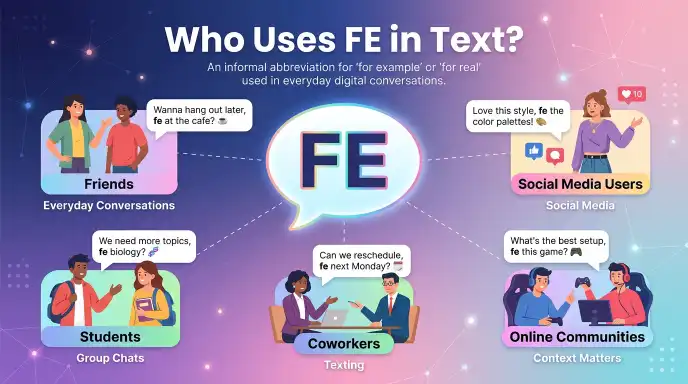
FE can be used by different age groups, especially people who regularly communicate through digital messaging.
Teenagers and Young Adults
Teenagers and young adults may use short abbreviations because quick replies are common in online conversations.
They may use FE when chatting with friends, classmates, or online contacts.
Gen Z Usage
Gen Z users are familiar with many abbreviations and shortened expressions.
However, that does not mean every Gen Z user regularly uses FE. Some people prefer writing “fair enough” in full, while others may simply say “true,” “okay,” or “makes sense.”
Its use depends heavily on personal texting style.
Common Platforms
You may encounter FE in:
TikTok comments
Snapchat chats
Instagram DMs
WhatsApp messages
SMS texts
Online communities
Its appearance is more likely in informal conversations than in formal writing.
How Often Does FE Appear Online?
FE is not necessarily one of the most frequently used texting abbreviations. Many people recognize “fair enough” but simply type the full phrase.
That means FE can be understood in context without being universally common.
If someone uses it, the conversation around it is usually enough to reveal the intended meaning.
Origin of the Term
The exact origin of using FE as a short form for “fair enough” is difficult to pin down.
The phrase “fair enough” itself is much older than internet texting. People have used it in ordinary spoken and written English to show acceptance of a reasonable point.
The abbreviation likely became more useful as online messaging and texting culture grew.
People often shorten common phrases because typing a few letters is faster than writing the complete expression.
Internet Culture and FE
The growth of chat rooms, instant messaging, texting, and social media created an environment where short responses became normal.
Expressions such as IDK, IDC, BRB, and other abbreviations became popular because they save time and fit naturally into fast conversations.
FE follows the same basic idea.
Its history is therefore less about one specific person creating the abbreviation and more about the general development of digital communication.
Because there is no single universally accepted origin story for FE in this meaning, it is better to describe its origin as uncertain rather than claiming a specific source.
FE vs IDK, IDC, IMO, and BRB
These abbreviations are not interchangeable. Each one has a different purpose in a conversation.
| Term | Meaning | Type | Usage | Popularity |
| FE | Fair Enough | Abbreviation | Shows acceptance or understanding | Moderate |
| IDK | I Don’t Know | Initialism | Shows uncertainty or lack of knowledge | Very High |
| IDC | I Don’t Care | Initialism | Shows lack of concern or interest | High |
| IMO | In My Opinion | Initialism | Introduces a personal opinion | High |
| BRB | Be Right Back | Initialism | Says someone will return shortly | High |
The biggest difference is the purpose of each abbreviation.
FE responds to someone’s point.
IDK shows uncertainty.
IDC shows that something does not matter to the speaker.
IMO introduces an opinion.
BRB tells someone that the speaker is temporarily leaving the conversation.
Understanding these differences can help you avoid confusing one abbreviation with another.
Real-World Usage Example
Imagine two classmates are making plans to study together after school.
One student says:
“I can’t stay until 5 because my ride comes at 4.”
The other student replies:
“FE. Let’s start earlier.”
Here, FE means “Fair enough.”
The second student understands the transportation problem and adjusts the plan.
This is a good example of how FE works in real conversation. It does not add a lot of information by itself. Instead, it shows that the speaker has accepted the explanation.
Another real-world situation could happen in a group chat.
Someone might say:
“I’m not joining the game tonight because I have work early tomorrow.”
Another person could respond:
“FE. Maybe tomorrow.”
Again, the abbreviation simply acknowledges the reason.
Understanding FE From Context
Context is especially important when you see FE online.
If someone sends:
“I can’t go tonight.”
and you respond:
“FE.”
the meaning is probably “fair enough.”
But imagine seeing:
“FE is used in this scientific formula.”
That is clearly a different situation.
The same two letters can have different meanings in education, science, technology, business, gaming, and online communities.
Before interpreting an abbreviation, look at the words around it.
Ask yourself:
What are they talking about?
Is this a casual conversation?
Does “fair enough” make sense here?
Are they discussing a technical subject?
This simple check can prevent misunderstandings.
Capital Letters vs Lowercase FE
You may see the abbreviation written as FE, Fe, or fe.
In casual texting, capitalization usually does not change the intended meaning.
For example:
“FE”
“fe”
Both may mean “fair enough” when used in the right context.
However, capitalization can matter in specialized subjects. That is another reason context is important.
In casual messaging, people often type abbreviations however they prefer because texting is less formal than standard writing.
Frequently Asked Questions
Q1. What does FE mean in text messages?
FE usually means “fair enough” in casual text messages. It shows that someone understands or accepts another person’s point or explanation.
Q2. What does FE mean on TikTok?
On TikTok, FE can mean “fair enough” when used as a reply to someone’s explanation or opinion. The exact meaning still depends on the context.
Q3. Is FE slang?
FE is generally an abbreviation, rather than traditional slang, when it means “fair enough.” It is used as a shortened form in casual digital communication.
Q4. Is FE rude or offensive?
No, FE is generally not rude or offensive. However, replying with only “FE” can sometimes sound dry or dismissive depending on the conversation.
Q5. How should you reply to FE?
You can reply with “Exactly,” “True,” “Thanks for understanding,” or simply continue the conversation. The best response depends on the context and tone.
Conclusion:
So, what does FE mean in text? In casual online conversations, FE usually means “fair enough.” It is a short way to show that you understand, accept, or recognize someone’s point.
You may see it in TikTok comments, Snapchat, Instagram, WhatsApp, SMS, and other informal chats. It can be useful when you want to acknowledge someone’s explanation without writing a long response.
FE is generally not rude or offensive, but it may sound a little dry when used by itself in a serious conversation. For schoolwork, formal emails, or professional writing, writing the full phrase or using a clearer sentence is usually better.
Most importantly, always consider the context. FE can have different meanings outside casual texting, so the surrounding conversation helps you understand what the writer actually means.