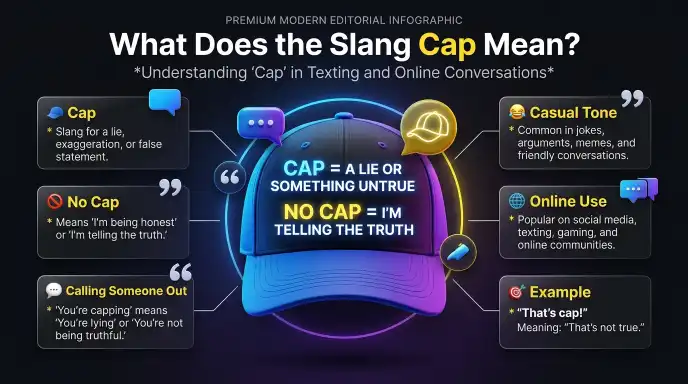
Cap in slang means a lie, false statement, or exaggeration. When someone says “you’re capping,” they mean you are not telling the truth or are making something sound bigger than it really is. What does the slang cap mean? In informal English, cap means a lie, false claim, or exaggeration.
When someone says “That’s cap,” they usually mean “That’s not true” or “I don’t believe you.” The related phrase “no cap” means “no lie,” “for real,” or “I’m being honest.”
People often search for what the slang cap means because “cap” has a normal English meaning too. In a text, comment, gaming chat, or social media post, its meaning can change with the context. This guide explains how cap, capping, and no cap are used, what they mean, where they came from, and when they may sound too informal.
Quick Answer: What Does the Slang Cap Mean?
In slang, cap means a lie, false statement, or exaggeration. “That’s cap” means “That’s not true,” while “no cap” means “I’m telling the truth” or “I’m being serious.”
What Does the Slang Cap Mean in Text?
The slang cap usually means that someone is lying, exaggerating, or making a claim that the speaker does not believe.
For example:
“You ran 20 miles before breakfast? That’s a cap.”
The speaker is saying that the claim sounds false or exaggerated.
Cap is usually used in short, informal conversations. It can be serious, but it is also often playful between friends.
What Does “That’s Cap” Mean?
“That’s cap” is one of the most common forms of the expression.
It can mean:
- That is a lie.
- That is not true.
- You are exaggerating.
- I do not believe you.
The exact tone depends on the conversation.
If a friend says, “I can eat five large pizzas,” another friend might reply, “That’s cap 😂.” The response is probably teasing rather than accusing the person of serious dishonesty.
What Does “Capping” Mean?
Capping is the verb form of cap.
When someone says:
“You’re capping.”
they mean:
“You’re lying” or “You’re exaggerating.”
For example:
“Stop capping. You know you didn’t finish the whole project in one hour.”
Here, the speaker thinks the other person is not being truthful.
Full Form and Definition of Cap Slang
Cap does not have a traditional full form. It is not an acronym like LOL, BRB, or IDK.
In slang, cap is simply a word that has developed an additional informal meaning.
| Slang expression | Meaning |
| Cap | A lie or exaggeration |
| That’s cap | That is not true |
| Capping | Lying or exaggerating |
| Stop capping | Stop lying or exaggerating |
| No cap | No lie; for real |
| No cap, seriously | I am being completely honest |
So, if someone asks “What does cap stand for?” The simple answer is that it does not stand for a longer phrase in this slang use.
What Does “No Cap” Mean?
“No cap” means that someone is being honest, serious, or truthful.
It is often used to add emphasis to a statement.
For example:
“No cap, that was the best burger I’ve ever had.”
The speaker is saying that they genuinely mean it.
You may also see:
“No cap, I was so nervous.”
Here, the phrase tells the reader that the speaker is not exaggerating.
“No cap” is closely connected to the slang meaning of cap, but it does not mean the same thing as cap by itself.
Cap vs. No Cap
| Expression | Meaning |
| Cap | A lie or exaggeration |
| No cap | Truth or honesty |
| That’s cap | I do not believe you |
| You’re capping | You are lying or exaggerating |
| No cap, seriously | I genuinely mean this |
This simple contrast makes the slang easier to understand.
Different Meanings of Cap in Slang
The slang meaning of cap is usually connected to dishonesty or exaggeration, but the exact use can vary.
Cap as a Lie
The most common meaning is a lie or false claim.
“He said he never missed a day of school. That’s a cap.”
The speaker believes the statement is untrue.
Cap as Exaggeration
Cap can also refer to exaggerating something.
A person may not be completely lying. They may simply be making a story sound more impressive than it really is.
“You’re capping if you say you finished that game in ten minutes.”
The speaker thinks the claim is unrealistic or overstated.
Cap as Doubt
Sometimes people use cap simply to show that they do not believe what someone said.
For example:
“I got a perfect score without studying.”
“Cap.”
The one-word reply means, “I don’t believe you.”
This use is common in quick online conversations.
Where Is Cap Commonly Used?
Cap is mainly used in casual speech and informal online communication. It can appear in texts, social media comments, gaming chats, and conversations between friends.
The meaning does not usually change across these platforms, but the tone can.
Cap in Texting
Text messages often use very short forms:
“That’s cap.”
“Stop capping 😂.”
“No cap.”
These messages are quick and easy to understand when both people know the slang.
Cap on TikTok and Instagram
On social media, people may use cap when reacting to a claim, story, video, or comment.
For example:
“Bro said this works every time. Cap.”
“No cap” is also common when someone wants to emphasize a strong opinion.
“This is the best song on the album, no cap.”
Cap on Discord
Discord users may use cap in casual conversations, especially in gaming or community chats.
For example:
“You got that rare item on your first try?”
“Yeah.”
“Cap.”
The speaker is saying they doubt the claim.
Cap in Gaming
Gamers often use caps when questioning another player’s achievement or story.
For example:
“I won the whole match by myself.”
“That’s a cap.”
It can be playful, competitive, or genuinely doubtful depending on the players.
Is Cap Rude, Offensive, or Neutral?
Cap is generally informal and not offensive. However, it can sound rude if you use it to directly accuse someone of lying.
The context matters.
| Context | Tone of “cap” |
| Close friends | Often playful |
| Gaming | Casual or teasing |
| Social media | Casual or challenging |
| Argument | Can sound confrontational |
| School | Informal |
| Workplace | Usually too casual |
For example:
“That’s cap 😂”
may be harmless among friends.
But saying:
“Your explanation is cap.”
during a serious discussion could sound dismissive.
Cap is therefore best treated as casual slang, not formal language.
Real-Life Examples of Cap Slang
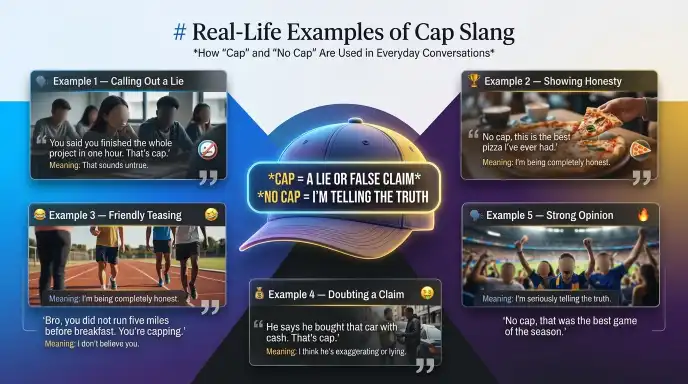
Friendly Example
“I could finish this entire cake myself.”
“Cap 😂.”
The response is probably playful. The friend is joking that the claim is not believable.
Casual Example
“I found those shoes for only $20.”
“No cap?”
Here, the person is asking if the claim is really true.
Argumentative Example
“You never sent me the details.”
“That’s Cap. I sent them yesterday.”
In this situation, cap is being used more seriously. The speaker directly rejects the other person’s statement.
Gaming Example
“I beat the final boss without losing any health.”
“Bro, that’s Cap.”
The speaker doubts the gaming claim.
Social Media Example
“This trick makes your battery last twice as long. No cap.”
Here, no cap is being used to stress that the person claims to be serious and truthful.
Origin and Background of Cap Slang
The slang sense of cap has roots in African American English and Black American speech. It later spread more widely through music, popular culture, and online communication.
The exact history of the expression is more complex than simply saying that it “started on the internet.” The slang meaning existed before its widespread use on social media.
The related phrase “no cap” became especially visible in hip-hop and popular online culture before becoming common in broader informal English.
The word also has older expressions connected with “capping,” which makes simple one-line origin stories unreliable. The modern slang sense is best understood as part of a longer history of informal American English rather than as a term invented by TikTok or texting.
Today, “cap” and “no cap” are widely recognized in casual online communication.
Cap vs. Lie: What Is the Difference?
Cap and lie are close in meaning, but they do not always carry the same tone.
“Lie” is a normal English word and can be used in formal or serious situations.
“Cap” is casual slang.
For example:
“He lied about his age.”
This sounds neutral and direct.
“He was capping about his age.”
This sounds informal and conversational.
Cap can also suggest exaggeration rather than deliberate deception. Someone may say “That’s cap” because a story sounds unrealistic, even if they cannot prove the person is intentionally lying.
That is why context matters.
Comparison With Similar Slang
Several slang expressions can be used when someone doubts a statement.
| Slang | Meaning | Tone |
| Cap | Lie or exaggeration | Casual |
| No cap | Honestly; for real | Casual |
| Capping | Lying or exaggerating | Casual |
| For real | Seriously; honestly | Casual |
| Fake | Not genuine or believable | Casual |
| BS | Nonsense or something untrue | More blunt |
“Cap” is often softer or more playful than directly calling someone a liar, but this depends on tone and context.
When Should You Avoid Using Cap?
Cap is easy to understand in casual conversations, but there are situations where plain English is better.
Avoid using it when:
- You are writing a formal email.
- You are speaking in a professional meeting.
- You are communicating with someone unfamiliar with slang.
- You are discussing a serious accusation.
- You need to make your meaning completely clear.
- You are writing an academic assignment.
Instead of:
“That’s a cap.”
you could say:
“I’m not sure that is accurate.”
Instead of:
“You’re capping.”
you could say:
“I think you may be exaggerating.”
These alternatives are clearer and more polite in formal situations.
Polite Alternatives to Cap
If you want to challenge a statement without sounding harsh, choose a phrase that matches the situation.
Casual Alternatives
- “Really?”
- “Are you serious?”
- “No way.”
- “For real?”
- “I’m not sure about that.”
More Polite Alternatives
- “Is that accurate?”
- “Are you sure about that?”
- “I’m not sure I believe that.”
- “That sounds a little exaggerated.”
- “Could you explain that?”
These options are useful when speaking with teachers, parents, coworkers, or people you do not know well.
Why Do People Use Cap Slang?
People use caps because they are short and expressive.
Instead of saying:
“I think you are exaggerating and I do not believe your statement.”
someone can simply say:
“That’s a cap.”
The slang also adds personality to casual conversations. Among friends, it can make a response sound playful or teasing.
“No cap” works in the opposite direction. It lets someone emphasize that they are being sincere.
For example:
“No cap, I was scared.”
The phrase adds extra emphasis without requiring a long explanation.
Impact of Using Cap in Communication
Using a cap can make casual communication faster and more natural when everyone understands the slang.
It can also create problems when the listener does not know what it means.
For example, someone unfamiliar with internet slang may understand “cap” as a hat. That can make the message confusing.
Tone is another issue. A playful “cap 😂” between friends may be harmless, while “You’re capping” during an argument may feel like a direct accusation.
The safest approach is simple: use cap with people who understand informal slang, and choose plain English when clarity matters more than style.
Is Cap Safe for Social Media?
Yes. Cap is generally harmless slang and is commonly used in casual online conversations.
It is not inherently offensive or dangerous. The main concern is tone.
Calling someone a liar publicly can start an argument, even when you use a casual word like cap. It is better to consider the situation before accusing someone of “capping.”
On public posts, a softer response such as “Are you sure?” may be more respectful.
Frequently Asked Questions
Q1. What does the slang cap mean?
Cap means a lie, false claim, or exaggeration. “That’s cap” means “That’s not true” or “I don’t believe you.”
Q2. What does no cap mean?
“No cap” means “no lie,” “for real,” or “I’m being honest.” It is used to emphasize that someone is serious or truthful.
Q3. What does capping mean in slang?
Capping means lying or exaggerating. If someone says “You’re capping,” they are saying that they think you are not telling the truth.
Q4. Is cap a rude word?
Cap is not normally offensive, but it can sound rude when used to accuse someone of lying. Its tone depends on the situation and relationship between the speakers.
Q5. Is cap used on social media?
Yes. Cap and no cap are common in informal online communication, including social media comments, texting, gaming chats, and other casual conversations.
Q6. Does cap stand for anything?
No. In this slang use, cap is not an acronym and does not have a traditional full form. It is an informal word meaning a lie or exaggeration.
Conclusion: What Does the Slang Cap Mean?
What does the slang cap mean? It usually means a lie, false claim, or exaggeration. “That’s cap” tells someone that you do not believe their statement, while “no cap” emphasizes that a person is being honest or serious.
The slang is common in casual conversations, texting, gaming, and social media. It is generally harmless, but it can sound confrontational when used to accuse someone of lying.
The key is context. Use cap with friends and other people who understand informal slang. For school, work, or serious conversations, plain English is usually the clearer choice.

I’m Emily Carter, and I enjoy writing about slang, internet language, and modern English expressions. My goal is to explain word meanings in a simple, clear, and easy-to-understand way so anyone can learn with confidence.