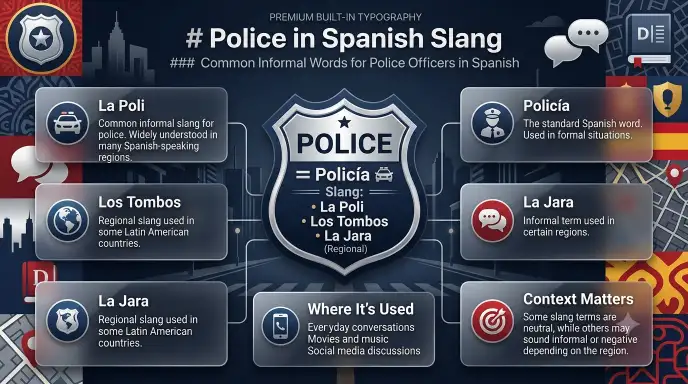
Police in Spanish slang refers to informal Spanish words used to talk about police officers, law enforcement, or authorities. Common slang terms include “la policía,” “los polis,” “los pacos,” and other regional expressions that change depending on the country and context.
People search for police in spanish slang because they often hear these words in movies, songs, social media posts, online conversations, or Spanish-speaking communities. Unlike standard Spanish, slang terms for police can show humor, fear, respect, criticism, or simply casual speech.
The meaning depends heavily on the country. A word that sounds normal in one Spanish-speaking region may sound disrespectful somewhere else. This guide explains the most common police slang terms, their meanings, where they are used, and how to understand them correctly.
Quick Answer: Police in Spanish Slang
Police in Spanish slang can be expressed with words like “polis,” “pacos,” or other regional terms. Some are neutral and casual, while others may sound negative depending on the country, speaker, and situation.
What Does Police in Spanish Slang Mean?
Police in Spanish slang does not refer to one single word. Spanish-speaking countries have developed different informal terms for police officers over time.
The most common examples include:
| Slang Term | Meaning | Common Region | Tone |
| Polis | Police officers | Many Spanish-speaking areas | Casual |
| Pacos | Police officers | Chile and some other regions | Often informal |
| La poli | The police | Several Latin American countries | Casual |
| La tira | Police | Mexico (regional) | Informal |
| Los tombos | Police officers | Colombia and some areas | Informal |
The correct meaning depends on:
- The country
- The speaker’s attitude
- The situation
- If the conversation is serious or casual
Some people use these words simply because they are shorter and more natural in everyday speech. Others may use them to criticize or joke about law enforcement.
Full Form and Definition of Police Slang in Spanish
Does Police in Spanish Slang Have a Full Form?
No. Police slang terms in Spanish are not abbreviations and do not have a full form like internet acronyms.
They are informal words that developed through everyday conversations.
Common Definitions
Polis: A casual way to say police officers. It is similar to saying “cops” in English.
Pacos: A slang word for police officers mainly associated with Chile. The tone can be neutral, humorous, or negative depending on the speaker.
La poli: A shortened informal form of “la policía” meaning “the police.”
Los tombos: A Colombian slang term for police officers.
Different Meanings of Police in Spanish Slang
Because Spanish is spoken across many countries, police slang has different meanings in different places.
Polis Meaning
“Polis” is one of the easiest slang words for English speakers to understand because it works similarly to the English word “cops.”
Example:
“Los polis llegaron rápido.”
Meaning:
“The cops arrived quickly.”
This term is usually casual and does not automatically sound offensive.
Pacos Meaning
“Pacos” is commonly used in Chile to refer to police officers.
The tone changes depending on the situation.
It may be used:
- As a normal informal term
- In jokes
- In criticism of police actions
Example:
“Los pacos están cerca.”
Meaning:
“The police are nearby.”
La Poli Meaning
“La poli” is a shortened version of “la policía.”
It is often used in everyday speech because it sounds quicker and more relaxed.
Example:
“Llama a la poli.”
Meaning:
“Call the police.”
This use is usually understandable in casual conversations.
Is Police in Spanish Slang Rude, Offensive, or Neutral?
Police slang in Spanish can be neutral, negative, or humorous depending on the word and context.
The same term may sound completely different depending on who says it.
| Usage Situation | Possible Tone |
| Talking with friends | Casual |
| News discussion | Neutral |
| Protest conversations | Sometimes negative |
| Jokes or memes | Humorous |
| Insults toward police | Negative |
A person saying “los polis” while telling a story may simply mean “the police.” However, someone using another slang term during an argument may express anger or criticism.
Context matters more than the word itself.
Where Is Police in Spanish Slang Commonly Used?
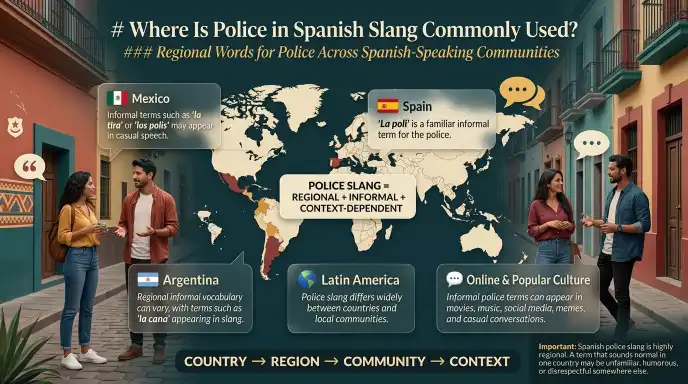
Police slang appears mostly in informal communication.
You may see these terms in:
- Text messages
- Social media comments
- TikTok videos
- Instagram posts
- Reddit discussions
- YouTube comments
- Movies and TV shows
- Music lyrics
- Online communities
They are less common in formal writing, official documents, or professional communication.
Social Media Usage
On platforms like TikTok and Instagram, users often use slang because it makes conversations shorter and more natural.
Examples:
- Talking about a local event
- Discussing a news story
- Sharing a personal experience
- Making jokes or memes
Gaming and Online Communities
In gaming chats and Discord communities, Spanish speakers may use informal police words when discussing:
- Role-playing games
- Crime-themed games
- Server rules
- Police characters
The meaning usually depends on the game context.
Real-Life Examples of Police in Spanish Slang Usage
The meaning of police slang becomes easier to understand when you see how people use it in normal conversations. The examples below show different tones, from neutral to negative.
Friendly or Casual Conversation
Spanish: “Los polis ya se fueron.”
English: “The cops already left.”
Meaning: The speaker is casually talking about police officers. There is no strong emotion behind the word.
Tone: Neutral and informal.
Text Message Example
Mensaje: “Cuidado, hay polis cerca.”
English: “Be careful, there are police nearby.”
Meaning: Someone is warning a friend about police presence.
Tone: Casual and practical.
Social Media Example
Post: “La poli llegó en cinco minutos.”
English: “The police arrived in five minutes.”
Meaning: A person is describing a situation online and using a shorter informal word instead of “la policía.”
Tone: Everyday conversation.
Argumentative Context
Spanish: “Siempre defienden a los polis.”
English: “They always defend the police.”
Meaning: Here, the word may appear in a discussion about law enforcement. The speaker’s opinion depends on the larger conversation.
Tone: Could be neutral or critical.
Gaming or Online Community Example
Spanish: “Los polis vienen por la zona.”
English: “The police are coming to the area.”
Meaning: In a game or role-playing environment, the word may simply describe police characters.
Tone: Informal gaming language.
Origin and Background of Police in Spanish Slang
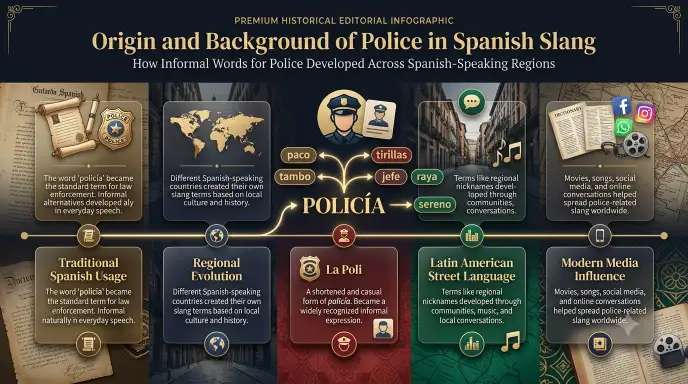
Spanish police slang developed naturally through everyday speech in different Spanish speaking communities. Unlike some internet slang terms, these expressions did not come from one specific online trend.
Many slang words for police developed because people often shorten common words or create informal nicknames for groups and professions.
Origin of “Polis”
The term “polis” is a shortened informal form related to “policía.” It follows a common pattern in Spanish where longer words are shortened in casual speech.
Similar examples exist in many languages:
- English: police → cops
- Spanish: policía → polis
Origin of “Pacos”
The history of “pacos” is more regional and is strongly connected with Chilean Spanish. Different explanations exist about how the word developed, but the exact origin is not completely certain.
Because slang history can be difficult to verify, it is better to treat many origin stories as possibilities rather than proven facts.
Regional Development
Police slang changes because Spanish is spoken across many countries, including:
- Mexico
- Spain
- Chile
- Colombia
- Argentina
- Peru
- Puerto Rico
- Dominican Republic
Each region creates its own expressions based on local culture, history, and social experiences.
Comparison With Similar Police Slang Terms
Different Spanish-speaking communities use different informal words for police.
| Term | Meaning | Region | Tone |
| Polis | Police officers | Many Spanish speaking regions | Casual |
| Pacos | Police officers | Chile | Informal, sometimes negative |
| La poli | The police | Several countries | Neutral/casual |
| Tombos | Police officers | Colombia | Informal |
| Cops | Police officers | English influence | Casual in bilingual settings |
A Spanish learner should avoid assuming that all these words have the same feeling. Some are common everyday terms, while others may carry stronger regional meanings.
When to Avoid Using Police in Spanish Slang
Police slang is mainly for informal conversations. It is not always suitable in formal situations.
Avoid using slang terms when:
- Writing official documents
- Speaking in a workplace setting
- Talking with government officials
- Writing academic assignments
- Giving a formal presentation
- Speaking with people you do not know well
For formal situations, use:
- La policía (the police)
- Los agentes de policía (police officers)
- Las autoridades (the authorities)
These words sound more professional and respectful.
Polite Alternatives to Police Slang
If you want to speak clearly and avoid regional misunderstandings, standard Spanish words are better choices.
| Spanish Word | English Meaning | Usage |
| La policía | The police | General and safe |
| Oficial de policía | Police officer | Formal |
| Agente | Officer/agent | Professional |
| Autoridades | Authorities | Formal discussions |
These alternatives work across most Spanish-speaking countries.
Why Do People Use Police in Spanish Slang?
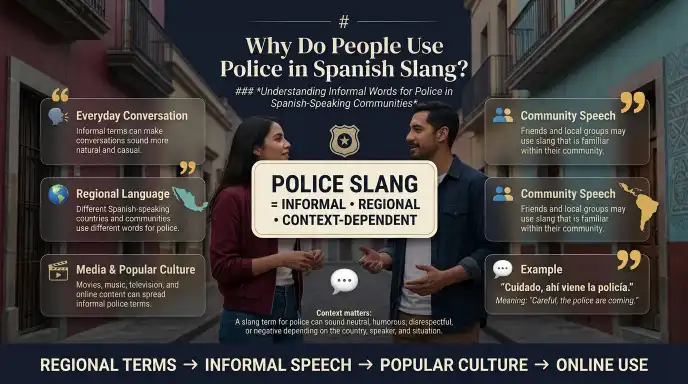
People use police slang for several reasons.
Shorter Communication
Informal words are often faster to say and easier to use in conversations.
Example:
“Los polis llegaron.”
is shorter than:
“La policía llegó al lugar.”
Social Connection
Friends often use slang because it makes conversations feel relaxed and natural.
Cultural Identity
Regional slang helps people express where they come from and connect with their community.
Media Influence
Movies, music, TikTok, and online discussions spread slang between different groups. However, a word popular in one region may not have the same meaning everywhere.
Impact of Using Police Slang in Communication
Using slang can make conversations sound more natural, but it can also create confusion.
Positive Effects
Police slang can:
- Make speech feel casual
- Help people connect socially
- Match local communication styles
- Make conversations shorter
Possible Problems
It can also:
- Sound disrespectful in formal settings
- Be misunderstood by Spanish learners
- Carry negative meanings in some regions
- Create confusion between countries
Understanding the audience is the key to using slang correctly.
Is Police in Spanish Slang Safe for Social Media?
Yes, most police slang terms in Spanish are generally safe to use on social media when they are used in a normal conversational way.
Words like “polis” or “la poli” are commonly used to talk about police officers casually. However, the meaning can change depending on the post, audience, and tone.
Before using police slang online, consider:
- The platform: A casual TikTok caption may allow more slang than a professional LinkedIn post.
- The audience: Friends may understand slang better than strangers.
- The context: A joke, news discussion, or serious topic can change the meaning.
For example:
Neutral post:
“Los polis llegaron rápido y ayudaron a la gente.”
Meaning:
“The police arrived quickly and helped people.”
This sounds respectful and neutral.
Critical discussion:
“Todos apoyan a los polis sin preguntar.”
Meaning:
“Everyone supports the police without asking questions.”
Here, the same type of word appears in a discussion with a stronger opinion.
The word itself is not always the problem. The surrounding message creates the meaning.
Common Misunderstandings About Police in Spanish Slang
Many Spanish learners misunderstand police slang because they expect one word to work the same way everywhere.
All Police Slang Is Not the Same
A common mistake is thinking every Spanish speaking country uses the same slang.
For example:
- “Polis” may be understood in many places.
- “Pacos” is strongly connected with Chilean Spanish.
- “Tombos” is more regional.
Using a regional term in the wrong place may sound unusual.
Slang Does Not Always Show Disrespect
Some people think slang words for police are automatically insulting.
That is not correct.
A person may use slang simply because it is common in their community.
Example:
“Los polis están aquí.”
This can simply mean:
“The police are here.”
There is no insult in the sentence.
Tone Changes the Meaning
The same word can sound different depending on the speaker’s attitude.
A calm conversation:
“Los polis llegaron temprano.”
Meaning:
“The police arrived early.”
An angry statement:
“Esos polis siempre hacen eso.”
Meaning:
“Those cops always do that.”
The second example may express frustration, depending on the situation.
Can You Use Police in Spanish Slang at Work or School?
Usually, it is better to avoid slang in formal environments.
In professional or educational settings, use standard Spanish instead.
Better choices include:
- La policía
- Los agentes de policía
- Las autoridades
Slang is better for:
- Friends
- Casual chats
- Informal online conversations
- Personal messages
Professional communication usually requires clearer and more neutral language.
Frequently Asked Questions
Q1. What does police in Spanish slang mean?
Police in Spanish slang refers to informal words used for police officers, such as “polis,” “pacos,” or “la poli.” The meaning depends on the country and the speaker’s tone.
Q2. What is the Spanish slang word for police?
Common slang words include “polis” in many Spanish-speaking communities, “pacos” in Chile, and “tombos” in Colombia. Each term has its own regional meaning.
Q3. Is “polis” rude in Spanish?
Usually, “polis” is casual rather than rude. It is similar to saying “cops” in English. However, the tone and situation can affect how it sounds.
Q4. Can I use police slang in Spanish conversations?
Yes, but it is best used with people who understand the local slang. In formal situations, standard words like “la policía” are safer.
Q5. Is police slang used on TikTok and Instagram?
Yes. Spanish speakers may use police slang in captions, comments, videos, and discussions. The meaning depends on the topic and the creator’s tone.
Q6. What is the safest Spanish word for police?
“La policía” is the safest and most widely understood option. It works in casual and formal situations.
Conclusion:
Police in Spanish slang includes different informal words such as “polis,” “pacos,” and “tombos.” These expressions do not have one universal meaning because Spanish speaking countries use slang differently.
Some terms are simply casual ways to say “police,” while others may carry regional or emotional meanings. The most important factors are context, tone, and location.
If you are learning Spanish, start with the standard term “la policía” and learn slang expressions gradually through real conversations. Understanding when and where a slang word is used will help you communicate naturally while avoiding misunderstandings.