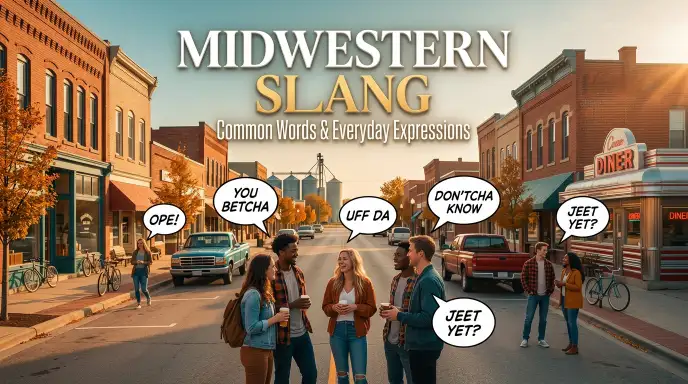
Midwestern slang refers to the informal words, phrases, and expressions commonly used by people in the American Midwest. These terms often reflect the region’s culture, friendliness, and everyday lifestyle.
While some Midwestern slang is unique to states like Minnesota, Wisconsin, Illinois, Iowa, Michigan, Ohio, Indiana, Missouri, Nebraska, Kansas, and the Dakotas, many expressions have spread through social media and online conversations.
People search for midwestern slang because they hear unfamiliar expressions in movies, TV shows, TikTok videos, Reddit discussions, or while talking to someone from the Midwest. Some phrases sound unusual to people from other parts of the United States, but they are perfectly normal within the region.
Learning these expressions helps you understand conversations, local humor, and regional culture more easily. In this guide, you’ll discover what Midwestern slang means, where it is used, if it is considered rude, and how native speakers naturally use it in everyday life.
Quick Answer: Midwestern Slang
Midwestern slang is a collection of casual words and phrases commonly used in the Midwestern United States. Most expressions are friendly, informal, and rooted in regional culture, making conversations sound warm, polite, and easygoing.
What Does Midwestern Slang Mean in Text?
Midwestern slang refers to regional expressions people from the American Midwest use in conversations, text messages, and sometimes on social media. Unlike internet abbreviations such as “LOL” or “BRB,” Midwestern slang usually consists of everyday words or phrases rather than shortened text.
For example, someone from Wisconsin might text:
“Ope, sorry! I didn’t see your message.”
Here, “ope” is a classic Midwestern expression used when someone makes a small mistake or accidentally bumps into something.
Another person might say:
“You bet!”
This simply means:
- You’re welcome.
- Absolutely.
- Of course.
Many Midwestern expressions sound very polite because the region is known for its friendly communication style.
What Makes Midwestern Slang Different?
Unlike internet slang that changes quickly, many Midwestern expressions have been passed down through families and local communities for generations.
These phrases often:
- Show friendliness.
- Make conversations feel relaxed.
- Reflect local traditions.
- Create a sense of community.
- Express politeness without sounding formal.
That is why people from other regions sometimes notice Midwestern speech immediately.
Definition of Midwestern Slang
Midwestern slang is not a single word or abbreviation. Instead, it describes the collection of informal expressions commonly spoken throughout the Midwestern United States.
These expressions may vary by state, city, or even small towns.
For example:
| Expression | Meaning |
| Ope | A quick apology or reaction after a small mistake |
| You Bet | Certainly or You’re welcome |
| Uff Da | Surprise, frustration, or amazement (especially in Minnesota) |
| Pop | Soft drink or soda |
| Hotdish | A baked casserole meal popular in parts of the Midwest |
Not every Midwesterner uses every expression, but many are widely recognized across the region.
Different Types of Midwestern Slang
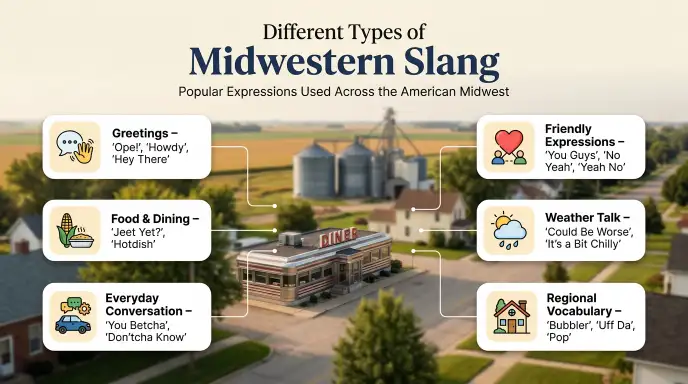
Because the Midwest covers many states, its slang is not exactly the same everywhere.
Friendly Expressions
Many Midwestern sayings help people sound kind and welcoming.
Examples include:
- You bet.
- No problem.
- Sure thing.
- Sounds good.
These phrases are common in everyday conversations.
Regional Vocabulary
Some words describe everyday objects differently from other parts of the country.
Examples include:
- Pop instead of soda.
- Hotdish instead of casserole.
- Bubbler (in some areas) instead of drinking fountain.
These differences often surprise visitors.
Weather Related Expressions
The Midwest experiences very cold winters and changing seasons.
People sometimes joke with phrases like:
- “It’s not that cold.”
- “Could be worse.”
- “Just another winter.”
These sayings reflect the region’s climate and sense of humor.
Farm and Small Town Language
Many Midwestern communities have strong farming traditions.
Because of this, some expressions come from rural life and agriculture.
Not everyone uses these terms today, but they remain part of the region’s identity.
Is Midwestern Slang Rude, Offensive, or Neutral?
Most Midwestern slang is completely neutral.
In fact, many expressions are known for sounding especially polite.
| Situation | Tone |
| Talking with friends | Friendly |
| Family conversations | Warm |
| School | Usually acceptable |
| Workplace | Depends on the expression |
| Social media | Casual |
| Formal business writing | Usually avoid regional slang |
Unlike some internet slang, Midwestern slang rarely contains offensive language.
However, individual words can have different meanings depending on the situation.
For example, playful teasing between close friends may sound rude if used with strangers.
That is why understanding the context is always important.
Can You Use Midwestern Slang at Work?
Some expressions work well in casual workplace conversations.
For example:
- “You bet!”
- “Sounds good.”
- “No worries.”
These are generally considered friendly and professional enough for informal office chats.
However, very regional words like “ope” or “hotdish” may confuse coworkers who are unfamiliar with Midwestern culture.
Where Is Midwestern Slang Commonly Used?
Midwestern slang appears both in everyday speech and online conversations.
Everyday Conversations
People naturally use these expressions while talking with family, neighbors, coworkers, and friends.
Text Messages
Friends often include Midwestern phrases in casual texting.
Example:
“Ope, I completely forgot about dinner.”
TikTok
Creators sometimes make funny videos about Midwestern accents and expressions.
These videos often introduce regional slang to people outside the Midwest.
Regional communities frequently discuss local sayings and compare expressions from different Midwestern states.
People sometimes use Midwestern slang in captions or comments to highlight their regional identity or share humorous experiences.
Discord
Friends from the Midwest may naturally use familiar expressions while chatting during games or community discussions.
Gaming
Although gaming slang is usually universal, Midwestern players sometimes include regional phrases while talking with teammates.
Family Gatherings
Many Midwestern expressions are learned at home and passed from one generation to the next.
Because of this, they remain an important part of local culture and identity.
Real Life Examples of Midwestern Slang
The meaning of Midwestern slang becomes much clearer when you see how people use it in everyday conversations. The tone is usually friendly, polite, and relaxed.
Friendly Conversation
Emma: “Thanks for helping me move today.”
Jake: “You bet!”
Here, “You bet!” means “You’re welcome” or “Happy to help.”
Casual Text Message
Alex: “Ope, I forgot my wallet.”
Ryan: “DW. We can come back later.”
“Ope” is a quick reaction to making a small mistake.
Family Conversation
Mom: “We’re having hotdish for dinner.”
Daughter: “Awesome! That’s my favorite.”
In many Midwestern homes, “hotdish” refers to a baked casserole-style meal.
At the Grocery Store
Customer: “Excuse me.”
Shopper: “Ope, sorry! Let me move.”
This is one of the most common real-life uses of “ope.”
Social Media
TikTok Caption:
“Only Midwestern people say ‘ope’ five times a day.”
Comments like this often celebrate regional culture with humor.
Gaming Chat
Player 1: “Ope, I pressed the wrong button.”
Player 2: “No worries. We’ll try again.”
Even while gaming, Midwestern players may naturally use familiar expressions.
Workplace Chat
Manager: “Can you finish this today?”
Employee: “You bet.”
This sounds friendly while still being respectful.
Origin and Background of Midwestern Slang
Midwestern slang developed over many generations as people from different cultural backgrounds settled in the American Midwest.
Large immigrant communities from countries such as Germany, Norway, Sweden, Finland, Poland, and Ireland influenced local speech. Over time, their words, pronunciation, and expressions blended with American English to create the regional style people recognize today.
Some expressions also grew from farming communities, small towns, and close-knit neighborhoods where friendly communication was highly valued.
Has Midwestern Slang Changed?
Yes.
Some traditional expressions are still very common, while others are becoming less frequent among younger generations.
At the same time, social media has introduced classic Midwestern sayings to people around the world. Videos about phrases like “ope” and “you bet” regularly appear on TikTok, YouTube, and Instagram, helping keep these expressions popular.
Unlike many internet slang terms that disappear after a few years, many Midwestern expressions have remained part of everyday speech for decades.
Comparison With Similar Regional Slang
Every region of the United States has its own way of speaking. Midwestern slang is known for sounding especially polite and welcoming.
| Region | Common Expression | Typical Meaning |
| Midwest | Ope | Small apology or reaction |
| Midwest | You Bet | Absolutely or You’re welcome |
| Southern U.S. | Y’all | You (plural) |
| Northeastern U.S. | Wicked | Very or extremely |
| West Coast | Dude | Friend or person |
| Appalachian Region | Reckon | Think or believe |
These expressions all reflect regional culture rather than internet slang.
Why Do People Use Midwestern Slang?
People continue using Midwestern slang because it feels natural and helps express local identity.
Common reasons include:
- It creates a friendly atmosphere.
- It reflects regional traditions.
- It helps people connect with others from the Midwest.
- It makes conversations feel relaxed.
- It shows local pride.
- It often sounds warm and welcoming.
- Many expressions have been passed down through families.
For many speakers, these phrases become everyday habits rather than conscious choices.
Impact of Using Midwestern Slang in Communication
Regional slang can make conversations feel more personal.
Advantages
- Builds familiarity.
- Creates a friendly tone.
- Strengthens local identity.
- Makes conversations sound natural.
- Helps preserve regional culture.
Possible Challenges
Someone from another country or even another part of the United States may not understand certain expressions immediately.
For example, a visitor may not know that “pop” means a soft drink or that “ope” is simply a brief apology after a small mistake.
In those situations, a little explanation helps avoid confusion.
When Should You Avoid Using Midwestern Slang?
Midwestern slang works best in casual settings.
You may want to avoid it in situations like these:
Formal Business Emails
Instead of writing:
“Ope, I forgot the attachment.”
Write:
“I apologize. I forgot to attach the file.”
Academic Writing
School essays and research papers should generally use standard English instead of regional expressions.
International Communication
If you are speaking with someone unfamiliar with American regional slang, they may not understand phrases like “you bet” or “hotdish.”
Using plain English makes communication easier.
Professional Presentations
Formal presentations usually sound clearer when you avoid regional expressions unless they are directly relevant to your topic.
Is Midwestern Slang Safe for Social Media?
Yes.
Most Midwestern slang is completely safe to use on social media.
It is generally:
- Family friendly.
- Non offensive.
- Easygoing.
- Positive.
- Suitable for public conversations.
People often use these expressions in:
- TikTok videos
- Instagram captions
- Facebook posts
- Reddit discussions
- Snapchat messages
- Discord chats
Some creators even build entire comedy channels around Midwestern culture and speech.
The only thing to remember is that people outside the Midwest may not recognize every expression, so context can help make your message clearer.
Tips for Using Midwestern Slang Naturally
If you want to sound authentic, keep these tips in mind:
- Use expressions naturally instead of forcing them into every sentence.
- Match the tone of the conversation.
- Remember that different Midwestern states have different local sayings.
- Be prepared to explain unfamiliar phrases to people outside the region.
- Use regional slang to connect with others, not to confuse them.
When used naturally, Midwestern slang adds personality and warmth to everyday
Frequently Asked Questions
Q1. What is Midwestern slang?
Midwestern slang is a collection of informal words and expressions commonly used in the American Midwest. These phrases reflect the region’s culture, friendliness, and everyday way of speaking.
Q2. What does Midwestern slang mean in text?
In text messages, Midwestern slang includes regional words or phrases such as “ope” or “you bet.” These expressions usually carry the same meaning they do in everyday conversations.
Q3. Is Midwestern slang different from internet slang?
Yes. Midwestern slang comes from a specific region of the United States, while internet slang includes abbreviations and expressions like “LOL,” “BRB,” or “IMO” that are used online worldwide.
Q4. Is Midwestern slang rude?
No. Most Midwestern slang is friendly and polite. It is generally considered neutral and is not meant to offend others.
Q5. Where is Midwestern slang most commonly used?
It is most common in Midwestern states such as Minnesota, Wisconsin, Illinois, Iowa, Michigan, Indiana, Ohio, Missouri, Nebraska, Kansas, North Dakota, and South Dakota. It also appears on social media, especially when people discuss regional culture.
Q6. What are some popular Midwestern slang words?
Some well known examples include:
- Ope
- You bet
- Pop
- Uff da
- Hotdish
Each expression has its own meaning and may be more common in certain Midwestern states.
Q7. Is Midwestern slang safe for social media?
Yes. Most Midwestern slang is family friendly and appropriate for platforms like TikTok, Instagram, Reddit, Facebook, Snapchat, and Discord.
Q8. Why do people use Midwestern slang?
People use it because it feels natural, reflects local culture, and helps create warm, friendly conversations. Many expressions have been passed down through generations.
Q9. Can I use Midwestern slang at work?
Some expressions, such as “You bet” or “Sounds good,” work well in casual workplace conversations. Very regional phrases like “ope” may confuse people who are unfamiliar with Midwestern speech.
Q10. Is Midwestern slang still popular?
Yes. While some older expressions are less common today, many are still widely used. Social media has also introduced Midwestern slang to people outside the region, helping keep it popular.
Conclusion:
Midwestern slang is more than a list of regional words it reflects the friendly, welcoming culture of the American Midwest. Expressions like “ope,” “you bet,” and “pop” make conversations feel natural and help people connect through shared local traditions.
Although these phrases are common in states across the Midwest, many have become familiar to a wider audience through TikTok, Reddit, Instagram, and other online communities. Most Midwestern slang is neutral, respectful, and safe to use in everyday conversations and on social media.
If you are learning American English or simply want to understand regional expressions, knowing Midwestern slang will help you follow conversations more confidently and appreciate the unique character of Midwestern speech.