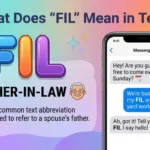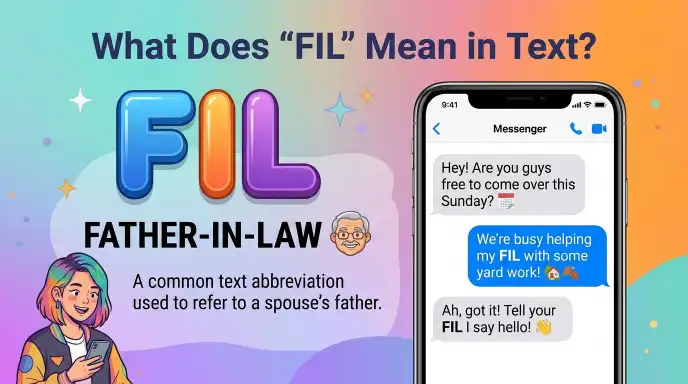
FIL most commonly means “Father-in-Law” in text messages. It refers to the father of someone’s husband or wife. People use this abbreviation when chatting about family, marriage, relatives, or everyday plans.
You may see FIL in WhatsApp messages, Instagram captions, TikTok comments, Snapchat chats, or ordinary text conversations. It saves people from typing the full phrase every time they mention this family relationship.
If someone sends you a message like “My FIL is visiting today,” they are most likely talking about their father-in-law. However, the meaning can change in technical or professional conversations.
This guide explains what FIL means, how people use it online, and how to understand it in different situations. You’ll also find realistic chat examples and simple replies you can use.
FIL Meaning in Text
FIL stands for “Father-in-Law.” A father-in-law is the father of your spouse. In other words, if you are married, your husband’s father or your wife’s father is your father-in-law.
People use FIL as a short form in casual messages. It is especially useful when talking about family visits, birthdays, holidays, weddings, or everyday experiences with relatives.
For example:
“My FIL is coming over for dinner tonight.”
This means:
“My father-in-law is coming over for dinner tonight.”
The abbreviation makes the message shorter without changing its meaning.
FIL is best described as a family-related abbreviation or initialism, rather than a trendy slang expression. It is formed from the first letters of the words Father-In-Law. Dictionary.com and several texting-abbreviation references also list this family-related meaning.
Is FIL an Acronym or an Abbreviation?
People sometimes use the words acronym and abbreviation interchangeably, but they are not exactly the same.
An abbreviation is a shortened form of a word or phrase. An initialism uses the first letters of a phrase, with each letter pronounced separately.
FIL is an initialism because people generally say the individual letters rather than pronounce it as a new word.
You may see it written in different ways:
- FIL : the common uppercase form.
- Fil : a less common mixed-case version.
- fil : a lowercase form sometimes used in casual typing.
The capitalization usually does not change the intended family meaning.
What Does FIL Mean in Everyday Conversations?
In everyday conversations, FIL helps people mention their spouse’s father without repeatedly writing “father-in-law.”
For example:
- “My FIL loves gardening.” : The person’s father-in-law enjoys gardening.
- “I’m visiting my FIL tomorrow.” : The person plans to visit their spouse’s father.
- “My FIL made dinner for everyone.” : The person’s father-in-law prepared the meal.
The surrounding words usually make the meaning easy to understand. If someone mentions a spouse, wedding, family gathering, or relatives, FIL most likely refers to a father-in-law.
It is not normally an expression of excitement, anger, or romance. It simply identifies a family relationship.
FIL and Other Family Abbreviations
FIL belongs to a group of common family-related abbreviations used in informal online conversations.
| Abbreviation | Meaning |
| FIL | Father-in-Law |
| MIL | Mother-in-Law |
| BIL | Brother-in-Law |
| SIL | Sister-in-Law |
| DIL | Daughter-in-Law |
These short forms can make family conversations easier, especially when someone is discussing several relatives in the same message.
For example, a person might write, “My MIL and FIL are visiting this weekend.” This means both their mother-in-law and father-in-law are coming to visit.
Where People Use FIL
FIL can appear across different messaging and social media platforms. Its meaning is generally the same when the conversation involves family or marriage.
However, each platform has its own communication style. Here is how the abbreviation may appear in different places.
FIL on TikTok
TikTok users often discuss family experiences through videos, captions, and comments. FIL may appear when someone talks about their spouse’s family, a family celebration, or a funny experience with their father-in-law.
Example:
“My FIL has the funniest stories 😂”
Meaning: The person is talking about their father-in-law and saying that he tells funny stories.
You might also see the abbreviation in comments under videos about weddings, parenting, family gatherings, or married life.
Context is important on TikTok. If a video discusses family relationships, the father-in-law meaning is a natural interpretation. The abbreviation does not have a separate official TikTok meaning.
FIL on Snapchat
Snapchat conversations are usually casual and personal. Friends and family members may use FIL when sharing plans or talking about relatives.
Example:
“Going to my FIL’s house after work.”
Meaning: The sender is visiting their father-in-law after work.
Someone might also use it when sending a photo from a family dinner or a holiday gathering.
For example:
“Dinner with FIL tonight ❤️”
Here, the sender is simply sharing a moment with their father-in-law.
FIL on Instagram
On Instagram, FIL may appear in captions, comments, Stories, or direct messages. People sometimes use family abbreviations to keep captions short and conversational.
Example:
“Birthday celebration with my FIL!”
Meaning: The person is celebrating their father-in-law’s birthday or spending time with him.
It can also appear in posts about weddings, anniversaries, vacations, and family events.
If you see FIL under a post about someone’s marriage or relatives, Father-in-Law is usually the most likely meaning.
FIL on WhatsApp
WhatsApp is commonly used for private conversations and family group chats. FIL can make messages shorter when someone is discussing relatives or household plans.
Example:
“My FIL will pick us up at 6.”
Meaning: The sender’s father-in-law will collect them at six o’clock.
Another example might be:
“We’re having lunch with FIL tomorrow.”
The sender is planning to have lunch with their father-in-law.
In a family group, people may already know who FIL refers to. That shared understanding makes the abbreviation convenient.
FIL in SMS Text Messages
FIL can also appear in regular SMS conversations. Someone might use it when sending a quick update about a family member.
Example:
“FIL is feeling better now.”
Meaning: The person’s father-in-law is recovering or feeling healthier.
SMS messages often have less surrounding information than longer conversations. Still, words such as my, husband, wife, family, and parents can help identify the intended meaning.
If the message does not provide enough context, asking the sender is perfectly reasonable.
Real Chat Examples: How FIL Is Used
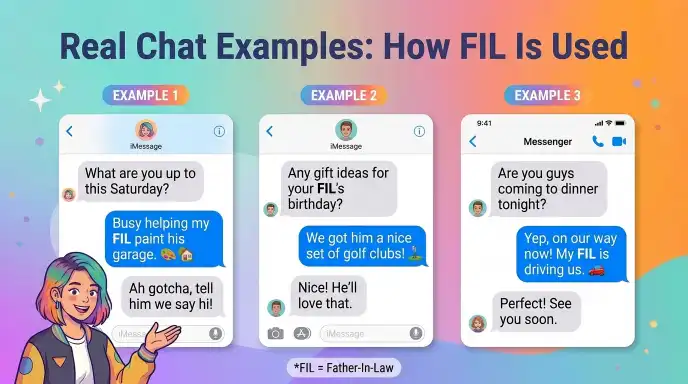
The following conversations show how people might naturally use FIL in everyday messages. Each example uses the abbreviation in a family-related situation.
Example 1: Planning a Family Visit
A: Are you free this Sunday?
B: I think so. My FIL is visiting us.
A: Oh, enjoy your time together!
Meaning: B is saying that their father-in-law will visit on Sunday.
Example 2: Talking About Dinner
A: Who cooked all this food?
B: My FIL made everything.
A: Wow, he must be a great cook!
Meaning: B is talking about their father-in-law’s cooking.
Example 3: Sharing Weekend Plans
A: What are you doing this weekend?
B: We’re going to my FIL’s house.
A: Nice! Have a good time.
Meaning: B plans to visit their father-in-law’s home.
Example 4: Discussing a Birthday
A: Is anyone celebrating a birthday today?
B: Yes, it’s my FIL’s birthday.
A: Send him my best wishes!
Meaning: B is referring to their father-in-law’s birthday.
Example 5: Talking About a Gift
A: Did you buy a gift for your family?
B: Yes, I got something special for my FIL.
A: That’s thoughtful!
Meaning: B bought a gift for their father-in-law.
Example 6: Asking for Advice
A: Who helped you fix the garden fence?
B: My FIL. He’s really good with tools.
A: That’s helpful!
Meaning: B’s father-in-law helped with the repair.
Example 7: Sharing Good News
A: How did your family dinner go?
B: It was lovely. My FIL enjoyed it so much.
A: Glad everyone had a great time!
Meaning: B is describing their father-in-law’s experience at dinner.
Example 8: Talking About a Holiday
A: Where are you spending the holidays?
B: At my FIL’s place this year.
A: Sounds like a nice family plan.
Meaning: B will spend the holidays at their father-in-law’s home.
Example 9: Asking About a Relative
A: Who is coming to the wedding?
B: My parents, my MIL, and my FIL.
A: That’s a big family gathering!
Meaning: B is listing their parents, mother-in-law, and father-in-law.
Example 10: Giving an Update
A: How is your FIL doing now?
B: He’s feeling much better, thanks for asking.
A: That’s wonderful news!
Meaning: A is asking about B’s father-in-law.
Notice the pattern: In all these examples, FIL refers to a family member. The abbreviation does not change the message’s meaning; it simply makes the wording shorter.
How to Reply When Someone Says FIL
Your reply depends on what the person is discussing. If they mention a visit, birthday, or family event, you can respond naturally without repeating the abbreviation.
Here are some simple ways to reply.
Funny Replies
If you are close to the sender and the conversation is playful, a little humor can make the chat more enjoyable.
- “Sounds like FIL is the family VIP today 😂”
- “Hope FIL brings some good food!”
- “Family gathering mode activated!”
- “Tell FIL I said hello!”
Use these replies only when the conversation is relaxed and the other person enjoys joking.
Casual Replies
For an ordinary conversation, keep your response short and natural.
- “Oh, nice!”
- “That sounds good.”
- “Enjoy your visit!”
- “Hope everything goes well.”
These replies work well when someone is simply sharing a family update.
Friendly Replies
A warm response is suitable when the sender talks about a birthday, visit, celebration, or personal family moment.
- “That’s lovely! Hope you have a great time.”
- “Send him my best wishes.”
- “Glad you got to spend time together.”
- “Hope he has a wonderful day!”
A friendly reply shows interest without making the conversation complicated.
Neutral Replies
Sometimes you may not know what FIL means. It is better to ask than to guess.
Try one of these:
- “Just checking, does FIL mean father-in-law?”
- “Who are you referring to?”
- “Can you explain that abbreviation?”
- “Do you mean your spouse’s father?”
Asking for clarification is completely normal. Not everyone knows the same family abbreviations, and a simple question can prevent confusion.
Is FIL Rude or Offensive?
No, FIL is not generally rude or offensive. When it means “Father-in-Law,” it is a neutral abbreviation for a family relationship.
It does not contain profanity or an insulting expression. People use it in ordinary conversations about their spouse’s family.
However, if it is appropriate depends on the audience and the setting.
Is FIL Safe to Use?
Yes. FIL is generally safe to use in casual conversations when the other person understands the abbreviation.
For example:
“My FIL is visiting this weekend.”
This is a normal way to share a family update.
Still, writing the complete phrase may be clearer when talking to someone who is unfamiliar with texting shorthand.
Is FIL Appropriate at School?
The abbreviation itself is not offensive, but it may not be familiar to every teacher or student.
In an informal conversation with friends, using FIL is usually fine if everyone understands it.
For school assignments, formal messages, or written work, it is better to write “father-in-law” in full. Clear language is more important than saving a few letters.
Is FIL Appropriate at Work?
FIL can be used in a casual workplace chat if colleagues understand the abbreviation.
For example:
“I’ll be leaving early because my FIL has an appointment.”
The meaning is understandable in a conversation where personal family updates are appropriate.
However, formal emails and professional documents should generally use the complete phrase.
For example:
“I need to leave early to accompany my father-in-law to an appointment.”
This version is clearer for people who may not recognize FIL.
The main issue is formality, not offensiveness. The abbreviation is harmless, but complete words often work better in professional communication.
Who Uses FIL?
FIL can be used by adults, married couples, family members, and people discussing relationships. It is not limited to one age group or social media platform.
Because the abbreviation describes a family relationship, it is most useful for people who need to talk about their spouse’s father.
Do Adults Use FIL?
Adults may use FIL in private messages, family group chats, online communities, and conversations about married life.
For example, someone might write:
“My FIL is taking us to the airport tomorrow.”
This is a quick way to explain a family arrangement.
People who regularly communicate with relatives online may find these short forms convenient.
Do Younger People Use FIL?
Younger adults may encounter FIL when talking with married friends, relatives, or people in online family communities.
However, it would be inaccurate to describe FIL as a special Gen Z slang trend. It is a practical family abbreviation, not a generation-specific expression.
Some younger users may recognize it immediately, while others may need an explanation.
Is FIL Common on Social Media?
FIL appears in online abbreviation references and everyday family-related communication. However, there is no reliable public measurement showing exactly how often people use it across TikTok, Snapchat, Instagram, or WhatsApp.
It is more useful to understand its purpose than to assume it is trending.
People generally use it when:
- Discussing a spouse’s family.
- Sharing news about a father-in-law.
- Planning a family visit.
- Talking about birthdays or celebrations.
- Writing short captions or messages.
- Communicating in family group chats.
FIL is useful because it is recognizable shorthand in the right context. Its usefulness does not depend on being a popular internet trend.
Origin of FIL
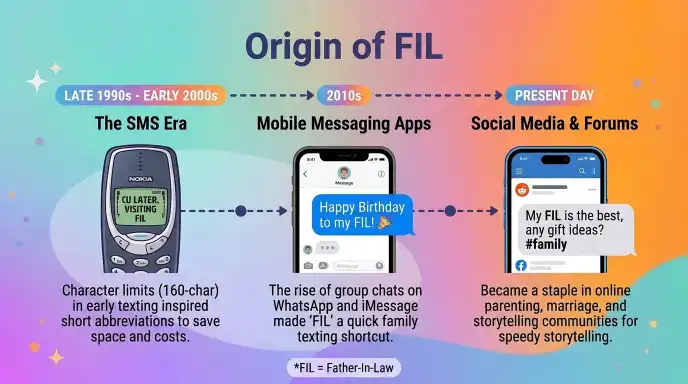
FIL comes from the phrase “Father-In-Law.” It follows a simple abbreviation pattern: taking the first letter of each word to create a shorter form.
The exact first use of FIL in text messages is difficult to establish. There is no clear evidence identifying one person, website, or social media platform as its creator.
How Did Family Abbreviations Develop?
People have used shortened forms of words and phrases for a long time. Digital messaging made them especially convenient because users often want to communicate quickly.
As texting, email, online forums, and social networks became common, people began using short forms for everyday expressions and relationships.
Family abbreviations are practical examples of this habit. Instead of repeatedly typing a long relationship term, someone can use a few letters.
Other examples include:
- MIL: Mother-in-Law
- BIL: Brother-in-Law
- SIL: Sister-in-Law
- DIL: Daughter-in-Law
These forms make sense because they follow a similar pattern.
Did FIL Originate on TikTok or Snapchat?
There is no good reason to attribute the origin of FIL to TikTok or Snapchat.
The abbreviation is based on a family relationship phrase and appears in general texting and abbreviation references. Social media may provide places where people use it, but that does not mean a particular platform created it.
Why Is the Origin Not Exact?
Many everyday abbreviations do not have a documented inventor or a single recorded starting date.
FIL is easy to form from the words Father-In-Law. Different people could independently use the same initial letters without copying a particular online trend.
The most reliable explanation is that FIL is a straightforward initialism for “Father-in-Law,” rather than a slang term with a clearly documented internet origin.
FIL Compared With IDK, IDC, IMO, and BRB
FIL is different from common texting abbreviations such as IDK and BRB. It identifies a family relationship, while the others communicate a thought, feeling, or action.
| Abbreviation | Meaning | Type | Usage | Popularity |
| FIL | Father-in-Law | Initialism | Referring to a spouse’s father | Recognized family shorthand |
| IDK | I Don’t Know | Initialism | Showing uncertainty | Widely recognized |
| IDC | I Don’t Care | Initialism | Expressing indifference | Widely recognized |
| IMO | In My Opinion | Initialism | Sharing a viewpoint | Widely recognized |
| BRB | Be Right Back | Initialism | Temporarily leaving a chat | Widely recognized |
FIL vs. IDK
IDK means “I Don’t Know.” People use it when they do not have an answer or are unsure about something.
Example:
“IDK what time the movie starts.”
FIL has a different purpose. It identifies someone’s father-in-law rather than expressing uncertainty.
FIL vs. IDC
IDC means “I Don’t Care.” It is used when someone wants to express that a choice or situation does not matter to them.
Example:
“IDC which restaurant we choose.”
FIL does not communicate a feeling or attitude. It simply refers to a family member.
FIL vs. IMO
IMO means “In My Opinion.” People use it before sharing a personal view.
Example:
“IMO, this is the best movie of the year.”
FIL is not used to introduce an opinion. It is a family-related abbreviation.
FIL vs. BRB
BRB means “Be Right Back.” Someone sends it when they are temporarily leaving a conversation but expect to return.
Example:
“BRB, someone is at the door.”
FIL does not describe an action or a break from chatting. It refers to a person’s relationship with their spouse’s father.
Real-World Usage Example
Imagine that Sara is married and is planning a family dinner with her husband. She sends a message to her friend:
Sara: We’re having dinner with my FIL tonight.
Friend: Oh, nice! Is it a special occasion?
Sara: Yes, it’s his birthday, so we’re taking him out.
Friend: That’s lovely. Hope he has a great birthday!
In this conversation, Sara uses FIL to refer to her father-in-law. Her friend understands the abbreviation because the discussion is about a family dinner and birthday.
Now imagine that Sara sends the same message to someone who has never seen the abbreviation before. That person might ask what FIL means.
There is nothing wrong with asking. Sara can simply explain that it stands for Father-in-Law.
This example shows why context matters. A familiar abbreviation can make communication faster between people who understand it, but writing the full phrase may be more helpful when the reader is unfamiliar with it.
The best approach is to use shorthand when it makes the message easier, not harder, to understand.
Frequently Asked Questions
1. What does FIL mean in text messages?
FIL means “Father-in-Law.” It refers to the father of someone’s husband or wife. People use it in casual messages about family, marriage, and relatives.
2. What does FIL mean on TikTok?
On TikTok, FIL can mean “Father-in-Law,” especially in videos or comments about marriage and family life. The surrounding content helps confirm the meaning.
3. Is FIL slang?
FIL is generally an initialism or family-related abbreviation, not a trendy slang word. It is formed from the first letters of “Father-In-Law.”
4. Is FIL rude or offensive?
No, FIL is not generally rude or offensive. It is a neutral way to refer to someone’s father-in-law. However, writing the full phrase may be better in formal conversations.
5. How should you reply to FIL?
If someone mentions their father-in-law, you can reply naturally with “That’s nice,” “Hope you have a great time,” or “Send him my best wishes.” If you are unsure, ask what FIL means.
Conclusion:
FIL most commonly means “Father-in-Law” in text messages and online conversations. It is a short family-related abbreviation used when someone talks about their spouse’s father.
You may see it in WhatsApp chats, Instagram captions, TikTok comments, Snapchat messages, and regular SMS conversations. People use it when discussing family visits, birthdays, celebrations, and everyday plans.
FIL is generally harmless and is not considered offensive. Still, it is better to write “father-in-law” in formal messages or whenever the reader may not understand the abbreviation.
Remember that context is important. If the conversation involves marriage or relatives, FIL most likely refers to a father-in-law. When the meaning is unclear, asking a quick question is always better than guessing.